跨境直接投资

Search documents
管涛:2025年我国国际收支口径跨境直接投资逆势向好|国际
清华金融评论· 2025-12-09 10:55
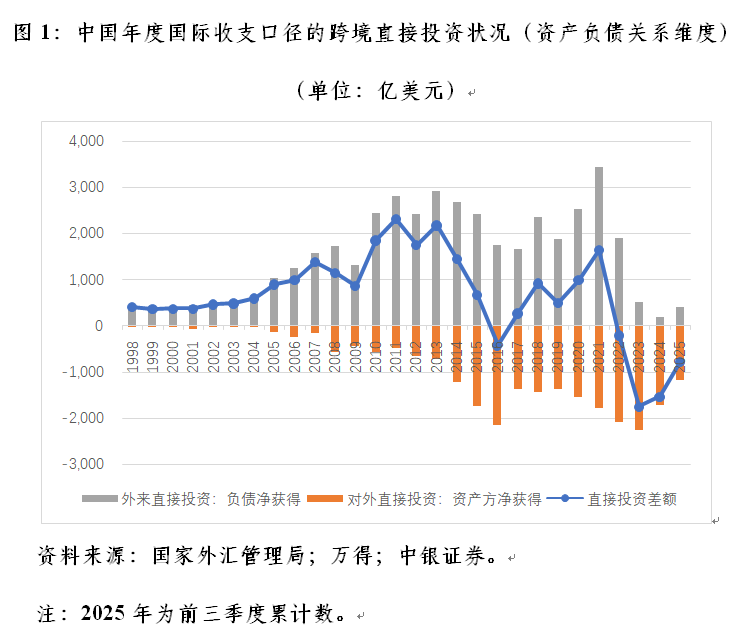
Core Viewpoint - The article discusses the recent trends in China's cross-border direct investment, highlighting a shift from net outflows to net inflows in foreign direct investment, despite ongoing external pressures such as tariffs and trade protectionism [1][2]. Group 1: Investment Trends - In the first three quarters of 2023, China's net outflow of outward direct investment decreased year-on-year, while foreign direct investment shifted from net outflow to net inflow [1][2]. - The cross-border direct investment still shows a deficit, but the deficit amount has halved compared to the previous year, indicating an improvement in capital flow under direct investment [1][2]. - From 2021 to 2024, China's cross-border direct investment transitioned from a surplus to a deficit, with the deficit increasing by $319 billion [9]. Group 2: Factors Influencing Investment - The significant reduction in foreign direct investment inflows is attributed to a sharp decline in equity investment inflows and a reversal in inter-company debt flows [11][12]. - Equity investment inflows dropped from $300.6 billion to $72.8 billion between 2021 and 2024, contributing to 70% of the total decline in foreign direct investment inflows [11]. - The net outflow of equity investment remained stable, with a slight increase from $152.4 billion to $130 billion, indicating that the primary reason for the decrease in outward direct investment was the reduction in inter-company debt outflows [26]. Group 3: Government Response and Economic Outlook - The Chinese government has implemented measures to mitigate external shocks, including deepening reforms and expanding high-level opening-up policies [18][19]. - In response to external pressures, the government has introduced a foreign investment stabilization plan, focusing on easing foreign investment access and optimizing the business environment [19]. - The first three quarters of 2023 saw a 50.8% reduction in the cross-border direct investment deficit, primarily due to increased foreign direct investment inflows and decreased outward direct investment outflows [22].

今年我国国际收支口径 跨境直接投资逆势向好
Sou Hu Cai Jing· 2025-12-07 16:53
Core Viewpoint - China's industrial enterprises' profits increased by 1.9% year-on-year in the first ten months of this year, reversing the negative growth seen in the first seven months, but still lagging behind the five-year compound average growth rate by 3.0 percentage points [1] Group 1: Foreign Direct Investment Trends - China has experienced significant fluctuations in foreign direct investment (FDI) in recent years, with net inflows decreasing and net outflows increasing since 2022, raising concerns about "de-Chinaization" in global supply chains [1][2] - From 2021 to 2024, China's cross-border direct investment shifted from a surplus to a deficit, with a total increase in deficit of $319 billion, primarily due to a sharp decline in net inflows of foreign direct investment [3][4] - The net inflow of foreign direct investment dropped from $344.1 billion to $18.6 billion between 2021 and 2024, contributing significantly to the overall increase in direct investment deficit [3][5] Group 2: Capital Flow Dynamics - The reversal in capital flows is attributed to a drastic shift in equity investments and inter-company debt relations, with equity investments changing from a net inflow of $148.2 billion to a net outflow of $57.2 billion from 2021 to 2024 [4] - The decline in foreign direct investment net inflows is primarily due to a significant drop in equity investment net inflows, which decreased by 75.8% [5][6] - In 2023, the net inflow of equity investment was $86.9 billion, with a capital increase of $120 billion, indicating a negative gap of $33.1 billion [6][10] Group 3: Government Response and Economic Outlook - The Chinese government has emphasized the need to prevent and mitigate external shocks, focusing on deepening reforms and expanding high-level opening-up [7][8] - Despite external pressures, key economic indicators have performed well, with foreign direct investment net outflows decreasing by 50.8% year-on-year in the first three quarters of this year [8][9] - The improvement in cross-border direct investment is attributed to a reduction in net outflows from inter-company debt and an increase in net inflows from equity investments [9][10] Group 4: Industry Performance - In the first ten months of this year, profits of large-scale industrial enterprises in China grew by 1.9%, although this growth is lower than the five-year compound average growth rate [12][13] - The non-financial outward direct investment from the Ministry of Commerce reached $110.7 billion in the first three quarters, reflecting a year-on-year growth of 4.0%, which is lower than the previous year's growth rate [13]
管涛:今年我国国际收支口径跨境直接投资逆势向好 | 立方大家谈
Sou Hu Cai Jing· 2025-12-07 13:18
Core Viewpoint - China's foreign direct investment (FDI) landscape has experienced significant fluctuations in recent years, particularly since 2022, with a notable shift from net inflows to net outflows, raising concerns about "de-Chinaization" in global supply chains. However, preliminary data from the State Administration of Foreign Exchange indicates a reversal in this trend in 2023, with net outflows decreasing and net inflows returning, despite ongoing external pressures [3][5][15]. Group 1: Trends in Cross-Border Direct Investment - Historically, China has been a major recipient of foreign investment, with a shift towards balancing inbound and outbound investments since the early 2000s. Prior to 2022, China consistently recorded a surplus in cross-border direct investment, contributing to the resilience of its international balance of payments [4][5]. - The COVID-19 pandemic initially boosted China's direct investment surplus in 2020 and 2021, with surpluses reaching $165.3 billion in 2021, the highest since 2014. However, this trend reversed in 2022, leading to significant net outflows in subsequent years [5][6][10]. - From 2021 to 2024, China's cross-border direct investment shifted from a surplus to a deficit, with a total increase in net outflows of $319 billion. This was primarily driven by a sharp decline in net inflows of foreign direct investment [6][10]. Group 2: Factors Influencing Investment Flows - The decline in foreign direct investment inflows from 2021 to 2024 was largely due to a significant drop in equity investment inflows and a reversal in inter-company debt flows. Equity investment inflows decreased from $300.6 billion to $72.8 billion, contributing 70% to the overall decline in foreign direct investment inflows [8][10]. - The net outflow of equity investment remained stable, while inter-company debt flows saw a significant reversal, indicating a complex interplay of factors affecting cross-border investment dynamics [14][25]. - In 2023, net outflows of cross-border direct investment decreased by 50.8% year-on-year, primarily due to increased net inflows of foreign direct investment and reduced net outflows of direct investment [15][19]. Group 3: Government Response and Market Outlook - The Chinese government has recognized the need to mitigate external shocks and has implemented measures to enhance foreign investment, including easing restrictions and optimizing the business environment [15][16]. - Despite external pressures, key economic indicators have shown resilience, with foreign direct investment net inflows increasing in 2023, reflecting a stabilization in foreign capital withdrawal [21][24]. - The overall investment climate remains cautious, with domestic enterprises adopting a rational approach to overseas investments amid geopolitical tensions and economic challenges [26][27].
管涛:今年我国国际收支口径跨境直接投资逆势向好
Di Yi Cai Jing· 2025-12-07 12:09
Core Viewpoint - In the context of external extreme tariff pressures, China's net outflow of foreign direct investment (FDI) decreased year-on-year in the first three quarters of this year, indicating a potential stabilization in cross-border capital flows despite ongoing global economic challenges [1][14]. Group 1: Trends in Foreign Direct Investment - Historically, China has been a major recipient of foreign investment, but recent years have seen significant fluctuations in FDI due to external pressures and market concerns about "de-Chinaization" and supply chain restructuring [1][2]. - From 2021 to 2024, China's cross-border direct investment shifted from a surplus to a deficit, with a total increase in deficit of $319 billion, primarily due to a sharp decline in foreign direct investment inflows [6][11]. - In 2021, China's direct investment surplus reached a record high of $165.3 billion, but this trend reversed in 2022, leading to significant deficits in subsequent years [4][6]. Group 2: Factors Influencing Investment Flows - The decline in foreign direct investment inflows is attributed to a drastic reduction in equity investments and a reversal in inter-company debt flows, reflecting the impact of interest rate differentials and the yuan's role in cross-border financing [7][9]. - Specifically, equity investment inflows dropped from $300.6 billion to $72.8 billion from 2021 to 2024, contributing 70% to the total decline in foreign direct investment inflows [10][11]. - In contrast, the net outflow of equity investments decreased from $152.4 billion to $130 billion, indicating a stabilization in outward investment [13][23]. Group 3: Recent Developments and Government Response - In the first three quarters of this year, China's cross-border direct investment deficit was $78 billion, a 50.8% decrease year-on-year, largely due to an increase in foreign direct investment inflows and a reduction in outflows [16][19]. - The Chinese government has implemented measures to mitigate external shocks, including deepening reforms, expanding high-level opening-up, and stabilizing key economic indicators [14][16]. - The net inflow of foreign direct investment turned positive in the first three quarters, with a significant increase in inter-company debt flows and equity investments, suggesting a potential recovery in foreign investment sentiment [21][22].
2025中国外资统计公报
Sou Hu Cai Jing· 2025-12-05 04:17
Core Insights - The 2025 China Foreign Investment Statistical Bulletin indicates that in 2024, China attracted actual foreign investment of $116.24 billion, showing a year-on-year adjustment but a continued optimization in investment structure, with a 9.9% increase in the number of newly established foreign-invested enterprises, reflecting the enduring appeal and resilience of the Chinese market [1][18]. Investment Structure - The service sector remains the dominant force in foreign investment, with the tertiary industry accounting for 66.0% of actual foreign investment and 91.2% of new enterprises established in 2024. Key areas of foreign investment include leasing and business services, scientific research and technical services, wholesale and retail, and information transmission and software services [2][21]. - High-tech industries showed remarkable performance, with actual foreign investment amounting to $40.26 billion, representing 34.6% of the national total. High-tech manufacturing attracted $13.51 billion, an increase of 0.5 percentage points, while high-tech services received $26.76 billion [2][28]. Regional Distribution - Foreign investment remains highly concentrated in eastern regions, which accounted for 87.0% of the total actual foreign investment. The Yangtze River Economic Belt attracted 53.4% of the national foreign investment, highlighting its role as a key driver of high-quality economic development in China. Jiangsu province led in actual foreign investment, followed by Shanghai, Zhejiang, Guangdong, and Shandong, collectively accounting for over two-thirds of the national total [3][31]. Source of Foreign Investment - Asia is the primary source of foreign investment, contributing 78.8% to China's actual foreign investment in 2024. Hong Kong remains the largest source, accounting for 63.5%, followed by Singapore at 9.2%. Investments from free ports like the Cayman Islands and British Virgin Islands are also significant, while EU investments account for 5.8%, primarily in manufacturing and R&D [4][22]. Global Context - In the global landscape, China ranks fourth in attracting foreign direct investment (FDI), maintaining its position as the leading developing country for 33 consecutive years, capturing 7.7% of the global FDI total. Despite increasing international competition, China's vast market, complete industrial system, and continuously improving business environment ensure its significant role in global foreign investment flows [5][19].