选择过载

Search documents
如何在AI时代,找回你被埋没的创造力。
数字生命卡兹克· 2026-03-31 02:11
Core Viewpoint - The article discusses the phenomenon of people feeling lost when using AI tools, suggesting that this is not due to a lack of need for these tools, but rather a forgotten sense of creativity that has been buried under years of structured education and work environments [1][7][8]. Group 1: The Nature of Creativity - Creativity is an inherent trait in everyone, often suppressed by educational and professional structures that prioritize standard answers and processes over innovative thinking [4][5][6]. - The loss of creativity is attributed to years of conditioning that leads individuals to forget their innate creative instincts [8][10]. Group 2: Steps to Reignite Creativity - **Identify Discomfort**: The first step to reclaiming creativity is recognizing what causes discomfort or dissatisfaction, as this feeling can ignite the desire to create [15][22]. - **Narrow Focus**: After identifying ideas, individuals often struggle with the scope of their ambitions. Limiting the scope to manageable tasks can enhance productivity and creativity [34][40]. - **Create a Rough Draft**: The importance of producing a rough version of an idea is emphasized, as the act of creating helps clarify thoughts and leads to further improvements [54][58][64]. Group 3: Learning from Other Fields - Creativity can be enhanced by exploring unrelated fields and experiences, which can provide new perspectives and ideas that can be applied to one's own work [78][80][86]. - The process of deconstructing successful works from other domains can help individuals understand effective structures and techniques that can be adapted to their own projects [83][87]. Group 4: The Role of Downtime - Allocating time for the mind to wander and process thoughts without distractions is crucial for fostering creativity, as it allows for the subconscious to connect ideas [106][124]. - The article suggests that many great ideas emerge during moments of inactivity, highlighting the need for intentional breaks from constant stimulation [121][126]. Group 5: Internal Motivation - The final point emphasizes that creative endeavors should primarily be for personal satisfaction rather than external validation, as intrinsic motivation significantly boosts creativity and fulfillment [136][140].


年内新发超2400只!试试这套“不心累”选基策略
Morningstar晨星· 2025-12-25 01:04
Core Viewpoint - The article discusses the paradox of choice in the investment fund market, highlighting that while the number of new funds has surged, this abundance of options can lead to decision fatigue and anxiety among investors [1][4][24]. Group 1: Market Trends - As of December 22, over 2400 new funds have been established this year, marking the second-highest record in history, with index products accounting for more than half of this issuance [1]. - The proliferation of funds has not simplified investment decisions; instead, it has complicated them, leading to a phenomenon known as "choice overload" [4][8]. Group 2: Psychological Insights - The article references a psychological experiment showing that more choices can lead to lower decision-making satisfaction, as seen in a jam tasting scenario where fewer options resulted in higher purchase rates [6]. - Behavioral finance concepts such as "regret aversion" and "loss aversion" are discussed, indicating that the anxiety of making the wrong choice can outweigh the satisfaction of making a correct one [8]. Group 3: Investor Types - Investors generally fall into two categories: "maximizers," who seek the best possible options, and "satisficers," who look for options that meet their minimum criteria [13][14]. - The investment industry tends to attract maximizers, leading to a culture of continuous comparison and adjustment, which can exacerbate the stress of decision-making [15]. Group 4: Strategies to Mitigate Decision Fatigue - The article suggests three strategies to reduce the mental burden of choosing among numerous funds: 1. Accept that there is no perfect investment portfolio, as outcomes are influenced by unpredictable future events [17]. 2. Establish clear criteria to narrow down choices, such as performance history and management experience [18][19]. 3. Embrace one's investment strategy and align it with personal goals, rather than constantly seeking the "optimal" choice [21]. Group 5: Future Considerations - The article emphasizes that the abundance of choices is likely to be a new norm for investors, and understanding personal investment preferences will be crucial in navigating this landscape [24][26]. - It is noted that many new funds may not offer significant advantages and that investors should focus on their foundational investment needs rather than being swayed by trends [24].

YAMA:错过就错过
3 6 Ke· 2025-07-26 00:02
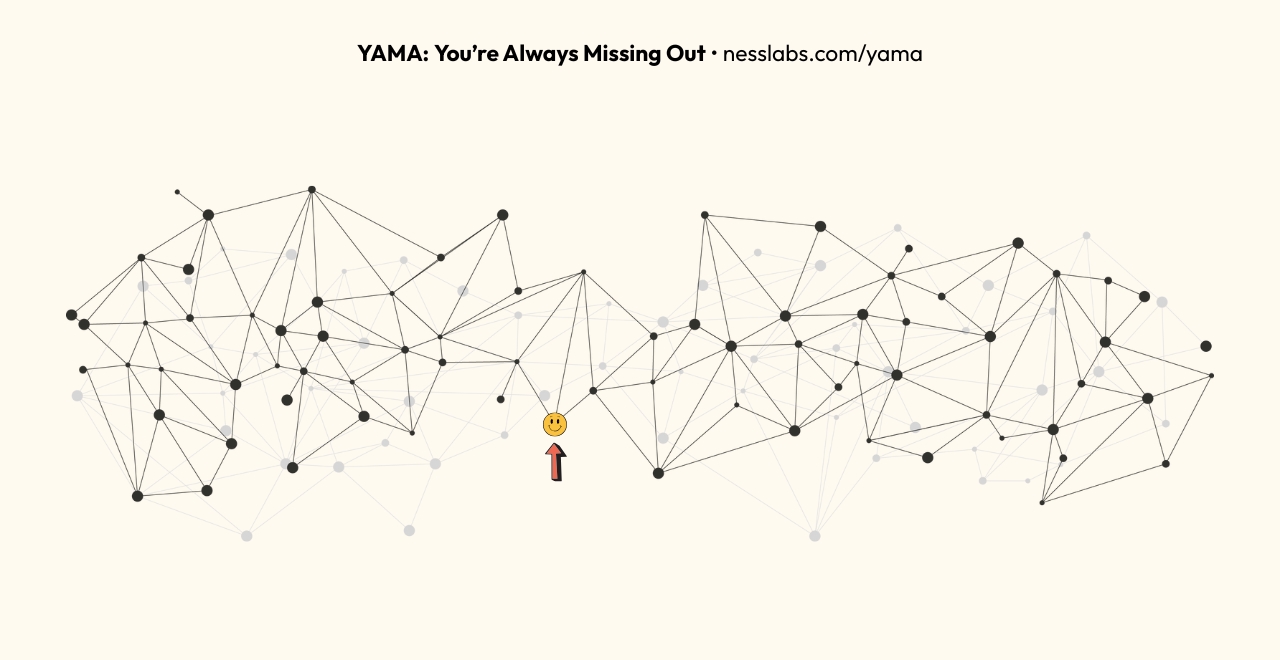
Core Concept - The article introduces the concept of YAMA (You're Always Missing Out), which emphasizes the inevitability of missing out on certain experiences and suggests that worrying about these missed opportunities is futile [1][5]. Group 1: The Nature of Choices - The phenomenon of "choice overload" occurs when an abundance of options leads to decreased satisfaction and increased anxiety, as the brain struggles to process numerous alternatives [3]. - In modern society, the vast array of entertainment and social activities creates a new form of psychological pressure that our ancestors did not face [4]. Group 2: Understanding YAMA - YAMA differs from JOMO (the Joy of Missing Out) in that it focuses on acceptance rather than active choice; it acknowledges that missing out is a normal part of life [5][6]. - YAMA promotes the idea that since individuals are limited beings in an infinite world, accepting the reality of missed experiences can lead to a more liberated mindset [6][7]. Group 3: Practical Application of YAMA - Before an activity, individuals should recognize that choosing one option means forgoing many others, which can alleviate the pressure of optimizing time [6]. - During an activity, it is important to refocus on the current experience rather than comparing it to other missed opportunities [7]. - After an activity, individuals should avoid immediately evaluating their choices or seeking validation through social media, instead acknowledging the inherent limitations of human experience [7].