
通胀复苏

Search documents
美联储明年或让经济在“过热”中狂奔,花旗点名“全天候”黑马资产!
Xin Lang Cai Jing· 2025-12-17 11:41
Core Viewpoint - Citigroup's global macroeconomic strategy team has provided actionable trading recommendations, focusing on the potential for AI-driven growth and sector rotations in the market [2][3]. Group 1: Trading Recommendations - The team suggests leveraging AI trading to boost the Nasdaq 100 index, recommending the purchase of out-of-the-money call options expiring in December 2026 [2][7]. - They believe that as long as capital investment continues to grow and liquidity remains ample, investors will have time to benefit from the expansion of the AI bubble [2][7]. - The report indicates that significant sector rotations typically occur after a bubble peaks, rather than before, and advises that technology stocks should be part of a bullish allocation [2][7]. Group 2: Sector Performance Expectations - The team anticipates that cyclical sectors, including financials, will thrive alongside technology stocks, suggesting an overweight position in financials and an underweight in consumer staples [2][3]. - They assert that cyclical stocks are likely to perform well in an environment of recovering inflation and economic growth [2][3]. Group 3: Economic and Market Outlook - Citigroup warns that U.S. equities and bonds often perform poorly in midterm election years, particularly in the third quarter, especially when the ruling party remains in power [3][8]. - The team recommends going long on copper as a way to capitalize on expected global growth recovery in 2026, highlighting its "all-weather" trading advantage [3][8]. - They express skepticism about the Federal Reserve's independence under the next chair appointed by Trump, predicting that the Fed will allow the economy to run hot, potentially leading to inflationary pressures later in 2026 [3][8]. Group 4: Cross-Asset Strategy - A relative value trade is recommended: going long on AI equities while shorting AI credit, as AI trading is expected to continue driving major indices higher [10]. - Concerns about credit risk exposure related to Oracle's debt and other AI-related bonds may lead to rising credit default swap (CDS) premiums, prompting the team to suggest going long on the S&P 500 and investment-grade CDS indices [10].
周度速览|权益市场行情综述
Xin Lang Cai Jing· 2025-11-11 03:04
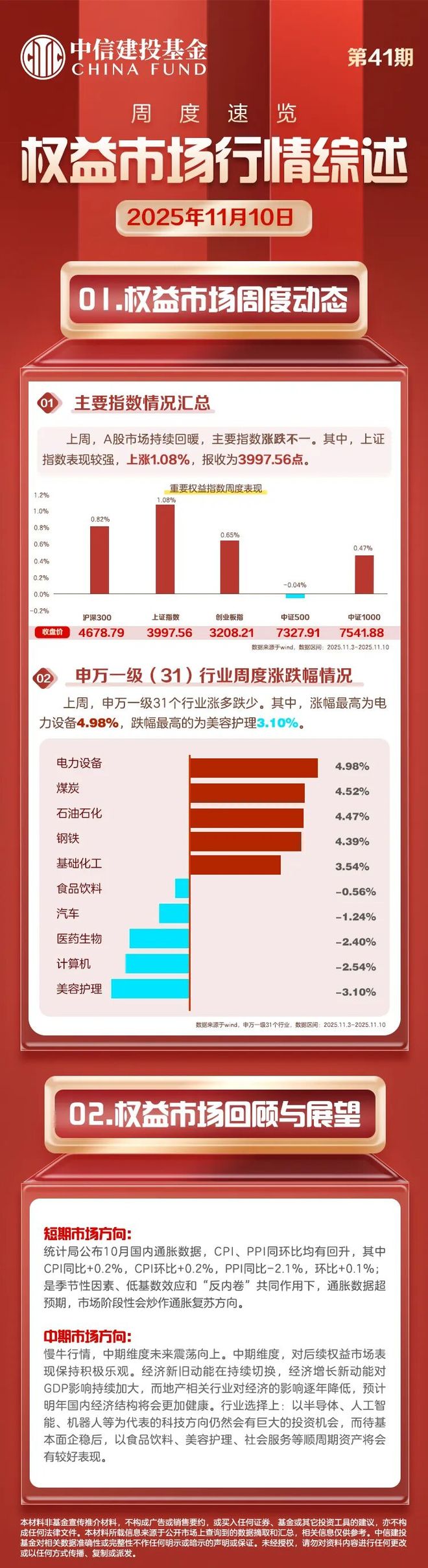
Group 1 - The core viewpoint of the article highlights the performance of various industries, with the power equipment sector showing the highest increase at 4.98%, while the beauty and personal care sector experienced the largest decline at 3.10% [3] - The weekly performance of the 31 industries indicates a general upward trend, with most sectors gaining, particularly power equipment, coal, and petroleum and petrochemicals [3] - The consumer price index (CPI) and producer price index (PPI) data for October show a rebound, with CPI up 0.2% year-on-year and 0.2% month-on-month, while PPI decreased by 2.1% year-on-year but increased by 0.1% month-on-month, suggesting a potential market focus on inflation recovery [4] Group 2 - The medium-term market outlook suggests a slow bull market with a positive view on equity market performance, driven by a shift in economic dynamics and a healthier economic structure expected next year [5] - Investment opportunities are identified in technology sectors such as semiconductors, artificial intelligence, and robotics, while consumer sectors like food and beverage, beauty care, and social services are anticipated to perform well once the fundamentals stabilize [5]

加纳过度依赖黄金风险过高
Shang Wu Bu Wang Zhan· 2025-10-16 15:54
Core Insights - Ghana's recent macroeconomic stability is highly vulnerable to fluctuations in global commodity prices, particularly gold prices [1] - The sustainability of Ghana's economic rebound is critically dependent on sustained high gold prices, presenting a significant and unstable risk factor [1] - A decline in gold prices would substantially reduce Ghana's dollar earnings from its largest export product, leading to decreased foreign exchange inflows and a potential depletion of international reserves [1] Economic Implications - A reduction in foreign exchange inflows could erode Ghana's external buffers and exert pressure on the local currency, leading to significant depreciation [1] - Currency depreciation would increase import costs, potentially triggering a sharp rebound in inflation [1] - To address the resurgence of inflation, the central bank of Ghana may need to adopt a tighter policy stance than currently anticipated by the market, possibly through interest rate hikes [1]