
板块轮动

Search documents
X @Yuyue
Yuyue· 2026-03-30 16:08
“稀土、CPU,现在又是持续时间较长的内存。吸引跟风盘接盘后迅速撤离,再切入下一个估值洼地”$MU 400 就好像昨天一样,港股 7709 也快回 20 了(已经高点腰斩)和炒 Meme 没什么区别,资金抱团坐庄,炒股价的时候跟真实需求也基本没啥关系,按 @thecryptoskanda 的说法,改天可能就来炒插座了 🤣 https://t.co/5dgxM2RfXGYuyue (@yuyue_chris):美股的极致轮动和 Meme 别无二致在上一篇文章里我提到了一个核心体感:今年的美股,越来越像币圈的加速版最直观的表象就是,从 2026 年初开始, $NVDA 这样的大盘股再也无法像过去那样闭眼无脑拉升了。在我看来整个市场彻底变成了一个由 “板块轮动” 主导的绞肉机。如果以为现在还是那个 https://t.co/sS4XhWBlGI ...
仓位上涨
第一财经· 2026-03-30 11:28
Market Overview - The A-share market showed a mixed performance with the Shanghai Composite Index rebounding slightly, while the Shenzhen Component Index and the ChiNext Index experienced minor declines, indicating a volatile market with noticeable sector rotation [5] - A total of 2,865 stocks rose, reflecting a market environment where more stocks gained than lost, suggesting an improvement in market profitability compared to previous periods [5] - The trading volume across both exchanges exceeded 1 trillion yuan, marking a 3.38% increase, indicating a moderate recovery in market activity and a stable trading environment [5] Capital Flow - Main funds exhibited a slight net outflow, indicating a cautious adjustment and structural optimization by institutional investors, who reduced holdings in high-performing sectors while focusing on low-position and defensive strategies [6] - Retail investors showed a more active participation with a net inflow of funds, indicating a willingness to engage in the market's recovery by targeting both hot and low-position stocks [6] Investor Sentiment - Retail investor sentiment was reported at 75.85%, reflecting a generally positive outlook among individual investors [7] - The sentiment towards market movements indicated that 64.24% of respondents expected the market to rise in the next trading day, showcasing optimism among investors [14]


X @Yuyue
Yuyue· 2026-03-30 01:36
美股的极致轮动和 Meme 别无二致在上一篇文章里我提到了一个核心体感:今年的美股,越来越像币圈的加速版最直观的表象就是,从 2026 年初开始, $NVDA 这样的大盘股再也无法像过去那样闭眼无脑拉升了。在我看来整个市场彻底变成了一个由 “板块轮动” 主导的绞肉机。如果以为现在还是那个 “买入并持有就能躺赢” 的单边上涨市场,那大概率会被教育得很惨大资金现在的玩法就是打一枪换一个地方,吃完叙事红利立马撤退。拿我之前玩过的 稀土题材和 CPU 题材来说稀土的 $MP / $USAR / $CRML 主要炒作期在关税时期,基于地缘博弈和供应链重塑的宏观预期,一月爆拉二浪打完回原地了CPU 板块 $INTC / $AMD 千亿市值的巨头同样逃不掉轮动的宿命,不要以为只有小盘股才这么玩。今年 1 月 CES 大展前后,Intel 靠发布新一代 Panther Lake 芯片困境反转 + 国家队的概念炒到 54,最肥美的一段过去又回原地; $AMD YTD 表现微跌或许目前的宏观流动性,根本不支持全市场的持续普涨。车身重了,拉不动,朴素的道理。资金只能打游击,集中火力在一个小板块里制造赚钱效应。稀土、CPU,现在又是 ...

分化悬殊!油价搅动A股,基金业绩首位差超49%!如何避免“均值回归”风险?
券商中国· 2026-03-16 04:35
Core Viewpoint - Recent fluctuations in international oil prices have significantly impacted the A-share market, accelerating sector rotation and creating a stark contrast between the previously popular technology growth sector and energy-related sectors, leading to a sharp divergence in theme fund performance [1] Fund Performance and Sector Rotation - Since March, energy-themed funds have seen the highest returns, with the Southern Oil A fund achieving a return of 34.51%, followed closely by the E Fund Oil A and Harvest Oil funds, both exceeding 33%. In contrast, some technology growth funds have experienced maximum drawdowns of over 14%, resulting in a performance gap of more than 49 percentage points [3] - Energy-related sectors such as oil and gas, coal, and electricity have shown strong performance, with funds like the Guotai CSI Coal ETF returning 9.63% and several electricity funds exceeding 8% returns. Agricultural theme funds have also performed well, with increases of over 5% [3] - Conversely, the technology growth sector has faced pressure, with funds like the Qianhai Kaiyuan High-end Equipment Manufacturing A and Jianxin Technology Select A dropping over 13% [3] Fund Flow Dynamics - The fund flow data indicates a clear migration of capital towards energy ETFs, with several funds receiving net inflows exceeding 10 billion yuan since March. For instance, the Huaxia CSI Electric Grid Equipment Theme ETF and others have seen significant inflows [4] - In contrast, popular technology-themed funds have faced outflows, with several funds experiencing net outflows exceeding 10 billion yuan, indicating a shift in investor sentiment towards energy sectors amid oil price volatility [4] Market Logic and Valuation - The rotation between sectors reflects a shift in macro pricing logic from focusing on profit growth to emphasizing "risk-free rates and risk premiums." Rising oil prices often lead to increased inflation expectations, which can suppress the valuations of high-duration growth stocks [6] - The current sensitivity of A-share technology stocks to interest rates remains high, suggesting that their prices may have already factored in overly optimistic expectations. If oil price volatility leads to sustained inflation expectations, growth stock valuations may continue to be pressured [6] Defensive Strategies - Despite the recent strong performance of cyclical sectors, investors should remain cautious of underlying risk signals, as the sustainability of cyclical trends heavily depends on the absolute level of oil prices, which are currently influenced by geopolitical tensions and short-term supply-demand mismatches [9] - A balanced investment strategy is recommended, incorporating defensive positions in resource sectors, maintaining core growth investments in technology with strong earnings visibility, and focusing on sectors that benefit from rising prices, such as upstream chemicals and coal [10]

存量市场博弈,板块轮动继续
Hua Tai Qi Huo· 2026-03-12 04:55
1. Report Industry Investment Rating - Not provided in the given content 2. Core View of the Report - Although the war has shifted to a low - intensity level, it may not end soon, and its impact on the market has emerged, triggering periodic theme trading. Sectors such as energy (including traditional and new energy) and military industry are repeatedly active. It is recommended to pay attention to changes in market trading volume, and in the short term, stock index futures will continue the range - repair trend [3] 3. Summary by Relevant Catalogs Market Analysis - **Macro - economic situation**: The Fourth Session of the 14th National Committee of the Chinese People's Political Consultative Conference closed on the morning of March 11. The Fourth Session of the 14th National People's Congress will hold a closing meeting on the afternoon of March 12. As of the end of January, the balance of inclusive small and micro - enterprise loans in China was 37.6 trillion yuan, a year - on - year increase of 11.4%, 5.4 percentage points higher than the growth rate of all loans. In January, the average interest rate of newly issued inclusive small and micro - enterprise loans was 3.67%, 0.16 percentage points lower than the annual average interest rate in 2025. Geopolitically, Trump said that there were "almost no targets left to strike" in Iran, and the US military action against Iran was "about to end", but US and Israeli officials said they had not received internal instructions to stop military operations [1] - **Stock market performance**: In the spot market, the three major A - share indexes fluctuated upwards. The Shanghai Composite Index rose 0.25% to close at 4133.43 points, and the ChiNext Index rose 1.31%. Among industries, the coal, power equipment, basic chemicals, and public utilities sectors led the gains, while the national defense and military industry, media, and electronics sectors led the losses. The daily market turnover was 2.5 trillion yuan. Overseas, the three major US stock indexes closed mixed, with the Dow Jones Industrial Average falling 0.61% to 47417.27 points and the Nasdaq rising 0.08% to 22716.13 points [2] - **Futures market situation**: In the futures market, the basis of stock index futures declined. In terms of trading volume and open interest, both the trading volume and open interest of stock index futures decreased [2] Strategy - Pay attention to the trading opportunities brought by the war. Although the war situation has entered a low - intensity stage, it may not end soon, which will lead to periodic theme trading in sectors such as energy and military industry. It is recommended to focus on changes in market trading volume, and in the short term, the stock index will continue the range - repair trend [3] Chart Summary - **Macro - economic charts**: Include charts showing the relationship between the US dollar index and A - share trends, US Treasury yields and A - share trends, RMB exchange rate and A - share trends, and US Treasury yields and A - share style trends [6][8][10] - **Spot market tracking charts**: The daily performance of major domestic stock indexes on March 11, 2026, shows that the Shanghai Composite Index rose 0.25%, the Shenzhen Component Index rose 0.78%, the ChiNext Index rose 1.31%, etc. There are also charts of the trading volume of the Shanghai and Shenzhen stock markets and the margin trading balance [13][14] - **Stock index futures tracking charts**: Include data on the trading volume and open interest of IF, IH, IC, and IM contracts, the basis of stock index futures, and the inter - period spreads of stock index futures, as well as corresponding charts [17][35][44]
美伊局势升级,商品市场如何演变?
An Liang Qi Huo· 2026-03-02 10:30
1. Report's Investment Rating for the Industry - No information about the report's investment rating for the industry is provided in the content [1][2][3] 2. Core Viewpoints of the Report - The current conflict between the US and Iran is a continuously escalating crisis, with the oil and chemical sectors being the core focus of market sentiment and funds [3] - The energy sector may be the next "pre - startup" sector in the commodity market's internal sector rotation [9] - The escalation of the Iranian situation is expected to drive up international oil prices through supply reduction and cost increase [14][15] - The Iranian situation will have an impact on the chemical, precious metal, and shipping sectors, with different driving logics for each [19][20][24] - The key to the market trend lies in whether the Iranian event continues to escalate and the degree of its penetration into the real - world industry [31] 3. Summary by Relevant Catalogs 3.1 Commodity Internal Sector Rotation - In typical upward trends of the Wenhua Finance Index, there is an obvious rotation rhythm among sectors: precious metals → non - ferrous metals → energy → agricultural products → black - series [9] - Precious metals and non - ferrous metals have shown a trend since April, and the energy sector is at a relatively low valuation after a previous correction and has shown signs of stabilization and recovery [9] 3.2 Pricing Logic of Geopolitical Conflicts - Although Iran's direct impact on global oil supply is limited (current daily crude oil exports are about 1.6 - 1.8 million barrels, accounting for less than 3% of global supply), the blockade of the Strait of Hormuz (through which about 19% of the world's crude oil is transported daily) will lead to a significant increase in short - term logistics costs and insurance rates, supporting the rise in oil prices [14] - After the Strait of Hormuz and the Red Sea were blocked, the detour route from the Port of Ras Tanura in Saudi Arabia to the Port of Shanghai in China is about 70% longer, and the shipping time is extended by about 14 - 16 days, with an estimated freight increase of 50% - 80% [15] 3.3 Impact on Other Sectors 3.3.1 Chemical Sector - Iran is the third - largest oil producer in OPEC and has the world's second - largest natural gas reserves and third - highest production. It converts a large amount of natural gas into downstream chemical products [19] - Iran is a major global supplier of methanol, urea, ethylene glycol, and sulfur, and changes in the Middle East situation will affect the prices of these chemical products [19] 3.3.2 Precious Metals - The Iranian event drives up the price of precious metals through three paths: direct explosion of safe - haven demand, pricing of inflation expectations, and long - term narrative of the US dollar's credit. These factors combine short - term and long - term effects, as well as emotions and expectations [20][21][23] 3.3.3 Shipping Index - After the Strait of Hormuz was blocked, ships had to detour around the Cape of Good Hope, resulting in a decrease in the efficiency of shipping capacity utilization [24] - The shipping index is driven by a complete chain of "route obstruction - longer voyage - tightened shipping capacity - rising freight rates", and this round of driving is not just short - term emotional speculation [29] 3.4 Summary - The crude oil sector is at a key "relay" position, and the escalation of the Iranian situation has catalyzed the market, with the entire crude - oil system rising [30] - Different assets have different rising logics. The key to the market trend depends on whether the Iranian event continues to escalate and the degree of its impact on the real - world industry [31]
美股板块轮动,软件股逼空反弹,奈飞为何盘后大涨?
3 6 Ke· 2026-02-27 02:33
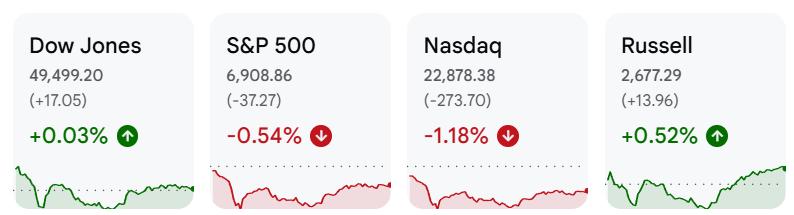
Core Viewpoint - The U.S. stock market is experiencing a clear divergence, with the Dow Jones slightly up, the Nasdaq down nearly 1.2%, and the Russell 2000 index rising about 0.5%, indicating a rotation of funds away from concentrated tech stocks [1] Group 1: Market Dynamics - The core variable dragging down the Nasdaq is Nvidia, which reported strong earnings but saw its stock drop over 5% post-announcement, suggesting a "buy the rumor, sell the news" scenario rather than a fundamental reversal [2] - Retail investors have significantly increased their net buying of Nvidia, while institutional investors have reduced their positions, indicating a misalignment that may amplify short-term volatility [3] - The overall performance of the tech giants is weaker than the broader S&P 500, suggesting that the issue is not industry weakness but rather a natural adjustment after excessive concentration [5] Group 2: Fund Flow and Sector Rotation - The Russell 2000 index's rise contrasts with the Nasdaq, reflecting a shift of funds from high-valuation tech stocks to relatively undervalued small-cap stocks [5] - This style switch typically occurs in two phases: when long-term industry trends change and when short-term fund structures become overly crowded [6] - The current market is closer to the second phase, indicating a redistribution of risk rather than a systemic risk release [7] Group 3: Sector-Specific Insights - The software sector is experiencing extreme positioning, with short positions at a seven-year high and long positions at a seven-year low, making it highly sensitive to positive news [8] - The market is not uniformly bearish; rather, there is an increasing divergence between bulls and bears, leading to an imbalanced position structure [10] - Despite pressure on the tech sector, some individual stocks are performing strongly, indicating that funds are reassessing profit quality and valuation alignment [11][12] Group 4: Company-Specific Developments - Netflix's stock surged about 10% after it decided to abandon its acquisition of Warner Bros. Discovery, signaling a shift in its capital allocation strategy [15] - The decision to halt the acquisition, which was valued at approximately $82.7 billion, alleviates market concerns regarding regulatory risks and competitive pressures [19] - The resumption of Netflix's stock buyback program is seen as a sign of management's confidence in future cash flows and valuation, potentially indicating a 15%-25% upside in stock price [22][24]

板块轮动加速,但节前缩量背后有什么名堂?
Sou Hu Cai Jing· 2026-02-22 00:30
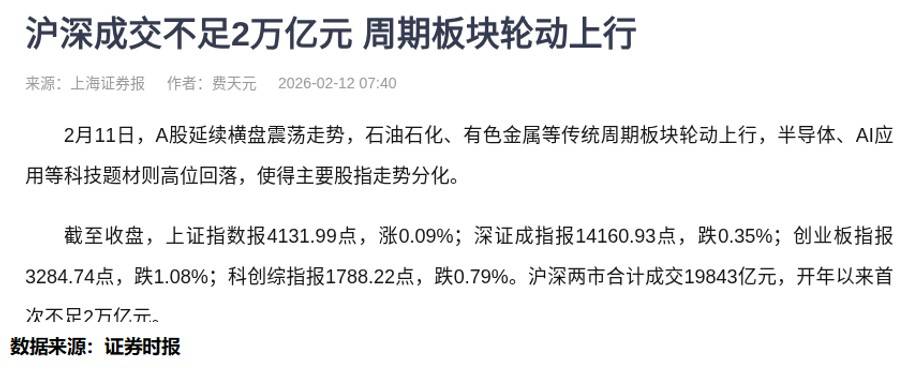
Market Overview - The A-share market is currently experiencing a sideways fluctuation, with traditional cyclical sectors like oil and non-ferrous metals showing upward movement, while technology sectors such as semiconductors and AI applications are retreating from high levels [1] - The trading volume in the Shanghai and Shenzhen markets has narrowed to below 2 trillion yuan [1] - The chemical sector is active due to changes in the supply-demand dynamics of specific products, with some stocks reaching high prices for four consecutive trading days [1] - The commercial aerospace concept has shown localized movements due to breakthroughs in key industry experiments [1] Investment Trends - Multiple institutions have observed a high probability of market style switching around the Spring Festival, with value and large-cap styles expected to dominate before the holiday, while growth and small-cap styles may perform better afterward [1] - Key focus areas include the AI industry chain, companies going overseas, and resource price increases [1] Behavioral Analysis - In a high-volatility environment, many market participants rely solely on price trends, often falling into a cycle of chasing gains and cutting losses [1] - Quantitative big data provides a new and more reliable perspective for observing core market behaviors, moving beyond subjective experience [1] Institutional Participation - Data shows that institutional funds remain actively engaged even during price adjustments, indicating core support for market continuity [5] - The behavior of institutional funds can validate the internal continuity of market trends, eliminating judgment interference caused by price fluctuations [8] Market Dynamics - During periods of price increases, some stocks experience significant adjustments, leading to misjudgments about the end of trends, which can cause participants to exit prematurely [3][11] - Weak rebounds in certain technology stocks lack institutional support, indicating low continuity in these price movements [11][14] Data-Driven Investment Insights - The use of quantitative big data allows for capturing the behavior characteristics of funds, providing a more objective and quantifiable observation dimension [14] - This approach helps participants avoid the pitfalls of traditional price-based judgments and fosters a data-centric investment recognition system [14]
盘前:纳指期货现跌0.2% GDP与PCE将公布
Xin Lang Cai Jing· 2026-02-20 13:22
Economic Indicators - US stock index futures experienced a slight decline ahead of key economic data releases and a potential Supreme Court ruling on Trump's tariff policies [2][12] - The upcoming US Q4 GDP report is expected to show a growth of 2.5%, down from a previous 4.4% in Q3 [3][12] - The PCE price index is anticipated to rise by 2.8% year-over-year, with the core PCE expected to increase by 3% [3][12] - There is a division among Federal Reserve policymakers regarding concerns over the labor market and inflation, with inflation rates still above the Fed's 2% target [3][12] Market Reactions - The market is currently stagnant, awaiting catalysts such as the Supreme Court ruling and Nvidia's upcoming earnings report, which may induce volatility [4][13] - The S&P 500 index has remained flat year-to-date, while the Nasdaq index has seen a decline, indicating sector rotation and broadening market participation [4][13] Corporate Earnings and Performance - Grail's stock plummeted by 47% after its drug trial failed to meet primary endpoints [16] - Opendoor Technologies' stock surged by 19% following a Q4 revenue of $736 million, exceeding market expectations of $549 million [16] - Akamai Technologies' stock fell approximately 10% due to Q1 earnings guidance that did not meet expectations [16] - Comfort Systems reported a Q4 EPS of $9.37, surpassing expectations of $6.75, with revenue of $2.65 billion, significantly above the forecast of $2.34 billion [18] Tariff Impact on Businesses - JPMorgan's report indicates that US mid-sized businesses have been severely impacted by tariffs, with monthly tariff expenditures tripling since early 2025 [15] - Tariff expenditures account for about 10% of international spending for all mid-sized US businesses, rising to approximately 15% for those paying tariffs [15] - Research shows that US businesses and consumers bear 96% of the tariff costs, with 43% of these costs passed on to consumer prices [15][7] Commodity Prices - Goldman Sachs forecasts that gold prices will gradually rise to $5,400 per ounce by the end of 2026, driven by central bank demand and increased private investment [5][14]

重塑能源股价大涨13.53%,氢燃料电池业务增长显著
Jing Ji Guan Cha Wang· 2026-02-20 04:49
Group 1 - The stock price of ReShape Energy (02570.HK) experienced a significant increase of 13.53%, reaching HKD 58.75 on February 20, 2026 [1] - The overall performance of the new energy materials sector, to which ReShape Energy belongs, rose by 0.94%, indicating a market rotation from high-valuation growth stocks to cyclical and emerging industries with improved fundamentals [2] - The company's core business, hydrogen fuel cell systems, saw a remarkable sales revenue growth of 141.8%, despite a year-on-year decline in total revenue, and the loss margin narrowed by 28.7% [2] Group 2 - The overseas revenue of ReShape Energy increased by 360.3% year-on-year, reflecting positive developments in business structure optimization [2] - Technical indicators showed that the stock price broke through short-term moving averages with a significant increase in trading volume, indicating heightened market participation [2]