
银行负债结构优化

Search documents
再见了,5年期大额存单!
Xin Lang Cai Jing· 2025-12-02 11:44
Core Viewpoint - The recent collective withdrawal of 5-year large deposits by six major state-owned banks has raised concerns among ordinary depositors regarding asset allocation [2][13]. Group 1: Withdrawal of Long-term Deposit Products - Six major state-owned banks, including Industrial and Commercial Bank of China, Agricultural Bank of China, Bank of China, China Construction Bank, Bank of Communications, and Postal Savings Bank of China, have completely stopped offering 5-year large deposits [2][13]. - The exit of 5-year large deposits is not sudden; for instance, Bank of China had previously announced the sale of various deposit terms, including 5-year deposits, but limited them to specific customers [8][19]. - The availability of 3-year large deposits has also become scarce, with some banks indicating that the longest available term is now 2 years at a rate of 1.40% [10][21]. Group 2: Impact on Depositors - The reduction of long-term deposit products has left ordinary depositors in a dilemma regarding asset allocation, as many are uncertain about where to place their funds [11][22]. - A representative case is highlighted where a depositor with 1 million yuan intended to invest in a 5-year large deposit for stable returns but found no available options [11][22]. Group 3: Industry Response and Trends - The trend of withdrawing long-term deposit products reflects banks' reluctance to absorb higher-cost long-term liabilities due to pressure on interest margins, leading them to lower rates or reduce the supply of long-term products [11][22]. - The industry is being compelled to accelerate transformation, with suggestions for banks to expand non-interest income through wealth management and custodial services while stabilizing net interest margins [11][22].








六大行,集体停售!
Jin Rong Shi Bao· 2025-12-02 07:16
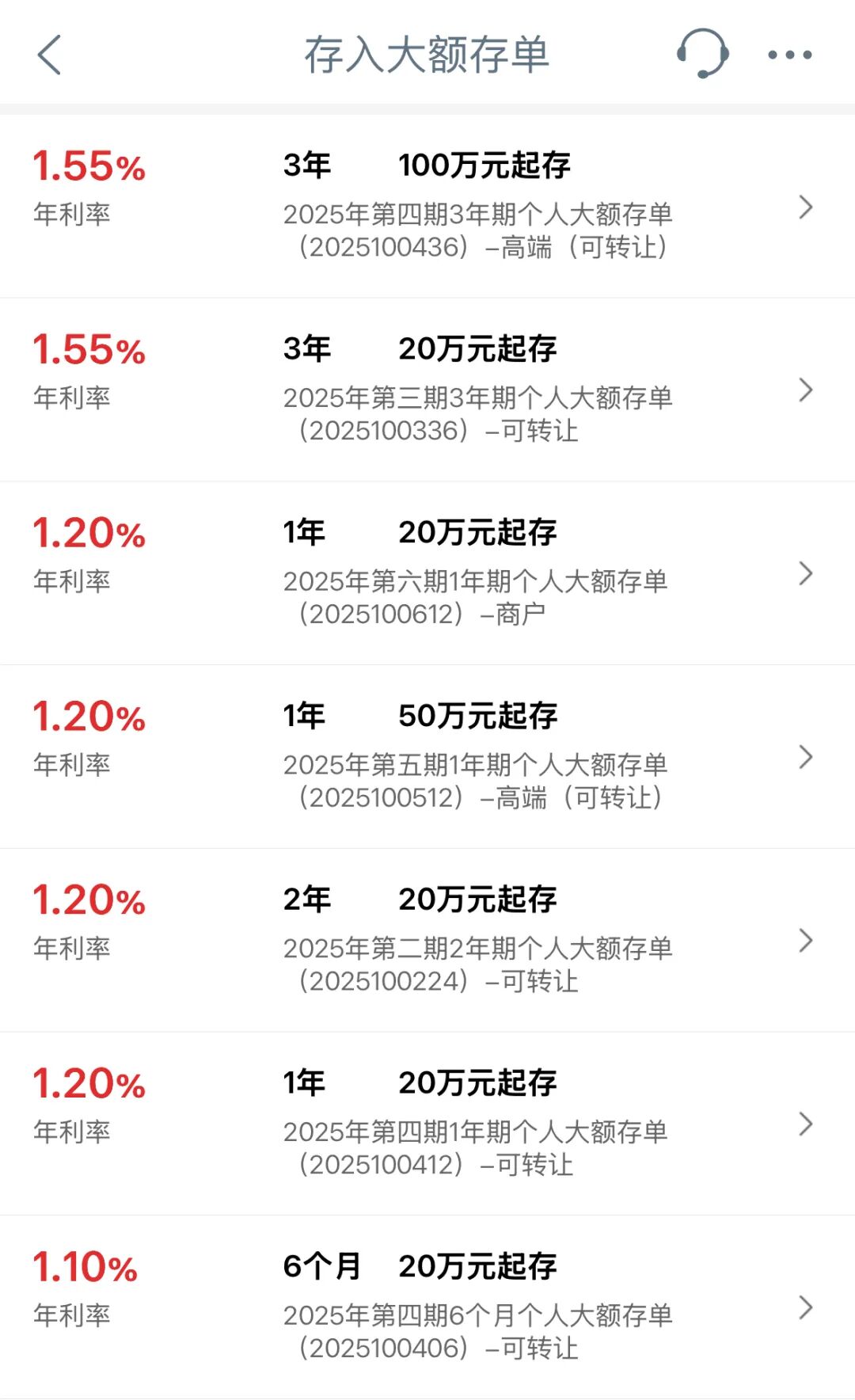
Core Viewpoint - The major state-owned banks in China have completely stopped offering 5-year large denomination certificates of deposit (CDs), leading to a significant reduction in the availability of long-term deposit products in the market [1][2][6]. Group 1: Bank Actions - Six major state-owned banks, including Industrial and Commercial Bank of China, Agricultural Bank of China, Bank of China, China Construction Bank, Bank of Communications, and Postal Savings Bank of China, have ceased the sale of 5-year large denomination CDs [1][2]. - The remaining available terms for large denomination CDs have shifted to shorter durations, with the longest being 3 years, which has a rate of 1.55% [2][6]. - The trend of discontinuing long-term deposit products is not limited to national banks; local commercial banks and private banks are also following suit, as seen with the announcements from banks in Inner Mongolia [10][11]. Group 2: Market Dynamics - The withdrawal of 5-year CDs is attributed to the current downward trend in interest rates, which discourages banks from offering higher rates for long-term deposits [10]. - There is a notable increase in the overall deposit scale due to high savings enthusiasm among residents, while the demand for loans remains weak, leading banks to be less inclined to attract long-term deposits [10]. - Many banks are also reducing deposit rates, with some institutions cutting rates by as much as 65 basis points, reflecting a broader strategy to optimize their liability structure under pressure from interest margins [10][11]. Group 3: Investor Sentiment - The reduction in long-term deposit products has created a dilemma for ordinary depositors, as they struggle to find stable investment options [11]. - A survey indicates a slight decline in the proportion of depositors preferring to save more, suggesting a shift in asset allocation strategies among investors in a low-interest-rate environment [11]. - Financial experts recommend that investors adjust their expectations for returns and consider diversifying their asset allocation to include cash management products, money market funds, and government bonds [11]. Group 4: Industry Implications - The decline of long-term deposit products is prompting banks to accelerate their transformation efforts, focusing on wealth management and custodial services to stabilize non-interest income [11]. - Banks are encouraged to enhance their strategies on both asset and liability sides to maintain net interest margins amidst changing market conditions [11].
一周银行速览(11.7—11.14)
Cai Jing Wang· 2025-11-14 09:09
Regulatory Voice - The People's Bank of China reported that by the end of October, the balance of RMB deposits reached 325.55 trillion yuan, a year-on-year increase of 8% [1] - The total balance of domestic and foreign currency deposits was 332.92 trillion yuan, growing by 8.3% year-on-year [1] - In the first ten months, RMB deposits increased by 23.32 trillion yuan, with household deposits rising by 11.39 trillion yuan [1] Industry Focus - The establishment of Xinjiang Rural Commercial Bank has been approved, marking a significant step in China's rural financial reform [2] - Xinjiang becomes the sixth province to have a provincial-level rural commercial bank, with expected assets exceeding 700 billion yuan upon opening [2] Corporate Dynamics - Xinyin Investment, a wholly-owned subsidiary of Industrial Bank, has been approved to commence operations with a registered capital of 10 billion yuan [7][8] - This marks the sixth licensed Asset Investment Company (AIC) approved in the industry, and the first initiated by a joint-stock bank [8] Financial Personnel - Changshu Bank announced a major management reshuffle, with the resignation of its president and vice president due to work changes [9] - The bank plans to appoint Lu Dingchang as the new president and chief compliance officer, alongside two new vice presidents [9] - Additionally, local state-owned shareholders have increased their stake in Changshu Bank, acquiring 561.93 million shares, raising their total holding to 3.98% [9] Industry Trends - Domestic private banking continues to thrive, with several banks reporting double-digit growth in private banking clients [3] - Ping An Bank has surpassed 100,000 private banking clients, joining the "100,000 Club" alongside six other banks [3] - A trend of integrating and shutting down independent credit card and direct banking apps is emerging among banks, reflecting a shift towards digital transformation [4] - Many small and medium-sized banks are actively removing long-term deposit products to optimize their liability structure and reduce costs [6]

政策宽松与负债改善双轮驱动,银行ETF基金(515020)迎来战略配置窗口
Sou Hu Cai Jing· 2025-10-22 05:46
Core Viewpoint - The banking sector is experiencing dual benefits from improving fundamentals and supportive policies due to declining market interest rates and expectations of continued monetary easing [1] Group 1: Interest Rate Changes - Several small and medium-sized banks are accelerating the reduction of deposit rates, leading to an inverted yield curve where long-term deposit rates are lower than short-term rates [1] - This change reflects the banking industry's proactive measures to optimize liability structures and alleviate net interest margin pressure [1] Group 2: Monetary Policy Outlook - The chief economist of Zheshang Securities, Li Chao, indicates that uncertainties from external factors and structural contradictions in domestic demand and excessive competition on the supply side persist, necessitating moderately loose monetary policy to counter economic downturn pressures [1] - For the full year, the monetary policy is expected to maintain a loose tone, with a forecast of a 50 basis point reserve requirement ratio cut and a 10 basis point interest rate cut by the end of the fourth quarter [1] Group 3: Banking Sector Valuation - The overall price-to-book (PB) ratio of the banking sector is at a historical low, highlighting undervaluation and high dividend characteristics, which enhance its defensive attributes amid market volatility [1] - The banking sector's appeal to stable funds continues to strengthen due to these factors [1]