银行贵金属业务

Search documents
最新!中国银行发布重要公告
Mei Ri Jing Ji Xin Wen· 2026-02-10 22:25
Core Viewpoint - Bank of China announced adjustments to its personal agency business for the Shanghai Gold Exchange during the 2026 Spring Festival, including changes to margin ratios, price fluctuation limits, and trading hours [2]. Group 1: Trading Adjustments - The trading holiday will commence from February 14, 2026, and will last until February 23, 2026, with normal trading resuming on February 24, 2026. There will be no night trading on February 13, 2026 [2]. - Starting from the close on February 11, 2026, the margin ratio for gold futures contracts on the Shanghai Gold Exchange will increase from 18% to 21%, while Bank of China's margin ratio for gold contracts will rise from 47.52% to 55.44%. The price fluctuation limit will change from 17% to 20% [2]. - For silver futures contracts, the margin ratio will increase from 24% to 27% on the Shanghai Gold Exchange, and Bank of China's margin ratio will rise from 68.88% to 77.49%. The price fluctuation limit will change from 23% to 26% starting February 11, 2026 [2]. Group 2: Market Context and Implications - Recent volatility in domestic and international precious metal prices has heightened market uncertainty, prompting major banks to adjust their gold-related business practices [5]. - The adjustments are partly in response to compliance pressures following the introduction of new gold tax regulations in November 2025, which increased operational complexity and costs for banks in the physical gold business [5]. - Analysts suggest that despite current challenges, there remains significant growth potential in the banking sector's precious metals business, with opportunities to promote lower-risk investment products such as gold accumulation plans and physical gold sales [5].


机遇“金闪闪” 银行贵金属业务规模大增
Shang Hai Zheng Quan Bao· 2025-11-03 18:11
Core Viewpoint - The strong international gold prices and rising global risk aversion are driving the growth of banks' precious metals businesses, with significant year-on-year increases reported in the third-quarter financial results of listed banks. However, the recent fluctuations in gold prices present new challenges for these banking operations [1]. Group 1: Growth in Precious Metals Business - The precious metals business of banks has rapidly expanded due to the sustained rise in gold prices, with smaller banks showing particularly impressive growth. As of the end of September, Nanjing Bank's precious metals business reached 7.201 billion yuan, a staggering increase of 11,914.36% compared to the end of 2024. Hangzhou Bank's precious metals business grew to 1.217 billion yuan, up 1,523.57% from the end of 2024 [2]. - Joint-stock banks also experienced significant growth in their precious metals business. By the end of September, compared to the end of 2024, the precious metals business of Shanghai Pudong Development Bank increased by over 350%, while China CITIC Bank saw an increase of over 200%. Other banks like Zhejiang Commercial Bank, Industrial Bank, China Merchants Bank, and Minsheng Bank all reported growth exceeding 100% [2]. - Major banks maintained steady growth from a high base, with the precious metals business of Bank of China, China Construction Bank, and Agricultural Bank of China all increasing by over 10% compared to the end of 2024 [2]. Group 2: Strategic Focus on Precious Metals - The precious metals business combines wealth management and increased intermediary income, potentially becoming a significant factor in banks' intermediary income. Precious metals, especially gold, are seen as irreplaceable in banks' wealth management offerings and are crucial for customer asset allocation [3]. - Analysts note that the demand for gold as a hedge and a store of value is rising among residents. Banks, as key channels for gold bar sales and coin distribution, are well-positioned to meet this demand through the continued popularity of online investment products like account gold and gold accumulation [3]. - The decline in gold jewelry consumption may lead banks to reduce reliance on traditional jewelry sales and instead focus on innovation and promotion of their precious metals business [3]. Group 3: Risk Management Amid Price Volatility - Despite the growth, the high volatility of precious metals, particularly gold and silver, poses challenges for banks. Since October, these metals have entered a period of high volatility, prompting banks to enhance their risk management strategies [4]. - In response to market fluctuations, banks have adjusted trading rules and increased the minimum purchase thresholds for gold accumulation products to a range of 950 to 1,200 yuan, compared to around 500 yuan last year. Additionally, some banks have modified their precious metals wallet services to align with real-time gold price fluctuations [4]. - Looking ahead, institutions expect gold to retain its upward potential, maintaining its importance in asset allocation. The profitability of banks' precious metals business will increasingly depend on their internal capabilities, including the establishment of robust risk management systems to mitigate price volatility risks and the optimization of asset allocation for stable returns [4].






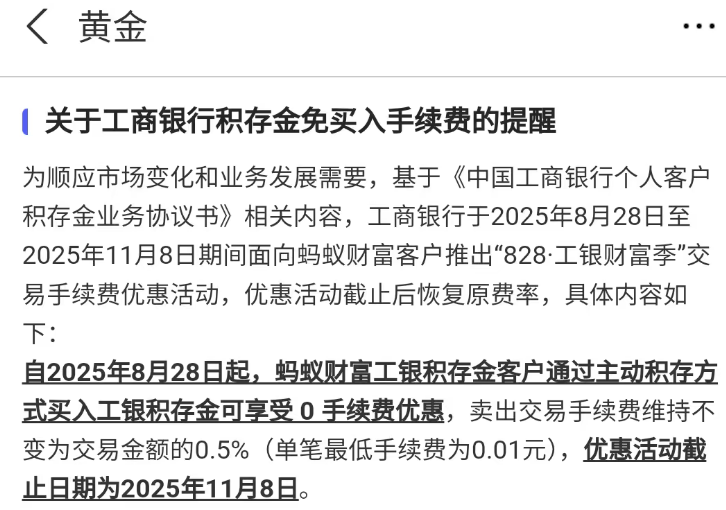
黄金大涨背后,银行布局加快了
Sou Hu Cai Jing· 2025-09-04 22:06
Core Viewpoint - The international gold price has reached a new high, surpassing $3600 per ounce, driven by increased market risk aversion and a significant year-to-date increase of over 36% in gold prices [1][10]. Retail Gold Business Expansion - Banks are actively expanding their retail gold business in response to rising consumer demand, with products like investment gold bars and accumulation gold being promoted to capture market share [1][3]. - Industrial and Commercial Bank of China launched a marketing campaign during the Qixi Festival, offering zero-fee accumulation gold purchases through platforms like Alipay and Tencent Finance [1]. - The retail gold business is seen as enhancing customer loyalty and service capabilities, with products like accumulation gold meeting asset allocation and preservation needs, thereby increasing transaction frequency and cross-selling opportunities in wealth management and insurance [3]. Performance Metrics - Postal Savings Bank reported a significant increase in gold accumulation trading amounting to 5.569 billion yuan, a year-on-year growth of 238.78%, and gold sales of 1.424 billion yuan, up 69.16% [4]. - The appeal of retail gold among younger consumers is growing, with nearly 100 million views on social media platforms discussing bank gold bars [4]. Gold Repurchase Services - Banks are enhancing their gold repurchase systems, with Industrial and Commercial Bank establishing 133 new gold repurchase service outlets to improve service coverage and volume [5]. Institutional Gold Business - The institutional gold business is also crucial, offering services such as gold leasing, price hedging, and the sale of precious metal products to corporate clients [6]. - The Shanghai Gold Exchange has approved 13 market makers for interbank gold inquiry trading, with Postal Savings Bank becoming a trial market maker [6]. Insurance Capital Involvement - The entry of insurance capital into the gold market is expected to drive banks' intermediary income through services like transaction execution and asset custody [9][10]. - China Bank reported a 37% increase in precious metal income in the first half of the year, while Industrial Bank led in interbank gold trading volume with over 3 trillion yuan [9][10].