黄金积存

Search documents
一天暴跌36%!年轻人疯狂借贷买黄金,这场韭菜盛宴正在重演
Sou Hu Cai Jing· 2026-02-23 16:32
Core Viewpoint - The article discusses a significant market crash in precious metals, particularly gold and silver, highlighting the rapid shift in investor sentiment and behavior leading up to the crash, and drawing parallels to past real estate market bubbles. Group 1: Market Dynamics - On January 31, 2026, spot silver prices plummeted by 36%, while gold fell below $4,700 per ounce, marking the largest single-day drop in nearly 40 years [1] - Prior to the crash, many young individuals were seen queuing outside banks to convert consumer loans into gold bars, indicating a shift in investment focus from real estate to precious metals [3] - A policy initiated on September 1, 2025, aimed at stimulating consumer spending through subsidized loans, inadvertently became a tool for speculative investment in gold [5] Group 2: Investment Behavior - The consumer loan policy allowed individuals to borrow up to 50,000 yuan with a government subsidy, leading to a surge in gold purchases as people sought to capitalize on low-interest loans [5] - In 2025, China's total gold demand reached 1,003 tons, with gold ETFs attracting 110 billion yuan in inflows, reflecting a growing trend of investment in gold [5] - The market frenzy peaked in January 2026, with international gold prices rising nearly 30% within a month, and silver prices soaring close to 60% [7] Group 3: Market Collapse - The announcement of Kevin Warsh as the next Federal Reserve Chair by President Trump triggered fears of tighter monetary policy, leading to a sharp increase in the dollar index and a subsequent crash in gold and silver prices [9] - The crash was exacerbated by high leverage among retail investors, resulting in forced liquidations as prices fell below critical levels, causing a rapid decline in market value [9] - Following the crash, major banks adjusted their gold accumulation policies, reminiscent of past real estate market interventions, indicating a shift in market stability [10][12] Group 4: Historical Parallels - The article draws comparisons between the current gold market situation and past real estate bubbles, suggesting that many investors may be left holding depreciated assets while early investors exit profitably [14] - A report indicated that 47% of Chinese homeowners are currently underwater on their mortgages, mirroring the precarious position of gold investors post-crash [12]

从“储蓄银行”向“财富管理银行”全面转型!邮储银行深圳分行副行长李文峰最新表态
券商中国· 2026-02-12 03:23
Core Viewpoint - The article discusses the evolving landscape of wealth management in the Guangdong-Hong Kong-Macao Greater Bay Area, emphasizing the transition from "scale expansion" to "quality enhancement" in the industry, particularly in Shenzhen, which is a key engine for development in the region [1]. Group 1: Current Trends in Wealth Management - The phenomenon of "deposit migration" is deepening, with Shenzhen experiencing a faster pace compared to the national average. This trend is seen as an opportunity for wealth management upgrades rather than a crisis of deposit loss [2]. - The "deposit migration" is driven by a combination of low interest rates, a recovering capital market, and the expiration of excess savings, indicating a reallocation of household wealth [2][3]. - The customer base in Shenzhen is characterized by youth, high net worth, and a strong presence of technology finance, leading to diverse and rapid flows of wealth [3]. Group 2: Strategic Shifts in Wealth Management - The Postal Savings Bank of Shenzhen is transitioning from a "savings bank" to a "wealth management bank," focusing on professional capabilities, technological empowerment, and cross-border advantages to provide superior services to high net worth clients [2][3]. - The bank aims to establish deeper customer trust by shifting from merely selling products to providing asset allocation and accompanying services, which is seen as a long-term strategy to enhance competitive advantage [3]. Group 3: Product and Service Development - The bank is committed to creating "Shenzhen characteristic combinations" tailored to different customer segments, emphasizing appropriate product matching and risk management [4]. - A focus on digital technology is being implemented to enhance customer experience and operational efficiency, with the goal of building a comprehensive wealth management digital capability [6]. - The bank has established a wealth management system with differentiated services for various customer tiers, including mass affluent and high net worth clients, since 2019 [5][6]. Group 4: Future Outlook and Competitive Strategy - For 2026, the bank plans to enhance its competitive edge in wealth management by integrating financial services into key customer scenarios and providing tailored experiences for different demographics [7]. - The bank will promote a range of financial products, including investment products, insurance, and precious metals, to meet the diverse needs of its clientele [8].


女子一次出手8公斤金条,套现近900万元!近期千万元级别套现每天都有
Sou Hu Cai Jing· 2026-02-12 00:19
Core Viewpoint - The investor sentiment is shifting towards risk aversion amid significant fluctuations in gold prices, leading to increased selling and cautious buying behavior in the gold market [1][2]. Group 1: Investor Behavior - A notable increase in large-scale gold selling has been observed, with some investors cashing out millions due to high gold prices, such as a woman selling 8 kilograms of gold bars for nearly 9 million yuan [5][6]. - Many investors are opting to sell portions of their gold holdings to mitigate risk, even while maintaining a long-term positive outlook on gold prices [6][10]. - Smaller gold bars are becoming more popular among investors, with many choosing to make multiple smaller purchases rather than large single transactions to manage risk [8][10]. Group 2: Market Adjustments - Gold retailers, such as Cai Bai Jewelry, are adjusting their business strategies in response to market volatility, including implementing new buyback regulations and limiting the amount of gold that can be repurchased [6][12]. - Several banks have raised the minimum investment thresholds for gold accumulation products, reflecting a tightening of market conditions and a focus on risk management [11][12]. - The trading environment is becoming more controlled, with banks like ICBC implementing limits on gold accumulation and redemption during non-trading days to manage cash flow and risk exposure [12].

避险黄金:交易所、银行、金店掀起风控保卫战
Bei Jing Shang Bao· 2026-02-09 14:33
Core Insights - The global gold market has experienced significant volatility since 2026, with soaring gold prices igniting widespread investment enthusiasm among consumers [1][3] - Short-term trading in gold has gained popularity, leading to a surge in speculative behavior among investors, despite the inherent risks associated with such strategies [4][5] - Financial institutions are implementing stricter measures to manage risks, including raising transaction thresholds and tightening limit management to guide consumers towards more rational investment practices [8][9] Market Dynamics - The rapid increase in gold prices has led to a heightened interest in gold investments, with many consumers engaging in short-term trading rather than long-term strategies [3][4] - Social media platforms have seen a rise in discussions related to gold trading, indicating a shift in consumer sentiment towards more speculative trading practices [3] - Investors are increasingly attracted to products that offer real-time trading capabilities, reflecting a preference for short-term gains over traditional long-term investment approaches [4][5] Institutional Responses - Banks and trading institutions have begun to adjust their gold-related business practices, including raising minimum investment amounts and implementing dynamic limit management to mitigate risks [8][9] - The Shanghai Gold Exchange has raised margin requirements and optimized trading limits to reduce overall market leverage and prevent potential settlement risks [9] - Major gold retailers have also suspended certain trading activities to manage risks associated with market volatility [9][10] Risk Management - Analysts emphasize the importance of understanding the risks associated with gold as a non-yielding asset, particularly in the context of high volatility and leverage [6][10] - Financial institutions are encouraged to enhance investor education and risk assessment processes to help consumers make informed decisions regarding gold investments [12][13] - The recent adjustments in trading practices are seen as a necessary step to protect consumers and reduce the likelihood of significant losses during periods of market turbulence [10][12] Investment Strategy - Experts recommend that consumers return to the fundamental purpose of gold as a long-term asset for risk hedging rather than engaging in speculative trading [11][12] - A strategy of regular, incremental investments is suggested to mitigate the impact of market fluctuations and avoid emotional trading decisions [11][12] - Financial institutions are advised to focus on providing low-volatility investment products and ensuring that clients understand the risks associated with high-leverage products [12][13]
金价单日狂跌3.49%又回弹?最新报价曝光,普通人该不该抄底?
Sou Hu Cai Jing· 2026-02-05 17:35
Core Insights - The recent sharp decline in gold prices is primarily triggered by changes in the Federal Reserve's leadership, raising concerns about potential tightening of monetary policy [5][12] - The gold market is experiencing significant volatility, with professional investors and ordinary consumers showing differing responses to price changes [7][20] Group 1: Market Performance - On February 5, gold T+D dropped by 39.4 yuan per gram, a decline of 3.49%, while ICBC's gold bars increased by 2.58% [1] - The London gold price fell below $4900 per ounce, with a maximum intraday drop of $152.06, reaching a low of $4783.15 per ounce [3] - The gold price has seen a significant drop of nearly $700, or 12.81%, from its historical high of $5598.75 per ounce [3] Group 2: Investor Behavior - There is a noticeable divide in consumer behavior, with some rushing to sell gold while others are eager to buy at lower prices [7][20] - Ordinary investors are often misled by common misconceptions, such as treating gold jewelry as an investment, which can lead to significant losses [9] - The demand for gold from retail consumers is increasing, particularly among younger buyers and during festive seasons [13] Group 3: Supply and Demand Dynamics - The global gold supply is tightening, with major North American gold miners expected to see a decline in production and rising mining costs [13] - Central banks globally have increased their gold purchases, with a net acquisition of 863 tons in 2025, providing a support level for gold prices [12] - The World Gold Council reported that global gold demand surpassed 5000 tons for the first time in history, with investment demand surging by 84% [11] Group 4: Market Predictions and Strategies - Analysts predict that gold prices could reach $6000 per ounce, but caution exists due to the potential for significant short positions in the market [5][11] - Investment strategies vary, with recommendations for consumers to buy gold in smaller increments during price dips and for long-term investors to maintain a balanced portfolio [15][22] - The volatility in gold prices has led to a recommendation for investors to adopt a systematic investment approach to mitigate risks [22][24]

金价暴跌,男子花20万买200克,银行纷纷发布公告
Sou Hu Cai Jing· 2026-02-03 17:50
Core Viewpoint - The recent sharp decline in gold prices has led to a mixed market reaction, with some investors looking to buy the dip while others are counting their losses [1][3][4] Market Reaction - On January 30, gold futures on the New York Commodity Exchange fell below $4,800 per ounce, with a daily drop exceeding 10%, while spot gold hit a low of $4,682 before closing at $4,880.03, marking a maximum daily decline of over 12% [1] - Domestic gold jewelry prices also adjusted downward, with most products dropping approximately 80 yuan per gram, reflecting a significant market correction [1][4] Investor Behavior - In Beijing, some individuals exchanged old jewelry for cash, while others took the opportunity to invest in gold bars, indicating a mix of fear and greed in the market [3] - A customer at a gold store in Nanchang expressed a desire to invest in gold, stating that it serves both as an adornment and an investment, highlighting the dual nature of gold as a commodity [4] Price Dynamics - Major gold retailers like Chow Tai Fook and Chow Sang Sang reported price drops of 60 to 90 yuan per gram within just one to two days, illustrating the rapid market adjustment [4] - The recent price drop is noted as the largest single-day decline in 40 years, with silver prices also experiencing a significant drop of over 35% [4] Market Conditions - The decline in gold prices is attributed to a combination of overheated market conditions and external triggers, such as a downturn in U.S. stock markets and disappointing earnings reports from major companies like Microsoft [6][7] - The volatility in the market is further exacerbated by speculation and the behavior of institutional investors, leading to a chain reaction of sell-offs [7][9] Regulatory Response - Major banks in China have implemented measures to assess the risk tolerance of individual investors participating in gold accumulation transactions, indicating a proactive approach to managing systemic risk [9] - These measures aim to protect investors from high volatility and ensure that they are informed and capable of handling potential losses [9] Long-term Outlook - Despite short-term volatility, the long-term outlook for gold remains optimistic due to persistent factors such as inflation expectations, geopolitical uncertainties, and diverging monetary policies [12] - The current price fluctuations are viewed as a market correction rather than a fundamental shift in gold's value proposition [12] Conclusion - The market is experiencing a misalignment between expectations and reality, driven by liquidity and valuation asymmetries, necessitating a balanced approach between investor protection and market liquidity [14] - Investors are encouraged to maintain a long-term perspective, manage their positions carefully, and prioritize risk control in the face of market volatility [14]
金银价格巨震 多家银行出手
Zhong Guo Zheng Quan Bao· 2026-02-02 15:13
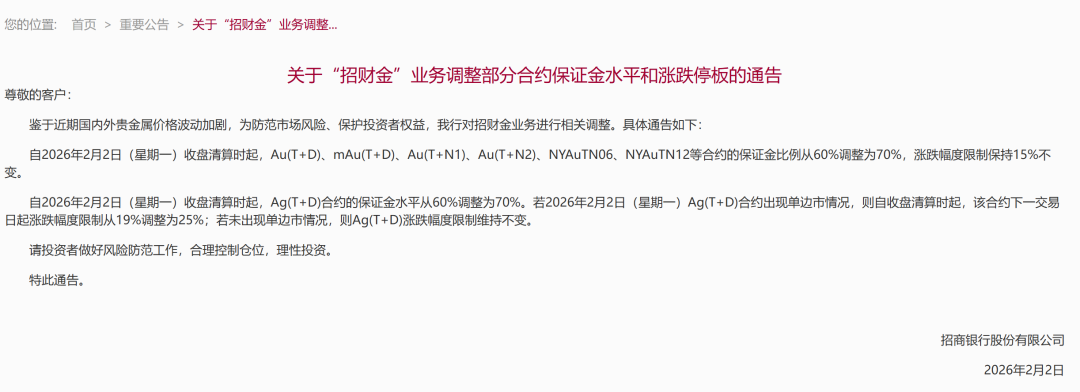
Core Viewpoint - The recent adjustments by several banks in response to significant fluctuations in precious metal prices aim to mitigate market risks and protect investors' interests through increased margin requirements and changes in trading limits [1][2][4][6]. Group 1: Bank Adjustments - China Merchants Bank announced an increase in margin requirements for various gold contracts from 60% to 70% effective February 2, while maintaining a 15% limit on price fluctuations [1]. - The Agricultural Bank of China and other banks are also adjusting their trading parameters for silver contracts, with margin levels rising from 50.80% to 66.04% for certain contracts, depending on market conditions [4][6]. - Postal Savings Bank has issued warnings to investors about the volatility in precious metal prices, urging them to assess their financial situations and manage their investments prudently [10]. Group 2: Market Impact - The adjustments are intended to lower trading leverage for investors, which may help prevent excessive speculation and enhance liquidity during extreme market conditions [2][6]. - If a one-sided market occurs, banks will increase the fluctuation limits for certain contracts, indicating a proactive approach to managing potential market disruptions [4][6]. - The overall trend suggests that other banks are likely to follow suit in implementing similar risk control measures in response to ongoing market volatility [6].
最新!多家银行,紧急调整!
券商中国· 2026-02-02 14:43
Core Viewpoint - Recent fluctuations in international gold and silver prices have led to significant adjustments in banking operations and risk management strategies to protect investors amid heightened market volatility [1][9]. Group 1: Market Fluctuations - On February 2, gold futures dropped below $4,500 per ounce, with silver prices experiencing a cumulative decline of approximately 40% from the peak on January 29, while gold prices fell by about 20% [1]. - The current market environment reflects a high volatility phase influenced by macroeconomic expectations, technical overbought conditions, and profit-taking by investors [9]. Group 2: Banking Responses - China Merchants Bank announced adjustments to its "Zhaocai Gold" business, increasing margin requirements for various gold and silver contracts from 60% to 70% to mitigate market risks [2]. - The Agricultural Bank of China implemented a risk assessment requirement for clients engaging in gold accumulation services, mandating a cautious risk tolerance rating [7]. - The Bank of China adjusted margin requirements for silver contracts, increasing the margin from 50.80% to 66.04% in case of a one-sided market [7]. Group 3: Investor Guidance - Banks are advising investors to enhance their risk awareness, control their positions, and avoid impulsive trading behaviors in light of the current market uncertainties [3][8]. - Financial institutions are promoting a strategy of maintaining a rational investment mindset, suggesting that investors should consider long-term perspectives and diversify their asset allocations [9].




事关黄金,工行、农行、邮储、招行最新提示
Di Yi Cai Jing Zi Xun· 2026-02-02 14:32
Core Viewpoint - The recent volatility in gold and silver prices has prompted banks to increase their risk warnings and adjust risk control measures significantly [2][3][4]. Group 1: Price Volatility - On February 2, international gold prices fell to $4403.64 per ounce, with a maximum daily drop exceeding 9%, while silver prices hit a low of $71.33 per ounce, with a drop close to 15% [2]. - Banks are advising clients to assess their risk tolerance carefully and maintain a rational investment mindset to avoid impulsive trading behaviors [2][3]. Group 2: Risk Warnings from Banks - Industrial and Commercial Bank of China (ICBC) issued a warning on February 2 regarding the significant increase in volatility in the international precious metals market, urging clients to control their positions effectively [2]. - Agricultural Bank of China also highlighted the heightened uncertainty in the precious metals market and advised clients to evaluate their financial situations before engaging in trading [3]. Group 3: Margin Adjustments - ICBC announced an increase in the standard trading margin for personal clients' silver contracts from 60% to 66% effective February 2, following a previous increase from 43% to 60% for gold contracts [4]. - Other banks, including Agricultural Bank and China Merchants Bank, have also adjusted margin requirements and trading limits for gold and silver contracts in response to market conditions [5].



多家银行提示!理性投资贵金属
Xin Lang Cai Jing· 2026-02-02 11:41
Core Viewpoint - Recent volatility in domestic and international precious metal markets has significantly increased uncertainty, prompting banks to issue warnings and adjust trading parameters to protect investors [1][3][4]. Group 1: Agricultural Bank - Agricultural Bank has issued a warning regarding the severe fluctuations in precious metal prices, urging clients to assess their risk tolerance and financial situation before engaging in trading [1][4]. - The bank announced adjustments to the trading limits for silver contracts under its Gold Market Access service, increasing the price fluctuation limit from 19% to 25% if a one-sided market condition occurs starting February 2, 2026 [1][5]. - Clients are advised to monitor market changes closely and manage their positions effectively to mitigate risks associated with market volatility [1][5]. Group 2: Postal Savings Bank - Postal Savings Bank has also highlighted the increased volatility in precious metal markets, advising clients to enhance their risk awareness and make rational investment decisions [1][5]. - The bank emphasizes the importance of avoiding impulsive trading behaviors and maintaining a balanced portfolio in light of the current market conditions [1][5]. Group 3: China Merchants Bank - China Merchants Bank has announced adjustments to its "Zhaocai Gold" business, increasing the margin requirement for various gold contracts from 60% to 70% due to heightened market volatility [3][7]. - The fluctuation limit for the Ag (T+D) contract will be raised to 25% if a one-sided market condition is observed, while it remains unchanged at 15% if not [3][7]. - These measures are aimed at safeguarding investor interests and mitigating market risks [3][7].