
账户黄金

Search documents
黄金买卖实操宝典:选对渠道抓准时机,稳健布局资产保值之路
Sou Hu Cai Jing· 2026-01-29 12:35
Core Viewpoint - Gold remains a crucial asset for investors due to its unique anti-inflation and safe-haven characteristics, especially in the context of rising interest rate expectations and geopolitical disturbances in 2026 [1] Group 1: Compliance and Security - The first step in gold trading is to select compliant and legal trading channels, which directly impacts the safety of investor funds and transaction fairness [3] - Main compliant channels include commercial banks, securities and fund platforms, and Hong Kong Gold Exchange member units, each catering to different investor needs [3] - Gold trading platforms like Jinsong Precious Metals, as an AA member of HKGX, provide reliable options with independent fund management and transparent transaction processes [3] Group 2: Matching Trading Products - Different gold trading products vary significantly in risk levels, trading rules, and capital requirements, necessitating investors to align their choices with their risk tolerance and investment goals [5] - Physical gold, account gold, gold ETFs, and gold derivatives each serve different investor profiles, from beginners to experienced traders [5][6] - New investors are advised to start with non-leveraged products like account gold or gold ETFs before exploring more complex options [6] Group 3: Understanding Price Influences - Gold prices are influenced by multiple factors, including macro monetary policy, geopolitical tensions, and central bank gold purchases, which can drive demand and price fluctuations [7] - The expectation of continued interest rate cuts by the Federal Reserve in 2026 is a significant factor supporting rising gold prices [7] - The relationship between the U.S. dollar index and gold prices is typically negative, with a stronger dollar leading to decreased demand for gold [7] Group 4: Practical Strategies and Common Pitfalls - Effective trading strategies and avoiding common mistakes are essential for successful gold trading [8] - Investors should adhere to the principle of using "idle money" for investments and maintain a reasonable allocation of 5%-15% of total assets in gold [8] - Timing the market is crucial, with different trading sessions exhibiting distinct volatility characteristics, necessitating careful planning and risk management [8][9] Group 5: Long-term Investment Philosophy - The essence of gold trading lies in achieving long-term stable value rather than seeking short-term profits, emphasizing the importance of compliance and risk management [10] - Platforms like Jinsong Precious Metals that prioritize compliance and investor service can support a stable investment journey [10] - A rational mindset and strategic approach are vital for investors to realize the value preservation and gradual asset appreciation that gold offers [10]


百利好丨黄金市场展望:趋势延续与理性配置指南
Sou Hu Cai Jing· 2026-01-15 12:15
Group 1: Market Overview - In 2025, international gold prices recorded the most significant annual increase in decades, with a cumulative rise of over 70% from the year's low to peak [1] - Multiple factors are expected to continue supporting the gold market in 2026, including divergent global economic growth prospects, major central banks maintaining gold reserve increases, potential adjustments in monetary policy cycles, complex geopolitical situations, and growing market investment demand [1] - Several market analysis institutions have set annual target prices above $5,000 per ounce, with some opinions being even more optimistic [1] Group 2: Investment Options - Gold investment encompasses various financial products to meet different investor needs, including physical gold, account gold, gold futures, spot gold, gold ETFs, and options [3] - These products can be broadly categorized into domestic and overseas types, differing in investment thresholds, trading mechanisms, liquidity, and risk-return characteristics [3] Group 3: Trading Channels - Choosing safe and compliant trading platforms is a prerequisite for investment, with domestic products typically accessible through officially recognized financial institutions [4] - For overseas mainstream products, it is advisable to select trading platforms that are regulated by international authorities and have mature operations [4] Group 4: Investment Strategies - A rational strategy is essential for managing risks and pursuing returns, emphasizing the importance of risk awareness and avoiding counter-trend operations [5] - Position management should focus on a light position and phased trading to avoid excessive trading [6] - Strict profit and loss limits should be set in advance to control volatility risks within acceptable ranges [7] - Investors should avoid frequent trading and focus on medium to long-term trends to reduce emotional interference from short-term fluctuations [8] Group 5: Risks and Outlook - Despite the overall positive trend, current gold prices are at historical highs, and market volatility may increase [9] - Potential risks include monetary policy rhythms of major economies not meeting expectations, unexpected easing of geopolitical tensions, significant improvements in gold supply, or high prices suppressing physical demand [9] - These factors may trigger short-term adjustments, but historically, technical corrections within structural trends often provide opportunities for long-term positioning [9]
2026年黄金还能持续“疯狂”么?机构:有望触及5055美元
天天基金网· 2025-12-23 10:53
Core Viewpoint - The article highlights a significant surge in gold prices, with both futures and spot prices reaching historical highs, and major financial institutions expressing optimism about gold price trends through 2026 [1][10]. Group 1: Current Gold Price Trends - On December 23, gold futures surpassed $4500 per ounce, while spot gold approached this threshold during trading [10]. - Domestic gold jewelry prices also increased, with brands like Chow Tai Fook and Lao Miao adjusting their prices to around 1403 CNY per gram [10]. Group 2: Institutional Predictions for Gold Prices in 2026 - UBS predicts gold prices could reach $4500 per ounce by June 2026, with potential to challenge $4900 per ounce [11]. - Goldman Sachs maintains a bullish outlook, forecasting gold prices to hit $4900 per ounce by December 2026 [12]. - ANZ anticipates that gold prices may exceed $5000 per ounce due to deteriorating global growth prospects and renewed trade tensions [13]. - Bank of America projects gold prices could reach $5000 per ounce, citing sustained driving forces behind recent price increases [14]. - JPMorgan estimates that gold prices could touch $5055 per ounce by the end of 2026, driven by demand from ETFs and central banks [14]. Group 3: Investment Options in Gold - Various investment avenues in gold include: - Physical gold, such as jewelry and bullion, which is suitable for long-term holding but has lower liquidity [15]. - Gold stocks, which may offer higher potential returns but are subject to greater volatility due to company performance and market conditions [15]. - Gold futures, which allow for leveraged trading but carry higher risks due to price fluctuations [15]. - Gold ETFs and related funds, ideal for investors seeking flexibility and efficiency in trading [15]. - Account gold, which offers high liquidity and the option to convert to physical gold after reaching a certain weight [16].

机遇“金闪闪” 银行贵金属业务规模大增
Shang Hai Zheng Quan Bao· 2025-11-03 18:11
Core Viewpoint - The strong international gold prices and rising global risk aversion are driving the growth of banks' precious metals businesses, with significant year-on-year increases reported in the third-quarter financial results of listed banks. However, the recent fluctuations in gold prices present new challenges for these banking operations [1]. Group 1: Growth in Precious Metals Business - The precious metals business of banks has rapidly expanded due to the sustained rise in gold prices, with smaller banks showing particularly impressive growth. As of the end of September, Nanjing Bank's precious metals business reached 7.201 billion yuan, a staggering increase of 11,914.36% compared to the end of 2024. Hangzhou Bank's precious metals business grew to 1.217 billion yuan, up 1,523.57% from the end of 2024 [2]. - Joint-stock banks also experienced significant growth in their precious metals business. By the end of September, compared to the end of 2024, the precious metals business of Shanghai Pudong Development Bank increased by over 350%, while China CITIC Bank saw an increase of over 200%. Other banks like Zhejiang Commercial Bank, Industrial Bank, China Merchants Bank, and Minsheng Bank all reported growth exceeding 100% [2]. - Major banks maintained steady growth from a high base, with the precious metals business of Bank of China, China Construction Bank, and Agricultural Bank of China all increasing by over 10% compared to the end of 2024 [2]. Group 2: Strategic Focus on Precious Metals - The precious metals business combines wealth management and increased intermediary income, potentially becoming a significant factor in banks' intermediary income. Precious metals, especially gold, are seen as irreplaceable in banks' wealth management offerings and are crucial for customer asset allocation [3]. - Analysts note that the demand for gold as a hedge and a store of value is rising among residents. Banks, as key channels for gold bar sales and coin distribution, are well-positioned to meet this demand through the continued popularity of online investment products like account gold and gold accumulation [3]. - The decline in gold jewelry consumption may lead banks to reduce reliance on traditional jewelry sales and instead focus on innovation and promotion of their precious metals business [3]. Group 3: Risk Management Amid Price Volatility - Despite the growth, the high volatility of precious metals, particularly gold and silver, poses challenges for banks. Since October, these metals have entered a period of high volatility, prompting banks to enhance their risk management strategies [4]. - In response to market fluctuations, banks have adjusted trading rules and increased the minimum purchase thresholds for gold accumulation products to a range of 950 to 1,200 yuan, compared to around 500 yuan last year. Additionally, some banks have modified their precious metals wallet services to align with real-time gold price fluctuations [4]. - Looking ahead, institutions expect gold to retain its upward potential, maintaining its importance in asset allocation. The profitability of banks' precious metals business will increasingly depend on their internal capabilities, including the establishment of robust risk management systems to mitigate price volatility risks and the optimization of asset allocation for stable returns [4].






多家国有大行暂停黄金积存业务
Sou Hu Cai Jing· 2025-11-03 08:36
Core Viewpoint - Major Chinese banks, including Industrial and Commercial Bank of China (ICBC) and China Construction Bank (CCB), have suspended new gold accumulation business due to macroeconomic policy changes and risk management requirements, impacting various gold investment products and services [1][2]. Group 1: Bank Actions - ICBC has halted the acceptance of new accounts for its "Ruyi Gold Accumulation" program, along with new accumulation plans and physical gold withdrawals, while existing plans will continue to be executed normally [1]. - CCB has suspended real-time purchases and new investment plans for its "Easy Gold" service, as well as physical gold exchanges, but existing customers can still redeem and close accounts [1]. - Other banks, such as Industrial Bank and Ping An Bank, have already raised the minimum investment amounts for gold accumulation products in response to increased trading activity and gold price volatility [2]. Group 2: Tax Policy Changes - A significant change in gold tax policy was announced, effective from November 1, 2025, which aims to optimize the VAT arrangements for gold transactions and clarify the distinction between investment and non-investment uses [2]. - The new tax policy is expected to promote more transparent and regulated gold trading, reducing gray market activities and increasing compliance costs [2]. Group 3: Market Reactions - The international gold price has seen significant fluctuations, with a year-to-date increase exceeding 50%, while domestic gold prices also reached historical highs before experiencing corrections [3]. - Following the announcements from banks, gold retail stocks in Hong Kong and A-share markets faced declines, indicating market sensitivity to these changes [3][4]. Group 4: Risk Management Objectives - The banks' decision to pause new business is aimed at managing three key risks: reducing immediate inventory and delivery pressures during extreme volatility, allowing time for compliance with new tax regulations, and mitigating the impact of emotional trading on business operations [4]. - The new tax policy is expected to enhance the advantages of standardized gold products, leading to a potential rebalancing of channels among banks, platforms, and investors [4]. Group 5: Investor Guidance - Investors are advised to adopt a cautious approach by avoiding high-risk positions and considering gold as a hedging component in their portfolios, while prioritizing compliance and clarity in product offerings [6]. - The current restrictions on new accounts and physical withdrawals may lead to temporary adjustments in trading parameters and potential delays in transactions [6]. Group 6: Future Observations - Key points to monitor include whether more banks will follow suit in suspending new accounts, the impact of the new tax policy on different gold trading channels, and the evolution of price and trading structures in the gold market [8].


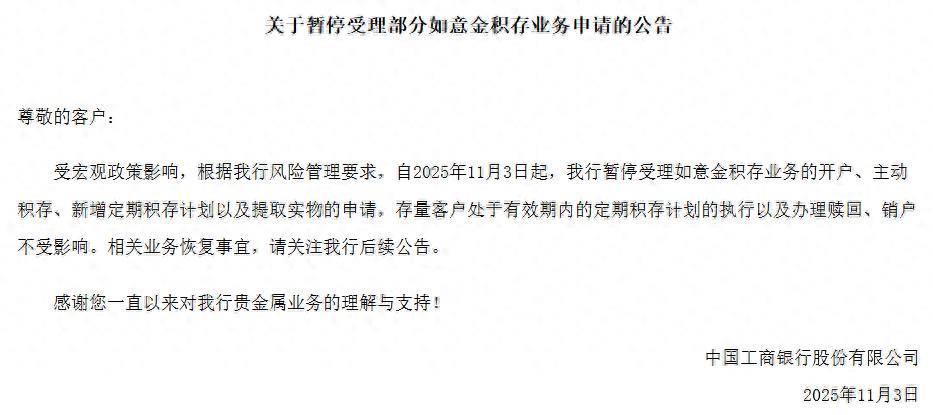
中国建设银行:暂停受理易存金业务实时买入、新增定投买入、实物金兑换等申请
Xin Hua Cai Jing· 2025-11-03 08:33
Core Points - China Construction Bank announced the suspension of certain gold investment services starting from November 3, 2025, due to market volatility and risk management considerations [2] - The suspended services include real-time purchases, new investment plans, and physical gold exchanges, while existing clients' investment plans and redemptions will remain unaffected [2] - The bank will also pause personal gold accumulation exchanges for physical precious metals, but other personal gold accumulation services will continue [2] Summary by Category - **Service Suspension** - The bank will suspend real-time buy-in, new investment plans, and physical gold exchange applications starting from November 3, 2025 [2] - Existing clients' investment plans, redemptions, and account closures will not be impacted [2] - **Impact on Personal Gold Accumulation** - Personal gold accumulation exchanges for physical precious metals will be paused [2] - Other personal gold accumulation services will remain unaffected [2] - **Future Announcements** - The bank will provide updates regarding the resumption of the suspended services in future announcements [2]
国盛证券:银行贵金属业务有望成重要增长极 红利策略或仍有持续性
智通财经网· 2025-10-27 03:03
Core Viewpoint - The gold market in 2025 presents challenges due to high volatility, but this does not alter the trend of listed banks deepening their precious metals business, supported by global central banks increasing gold reserves [1] Policy and Market Environment - As of September 2025, China's official gold reserves reached 74.06 million ounces, marking an increase of 40,000 ounces from August, continuing an 11-month growth trend [1] - In Q2 2025, global central banks added 166 tons of gold to their reserves, with 95% of surveyed central banks expecting further increases in the next 12 months [1] - The Financial Regulatory Bureau's pilot program for insurance funds to invest in gold creates new opportunities for banks to provide services to insurance institutions, enhancing their middle-income business [2] Business Dynamics and Revenue Contribution - In the first half of 2025, China's gold consumption was 505.205 tons, a year-on-year decrease of 3.54%, with gold jewelry consumption down 26% and gold bars and coins up 23.69% [3] - The demand for gold bars and coins reflects a growing need for gold as a hedge and store of value, positioning banks as key channels for these products [3] - The decline in gold jewelry consumption may lead banks to focus more on investment-type precious metals business, enhancing revenue stability [3] Risks and Outlook - High volatility in the gold market poses a significant challenge for listed banks, testing their risk control capabilities in proprietary trading and client asset preservation [4] - Future profitability from precious metals will depend on banks' ability to establish robust risk management systems and optimize asset allocation [4] - Banks with strong risk control and market-making capabilities are likely to strengthen their competitive position and expand market share [4]
本周聚焦:黄金波动下的机遇与挑战:银行贵金属业务有望成重要增长极
GOLDEN SUN SECURITIES· 2025-10-27 00:58
Investment Rating - The report maintains an "Accumulate" rating for the banking sector, indicating a positive outlook despite challenges in the gold market in 2025 [1]. Core Insights - The gold market is expected to present both opportunities and challenges for banks, with a trend towards deepening precious metal business driven by central bank purchases [1][2]. - The demand for gold bars and coins has increased significantly, reflecting a growing need for gold as a hedge and store of value among residents [4]. - The establishment of a market-making system for gold trading is anticipated to enhance market liquidity and stability, positioning listed banks as key players [3][4]. Summary by Sections 1. Policy and Market Environment - As of September 2025, China's official gold reserves reached 74.06 million ounces, marking an increase for 11 consecutive months [2]. - In Q2 2025, global central banks added 166 tons of gold to their reserves, with 95% of surveyed central banks expecting further increases in the next 12 months [2]. - New policies allowing insurance funds to invest in gold are expected to create new opportunities for banks to provide services to insurance institutions, enhancing their intermediary income [2]. 2. Business Dynamics and Revenue Contribution - In the first half of 2025, China's gold consumption was 505.205 tons, a year-on-year decrease of 3.54%, with significant growth in gold bar and coin consumption by 23.69% [4]. - The decline in gold jewelry consumption is prompting banks to shift focus from traditional jewelry sales to investment-oriented precious metal businesses [4]. - The growth in investment demand for gold bars and coins is expected to stabilize income from investment-related businesses, enhancing the profitability of the precious metals segment for banks [4]. 3. Industry Trends - The report highlights a structural shift in gold consumption, with investment demand rising while jewelry demand declines, indicating a need for banks to adapt their business strategies [4]. - The performance of the banking sector is expected to benefit from expansionary policies aimed at stabilizing the economy, with specific banks like Ningbo Bank and Jiangsu Bank recommended for investment due to positive fundamental changes [8]. 4. Key Data Tracking - The report includes various financial metrics, such as average daily trading volume and margin financing balances, which are essential for assessing market conditions [9][10].


香港第一金PPLI:国际际黄金疯涨背后的动力简单看懂关键逻辑
Sou Hu Cai Jing· 2025-10-20 06:29
Group 1 - The article discusses the recent investment experience in gold, highlighting a profitable short-term trade and the importance of taking profits quickly in volatile markets [1] - It emphasizes that despite short-term fluctuations, the long-term outlook for gold remains positive due to ongoing geopolitical tensions and economic uncertainties [1][3] Group 2 - Geopolitical conflicts, particularly the Russia-Ukraine situation, are expected to continue driving gold prices upward in the long term, despite temporary price drops during negotiation phases [3] - The uncertainty surrounding the U.S. government shutdown creates a favorable environment for gold, as prolonged shutdowns can lead to increased market volatility and speculation [6] - The Federal Reserve's potential interest rate cuts are seen as a long-term positive for gold, as lower rates typically increase the appeal of non-yielding assets like gold [9] - Institutional investors and ETFs are increasing their holdings in gold, indicating a sustained bullish sentiment in the market, although some institutional strategies may be aimed at attracting retail investors rather than genuine market analysis [10][11] - Central banks globally are increasing their gold reserves as a strategy to counteract the trend of de-dollarization, aiming to stabilize their currencies and maintain influence in the future monetary system [12]

金价新高!有人挪用消费贷炒金
Zhong Guo Jing Ying Bao· 2025-04-22 11:16
Core Viewpoint - The recent surge in gold prices has led to increased interest among retail investors, with some resorting to unconventional funding methods such as consumer loans and credit card cash advances to invest in gold [1][3]. Group 1: Gold Price Trends - As of April 21, gold futures on the Shanghai Futures Exchange surpassed 800 CNY per gram, reaching a historical high, while spot gold prices exceeded 3,400 USD per ounce [1]. - Domestic gold jewelry prices have also risen, with brands like Chow Tai Fook and Luk Fook reporting prices close to 1,040 CNY per gram [2]. Group 2: Investment Behavior - There has been a notable trend of consumers borrowing money to invest in gold, with reports of individuals using consumer loans for this purpose [3][4]. - A specific case highlighted a Beijing investor who used a 100,000 CNY consumer loan for gold trading, acknowledging the associated risks [3]. Group 3: Risk Warnings from Financial Institutions - Several banks have issued warnings regarding the heightened risks in the gold market, advising investors to maintain a rational investment mindset and manage their positions carefully [4][5]. - The China Construction Bank has specifically cautioned about the increased volatility in precious metals prices and the need for risk awareness [5]. Group 4: Market Analysis and Predictions - Analysts suggest that gold prices may continue to perform strongly due to ongoing uncertainties in U.S. tariff policies and global trade tensions, which are expected to sustain high demand for safe-haven assets like gold [5]. - A bank representative emphasized the importance of a balanced investment strategy, recommending that investors diversify their portfolios and stay informed about market conditions [6].