锂电反内卷

Search documents
电池反内卷,是时候了
高工锂电· 2026-02-02 12:21
Core Viewpoint - The lithium battery industry is experiencing a resurgence in demand, with over 50 listed companies in the lithium battery supply chain reporting optimistic profit forecasts for 2025, indicating a recovery in the cycle and a potential turnaround for the lithium battery sector [1] Group 1: Company Performance - Guoxuan High-Tech is expected to achieve a net profit of 2.5 to 3 billion yuan, representing a year-on-year increase of 107.16% to 148.59% [2] - Ruipu Lanjun anticipates a loss, while Funeng Technology continues to report losses [2] - Penghui Energy forecasts a net profit of 170 to 230 million yuan [2] Group 2: Market Dynamics - The demand for power and energy storage batteries remains high, with orders being released in concentrated bursts, leading to a situation where production lines for energy storage are nearly at full capacity [2] - Despite the high demand, structural issues such as overcapacity and declining profit margins persist within the industry [3] - The lithium carbonate price has entered an upward trend, ending a prolonged bottoming phase at around 60,000 yuan per ton, which has tightened the supply of energy storage cells [3][5] Group 3: Pricing and Cost Structure - The price of lithium carbonate and other key raw materials has risen significantly, with the comprehensive cost of lithium iron phosphate cells expected to increase by about 30% [8] - The pricing mechanism for power batteries is relatively mature, but the transmission of cost increases to end products has been insufficient [9][10] - Energy storage cell prices have increased by 20% to 30%, but this rise does not fully cover the cost increases due to non-linked costs [10][11] Group 4: Industry Challenges - The industry faces a dilemma where good demand is overshadowed by structural issues, leading to a call for a "de-involution" approach to ensure healthy profit margins [3][16] - The competition is intensifying, with low-end supply continuing to participate in the market, allowing for a wide range of choices for end-users [13][14] - The industry is at a critical juncture where the focus must shift from scale expansion to sustainable profit structures to avoid repeating past mistakes seen in the solar industry [24][29] Group 5: Policy and Future Outlook - Recent policies are pushing for a shift in consumption structure towards mid-to-high-end products, which will compel battery and vehicle manufacturers to compete on efficiency and performance [21][22] - The lithium battery industry is entering a new phase characterized by rigid demand and a systematic reduction in price war space, emphasizing the need for companies to establish true competitive advantages [23][29] - The transition towards large-scale production and manufacturing capabilities is becoming essential for companies to maintain their market position and profitability [25][26]



A股开盘:沪指跌0.2%、创业板指跌0.63%,脑机接口、光刻胶概念股走高,稀土永磁及金属板块调整
Jin Rong Jie· 2026-01-08 01:37
Market Overview - On January 8, A-shares opened lower across the board, with the Shanghai Composite Index down 0.2% at 4077.72 points, the Shenzhen Component down 0.42% at 13971.89 points, and the ChiNext Index down 0.63% at 3308.74 points [1] - The rare earth permanent magnet sector saw initial declines, with Huaxin Environmental falling over 4% and Zhongke Magnetic down over 3% [1] - The brain-computer interface sector was active, with Innovation Medical hitting a new high after four consecutive trading limits, and several other related stocks also rising [1] - The industrial metals sector experienced declines, with China Aluminum, Tianshan Aluminum, and Jiangxi Copper all down over 2% [1] Company News - Fenglong Co., Ltd. experienced a continuous trading limit from December 25, 2025, to January 7, 2026, with a cumulative increase exceeding 100%, indicating significant market deviation and potential speculation risks [2] - Sumida plans to acquire 60 million shares of Blue Science and Technology from its controlling shareholder at a price of 6.71 yuan per share, totaling 403 million yuan, which will increase its stake to 21.72% [2] - Kecuan Technology's subsidiary has built production capacity for optical modules and completed the first silicon photonic chip trial, although it has not yet generated significant revenue [2] Industry Insights - Prit's LCP film products are suitable for use as flexible electrode materials in brain-computer interfaces, with the company being the only domestic entity to achieve significant breakthroughs in this technology [3] - The global transformer market is expected to reach $103 billion by 2031, driven by increased demand for electrical equipment and significant investments in global power grids [11] - The liquid cooling market is projected to reach $16.5 billion by 2026, with a compound annual growth rate of approximately 59% [8] Financial Projections - Zhongke Blue News expects a net profit of 1.4 to 1.43 billion yuan for 2025, a year-on-year increase of 366.51% to 376.51%, with revenue projected at 1.83 to 1.85 billion yuan [4] - Fuhua Co., Ltd. plans to raise up to 700 million yuan through convertible bonds for various projects, including a production base in Vietnam and energy storage systems [5] - Anpei Long intends to raise up to 544 million yuan through a targeted stock issuance for expansion projects related to pressure sensors and MEMS sensor chip development [6]


锂电反内卷行至深水区 头部铁锂材料企业携手“自救”
起点锂电· 2025-11-21 10:35
Core Viewpoint - The lithium battery industry is entering a new cycle characterized by a surge in demand and supply optimization, leading to a significant increase in both volume and price across various segments. However, the industry faces challenges, particularly in the lithium iron phosphate (LFP) sector, where companies have been experiencing losses despite high shipment volumes [4][5]. Group 1: Industry Overview - The demand for lithium iron phosphate batteries has surged, with shipments in China reaching 1,050 GWh from January to October 2025, accounting for 78% of total lithium battery shipments, representing a 65% year-on-year increase [4]. - Despite high production and sales, LFP companies are still operating at a loss, with upstream material costs, such as lithium carbonate and phosphate, rising sharply, potentially exacerbating losses [4][5]. Group 2: Financial Performance of Key Companies - Major LFP companies have reported significant losses over the past three years, with a cumulative loss exceeding 10.9 billion yuan among five leading firms from 2023 to Q3 2025. Notably, De Fang Nano has incurred losses exceeding 3.5 billion yuan [6][7]. - The financial outlook for these companies remains bleak, with projected net profits for 2023 showing negative figures for most, except for Hunan Youneng, which is expected to maintain a slight profit [8]. Group 3: Industry Initiatives and Solutions - The industry is advocating for a collaborative approach to address the "involution" issue, with several companies proposing initiatives to promote self-discipline, price stability, and coordinated capacity release [10][12]. - Key initiatives include rebuilding market pricing logic based on costs, promoting innovation in new technologies, and ensuring a balanced supply-demand relationship to facilitate orderly capacity release [12][13]. - Companies are encouraged to establish long-term orders with upstream suppliers, optimize production processes, and implement cost control measures to mitigate financial losses [12][13].
锂电“反内卷”引爆,5日暴涨28%!江特电机回应宜春锂矿、机器人布局
Ge Long Hui A P P· 2025-08-13 12:50
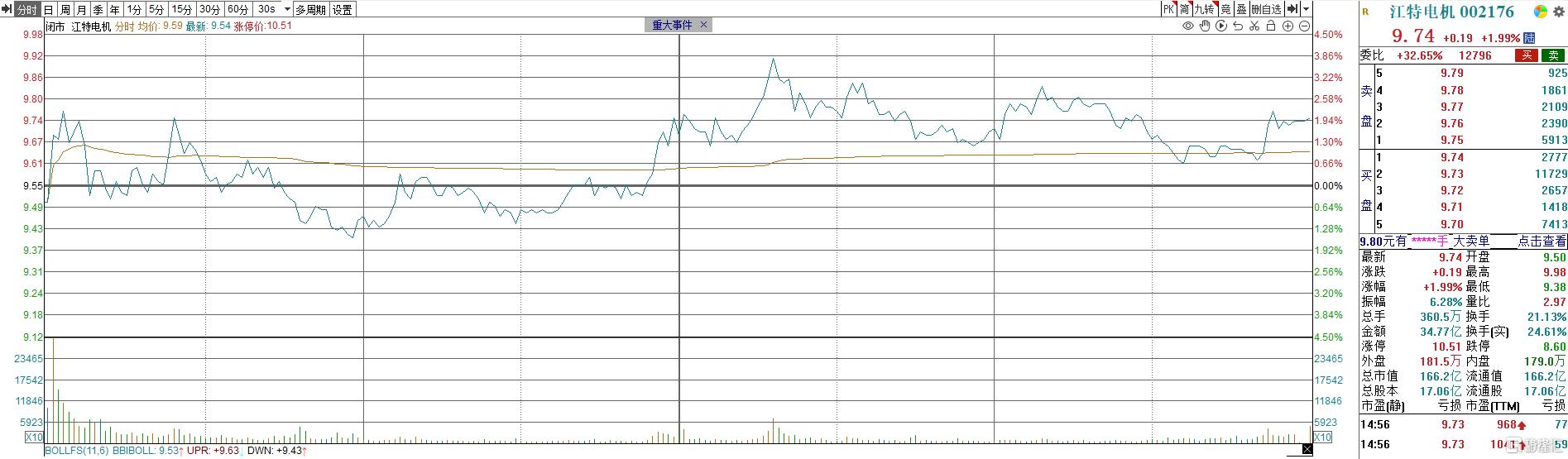
Core Viewpoint - The lithium battery sector is experiencing significant stock price volatility, with companies like Jiangte Electric showing resilience amidst broader market declines [1][2]. Group 1: Company Performance - Jiangte Electric's stock price increased by 1.99% to 9.74 CNY per share, with a total market capitalization of 16.62 billion CNY, despite declines in Tianqi Lithium and Ganfeng Lithium [2]. - The company has faced substantial losses, with projected net losses of 950 million to 1.25 billion CNY for the first half of the year, following a loss of 640.66 million CNY in the same period last year [10][13]. - Jiangte Electric's stock has seen a cumulative decline of nearly 74% over a three-year adjustment period, reaching a low of 6.2 CNY per share [13]. Group 2: Lithium Resource Development - Jiangte Electric holds over 10 million tons of lithium resources, with the Qian坑 lithium mine being the most significant, having a mining license valid for 30 years [9][10]. - The Qian坑 lithium mine has a resource reserve of 72.93 million tons at an average Li2O grade of 0.44%, and up to 126.67 million tons at a grade of 0.39%, classifying it as a large lithium mine [10]. - The development of the Qian坑 lithium mine is expected to significantly enhance the company's self-sufficiency in lithium and reduce production costs, positively impacting profitability over the next 30 years [10]. Group 3: Strategic Initiatives - Jiangte Electric is focusing on humanoid robot joint module development through its subsidiary, Weier (Shenzhen) Intelligent Drive Co., Ltd., and is actively collaborating with leading robotics companies and suppliers [11]. - The company is undergoing a change in control, with the original controlling shareholders transferring their stakes to Wubai Yingli Technology, which now holds 50% of Jiangte Electric [17][19]. - Wang Xin, a well-known investor, has increased his stake in Jiangte Electric and is now the controlling shareholder, indicating confidence in the company's future [21].

锂电行业“反内卷”:从价格厮杀走向“理性繁荣
高工锂电· 2025-07-20 12:11
Core Viewpoint - The "anti-involution" policy is reshaping market expectations and is seen as a 2.0 version of China's supply-side reform, particularly impacting emerging industries like lithium batteries, photovoltaics, and electric vehicles [2][3]. Group 1: Industry Overview - The lithium battery industry has experienced explosive growth over the past decade, with total production reaching 1170 GWh and industry output exceeding 1.2 trillion yuan in 2022, compared to just 29.868 GWh in 2014 [8]. - Despite significant growth, the industry faces challenges as rapid physical growth has not translated into corporate profits, with many companies selling inventory at prices just covering raw material costs [9][10]. - The lithium battery sector holds over 70% of the global market share, yet it is engaged in "bottom competition" internationally, leading to a decline in average prices [10]. Group 2: Policy and Legislative Changes - The "anti-involution" initiative has moved towards legislative depth, with new laws targeting price stability and fair trading conditions, including the prohibition of selling below cost [4]. - The government is addressing issues of homogeneous capacity caused by chaotic investment practices, emphasizing the need for transparent investment disclosures [5]. Group 3: Market Dynamics and Challenges - The industry is experiencing a price war, with over 30 car manufacturers reducing prices to clear inventory, leading to a significant drop in profit margins within the automotive sector [13]. - The lithium price has been on a downward trend since late 2022, with expectations of continued oversupply in the market, affecting upstream material suppliers [14]. Group 4: Future Directions and Innovations - The "anti-involution" marks a critical turning point for the lithium battery industry, focusing on the elimination of outdated capacity and driving technological upgrades [16][17]. - New investment trends are emerging, with a focus on battery recycling and solid-state batteries, indicating a shift towards a circular economy and technological innovation [20]. - Companies are increasingly investing in high-pressure lithium iron phosphate batteries, which are expected to enhance profit margins and meet rising demand for fast-charging solutions [21].