闭源模式

Search documents
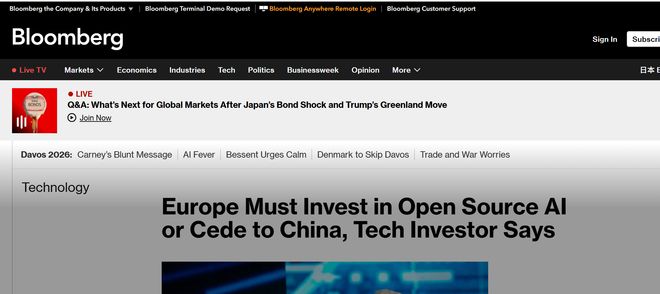
谷歌前CEO呼吁欧洲加大开源AI投资,避免依赖外部模型
Huan Qiu Wang Zi Xun· 2026-01-21 03:07
Core Viewpoint - Eric Schmidt, former CEO of Google, emphasizes the need for Europe to accelerate the development of its own open-source AI ecosystem and address high energy prices to avoid dependency on Chinese AI models [1][3] Group 1: AI Development Landscape - The global AI sector is experiencing differentiated development, with American companies favoring closed-source models that often involve purchasing and licensing technologies, such as Google's Gemini and OpenAI's ChatGPT [3] - In contrast, China leads in the development of open-source models that offer higher transparency and greater opportunities for technological exchange and innovation [3] Group 2: Recommendations for Europe - To gain a competitive edge in the global AI model and agent development race, Europe must increase funding for local open-source AI laboratories to build a self-sufficient technology system [3] - Additionally, Europe needs to tackle the issue of soaring energy prices and expedite the construction of data center infrastructure that meets AI training demands [3]


Meta闭源转向:巨头的求生与AI行业的范式重构
3 6 Ke· 2025-12-11 10:05
Core Insights - Meta's strategic shift from open-source to closed-source AI models, highlighted by the $14.3 billion acquisition and the development of the Avocado model, reflects the pressures of commercial realities and industry competition [2][3] - The transition signifies a critical moment in the commercialization challenges of open-source AI, as Meta's previous open-source efforts yielded over 30 million downloads but generated less than $1 billion in licensing revenue against over $70 billion in annual AI investments [2][3] - The closed-source model is seen as essential for capturing high-value markets, particularly in sectors like finance and healthcare, where data security and compliance are paramount [2][3] Meta's Strategic Shift - Meta's decision to adopt a "technology fusion" approach by integrating technologies from Google, OpenAI, and Alibaba aims to quickly address its shortcomings and meet industry demands [3] - The internal upheaval, including the departure of key personnel and layoffs at the FAIR lab, raises concerns about the compatibility of different model architectures and potential intellectual property disputes [3][4] - This shift marks the beginning of a new phase in the AI industry characterized by a coexistence of open-source and closed-source models, with open-source models still dominating academic research and smaller applications [3][4] Market Implications - Meta's transition to closed-source is expected to accelerate market consolidation, with leading companies likely to build commercial moats through closed-source models, while smaller players may find new opportunities in the open-source space [4] - The integration of Chinese models like Alibaba's Tongyi Qianwen into Meta's technology references indicates the growing global competitiveness of Chinese AI technologies [4] - The release of Avocado in Q1 2026 will be a pivotal moment, with the potential to replicate the success of the Microsoft-OpenAI partnership, creating a "model-hardware-advertising" business loop [4][5] Timeline of Key Events - February 2023: Launch of Llama 1, marking Meta's entry into large models with an open-source approach [5] - July 2023: Llama 2 becomes the most popular open-source large model with over 30 million downloads [5] - June 2025: Meta acquires a stake in Scale AI for $14.3 billion and appoints Alexandr Wang as Chief AI Officer, signaling a shift to closed-source [5][6] - October 2025: Announcement of a $27 billion Hyperion data center plan to support closed-source model capabilities [7] - Q1 2026: Expected launch of Avocado, focusing on complex reasoning and long video analysis, aiming to compete with GPT-5 and Gemini 3 Ultra [9] Strategic Differences in AI Models - U.S. giants primarily focus on closed-source models with clear commercial pathways, while Chinese players adopt a dual approach of open-source and closed-source to balance ecosystem development and monetization [11] - The U.S. strategy emphasizes closed-source to maintain competitive advantages, whereas China's approach leverages open-source to address specific industry needs and accelerate deployment [11][12] - The iteration pace differs, with U.S. companies releasing new versions semi-annually or annually, while Chinese firms adopt a more rapid release cycle driven by community engagement [12][13]

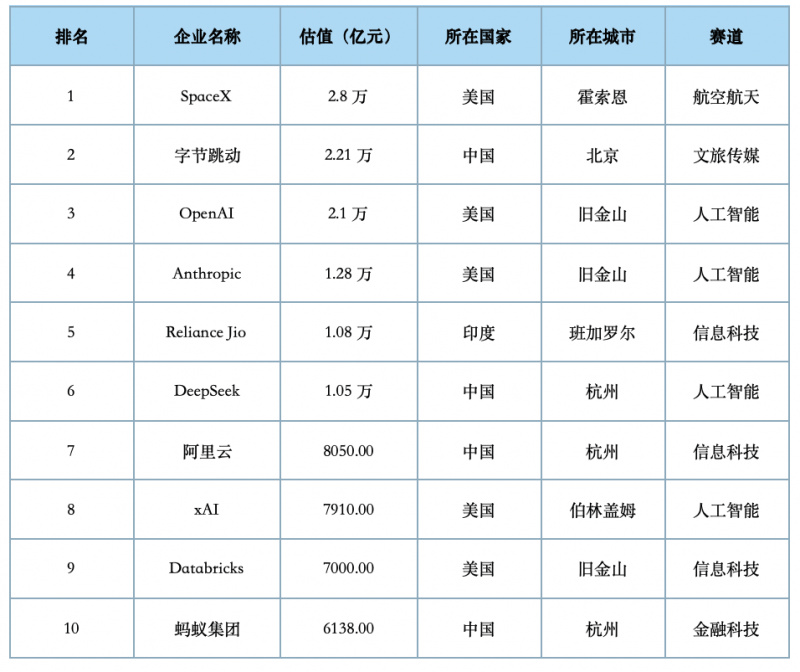
DeepSeek估值破万亿!跻身全球独角兽六强,中国第二
Sou Hu Cai Jing· 2025-12-10 05:12
Core Insights - DeepSeek, a Chinese AI company founded in July 2023, has rapidly ascended to become the sixth largest unicorn globally, with a valuation of 1.05 trillion yuan, second only to ByteDance in China [1][2]. Company Performance - DeepSeek's explosive growth began in early 2025, with its app reaching 180 million monthly active users within a month of launch, and further increasing to 194 million by March [3]. - However, by May 2025, the monthly active users dropped to 169 million, and by September, it was surpassed by ByteDance's Doubao, which had 172 million users [3]. - The company released its DeepSeek-V3.2 model on December 1, 2025, achieving reasoning capabilities comparable to GPT-5 and close to Google's Gemini-3.0-Pro [3]. Competitive Landscape - The AI sector is witnessing intense competition, with major players like ByteDance and Alibaba investing heavily in AI infrastructure, with ByteDance spending 80 billion yuan in 2024 and Alibaba committing 380 billion yuan over three years [3]. - DeepSeek has adopted an open-source strategy, offering competitive API pricing, with input costs for DeepSeek-V3 as low as 0.5 yuan per million tokens, significantly cheaper than GPT-4 Turbo [6]. Technological Developments - The generative AI landscape is evolving with three main technological directions: text generation, image generation, and video generation [4][5]. - Major international players, including Google, are making significant advancements in generative AI, with Google launching multimodal models that enhance image and video quality [6]. Industry Transformation - AI is reshaping various industries, enhancing productivity in programming, transforming artistic creation, and revolutionizing the film industry [7]. - The emergence of new job roles such as AI trainers and prompt engineers reflects the changing job landscape due to AI integration [7]. Infrastructure and Energy - The competition in AI is increasingly tied to computational power and energy resources, with a shift from chip supply issues to energy shortages [8]. - China, possessing the largest power infrastructure and rapidly growing renewable energy capacity, is positioned to leverage its energy advantages for AI development [8]. Conclusion - DeepSeek's rise as a global AI unicorn highlights China's potential in the AI sector, driven by a unique approach to technology and market strategy [9]. - The global generative AI competition encompasses various dimensions, including technological breakthroughs and infrastructure development, with China developing a differentiated competitive edge [9].