
险资增配权益资产

Search documents
兴业证券:险资连续七个季度增配股票
智通财经网· 2026-02-24 12:22
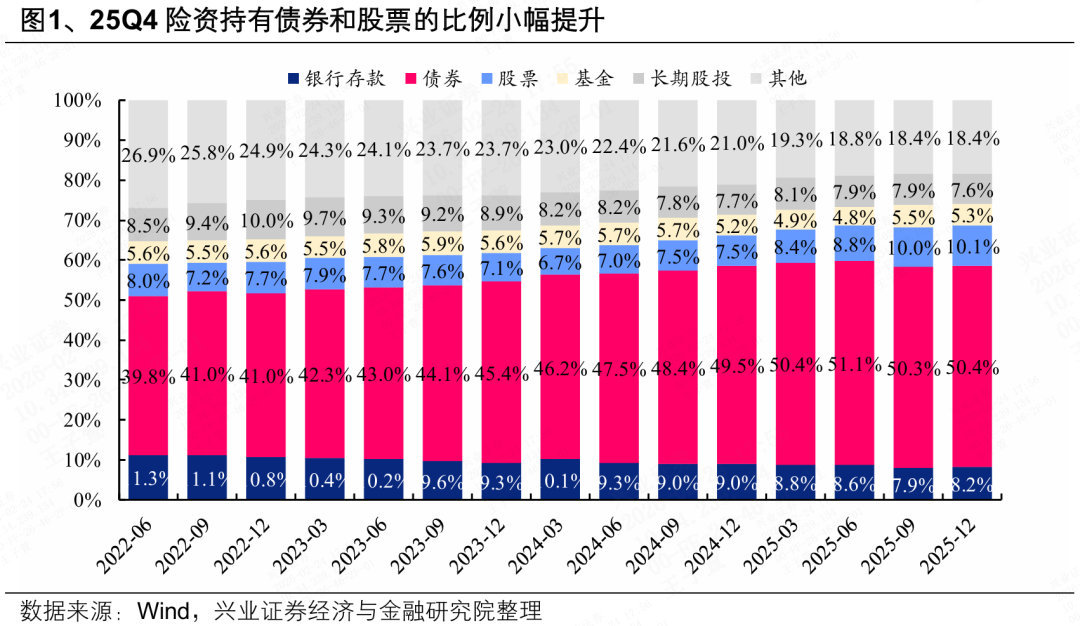
Core Viewpoint - Insurance funds have shown a continuous trend of increasing equity asset allocation, with a slight increase in stock holdings in Q4 2025, although the pace of increase has slowed compared to previous quarters [1][10]. Group 1: Stock Holdings - In Q4 2025, insurance funds have increased their stock holdings for the seventh consecutive quarter, with a slight rise of 0.1 percentage points to 10.1% [1][10]. - The estimated scale of stock accumulation by insurance funds in Q4 2025 reached 70.6 billion yuan, indicating a sustained trend of equity asset allocation [1][10]. - Despite the increase, the allocation ratio and accumulation scale for stocks have slowed down compared to the previous three quarters due to the already high historical levels of equity asset allocation [1][10]. Group 2: Asset Allocation - The proportion of insurance funds holding bonds and stocks has slightly increased in Q4 2025, with changes of +0.3 percentage points for deposits, +0.1 percentage points for bonds, and +0.1 percentage points for stocks [2]. - Conversely, the proportion of funds and long-term equity holdings has decreased, with changes of -0.2 percentage points for funds and -0.3 percentage points for long-term equity [2]. - The proportion of equity assets (stocks + funds) held by insurance funds has slightly decreased from 15.49% in Q3 2025 to 15.38% in Q4 2025, primarily due to a decline in fund holdings [4]. Group 3: Future Outlook - Insurance funds are expected to continue increasing their equity asset allocation trend into 2026, supported by policy backing and liability-driven factors, potentially becoming a major incremental force in the market [14]. - It is predicted that insurance funds will bring approximately 1.2 trillion yuan in incremental funds to the market in 2026, based on an estimated 30% of new premiums [14]. - The first quarter is anticipated to be a significant time window for insurance funds to allocate equity assets, as historically, 41% of new premiums have concentrated in this period [14].


兴证策略张启尧团队:险资连续七个季度增配股票
Xin Lang Cai Jing· 2026-02-24 11:40
Core Insights - The insurance capital's allocation towards bonds and stocks has slightly increased in Q4 2025, while the proportion of funds and long-term equity holdings has decreased [1][14] - The proportion of equity assets (stocks + funds) held by insurance capital has slightly declined due to a reduction in fund holdings, indicating a shift from outsourced investments to direct investments [3][15] Group 1: Asset Allocation Trends - In Q4 2025, the proportion of insurance capital held in deposits, bonds, and stocks increased by 0.3 percentage points, 0.1 percentage points, and 0.1 percentage points respectively, while fund and long-term equity holdings decreased by 0.2 percentage points and 0.3 percentage points [1][14] - The proportion of equity assets held by insurance capital decreased from 15.49% in Q3 2025 to 15.38% in Q4 2025, with stock holdings increasing steadily while fund holdings decreased [3][15] Group 2: Stock Investment Dynamics - Insurance capital has increased its stock holdings for seven consecutive quarters, with a slight increase of 0.1 percentage points to 10.1% in Q4 2025, reflecting a sustained trend towards equity asset allocation, with an estimated increase in scale of 706 billion [6][18] - Despite the continuous increase in stock allocation, the pace of accumulation has slowed compared to the previous three quarters, as the proportion of insurance equity asset allocation is already at a historically high level [6][18] Group 3: Future Projections - Insurance capital is expected to continue increasing its allocation to equity assets in 2026, driven by policy support and liability-side factors, potentially contributing approximately 1.2 trillion in new funds to the market [9][21] - The first quarter is anticipated to be a significant time window for insurance capital to allocate equity assets, as historically, 41% of new premiums have concentrated in this period [9][21]
一周保险速览(9.5—9.12)
Cai Jing Wang· 2025-09-12 17:00
Regulatory Voice - In 2024, the compulsory traffic accident liability insurance (CTALI) generated a premium income of 271.06 billion yuan, covering 372 million vehicles, with a loss of 15.27 billion yuan after accounting for claims costs of 226.28 billion yuan and management costs of 52.32 billion yuan [1] - The Financial Regulatory Authority has revised the "Insurance Company Capital Guarantee Fund Management Measures," which includes five major adjustments to better align with the rapid development of the insurance market [1] Industry Focus - The transformation of dividend insurance has achieved stage results, with the bancassurance channel becoming a new growth engine, significantly increasing its contribution to new business value [2] - Major insurance companies are collectively increasing their focus on dividend insurance, leading to breakthroughs in new premium ratios and new business value contributions [2] Corporate Dynamics - China Pacific Insurance issued H-share convertible bonds, raising 15.556 billion Hong Kong dollars with a subscription rate exceeding 70% from long-term investors, and a conversion premium rate of 25% [4] - Midea Group plans to acquire a stake in Samsung Insurance, with the transfer of 11.50% equity from Yuxing Technology Development to a company controlled by Midea [5] Financial Personnel - Bohai Life Insurance is publicly recruiting two vice presidents, one to oversee insurance business channels and the other to manage strategic planning and capital operations [6] - The qualification of Gui Zhiguo as vice president of CCB Life Insurance has been approved by the Shanghai Regulatory Bureau of the National Financial Supervision Administration [7]
红利资产回暖实锤?红利低波 ETF(512890)近20个交易日吸金23亿
Xin Lang Ji Jin· 2025-07-30 04:06
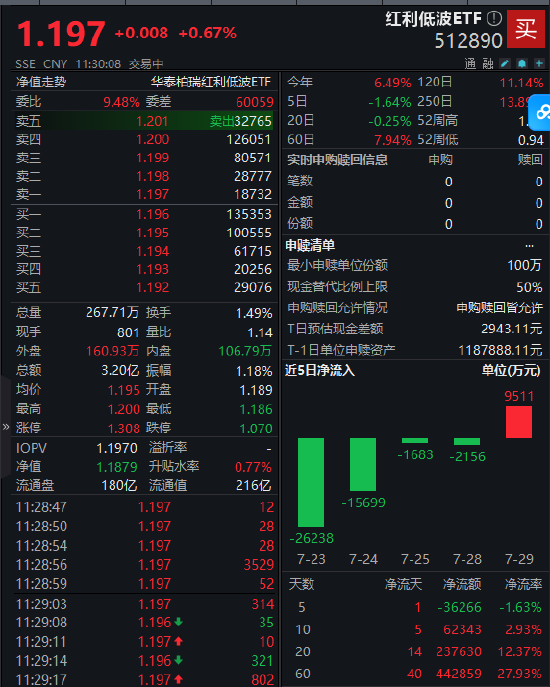
Group 1 - The core viewpoint of the news highlights the positive performance and investor interest in the Dividend Low Volatility ETF (512890), which has shown a net inflow of funds over a longer period despite some short-term fluctuations [1][4]. - As of July 30, 2025, the Dividend Low Volatility ETF (512890) has a circulating scale of 21.388 billion yuan, indicating strong market recognition [1]. - The ETF's top holdings include several banks, with notable increases in stock prices for institutions like Chengdu Bank (up 0.70%) and Jiangsu Bank (up 1.50%), reflecting a focus on high dividend yield and low volatility in stock selection [2][4]. Group 2 - The recent adjustments by the Ministry of Finance regarding long-term assessments of insurance funds are expected to encourage insurance capital to increase equity asset allocations, benefiting the banking sector due to its stable dividends and low volatility [4]. - The banking sector is currently characterized by low valuations and high dividend yields, which are likely to attract medium to long-term incremental capital inflows, enhancing the dividend value of bank stocks [4]. - Investors seeking stable returns and low-risk alternatives to bonds can consider participating in the Dividend Low Volatility ETF (512890) through its linked funds, even without a stock account [4].
沪指周一再创年内新高
Sou Hu Cai Jing· 2025-07-14 10:59
Market Performance - The overall performance of China's A-shares on July 14 was stable, with the three major indices showing mixed results. The Shanghai Composite Index rose slightly, reaching a new high for the year at 3519 points, with an increase of 0.27% [1] - The Shenzhen Component Index closed at 10684 points, down by 0.11%, while the ChiNext Index fell by 0.45% to 2197 points. The total trading volume in the Shanghai and Shenzhen markets was approximately 145.88 billion RMB, a decrease of about 25.34 billion RMB compared to the previous trading day [1] Sector Performance - According to data from Dongfang Caifu, the precious metals and energy metals sectors led all A-share industry sectors with increases of 2.94% and 2.25%, respectively [1] - The banking sector rebounded on July 14 after adjustments made the previous Friday, recording a gain of 0.77% for the day [1] Policy Changes - The Ministry of Finance of China recently announced adjustments to the long-term assessment indicators for state-owned commercial insurance companies, aiming to guide them towards stable long-term operations. The assessment method for the "return on net assets" will now combine annual indicators with 3-year and 5-year indicators, while the "capital preservation and appreciation rate" will also adopt a similar combined approach [1] Investment Insights - Analyst Zhang Yiwei from Galaxy Securities indicated that the adjustments are favorable for increasing the allocation of equity assets by insurance funds. Given the relatively stable performance and dividends of bank stocks, they present good medium to long-term return certainty and stability, aligning with the long-term, value, and stable investment strategies of insurance funds [2] - The current valuation of the A-share banking sector remains at historically low levels, with dividend yields among the highest across all A-share industries, suggesting that the dividend value is likely to continue attracting medium to long-term incremental capital inflows, benefiting the sector [2]

股权变更获批 新华保险跻身杭州银行第四大股东谋银保生态闭环
2 1 Shi Ji Jing Ji Bao Dao· 2025-04-17 10:22
Core Viewpoint - The recent approval of the share transfer from Australia and New Zealand Banking Group to New China Life Insurance Company signifies a strategic move to enhance asset allocation and strengthen the financial service capabilities of New China Life in the banking sector [1][2]. Group 1: Share Transfer Details - Hangzhou Bank announced the transfer of 329,638,400 shares from Australia and New Zealand Banking Group to New China Life at a price of 13.095 yuan per share, totaling approximately 4.317 billion yuan [2]. - Following the transfer, New China Life will hold a total of 356,555,844 shares, representing 5.63% of Hangzhou Bank's total ordinary shares as of April 14, 2025, making it the fourth-largest shareholder [2]. Group 2: Insurance Companies Increasing Bank Holdings - Since the beginning of 2024, multiple insurance companies have increased their stakes in various banks, including Changcheng Life acquiring Wuxi Bank and Xintai Life increasing holdings in Zhejiang Commercial Bank and Beijing Bank [3]. - New China Life and Ping An Life have also raised their stakes in major banks such as China Construction Bank and Postal Savings Bank [3]. Group 3: Reasons for Insurance Companies' Preference for Bank Stocks - The decline in long-term interest rates and the maturity of high-yield assets have pressured insurance companies to reallocate their assets, making bank stocks attractive due to their high dividends and stable returns [4]. - New accounting standards have led insurance companies to favor high-dividend assets and long-term equity investments to reduce profit volatility [4]. Group 4: Policy Support for Insurance Capital Allocation - In 2024, insurance companies have made 28 equity investments in listed companies, with New China Life being active in acquiring stakes in various firms [6]. - New China Life emphasizes its commitment to increasing equity asset allocation, aligning with national policies to support the development of the capital market and the real economy [7][8].

