非对称优势

Search documents
亚洲终于有了“千亿美元”药企
3 6 Ke· 2026-02-26 13:05
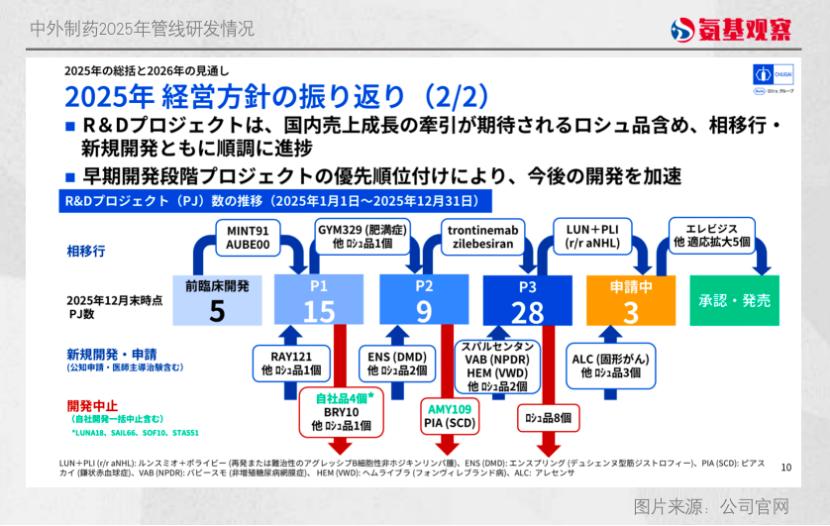
Core Insights - The article highlights the remarkable rise of Chugai Pharmaceutical, which achieved a market capitalization of $108.7 billion, marking it as the first Asian pharmaceutical company to enter the "billion-dollar club" [1][2] - Chugai's transformation from a local agent for Roche to a global innovation engine is underscored, showcasing a significant shift in its business model and financial performance [3][4] Group 1: Market Performance - Chugai's stock price reached a new high of 10,700 yen on February 25, reflecting a 16-fold increase from the 600 yen range between 1990 and 2013 [1] - Despite having a revenue of $8.2 billion in 2025, which is less than a third of Takeda's projected $30 billion, Chugai's market capitalization significantly outstrips Takeda's $58.8 billion and Daiichi Sankyo's $36.2 billion [2] Group 2: Financial Transformation - Chugai's revenue structure has dramatically changed, with a 222% increase in revenue to 1.2579 trillion yen by 2025, and domestic revenue dropping from 88% to 37.5% [3] - The company's net profit surged by 836% to 451 billion yen, demonstrating a successful transition from a regional distributor to a global innovator [3] Group 3: Strategic Alliance with Roche - Chugai's unique alliance with Roche, which began in 2002, allowed for high levels of autonomy while benefiting from Roche's resources, facilitating its transformation [4][5] - This partnership has enabled Chugai to maintain independent decision-making in pipeline development, avoiding the stagnation often seen in large corporate mergers [5] Group 4: Product Development and Innovation - Chugai has developed several key products, including the revolutionary Hemlibra for hemophilia A, projected to generate approximately $6.2 billion in global sales by 2025 [7] - The company maintains a high operating profit margin of 49.8%, surpassing industry averages and demonstrating effective cost management and innovation [7][10] Group 5: Strategic Insights for the Industry - The article suggests that Chugai's model offers valuable lessons for Chinese pharmaceutical companies facing similar challenges of aging populations and healthcare cost controls [12] - Emphasizing the importance of building asymmetric advantages, the article advocates for a focus on differentiated innovation and strategic patience in the pharmaceutical industry [14][15]

脑机接口2025:政策定调、技术破局、资本涌入,医疗刚需率先落地
Tai Mei Ti A P P· 2025-12-31 00:14
Group 1 - The brain-computer interface (BCI) industry in China is entering a historic turning point in 2025, driven by a combination of policy, capital, and technological advancements [2][3][5] - The Chinese government has significantly strengthened its top-level design for the BCI industry, with the first implementation opinions issued by multiple ministries and its inclusion in the national "14th Five-Year Plan" [5][6] - The successful clinical trial of China's first invasive BCI marks a critical milestone, indicating significant progress in the field [6][7] Group 2 - Investment in the BCI sector is surging, with financing amounts increasing nearly fourfold year-on-year in 2025, reflecting a fundamental recovery in capital confidence [2][7][10] - The number of financing events in the BCI field has risen sharply, with 16 events totaling 983 million yuan in 2025, compared to only 6 events totaling 201 million yuan in 2024 [7][10] - The financing structure shows a trend towards earlier rounds of investment, with over 75% of events occurring in the angel to A rounds, indicating a growing willingness to support early-stage projects [10][12] Group 3 - The BCI industry is characterized by a unique "asymmetric advantage" in China, driven by large clinical needs, efficient transformation systems, and comprehensive policy support [2][21][22] - The medical application of BCI is recognized as a priority, with the healthcare sector accounting for 56% of the BCI market, while consumer applications are still developing [25][28] - The market for serious medical applications is projected to reach between 15 billion to 85 billion USD globally, while the consumer medical market could reach between 25 billion to 60 billion USD [25] Group 4 - The BCI industry faces challenges in proving medical value, establishing payment models, and addressing ethical issues, necessitating a pragmatic evolution from "spectacle" to "utility" [3][30][33] - The industry must overcome three interconnected challenges: clinical validation, building trust among medical professionals and patients, and demonstrating economic value to healthcare systems [33][36] - The commercial path for consumer-grade BCI products requires addressing issues of device invisibility, establishing essential demand, and achieving affordable pricing [34][35]

停止无效“拼命”:高手都在悄悄磨练的五种“非对称优势”
3 6 Ke· 2025-11-13 07:11
Core Insights - The article emphasizes the importance of developing "asymmetric advantages" that are often overlooked, which can significantly differentiate individuals in a competitive environment [1][5]. Group 1: Skills for Success - The first key skill is utilizing AI effectively, where successful individuals treat AI as a laboratory for experimentation rather than just a tool, allowing them to maximize its potential [7][9][10]. - The second skill involves negotiation without direct confrontation, focusing on making value apparent to the other party, thus shifting the conversation from price to benefits [13][15][16]. - The third skill is prioritization, where successful individuals excel at determining what not to do, thereby enhancing their productivity and impact [18][20]. Group 2: Influence and Strategy - The fourth skill is accumulating digital influence without necessarily being a creator, where strategic content decisions can significantly enhance brand reputation and market trust [21][23]. - The fifth skill is maintaining composure under pressure, which involves strategic thinking, dynamic adjustment, resource allocation, and stakeholder management, ultimately leading to better decision-making in high-stress situations [24][25].
专门收购和孵化无聊产品,年收入 3 亿美金的 Tiny 给了些启发
投资实习所· 2025-09-01 06:31
Core Insights - Tiny has transformed into a holding company with an annual revenue of $300 million by acquiring and incubating overlooked but profitable products [1][6] - The company adopts a patient, opportunistic approach, acquiring businesses from founders seeking a long-term home while maintaining their independent operations [2][15] Group 1: Investment Philosophy - Tiny focuses on acquiring businesses that are "boring but profitable," avoiding the intense competition of popular Silicon Valley sectors [9][22] - The company seeks businesses with high profit margins, unique advantages, simple business models, stable profitability, a successful operating history, and quality teams [14][27] Group 2: Key Business Units - MetaLab serves as Tiny's cash flow engine, generating $40-50 million in annual revenue with a profit of $20 million, leveraging geographic arbitrage [11] - Dribbble, acquired for under $10 million, now generates tens of millions in annual revenue under Tiny's management, exemplifying the company's investment philosophy [12] - WeCommerce showcases Tiny's ability to create a cohesive ecosystem through the acquisition and integration of multiple Shopify applications [13] Group 3: Acquisition Strategy - Tiny's acquisition method contrasts traditional private equity by being founder-friendly, providing resources and support while preserving company culture [15][19] - Post-acquisition, Tiny enhances efficiency through standardized marketing processes, optimized pricing strategies, and shared best practices among its companies [17][18] Group 4: Entrepreneurial Insights - Entrepreneurs are advised to focus on industries with less competition and to leverage AI tools for market and financial analysis to reduce trial and error costs [22][24] - Common mistakes include entering over-saturated markets, and entrepreneurs should seek to scale their businesses while delegating less enjoyable tasks [25][26] Group 5: Future Outlook - Tiny's strategy highlights the potential of counter-cyclical investment opportunities, focusing on cash flow and long-term holding philosophy [28]