非洲制造

Search documents
狂揽30亿!广东夫妇创业,把国际巨头宝洁都甩身后,去IPO敲钟了
创业家· 2025-11-25 10:40
Core Insights - The article highlights the success story of Leshu Shi, a Chinese company that has become a leading player in the African hygiene products market, achieving significant growth and market penetration in a relatively short period [6][9][10]. Company Overview - Leshu Shi was established in 2009 as a small division of a trading company and has since evolved into a multinational giant, selling nearly 6 billion hygiene products annually across over 30 countries [9][20]. - The company went public on November 10, raising HKD 23.8 billion with a market capitalization of HKD 211.94 billion, and its stock price surged by 33.51% on the first day of trading [7][8]. Market Position - By 2024, Leshu Shi became the top seller of baby diapers and sanitary pads in Africa, surpassing international giants like Procter & Gamble and Kimberly-Clark [10][32]. - The company holds a 20.3% market share in the baby diaper segment and a 15.6% share in the sanitary pad segment, making it the "dual champion" in Africa [29][30]. Product Strategy - Leshu Shi's product strategy focuses on essential needs, targeting both baby and female hygiene products, with baby diapers accounting for over 70% of total revenue in 2024 [22][23]. - The company offers a range of products under various brands to cater to different market segments, including Softcare for the mid-to-high-end market and Cuettie for low-income consumers [25][26]. Financial Performance - In 2024, Leshu Shi reported revenues of USD 454.39 million (approximately RMB 3.2 billion) and a net profit of USD 95.11 million (approximately RMB 670 million) [28][29]. - The company has experienced a revenue growth rate of 28.4% from 2022 to 2023, but the growth rate slowed to 10.5% from 2023 to 2024 [80]. Market Opportunity - The African market presents significant growth potential, with a low penetration rate of baby diapers and sanitary pads at 20% and 30%, respectively, compared to over 70% in developed markets [38][39]. - The African population is young, with 36.5% of global births occurring in the region, indicating a continuous demand for baby products [35][36]. Competitive Advantage - Leshu Shi's competitive edge lies in its localized production strategy, which reduces costs and improves efficiency by manufacturing products within Africa [44][45]. - The company has established a deep distribution network, with over 2,000 wholesalers and 400 distributors across 12 countries, ensuring product availability in rural markets [50][53]. Challenges Ahead - Despite its success, Leshu Shi faces challenges such as slowing revenue growth, reliance on low pricing strategies, and potential fluctuations in raw material costs [82][89]. - The company must enhance its research and development capabilities to avoid falling into a low-price competition trap and to innovate its product offerings [93][96].


科特迪瓦-加纳跨境农业价值链试点项目正式启动
Shang Wu Bu Wang Zhan· 2025-08-26 17:42
Core Viewpoint - The African Union Commission (AUC), the Economic Community of West African States (ECOWAS), and the United Nations Economic Commission for Africa (ECA) have officially launched a pilot project for a cross-border agricultural value chain between Côte d'Ivoire and Ghana, aiming to enhance local processing and agricultural value addition [1] Group 1: Agricultural Production and Processing - Côte d'Ivoire and Ghana produce nearly 60% of the world's cocoa, but only 20% of it is processed locally, with the remainder exported to Europe and the United States [1] - Côte d'Ivoire imports 40% of its rice, while Ghana imports 60%, leading to a combined import cost exceeding $1.5 billion [1] Group 2: Project Objectives and Goals - The project aims to integrate the high-quality land resources of both countries to establish a joint agricultural industrial park [1] - It seeks to combine local processing, modern infrastructure, unified quality standards, and appropriate financing to boost agricultural value addition and create job opportunities [1] - The initiative is part of a broader effort to promote "Made in Africa" and further achieve African integration [1]
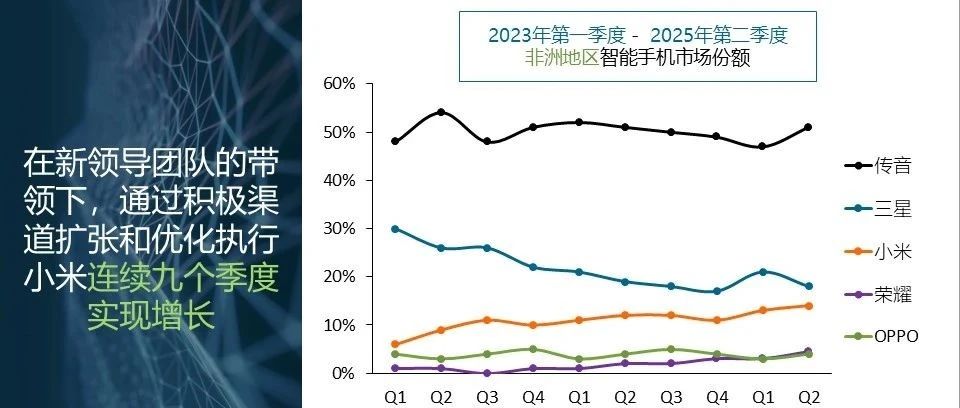
2025年第二季度,非洲智能手机市场增长7%,连续九个季度保持增长,传音稳固“非洲机王”的地位,小米持续增长,荣耀增幅最大
Canalys· 2025-08-22 02:32
Core Insights - The African smartphone market is projected to grow robustly, with a year-on-year increase of 7% in Q2 2025, reaching 19.2 million units, making it one of the best-performing regions globally [1][7] - The growth is driven by improved consumer purchasing power due to easing inflation in key markets like Egypt, Nigeria, and South Africa, with a forecasted compound annual growth rate (CAGR) of 2.1% from 2025 to 2029 [1][6] Market Performance - Egypt leads the North African market with a 21% year-on-year growth, supported by local production capabilities to meet demand during the festive season [4] - Nigeria rebounded by 10% due to stabilized currency and inflation relief, while South Africa saw a modest 2% growth, with a significant 63% increase in 5G smartphone shipments [4] - Smaller markets like Kenya showed resilience with a slight decline of 2%, whereas Algeria and Morocco faced declines of 27% and 7% respectively due to weak demand and stricter import regulations [4] Manufacturer Insights - Demand for ultra-low-cost smartphones under $100 surged by 38%, leading to a decrease in average selling prices [3] - Transsion maintained the top position with a 6% growth, holding a 51% market share, while Samsung grew by 3% to capture 18% of the market through localized distribution and affordable models [3][7] - Xiaomi experienced a significant 32% growth, achieving a 14% market share, while Honor's sales surged by 161%, driven by popular entry and mid-range models [3][7] - OPPO faced an 11% decline but is restructuring and expanding its retail presence in Egypt [3] Future Outlook - The African smartphone market is expected to grow by 3% in 2025, outpacing the overall sluggish global market amid rising component costs [6] - The rural market is becoming a new competitive focus, with limited traditional banking services driving the adoption of mobile payments and fintech [6] - Local production and the rise of digital finance are anticipated to lead Africa into a new phase of sustainable growth, establishing it as a critical testing ground for global brands [6]