
项目制学习

Search documents
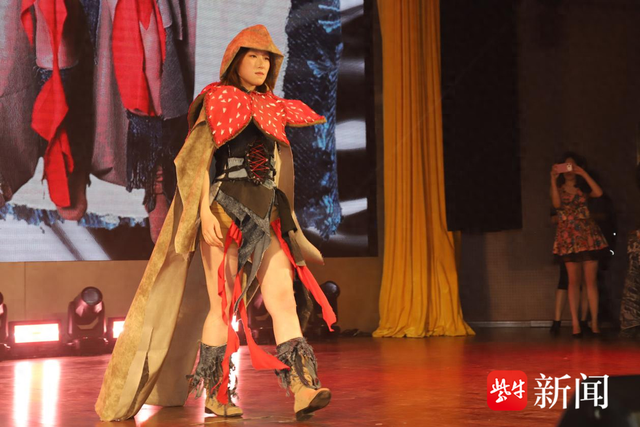
太潮了!仙外国际部上演牛仔时装秀
Xin Lang Cai Jing· 2025-12-28 13:12
Core Viewpoint - The event "The Jeaneration" at Nanjing Xianlin Foreign Language School's International High School showcases the school's innovative educational philosophy through a student-designed fashion show that emphasizes sustainability and interdisciplinary learning [1][3][5]. Group 1: Event Overview - "The Jeaneration" combines "Jean" (denim) and "Generation," symbolizing students' effort to "redefine classics" [3]. - Nearly 60 participants, including 21 student models and 6 teachers, showcased garments designed by 33 students [3]. - The designs drew inspiration from architectural aesthetics and natural elements, highlighting the school's project-based learning outcomes [3]. Group 2: Sustainability and Education Philosophy - Several pieces were created using discarded materials and old clothing, reflecting the school's commitment to sustainable development education [5]. - Teacher Duan Ran noted that hands-on transformation of waste into art enhances students' understanding of sustainability beyond classroom teachings [5]. - The school promotes a holistic education philosophy where art education contributes to value formation and worldview development [5]. Group 3: Interdisciplinary Learning - The fashion show emphasized student involvement in the entire process from concept design to final production, integrating knowledge from multiple disciplines [6]. - A participating student mentioned the need for geometric calculations and mechanical principles while deconstructing a denim jacket, showcasing the integration of STEM and arts [6]. Group 4: Community and Resource Integration - The event was guided by the resident MAD Art and Design Studio, reflecting a strategy of resource integration between internal and external support [8]. - Liu Mingyuan, the studio founder and alumnus, emphasized the creation of a comprehensive support system linking school courses with professional practice [8]. - The event included students from various projects and classes, breaking the notion that only art students can participate in artistic activities [8]. Group 5: Impact on Future Opportunities - The school’s diverse art education has opened various pathways for students, with an increasing proportion choosing art-related fields and gaining admission to top institutions like the London College of Fashion and Parsons School of Design [10]. - The guidance emphasized that art education is equally important as academic education for personalized development [10]. - Many participants, even those pursuing non-art majors, acknowledged that the skills gained from this experience are crucial for advancement in any field [10].

AI时代人才价值重估:“做题家”失宠,教育与产业如何突围?
2 1 Shi Ji Jing Ji Bao Dao· 2025-12-12 03:29
Core Insights - Artificial intelligence (AI) is fundamentally reshaping talent logic across various industries, challenging existing standards, educational models, and operational methods [1] - The emergence of generative AI is significantly lowering the barriers to knowledge acquisition, prompting a reevaluation of talent development and educational approaches [1] Group 1: AI's Impact on Talent and Education - AI enables easy access to knowledge, shifting the focus from "cost" to "value" in talent acquisition, where the challenge lies in converting low-cost knowledge into high-value outputs [2] - The future core competency will be the ability to define problems rather than execute steps, as AI tools will handle the latter [2] - A "T-shaped" skill set, combining deep expertise with broad business acumen, will be essential for navigating the AI-driven landscape [2] Group 2: Educational Reform and Industry Needs - Traditional education models are outdated, often producing graduates with skills that lag behind current industry demands, leading to a mismatch between talent supply and industry needs [3] - Problem-based and project-based learning approaches are advocated to replace rote learning, allowing students to engage in real-world problem-solving [3][4] - Successful educational models, like MIT's mechanical engineering course, emphasize practical outcomes over theoretical presentations, fostering innovation and real-world applicability [4] Group 3: Addressing Industry Challenges - The concept of "involution" in China's new energy and emerging technology sectors highlights the need for innovative thinking beyond traditional competitive frameworks [5] - AI can facilitate the creation of virtual environments for learning and experimentation, breaking down barriers in traditional education and industry [5] - The educational system should adapt to the "inverted pyramid" structure of talent needs, focusing on large-scale engineering teams for implementation after initial innovations [6] Group 4: Investment Perspectives in the AI Era - The importance of "adversity quotient" (AQ) is emphasized, as individuals who can quickly recover from failures will thrive in the fast-evolving AI landscape [7] - Social interaction and collaboration remain irreplaceable by machines, indicating that future educational and workplace environments must foster these elements [7] - Young professionals are encouraged to develop core competencies and complementary skills to enhance their competitive edge in the job market [7]
从高端住宅到教育标杆 缦云ONE迎来九年一贯制公立名校
Cai Jing Wang· 2025-06-09 03:50
Core Insights - The establishment of Tonghui School represents a significant milestone in the educational development of Beijing's sub-center, aiming to enhance the quality of education in the region [1][6] - The collaboration between the Cang brand of the company and the Beijing New Ecology Education Foundation is designed to create a public school model that integrates government management with social resources [2][4] Group 1: School Development and Educational Innovation - Tonghui School is positioned as a nine-year integrated public school, marking the first strategic cooperation with the Beijing New Ecology Education Foundation [1][2] - The school aims to become a model of educational innovation in alignment with the sub-center's development goals, leveraging successful examples from developed countries [2][3] - The school will utilize a "project-based learning" approach to enhance students' practical problem-solving abilities, integrating real-world challenges into the curriculum [4][5] Group 2: Collaborative Educational Framework - The school will be supported by a "Famous Principal Studio," consisting of renowned education experts who will guide the school's strategic planning, teacher training, and curriculum development [2][3] - The integration of various educational resources, including scientific education and family-school-community collaboration, will be emphasized to create a holistic educational experience [4][5] - The establishment of a "Cloud School" will allow students to engage in project-based courses, facilitating a seamless online and offline learning experience [5] Group 3: Community and Resource Integration - The Cang brand's commitment to creating a "good school at the doorstep" reflects its strategy to enhance community living through quality educational resources [1][6] - The project aims to break down traditional educational barriers by opening school facilities to the community, fostering a collaborative environment [5][6] - The partnership is expected to provide measurable lifestyle benefits to residents, reinforcing the company's long-term strategy of resource integration beyond housing [6]