预付卡

Search documents
个人房屋买卖是否缴纳印花税?财产和行为税问题汇总~
蓝色柳林财税室· 2025-12-15 01:24
Group 1 - The article discusses the tax implications related to real estate transactions, specifically focusing on land value-added tax and related deductions [4][6]. - It clarifies that when calculating land value-added tax, the stamp duty paid at the time of transfer is allowed to be deducted [4]. - The article outlines that the tax basis for urban maintenance and construction tax should be determined based on the end-of-period retained tax credits for value-added tax [4]. Group 2 - The article specifies that the tax obligation for purchasing pre-sale housing arises on the day the buyer signs the property transfer contract [4]. - It states that taxpayers must declare and pay the deed tax before handling the property registration procedures [4]. - It also mentions that green land within enterprise factory areas is subject to urban land use tax according to specific regulations [4].

增值税法系列宣传丨增值税税率、征收率
蓝色柳林财税室· 2025-12-12 08:25
Core Viewpoint - The article outlines the tax rates and collection rates under the Value-Added Tax (VAT) Law of the People's Republic of China, detailing the applicable rates for different categories of goods and services [3][4][7]. Tax Rates - The tax rate for the sale of goods, processing, repair services, tangible asset leasing services, and importation of goods is set at 13% [3]. - A reduced tax rate of 9% applies to the sale of transportation, postal, telecommunications, construction services, real estate leasing, sale of real estate, transfer of land use rights, and specific goods such as agricultural products, utilities, and publications [3]. - The tax rate for the sale of services and intangible assets, excluding certain specified items, is 6% [4]. - Exports of goods are taxed at a rate of 0%, unless otherwise specified by the State Council [5]. - For cross-border sales of services and intangible assets by domestic entities and individuals, the tax rate is also 0% [6]. Collection Rate - The collection rate for VAT calculated using the simplified tax method is set at 3% [7].
又一支付牌照遭注销!
券商中国· 2025-06-09 08:41
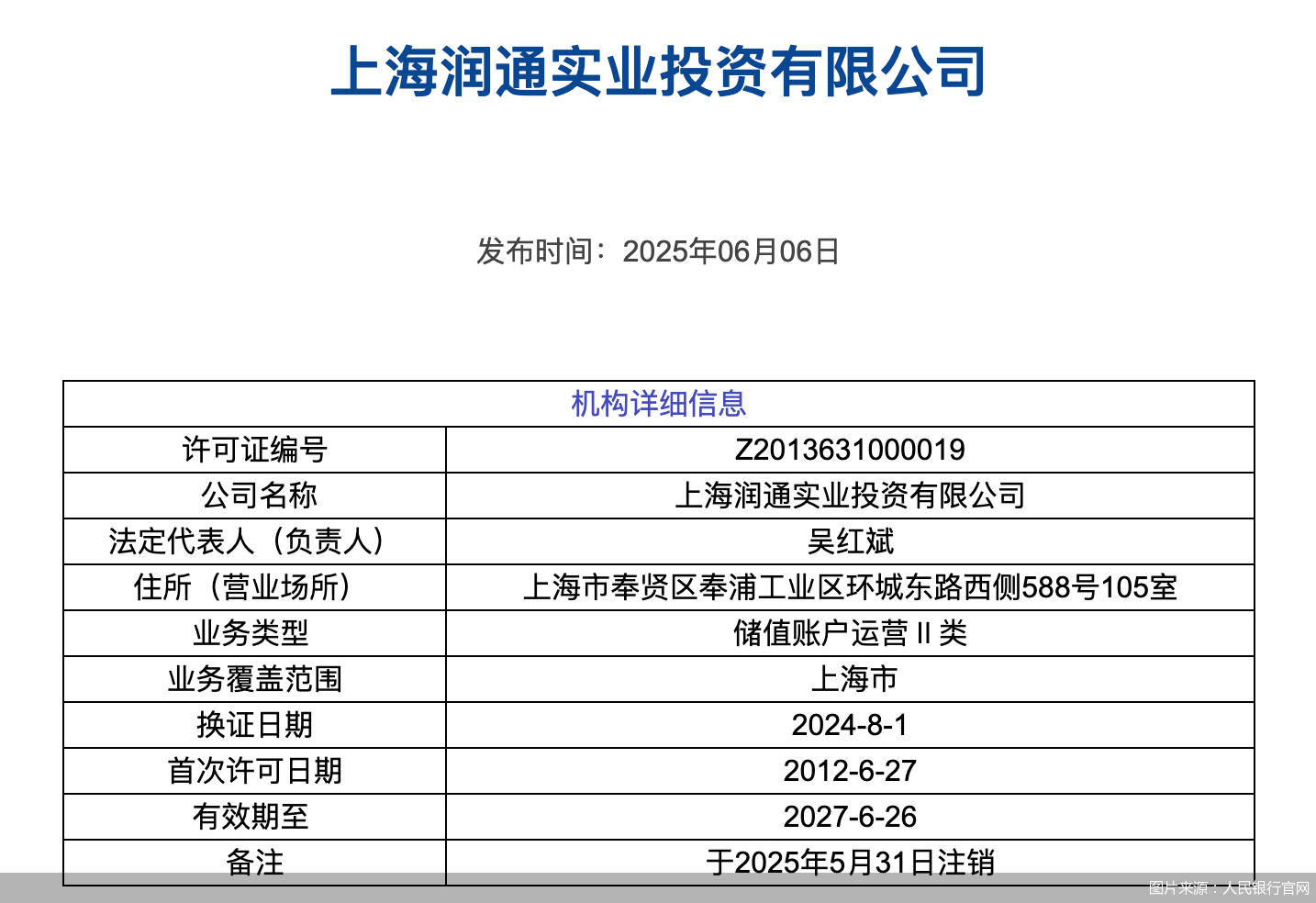
Core Viewpoint - The recent cancellation of the payment license for Shanghai Runtong Industrial Investment Co., Ltd. reflects ongoing challenges in the prepaid card sector, with a total of 102 payment institutions having their licenses revoked, indicating a significant industry reshuffle [1][3]. Group 1: Company Overview - Runtong Industrial was established in 2006 with a registered capital of 100 million RMB and was one of the early recipients of a payment license in June 2012 [2]. - The company previously operated two main products, "Yingdian Life Card" and "Yingdian Life Network," but has since shifted its focus to "Yingdian Film," providing various short films for viewing [2]. - Runtong Industrial was indirectly controlled by Shanghai Dashing Agricultural Financial Technology Co., Ltd., which was listed on the Hong Kong Stock Exchange but delisted in 2024 [2]. Group 2: Industry Challenges - The prepaid card sector is facing significant difficulties, as evidenced by the cancellation of licenses for other similar institutions, such as Shandong Feiyin Payment Technology Co., Ltd. and Huiming Business Service Co., Ltd. [3][4]. - The "Yingdian Life Card" was once popular for providing commercial point consumption and e-commerce services, but the rise of mobile payments has severely limited its market share and usage scenarios [4]. - Regulatory changes, including stricter capital requirements and tax policy adjustments, are further straining the performance of prepaid card institutions, leading to an expected continued reduction in the number of licensed entities [5]. Group 3: Future Outlook - Industry analysts predict that the overall growth rate of the payment industry is slowing, with both stored-value account transactions and transaction processing facing stagnation [5]. - Only a few institutions that successfully undergo digital transformation or maintain stable large enterprise clients are expected to survive in the future [5]. - There is a pressing need for payment institutions to prioritize compliance and risk control, while also exploring cross-industry collaborations to seek new opportunities [5].

润通实业支付牌照被注销,预付卡仍是“摘牌”重点类型
Bei Jing Shang Bao· 2025-06-08 11:56
Core Viewpoint - The payment license of Shanghai Runtong Industrial Investment Co., Ltd. has been revoked, marking a significant reduction in the number of third-party payment licenses in China [1][4]. Company Summary - Runtong Industrial was established in September 2006 and obtained a payment license in 2012, allowing it to issue and accept prepaid cards in Shanghai [1]. - The company’s prepaid card brand, "Yingdian Life Card," was primarily used for commercial point consumption and e-commerce services, and was a popular choice for enterprises and individuals in Shanghai [3]. - Complaints from consumers regarding the "Yingdian Life Card" have emerged since early 2022, with issues related to account freezing and significant balance reductions due to undisclosed management fees [3]. Industry Summary - Runtong Industrial is the sixth payment institution to have its license revoked in 2023, contributing to a total of 102 institutions exiting the market, leaving only 169 payment licenses remaining [4]. - The prepaid card issuance and acceptance category is particularly affected, with many institutions voluntarily withdrawing from the market [4]. - The implementation of the "Non-bank Payment Institution Supervision and Management Regulations" has raised the minimum registered capital requirement to 100 million yuan, leading to expectations of further declines in the number of prepaid card licenses [4]. - Analysts suggest that traditional prepaid card businesses are facing saturation and profit pressure, necessitating a shift towards digital transformation and enhanced online product offerings to survive [5].