风险测评

Search documents
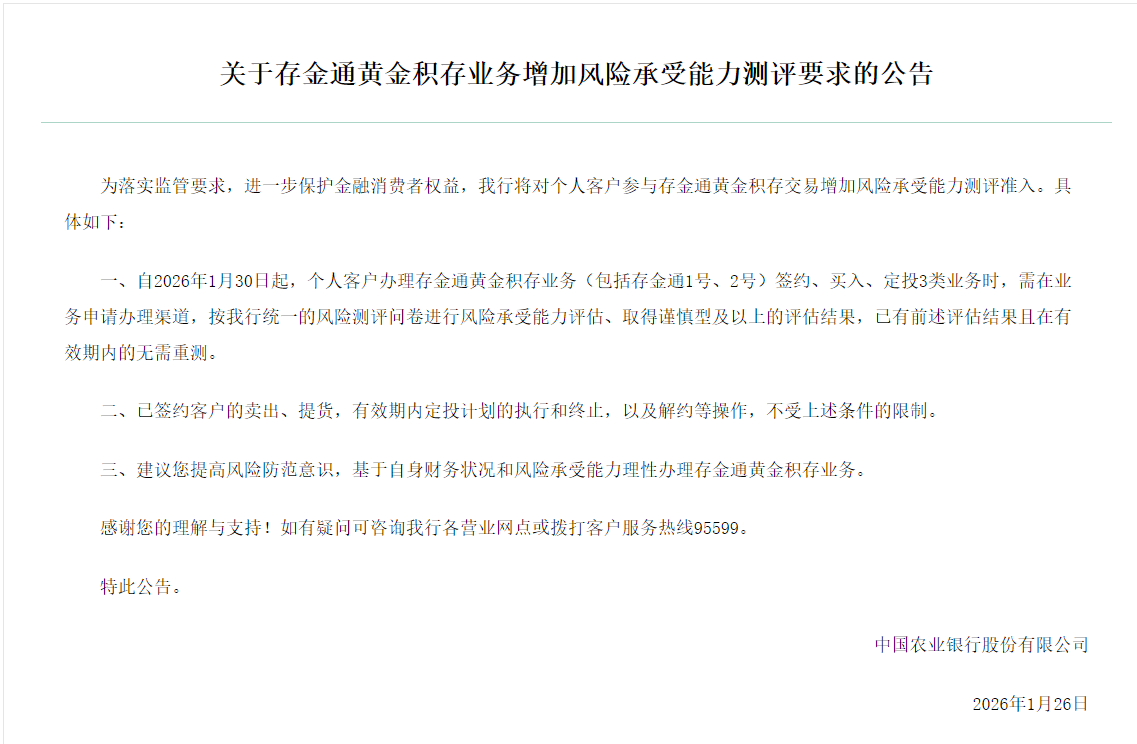
农业银行存金通业务增设风险测评门槛 2026年1月30日起正式实施
Jin Rong Jie· 2026-01-26 09:05
Core Viewpoint - The Agricultural Bank of China announced new risk assessment requirements for individual customers participating in the Gold Accumulation Program, effective January 30, 2026 [1] Group 1: New Requirements - Individual customers must complete a unified risk assessment questionnaire when applying for the Gold Accumulation Program, which includes signing, purchasing, and regular investment activities [1] - Customers must achieve at least a "cautious" risk tolerance level in their assessment results to qualify for participation [1] - Existing customers with valid risk assessment results do not need to retake the assessment [1] Group 2: Impact on Existing Customers - Customers who have already signed up for the Gold Accumulation Program are not restricted by the new risk assessment requirements when selling, withdrawing, or executing their investment plans [1] - The bank emphasizes the importance of risk awareness and encourages customers to consider their financial situation and risk tolerance when engaging in the Gold Accumulation Program [1]


您的2026基金导航图已上线:全景解锁投资好行为
Xin Lang Cai Jing· 2026-01-07 10:54
Group 1 - The article emphasizes the importance of having a clear investment direction as the new year 2026 begins, likening investment to a journey that requires regular reassessment and planning [1][96]. - A "Fund Investment Behavior Map" has been prepared, outlining 18 key scenarios that investors may encounter during three stages: pre-investment, during investment, and holding period [1][96]. - The map aims to help investors understand their financial health, avoid common pitfalls, and maintain composure during market fluctuations, ultimately enhancing their investment experience [1][96]. Group 2 - Investors are encouraged to ensure that funds allocated for investment are idle funds that are not needed in the short term [8][105]. - Establishing a financial health "traffic light" system is recommended, such as limiting investments in equity funds to no more than 30% of household cash reserves [8][107]. - The article warns against common negative behaviors, such as using credit card limits or short-term loans for investment, and emphasizes the importance of matching the type of investment product with the intended use of funds [8][107]. Group 3 - Regular risk assessments should be conducted to ensure that investment strategies align with current financial situations [14][113]. - Setting realistic investment return expectations is crucial to avoid overly optimistic or pessimistic outlooks [16][112]. - The article highlights the need for periodic reviews and adjustments of investment goals to adapt to significant life events or changes in financial circumstances [22][120]. Group 4 - Investors are advised to diversify their asset allocation across different categories, such as stocks, bonds, and cash, to mitigate risks [29][125]. - Understanding the historical performance and key characteristics of various funds is essential for making informed investment decisions [30][126]. - The importance of considering management fees and other costs to optimize investment returns is emphasized [33][130]. Group 5 - The article discusses the significance of maintaining investment discipline through regular contributions and avoiding impulsive decisions based on market fluctuations [37][136]. - It suggests that investors should periodically review their portfolios to ensure they remain aligned with their financial goals and risk tolerance [44][140]. - The need for continuous learning about investment strategies and market dynamics is highlighted to enhance decision-making capabilities [86][87].

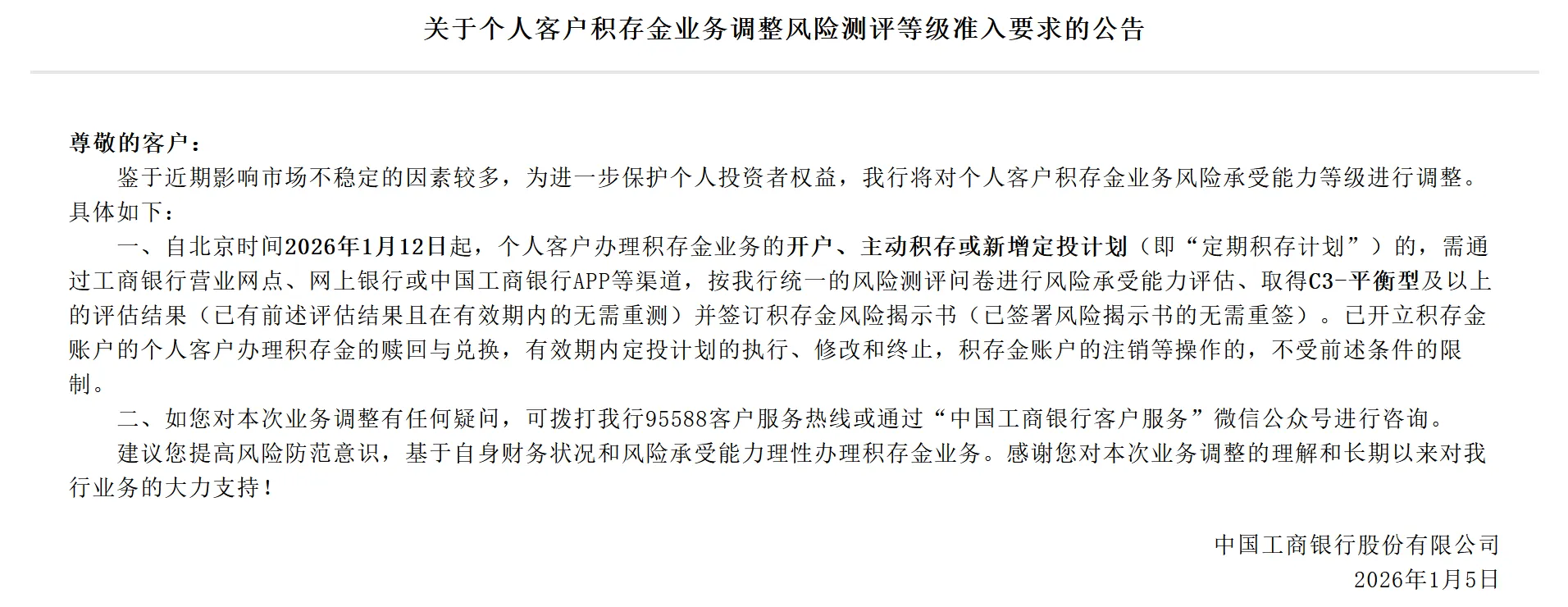
工商银行:1月12日起,调整个人客户积存金业务风险测评等级准入要求
Cai Jing Wang· 2026-01-06 09:58
Core Viewpoint - Industrial and Commercial Bank of China (ICBC) is adjusting the risk assessment requirements for personal clients' accumulation gold business to enhance the protection of individual investors' rights amid recent market instability [1]. Group 1: Policy Changes - Starting from January 12, 2026, personal clients wishing to engage in accumulation gold business must undergo a risk assessment through ICBC's designated channels and achieve a C3-balanced or higher rating [1]. - Clients who already possess a valid risk assessment result do not need to retake the assessment [1]. - Clients must sign a risk disclosure statement for the accumulation gold business, although those who have already signed do not need to re-sign [1]. Group 2: Existing Clients - Existing clients with accumulation gold accounts can perform redemption, exchange, and manage their investment plans without being subject to the new assessment requirements [1]. - The bank encourages clients to enhance their risk awareness and make rational decisions based on their financial status and risk tolerance [1].

聊聊投资前的“风险评测”
天天基金网· 2025-07-31 12:07
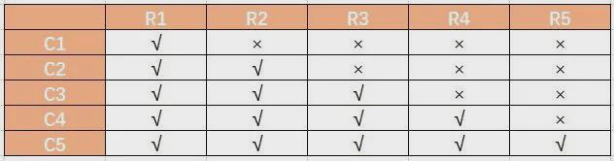
Core Viewpoint - The article emphasizes the importance of risk assessment in investment, highlighting that understanding one's risk tolerance is crucial for selecting suitable fund products and making informed investment decisions [3][4][10]. Risk Assessment - Risk assessment is a process to determine an investor's risk tolerance, which helps in identifying appropriate fund investments [4][5]. - Fund products are categorized into five risk levels (R1 to R5), with R1 being low risk and R5 being high risk, while investors are classified into five categories (C1 to C5) based on their risk tolerance [5][6]. - The classification allows investors with lower risk tolerance (C1) to invest in low-risk products (R1), while those with higher risk tolerance (C5) can invest in a broader range of products, including high-risk options [5][7]. Changes in Risk Tolerance - An investor's risk tolerance is generally stable over short periods but can change over longer durations due to factors like age, family assets, and financial knowledge [8]. - For instance, a novice investor may start with a low-risk tolerance (C1) but may evolve to a higher risk tolerance (C2 or C3) as they gain experience and knowledge [8]. Investment Planning - Investors should avoid following market trends and instead focus on investments that align with their risk tolerance [10][11]. - A diversified investment portfolio should be constructed based on risk tolerance, with lower-risk investors (C1, C2) primarily investing in fixed-income funds while allowing for some exposure to mixed funds [11]. - It is crucial for investors to anchor their investment strategies to their risk tolerance rather than market fluctuations to avoid emotional decision-making during market volatility [11]. Long-term Investment - The article advocates for a long-term investment approach, emphasizing that investors should commit to holding suitable funds over time to achieve satisfactory returns [11].

从那时起:聊聊投资前的“风险评测”
Sou Hu Cai Jing· 2025-07-31 02:52
Group 1 - The core viewpoint of the articles emphasizes the importance of risk assessment for investors to determine their suitable fund products based on their risk tolerance levels [1][2][6] - Risk assessment helps categorize fund products into five risk levels (R1 to R5), allowing investors to understand which products align with their risk profiles [2][3] - Investors are classified into five categories (C1 to C5) based on their risk tolerance, with C1 being the lowest and C5 the highest, influencing the types of funds they can invest in [3][5] Group 2 - The articles discuss that an investor's risk tolerance can remain stable over short periods but may change over longer periods due to factors like age, family assets, and investment knowledge [6][7] - It is suggested that investors should not follow market trends blindly but should adhere to their risk tolerance when making investment decisions [8][9] - The importance of long-term investment strategies is highlighted, encouraging investors to maintain their risk assessment as a guiding principle rather than reacting to market fluctuations [9]