马约拉纳粒子

Search documents
捕捉“幽灵粒子”的中国突破(院士讲科普)
Ren Min Ri Bao· 2025-11-28 22:00
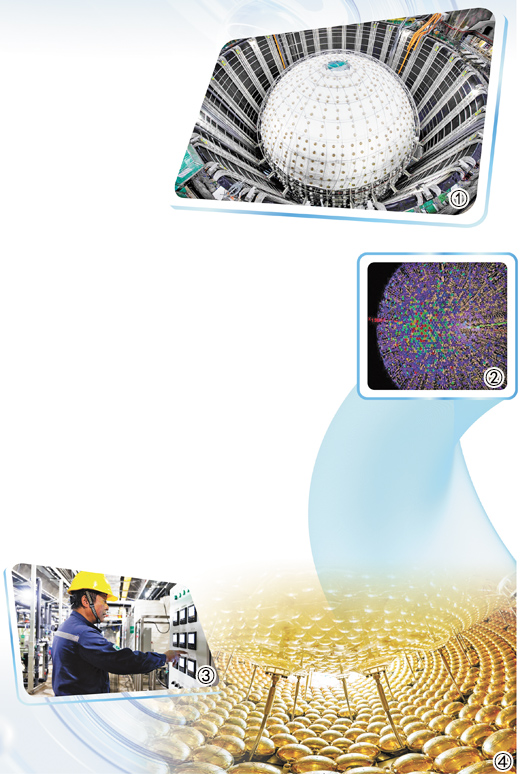
Core Insights - The Jiangmen Underground Neutrino Observatory (JUNO) has successfully completed its construction and released its first scientific results, marking a significant advancement in neutrino research [3][4][6] - The experiment aims to explore the properties of neutrinos, particularly their mass hierarchy, which is crucial for understanding the universe's evolution and the mystery of matter-antimatter asymmetry [4][5][8] Summary by Sections Experiment Overview - JUNO is a next-generation neutrino experiment designed to study "ghost particles" known as neutrinos, which are fundamental to understanding cosmic evolution [3][4] - The facility is located 700 meters underground in Jiangmen, Guangdong, and features a large detector with a diameter of 35.4 meters, containing 20,000 tons of liquid scintillator, making it 20 times larger than similar international facilities [8][9] Scientific Achievements - The first physical results from JUNO, reported after analyzing 59 days of effective data, have improved the measurement precision of the solar neutrino oscillation parameters by 1.5 to 1.8 times compared to previous experiments [3][6] - The experiment confirmed the "solar neutrino anomaly," suggesting the existence of new physics beyond current understanding [3][4] Historical Context - The success of JUNO builds on the foundation laid by the Daya Bay Neutrino Experiment, which was pivotal in measuring the mixing parameter θ13 and achieving the highest precision in neutrino measurements before JUNO [6][7] - The Daya Bay experiment, initiated in 2006, led to significant breakthroughs in neutrino oscillation studies, paving the way for the current JUNO project [6][7] Future Prospects - JUNO's design life is projected to be 30 years, with expectations to expand its research scope beyond mass hierarchy to include solar and terrestrial neutrinos, and potentially detect neutrinos from supernovae [9] - The project involves over 700 researchers from 17 countries and aims to produce significant scientific breakthroughs and train the next generation of physicists [9]

一颗芯片,花费巨头数十年
半导体芯闻· 2025-03-17 10:42
Core Viewpoint - Microsoft is making significant strides in quantum computing, with recent developments suggesting a potential breakthrough in the creation of practical quantum computers, which could revolutionize fields like cryptography and medicine [2][3]. Group 1: Quantum Computing Development - Microsoft has been working on quantum computing for nearly 20 years, led by Chetan Nayak and a team of hundreds, using a riskier approach compared to competitors like Google [2][3]. - The company announced a breakthrough in developing a chip capable of producing Majorana particles, which could accelerate the timeline for practical quantum devices from decades to just a few years [3]. - Microsoft invests approximately $300 million annually in quantum research, which, while modest compared to AI investments, reflects a long-term commitment to the field [3]. Group 2: Challenges and Criticism - Despite progress, there are concerns regarding the reliability of quantum bits (qubits), as even minor disturbances can lead to significant errors [5]. - Critics in the quantum physics community have raised doubts about Microsoft's claims regarding the observation of Majorana particles, suggesting that the data may not support their assertions [7]. - Microsoft is working to enhance the reliability of qubits using topological superconductors, which could help mitigate error rates [5][7]. Group 3: Future Outlook - Executives from Microsoft and other tech companies predict that practical quantum computers driven by qubits could be commercialized within the next few years to a decade [5]. - The ongoing research and development efforts are crucial for establishing a stable quantum computing platform, with the potential to reshape various industries [5][7].