2纳米制程技术

Search documents
美国又新增一个晶圆厂?
半导体芯闻· 2026-03-18 10:15
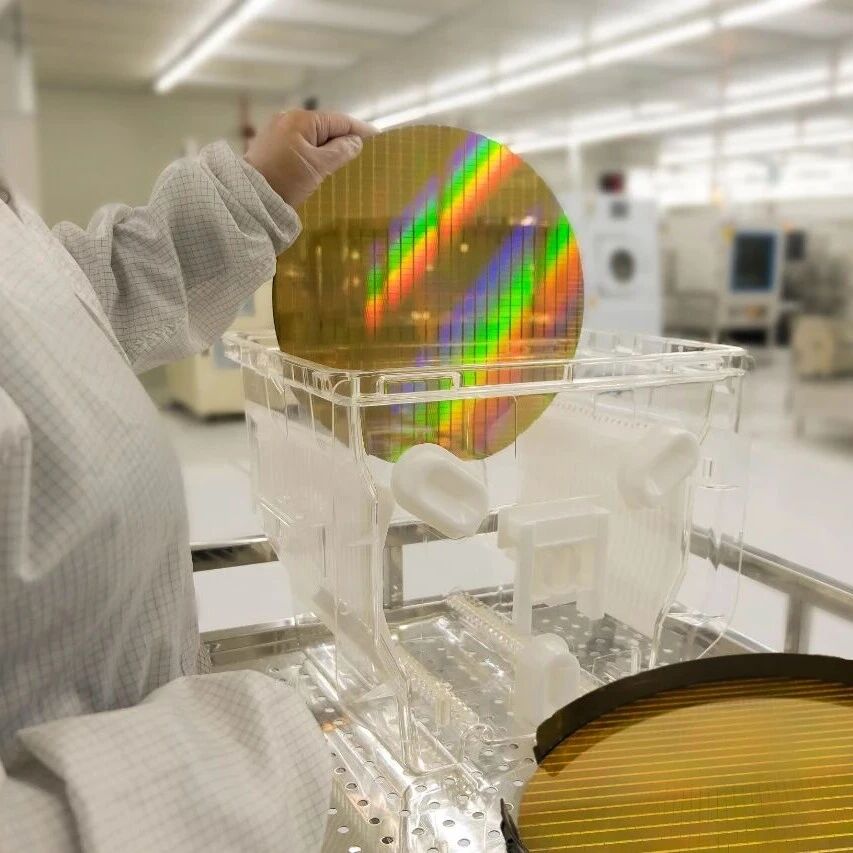
Core Viewpoint - The article discusses Samsung's plans to build a second semiconductor fab (Fab 2) in Taylor, Texas, in response to the tight capacity of competitor TSMC, highlighting the growing demand for foundry services from major tech companies [2][3]. Group 1: Fab 2 Construction and Regulatory Approval - Samsung is preparing to construct Fab 2 in its semiconductor park in Taylor, Texas, with the project now entering the regulatory review phase [2]. - The Taylor City Council has unanimously approved an amendment to extend the contract with HDR Engineering, which will assist Samsung in obtaining necessary building permits and ensuring compliance with safety and construction standards [2]. Group 2: Scale and Future Expansion - Fab 2 is expected to cover approximately 2.7 million square feet, matching the size of the currently under-construction Fab 1 [3]. - Samsung has acquired a total of 1,268 acres in Taylor, allowing for the potential development of up to 10 advanced fabs, indicating significant future expansion capabilities [3]. Group 3: Investment and Financial Support - Samsung's initial investment in the Taylor facility was announced at $17 billion, later increased to $37 billion, which includes $4.75 billion in federal subsidies under the CHIPS and Science Act [3]. Group 4: Technological Focus and Client Acquisition - The Taylor facility will focus on high-performance computing (HPC) and automotive electronics, utilizing Samsung's advanced 2-nanometer process technology [4]. - Samsung has secured orders from 121 clients, with potential large orders expected from major tech companies like Google, AMD, and ByteDance [4]. Group 5: Production Timeline and Partnerships - Fab 1 is set to begin mass production in 2027, as part of a significant partnership with Tesla, involving a $16.5 billion contract for the production of Tesla's latest AI chips [4]. - Elon Musk has indicated that the expected mass production timeline for the AI5 chip is around mid-2027 [4]. Group 6: Market Position and Growth - Samsung's foundry business revenue rose by 6.7% in Q4 2025, reaching $3.4 billion, increasing its global market share from 6.8% to 7.1%, solidifying its position as the second-largest foundry after TSMC [6].

又一颗2nm芯片,发布
半导体芯闻· 2025-12-03 10:28
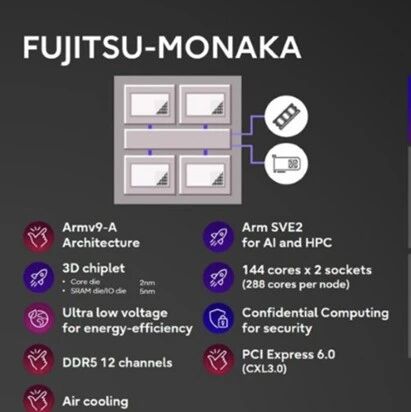
Group 1 - Fujitsu introduced the future development of the MONAKA series processors, which will include more core Arm server processors and built-in AI core functionality [1][3] - The MONAKA processor features Armv9-A architecture cores, supports SVE2 instruction set, and has a small chip design utilizing CoWoS system-level packaging and the industry's first 3.5D F2F packaging technology, totaling 144 enhanced Armv9 cores [1][3] - The MONAKA processor is built on a 2nm process technology and employs hybrid copper bonding (HCB) in a Face 2 Face (F2F) stacking method with 5nm SRAM modules, integrating compute, SRAM, and I/O modules [3] Group 2 - Future plans include the MONAKA-X processor, which will have pure CPU and CPU+NPU versions, with the pure CPU version expected by the end of 2029 using 3D multi-chip module layout and 1.4nm process technology [5] - The MONAKA-X CPU+NPU version is planned for the second half of 2030, featuring an NPU module for medium-sized LLMs, with a further MONAKA-XX processor expected by 2031 [5] - A collaboration between RIKEN, Fujitsu, and NVIDIA aims to develop the FugakuNEXT supercomputer, which will utilize the MONAKA-X and aims to enhance performance by 100 times while maintaining the same power consumption of 40MW, scheduled for operation in 2030 [8]
全球首颗2nm GPU,要来了
半导体行业观察· 2025-10-10 00:52
Core Viewpoint - AMD is set to launch its next-generation Instinct MI450 graphics accelerator using 2nm process technology, aiming to compete directly with NVIDIA's Rubin chip series [1][3][6] Group 1: Product Specifications - The Instinct MI450 will utilize TSMC's 2nm technology for its accelerator core chip (XCD), while the active interposer chip (AID) and media interface chip (MID) will be manufactured using TSMC's 3nm process [1][5] - MI450 is expected to deliver similar FP4/FP8 performance to NVIDIA's Rubin, but with 1.5 times the memory and bandwidth [3][5] - The MI400 series will integrate up to 432 GB of HBM4 memory, significantly enhancing bandwidth capabilities [7] Group 2: Market Positioning - AMD's data center operations head, Forrest Norrod, claims that MI450 will be the best solution for training, inference, distributed inference, and reinforcement learning, indicating confidence in competing with NVIDIA [6] - The MI450 is anticipated to be AMD's "Milan moment," referencing the significant leap made by AMD's EPYC server CPU series [6] - AMD plans to expand its rack options with the upcoming Helios system, which is expected to match the top configurations of NVIDIA's Rubin series [7] Group 3: Launch Timeline - The MI450 is projected to be released in 2026, coinciding with NVIDIA's launch of its next-generation Rubin series [7]



联发科:2nm芯片将上市!
国芯网· 2025-09-17 14:27
Core Viewpoint - The article highlights the advancements in semiconductor technology, particularly focusing on MediaTek's successful design of a flagship SoC using TSMC's 2nm process technology, which is expected to enter mass production by the end of next year [2][4]. Group 1: MediaTek's 2nm Process Technology - MediaTek has successfully completed the tape-out of its first flagship SoC utilizing TSMC's 2nm process technology, making it one of the first companies to adopt this advanced technology [2]. - The 2nm process technology features a new nanosheet transistor structure that enhances performance, power efficiency, and yield [4]. - Compared to the existing N3E process, TSMC's enhanced 2nm technology offers a 1.2x increase in logic density, up to an 18% performance improvement at the same power level, and approximately a 36% reduction in power consumption at the same speed [4].

联发科首款2nm芯片,完成流片
半导体芯闻· 2025-09-16 10:33
Core Viewpoint - MediaTek has successfully completed the design tape-out of its first flagship SoC using TSMC's 2nm process technology, marking a significant milestone in their partnership and is expected to enter mass production by the end of next year [2][3] Group 1: Technology Advancements - TSMC's 2nm process technology introduces a new nanosheet transistor structure, enhancing performance, power efficiency, and yield [2] - Compared to the existing N3E process, the new technology increases logic density by 1.2 times, improves performance by up to 18% at the same power level, and reduces power consumption by approximately 36% at the same speed [2] Group 2: Strategic Collaboration - The collaboration between MediaTek and TSMC aims to maximize performance and energy efficiency across various applications, including mobile platforms, computing, automotive, and data centers [2][3] - MediaTek's General Manager highlighted the company's commitment to applying advanced semiconductor process technologies to diverse innovative solutions [2]
2nm抢爆了,苹果加码600亿美元大单
半导体芯闻· 2025-05-12 10:08
Core Viewpoint - Analysts believe that Apple could order up to $60 billion in chips from TSMC, potentially leading to TSMC generating up to NT$1 trillion in revenue by 2025, driven by Apple's increasing share in TSMC's production and the significance of TSMC's Arizona manufacturing facility [1][2]. Group 1: Revenue Projections - TSMC's revenue for 2024 is projected to be $90 billion, with significant growth expected from Apple's increasing share in TSMC's overall revenue [2]. - If Apple's orders materialize, its contribution to TSMC's revenue could rise dramatically, with analysts estimating Apple will purchase NT$624 billion worth of chips from TSMC in 2024 [2]. - By 2025, if Apple's orders reach NT$1 trillion, it could account for 60% of TSMC's revenue, with a projected range of NT$800 billion to NT$1 trillion, representing a year-over-year growth rate of 28% to 44% [2]. Group 2: Technological Advancements - The growth in Apple's orders is primarily attributed to the adoption of TSMC's latest chip manufacturing technologies, particularly the 3nm process, which saw a significant revenue increase from 9% to 22% year-over-year [1]. - TSMC's 2nm process, which is the most advanced globally, is expected to play a crucial role in increasing Apple's order value, as it utilizes updated nanosheet transistors, replacing the previous FinFET design [6]. - TSMC is competing with Samsung and Intel for dominance in 2nm technology, with Intel planning to start production of its 18A process in 2025 [6].