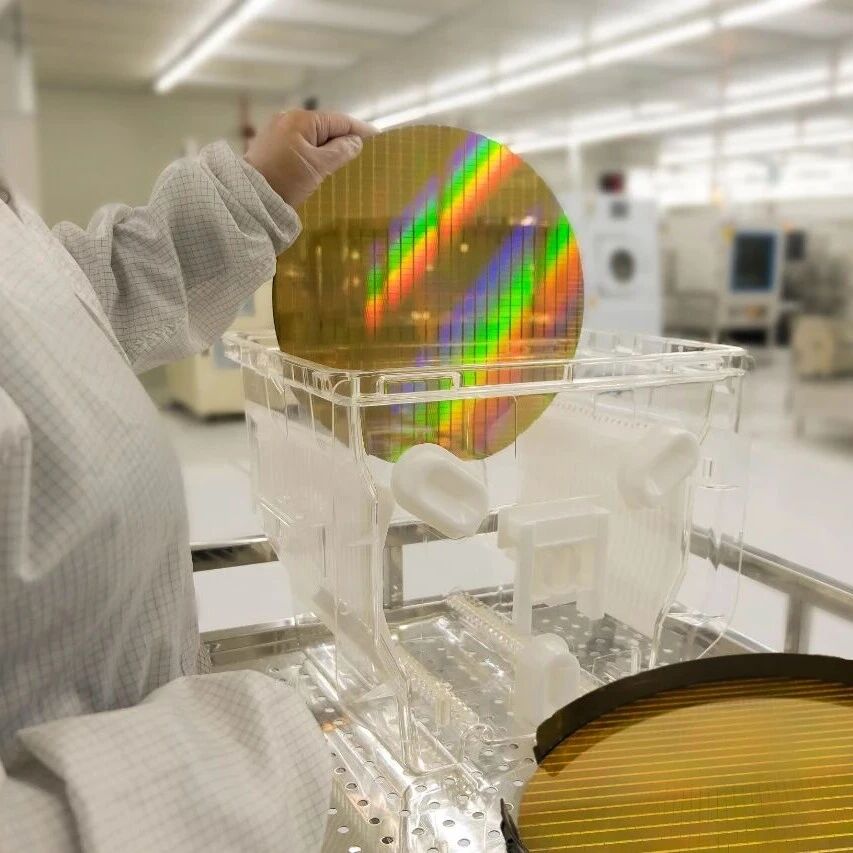
AI5芯片

Search documents
新力量NewForce总第4988期
First Shanghai Securities· 2026-03-26 05:42
Group 1: Tesla's Developments - Tesla's Robotaxi fleet is expanding to new cities, including Henderson, Las Vegas, and is in the final validation phase for Cybercab vehicles in California[5] - Elon Musk confirmed the upcoming release of FSD v14.3, which enhances proactive reasoning capabilities compared to v14.2, and includes new features like automated parking and an upgraded smart summon[7] - The Terafab project aims to produce over 1 TW of AI computing power annually, addressing the current 20 GW output that meets only 2% of global demand[8] Group 2: Financial Metrics - Tesla's stock price is currently at $383.03, with a market capitalization of $1.44 trillion and a total share count of 3.752 billion[6] - The 52-week high and low for Tesla's stock are $498.83 and $214.25, respectively[6] - The book value per share is $21.90, indicating a strong asset base relative to its stock price[6] Group 3: Product Innovations - Tesla's new patent for an "electric vehicle range extender integration" could solve range issues for heavy-duty trucks by allowing dynamic power balancing between the main battery and auxiliary batteries[9] - The launch of the Roadster has been postponed to late April 2026, promising advanced technology integration[10] - Tesla has introduced the Model YL Premium six-seater in Thailand, priced at 1,999,000 Thai Baht, with plans for U.S. production[10] Group 4: Strategic Initiatives - Tesla is planning to launch Megapack operations in India, supported by government incentives for energy storage investments[11] - The company is investing $2.9 billion in advanced solar manufacturing equipment from Chinese suppliers to meet its goal of producing 100 GW of solar cells by 2028[12]

马斯克的Terafab:科技史上最疯狂的基建设想,我们梳理了10个要点与3个趋势
锦秋集· 2026-03-23 12:36
Core Viewpoint - The Terafab project, initiated by Elon Musk, aims to create an unprecedented vertically integrated semiconductor manufacturing system to break the capacity limits of the global semiconductor supply chain, providing essential computational support for autonomous vehicles, humanoid robots, and space data centers. Group 1: Key Points of Terafab - Terafab represents a landmark attempt by tech companies to rewrite the global computational infrastructure supply model, targeting an annual capacity of 1 terawatt (TW) [8] - Musk's involvement is driven by the belief that traditional wafer fabs cannot match the speed and certainty required for AI-era computational supply [8] - The project addresses not only the "chip shortage" but also the inability of existing supply systems to deliver quickly enough to meet tech companies' demands [8] - Demand for high-performance chips is increasing exponentially within Musk's ecosystem due to the simultaneous expansion of autonomous driving, robotics, and large model training [8] - Terafab aims to change the decades-old semiconductor industry organization logic characterized by design, manufacturing, and testing divisions [8] - The project is noteworthy for its goal of vertical integration across the entire industry chain to achieve greater efficiency, collaboration, and supply control [8] - Musk has explicitly included space AI data centers and orbital computational deployment in Terafab's objectives [9] - The estimated funding requirement for the project could reach up to $40 billion [9] - Despite its grand vision, Terafab faces significant challenges in wafer manufacturing, engineering scaling, supply chain coordination, and mass production validation [9] Group 2: Trends - AI is not just a single track in the reconstruction era but serves as a universal engine driving decision-making, R&D, manufacturing, execution, and infrastructure scheduling [10] - The competitive boundaries among tech companies are being redefined, with integration of chips, cloud, models, and applications becoming key to competition [10] - The speed of value creation in the AI industry is outpacing the speed of hardware iteration [10] Group 3: Financial Aspects - The initial investment for Terafab is projected to be between $20 billion and $25 billion, with some analysts estimating total capital expenditure could approach $40 billion [26][27] - The project is expected to support a capacity of 1 terawatt, which is comparable to the total installed power generation capacity of the United States [27] - The funding sources may include a combination of private investment, potential IPO stories for SpaceX, and government support through initiatives like the Texas Semiconductor Innovation Fund [79][80]

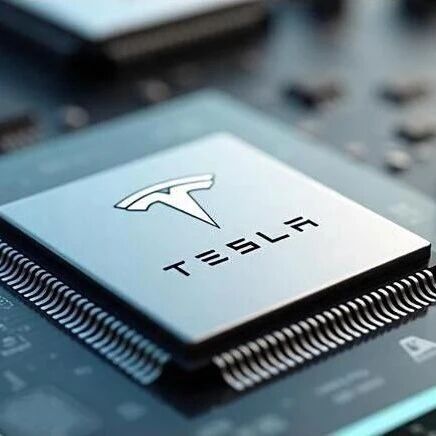
特斯拉AI6芯片,曝光
半导体芯闻· 2026-03-23 10:24
Core Insights - Tesla is optimistic about its chip tape-out timeline, indicating efforts to rapidly enhance its silicon chip manufacturing capabilities [1][3] - CEO Elon Musk is looking forward to the future of the AI6 autonomous driving chip, which is still two generations away from official release, but is already part of the company's ambitious AI hardware roadmap [1][3] - The AI6 chip aims to significantly improve Tesla's autonomous driving technology, humanoid robots, and data center operations [1][3] Group 1 - The AI5 chip has made progress, with Musk stating its design is "on track" and "nearly complete," describing it as a "critical" project requiring his personal involvement [3] - The performance of AI5 is comparable to Nvidia's Hopper level in a single system-on-chip (SoC) configuration and Blackwell level in a dual configuration, but with lower cost and power consumption [3] - AI5 is optimized for edge computing for Optimus robots and Robotaxi vehicles, while also capable of handling data center training tasks [3] Group 2 - The company plans to shorten future chip development cycles to nine months, enabling rapid iterations for AI7, AI8, and higher technologies [4] - Samsung is expected to produce the AI6 chip under a multi-billion dollar agreement, while AI5 will be jointly produced by TSMC and Samsung [4] - These chips will be central to Tesla's full self-driving system, enhancing safety and performance, while also providing efficient reasoning capabilities for expanding data centers [4] Group 3 - The advancement of the AI5 project has led Musk to restart the Dojo 3 supercomputer project, with long-term plans for internal production through the Terafab factory [4] - Tesla aims to accelerate chip development using AI tools to reduce reliance on third-party GPUs and provide high-performance, energy-efficient solutions tailored for its ecosystem [4] - The success of AI6 could mark a significant step for Tesla towards leadership in fully autonomous driving and robotics, although the timeline remains dependent on actual production circumstances [4]
商业航天行业跟踪:马斯克官宣Terafab项目,太空算力商业模式有望闭环
GF SECURITIES· 2026-03-22 14:45
Investment Rating - The industry investment rating is "Buy" [2] Core Insights - The Terafab project, announced by SpaceX and Tesla, aims to produce 1 trillion watts of computing power annually through the manufacturing of 100 billion to 200 billion advanced 2nm chips, with an investment of $20 billion to $25 billion [6] - The chips produced will serve both ground and space applications, with 80% allocated for space computing and 20% for ground computing [6] - The project is part of a broader strategy by Musk to create a commercial ecosystem integrating solar power, computing, and rocket technology, potentially completing a business loop in space computing [6] - Investment recommendations include focusing on semiconductor equipment companies like Changchuan Technology, and companies involved in photovoltaic equipment and materials [6] Summary by Sections Industry Overview - The report highlights the significant advancements in the commercial aerospace sector, particularly through the Terafab project, which is expected to revolutionize space computing capabilities [6] Financial Analysis - Key companies in the semiconductor and photovoltaic sectors are recommended for investment, with specific focus on their growth potential and market positioning [7]


芯片,突传重磅消息!马斯克,刚刚宣布!
券商中国· 2026-03-22 03:47
Core Viewpoint - Tesla and SpaceX are launching the "Terafab" project, aiming to build the largest chip manufacturing facility in history, targeting an annual production capacity of over 1 terawatt of computing power, with 80% allocated for space applications and 20% for terrestrial use [1][2]. Group 1: Project Overview - The "Terafab" project will integrate logic chips, memory chips, and advanced packaging technologies within a single facility, with a production goal of 100 billion to 200 billion chips annually [4]. - The project is essential for supporting Tesla's ambitious plans, including the deployment of solar energy capturing devices and AI satellites, which require significant chip supplies [2][4]. Group 2: Market Position and Strategy - Tesla aims to lead the artificial intelligence chip sector, with expectations that its AI chip production will surpass that of all other manufacturers combined [3]. - The company is currently reliant on external suppliers like Samsung and TSMC for its Autopilot and FSD systems, but the new facility is intended to reduce this dependency [3][5]. Group 3: Financial Implications - The construction of the chip factory is projected to cost several billion dollars, with Tesla planning to invest $20 billion in new equipment, significantly higher than the previous year's investment [5]. - Analysts suggest that Tesla may not bear the entire cost of the factory alone and could seek partnerships to share the financial burden [5][6].
刚刚,马斯克晶圆厂,正式发布
半导体行业观察· 2026-03-22 02:42
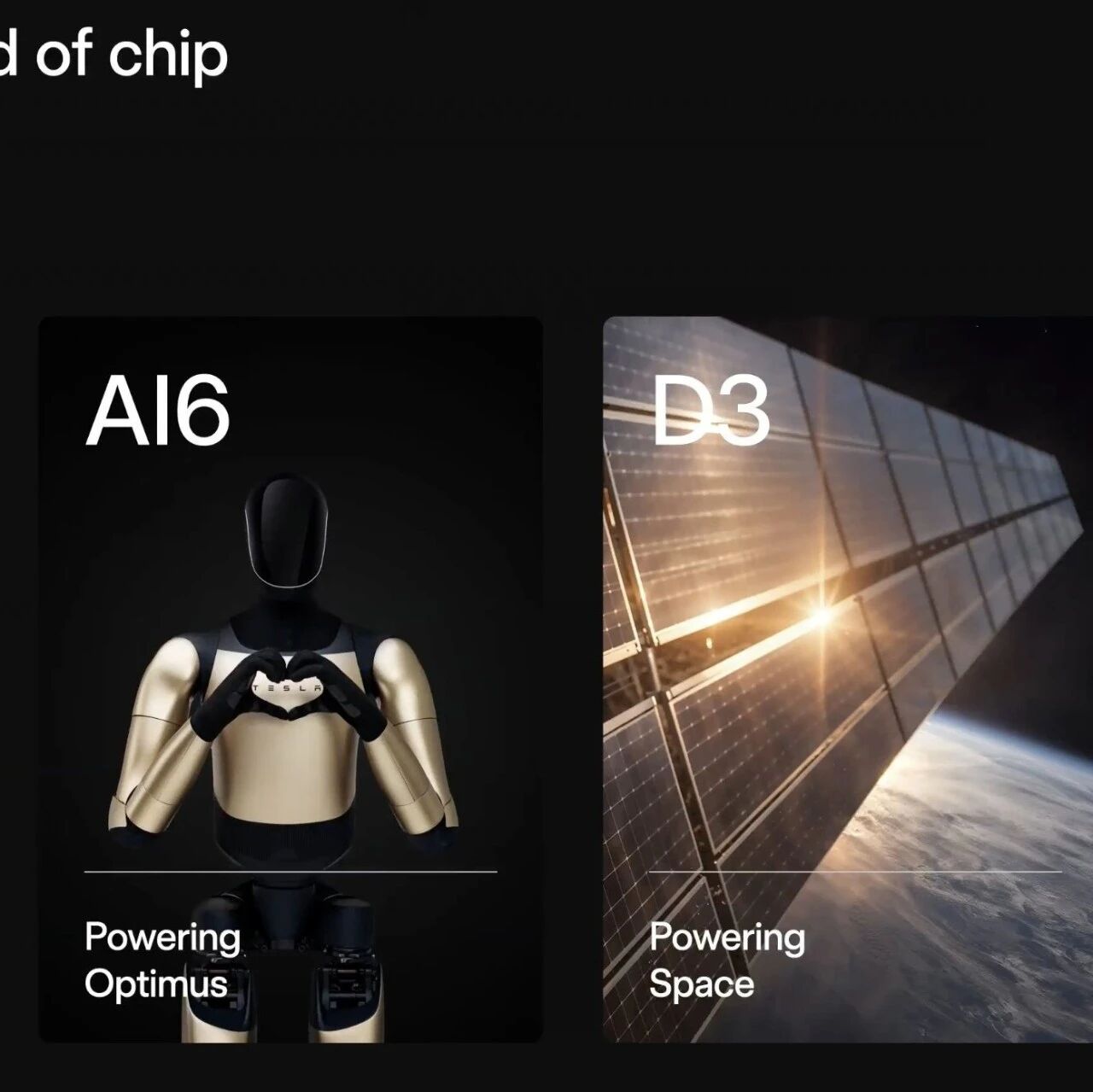
Core Viewpoint - The article discusses Elon Musk's announcement regarding the "TERAFAB" project, which aims to produce over 1 terawatt of computing power annually, with 80% allocated for space applications and 20% for terrestrial uses [2][10]. Group 1: Project Overview - The TERAFAB project will establish a vertically integrated semiconductor manufacturing facility in the U.S., covering logic chips, memory chips, and advanced packaging [3]. - The project is expected to require an investment of approximately $25 billion, surpassing existing super factory scales [4]. Group 2: Chip Development Roadmap - Tesla's chip evolution includes the AI5, AI6, and D3, targeting cutting-edge 2nm process technology with a production goal of 100 to 200 billion custom AI chips annually [4]. - The AI5 chip is designed for Full Self-Driving (FSD) and Optimus, with performance improvements of 40-50 times over the previous generation [7][8]. Group 3: Strategic Goals - The distribution of computing power from TERAFAB reflects ambitious goals, with a focus on creating a distributed interstellar computing network through AI satellites [12]. - Musk emphasizes the need for internal chip production to mitigate geopolitical risks and supply chain vulnerabilities, as existing suppliers like TSMC and Samsung cannot meet Tesla's demands [16][21]. Group 4: Challenges and Considerations - Building the TERAFAB facility presents significant challenges, including high capital costs and the complexity of advanced chip manufacturing processes [19][21]. - The timeline and location for the factory remain uncertain, with Tesla planning to utilize its substantial cash reserves for funding [18].
马斯克:对黄仁勋深感钦佩 SpaceX AI与特斯拉(TSLA.US)将持续大规模采购英伟达(NVDA.US)芯片
智通财经网· 2026-03-19 06:23
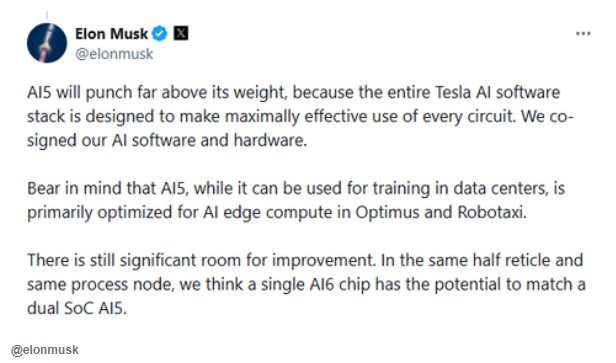
Group 1 - Elon Musk announced that SpaceX AI and Tesla (TSLA.US) will continue to make large-scale purchases of NVIDIA (NVDA.US) chips [1] - Tesla is developing its fifth-generation AI chip aimed at achieving full autonomous driving, which will power its autonomous driving system [1] - The AI5 chip is primarily optimized for AI edge computing support for the Optimus humanoid robot and Robotaxi autonomous vehicles, despite its capability for data center model training [1] Group 2 - Musk indicated that there is significant optimization potential for the AI5 chip, with expectations that the performance of a single AI6 chip could reach the level of a dual-core AI5 system under the same design and manufacturing process [1] - Tesla plans to widely roll out an updated version of its full self-driving (supervised version) software in the coming weeks [1] - SpaceX acquired xAI through an all-stock transaction, occurring ahead of a potential large-scale IPO later this year, marking the first time Musk referred to the merged entity as "SpaceX AI" [2]

马斯克称SpaceX AI和特斯拉将继续大规模订购英伟达芯片
Xin Lang Cai Jing· 2026-03-19 02:45
Group 1 - Elon Musk announced that SpaceX AI and Tesla are expected to continue large-scale orders of Nvidia chips [1][3] - SpaceX acquired xAI through an all-stock transaction, preparing for a potential large IPO later this year, marking the first time Musk referred to the merged entity as SpaceX AI [1][3] - Tesla is designing its fifth-generation AI chips to power its autonomous driving ambitions, which will support the full self-driving software [1][3] Group 2 - The AI5 chips are optimized primarily for humanoid robots like Optimus and AI edge computing for Robotaxi, although they can also be used for training in data centers [1][3] - Tesla is expected to widely release an update for its full self-driving (supervised) software in the coming weeks [4] - The Terafab project for manufacturing AI chips by Tesla is set to launch within seven days [2][5]
马斯克的巨型晶圆厂,靠谱吗?
半导体行业观察· 2026-03-19 01:32
Core Viewpoint - The article discusses Elon Musk's ambitious Terafab project, which aims to build a massive semiconductor manufacturing facility capable of producing hundreds of billions of chips annually. The feasibility and challenges of this project are examined from the perspective of semiconductor engineering [2][5][6]. Group 1: Project Overview - Terafab is designed to be larger than traditional gigafactories, integrating logic circuits, memory, and packaging under one roof, with a production target of 100 billion to 200 billion chips per year [2][6]. - Musk's vision includes a 2nm process node, with an estimated cost of $25 billion, although Tesla has not disclosed detailed cost data [6][19]. - The project aims to address Tesla's chip supply needs, which Musk has indicated will become critical in the next three to four years [5][6]. Group 2: Challenges in Semiconductor Manufacturing - Building a semiconductor fab is a complex task requiring significant resources, including 30-40 million man-hours, 83,000 tons of steel, and 60,000 cubic meters of concrete [15]. - The construction timeline in the U.S. is approximately twice as long as in Taiwan due to regulatory and labor challenges [15][16]. - The transition to a 2nm process involves significant technological changes, including the shift from FinFET to Gate-All-Around (GAA) transistor architecture, which requires new materials and processes [19][22]. Group 3: Yield and Equipment Issues - Achieving high yield rates in semiconductor manufacturing is critical, with any defect in the process potentially leading to significant yield loss [22]. - The global supply of advanced lithography equipment is limited, with ASML being the sole supplier of extreme ultraviolet (EUV) lithography machines, which have long lead times for delivery [24]. - The lack of a robust design ecosystem and process design kits (PDK) poses additional challenges for Tesla, as developing a new PDK can take one to two years [26]. Group 4: Strategic Partnerships and Future Directions - Tesla's collaboration with Samsung in Taylor, Texas, is seen as a foundational step for Terafab, allowing Tesla to gain insights into manufacturing processes and efficiency improvements [40]. - The establishment of a packaging line for AI chips at SpaceX's facility is viewed as a critical move to alleviate bottlenecks in the AI chip market [42]. - Potential partnerships with Intel for wafer fabrication and packaging services could provide Tesla with the necessary infrastructure to support its semiconductor ambitions [44]. Group 5: Elon Musk's Problem-Solving Framework - Musk's five-step problem-solving framework, which includes questioning existing norms, eliminating unnecessary steps, simplifying processes, accelerating timelines, and gradually automating, may be applied to the construction and operation of Terafab [31][34]. - While skepticism exists regarding the applicability of this framework to semiconductor manufacturing, it may help identify inefficiencies in the fab construction process [35].
美国又新增一个晶圆厂?
半导体芯闻· 2026-03-18 10:15
Core Viewpoint - The article discusses Samsung's plans to build a second semiconductor fab (Fab 2) in Taylor, Texas, in response to the tight capacity of competitor TSMC, highlighting the growing demand for foundry services from major tech companies [2][3]. Group 1: Fab 2 Construction and Regulatory Approval - Samsung is preparing to construct Fab 2 in its semiconductor park in Taylor, Texas, with the project now entering the regulatory review phase [2]. - The Taylor City Council has unanimously approved an amendment to extend the contract with HDR Engineering, which will assist Samsung in obtaining necessary building permits and ensuring compliance with safety and construction standards [2]. Group 2: Scale and Future Expansion - Fab 2 is expected to cover approximately 2.7 million square feet, matching the size of the currently under-construction Fab 1 [3]. - Samsung has acquired a total of 1,268 acres in Taylor, allowing for the potential development of up to 10 advanced fabs, indicating significant future expansion capabilities [3]. Group 3: Investment and Financial Support - Samsung's initial investment in the Taylor facility was announced at $17 billion, later increased to $37 billion, which includes $4.75 billion in federal subsidies under the CHIPS and Science Act [3]. Group 4: Technological Focus and Client Acquisition - The Taylor facility will focus on high-performance computing (HPC) and automotive electronics, utilizing Samsung's advanced 2-nanometer process technology [4]. - Samsung has secured orders from 121 clients, with potential large orders expected from major tech companies like Google, AMD, and ByteDance [4]. Group 5: Production Timeline and Partnerships - Fab 1 is set to begin mass production in 2027, as part of a significant partnership with Tesla, involving a $16.5 billion contract for the production of Tesla's latest AI chips [4]. - Elon Musk has indicated that the expected mass production timeline for the AI5 chip is around mid-2027 [4]. Group 6: Market Position and Growth - Samsung's foundry business revenue rose by 6.7% in Q4 2025, reaching $3.4 billion, increasing its global market share from 6.8% to 7.1%, solidifying its position as the second-largest foundry after TSMC [6].