
A股市场价值重估

Search documents
2026市场展望:宽幅震荡上行 多重动力支撑价值重估
Mei Ri Jing Ji Xin Wen· 2026-02-09 07:26
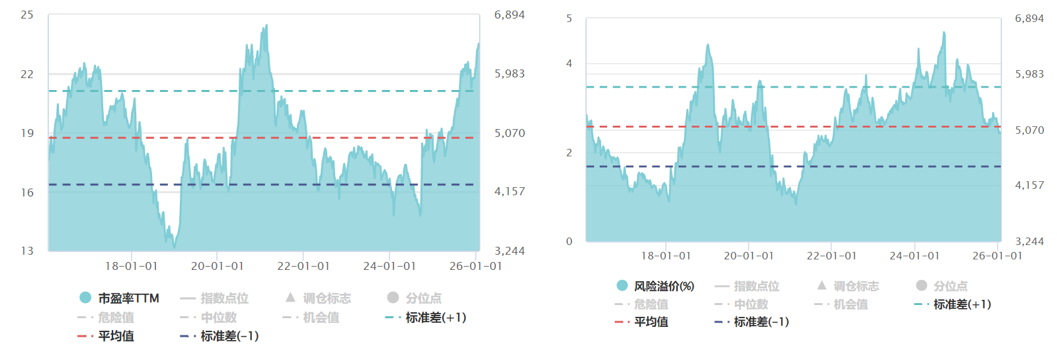
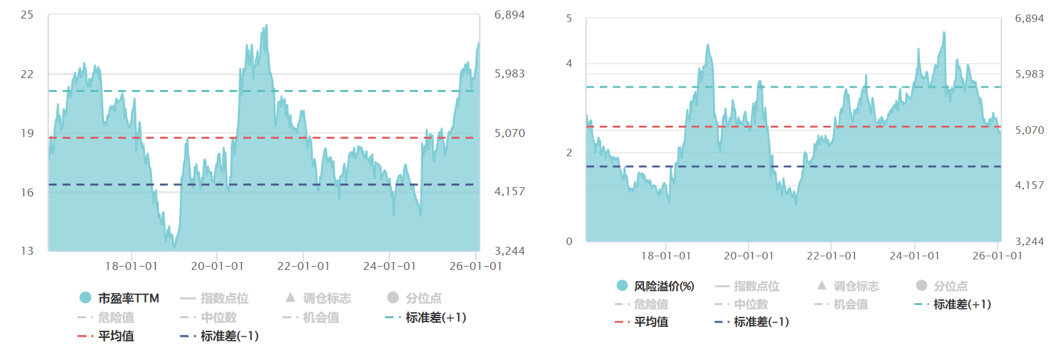
Market Overview - The A-share market has shown strong resilience since the beginning of the year, with broad indices exhibiting a relatively strong and volatile trend [1] - Despite this, there is still some selling pressure, evidenced by redemptions in core broad index ETFs and an increase in financing margin ratios, which may cool the market [1] Valuation Insights - The PE valuation of the Wind All A index is currently at a relatively high level compared to the past 10 years, exceeding the mean plus one standard deviation [1] - The risk premium level, calculated as the inverse of the A-share PE minus the yield of 10-year government bonds, remains around the 10-year average, indicating potential for value re-evaluation in the A-share market [1] Economic Indicators - The overall performance of the domestic economy in Q4 is relatively weak, with indicators such as retail sales, industrial output, and fixed asset investment showing weakness [4] - The manufacturing PMI has fluctuated, with a recent drop below expectations, indicating a contraction in the manufacturing sector [4] Policy Measures - Domestic macro policies have been actively implemented since the beginning of the year, with significant upgrades in fiscal measures, including extended interest subsidies for personal consumption loans and service industry loans [4] - Monetary policy has also shown structural support, with adjustments in re-lending and re-discount rates, particularly favoring sectors like technology and small enterprises [4] Global Economic Context - The Federal Reserve's monetary policy direction is a key focus, with expectations of a pause in interest rate cuts in the short term, but conditions for potential cuts later in the year are present due to low inflation and a cooling labor market [5] - The overall liquidity environment is expected to remain loose, supporting the A-share market alongside domestic fiscal policy [5] Fund Flows and Market Sentiment - A significant trend is the shift of household savings towards the stock market, with a substantial amount of fixed-term deposits maturing this year, potentially leading to increased investment in A-shares [7] - The ratio of household savings to A-share market capitalization remains above historical averages, indicating further potential for capital inflow into the stock market [7] Fund Issuance Trends - The issuance of public equity funds remains relatively low compared to the bull market from 2019 to 2021, suggesting room for growth in future fund issuance [8] Investment Opportunities - The A-share market is expected to experience a wide-ranging upward trend in 2026, supported by multiple factors including policy measures, funding conditions, and improving earnings [14] - Key sectors to focus on include technology and cyclical industries, with specific ETFs such as communication ETF (515880), semiconductor equipment ETF (159516), and mining ETF (561330) being highlighted as potential investment opportunities [14]

2026市场展望:宽幅震荡上行,多重动力支撑价值重估
Sou Hu Cai Jing· 2026-02-09 01:35
Market Overview - The A-share market has shown strong resilience since the beginning of the year, with broad indices exhibiting a relatively strong and fluctuating trend [1] - Despite this, there is still some selling pressure, as evidenced by redemptions in core broad index ETFs and an increase in financing margin ratios, which may cool the market [1] Valuation Insights - The PE valuation of the Wind All A index is currently at a relatively high level compared to the past 10 years, exceeding the mean plus one standard deviation [1] - However, the risk premium level, indicated by the inverse of the A-share PE minus the 10-year government bond yield, remains around the 10-year average, suggesting potential for value re-evaluation in the A-share market [1] Economic Indicators - The overall performance of the domestic economy in Q4 is relatively weak, with indicators such as retail sales, industrial output, and fixed asset investment showing weakness [4] - The manufacturing PMI has fluctuated, with a recent drop below expectations, indicating a contraction in the manufacturing sector [4] Policy Measures - Domestic macro policies have been actively implemented since the beginning of the year, with significant upgrades in fiscal measures, including extended interest subsidies for personal consumption loans and service industry loans [4] - Monetary policy has also shown structural support, with adjustments in re-lending and re-discount rates, particularly favoring key sectors like technology and small enterprises [4] Global Economic Context - The Federal Reserve's monetary policy direction is a key focus, with expectations of a pause in interest rate cuts in the short term, but conditions for potential cuts later in the year are present due to low inflation and a cooling labor market [5] - The overall liquidity environment is expected to remain loose, supported by domestic fiscal policies, which bodes well for the A-share market [5] Fund Flows and Market Sentiment - A significant trend is the shift of household savings towards the stock market, with a substantial amount of fixed deposits maturing this year, indicating potential inflows into A-shares [7] - The ratio of household savings to A-share market capitalization remains above historical averages, suggesting further room for this ratio to decline and for savings to flow into the stock market [7] Fund Issuance Trends - The issuance of public equity funds remains relatively low compared to the bull market from 2019 to 2021, indicating potential for growth in future fund issuance [9] Investment Outlook - The A-share market is expected to exhibit a wide-ranging upward trend in 2026, supported by multiple factors including risk premium, funding conditions, and policy measures [14] - Key sectors to focus on include technology and cyclical industries, with specific ETFs such as communication, semiconductor equipment, and mining being highlighted as potential investment opportunities [14]
重塑A股价值逻辑 监管三巨头齐聚,释放深改强信号
Jing Ji Guan Cha Wang· 2025-09-21 05:29
Core Viewpoint - The upcoming press conference on September 22, 2024, will focus on the achievements of the financial industry during the "14th Five-Year Plan" period, with capital market development expected to be a core topic [1] Group 1: Policy Evolution - The three high-level press conferences within 363 days illustrate the shifting focus of capital market policies from stabilizing the market to establishing long-term mechanisms [2] - The People's Bank of China (PBOC) has introduced two new monetary policy tools: a 500 billion yuan "securities fund insurance company swap facility" and a 300 billion yuan "special re-loan for stock repurchase and increase" [2] - The China Securities Regulatory Commission (CSRC) is set to release guidelines to promote long-term capital inflow and reform mergers and acquisitions, including measures to enrich equity fund products and lower fees [2] Group 2: Market Changes - Since September 2024, the A-share market has undergone a significant value reassessment, with the Shanghai Composite Index rising 33.42% from 2863.13 points to 3820.09 points by September 19, 2025 [4] - The market's driving logic has shifted from policy expectations to performance growth, indicating a fundamental change in market dynamics [4] - The "14th Five-Year Plan" period has seen institutional breakthroughs, including the smooth implementation of a comprehensive registration system and improved IPO review efficiency [4] Group 3: Future Development - The upcoming press conference is anticipated to signal important reforms for the capital market, focusing on enhancing the quality of listed companies and optimizing trading mechanisms [5] - The capital market has transitioned from short-term volatility concerns to long-term development strategies, reflecting a more mature and stable policy framework [5] - The continuous and stable nature of these policies provides valuable certainty for the market, as it moves towards a more regulated, transparent, and resilient capital market [5]