
AI代理经济

Search documents
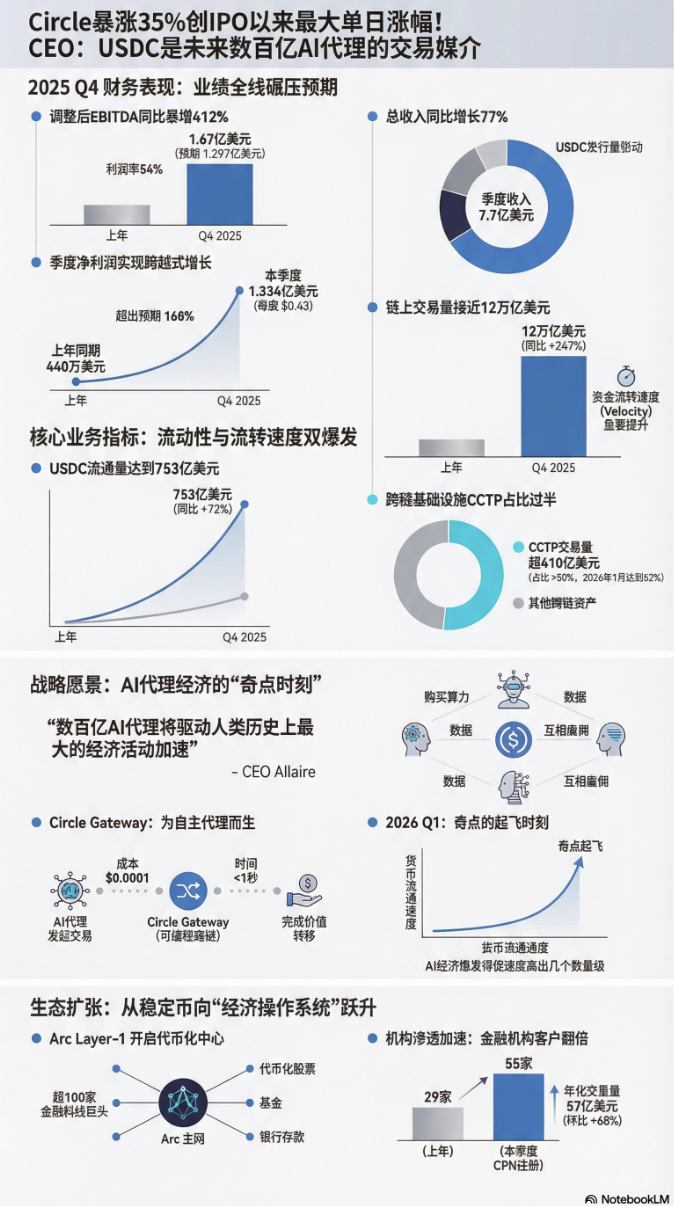
押注“奇点时刻”!Circle电话会:AI代理将成为最大业务增量
Hua Er Jie Jian Wen· 2026-02-26 10:00
Core Insights - Circle's Q4 2025 financial performance showed a remarkable 412% increase in adjusted EBITDA, driven by a significant rise in USDC circulation and on-chain transaction volume [3][4][6] - The company is strategically aligning its USDC network with the rapidly growing "AI agent economy," aiming to create the next-generation global economic operating system [2][7] Financial Performance - In Q4 2025, Circle achieved total revenue and reserve income of $770 million, a 77% year-over-year increase, surpassing analyst expectations of $747 million [3][29] - Net profit surged from $4.4 million in the same quarter last year to $133.4 million, translating to earnings per share of $0.43, significantly exceeding Wall Street's forecast of $0.16 [3][29] - Adjusted EBITDA reached $167 million, reflecting a 412% year-over-year growth, with an impressive EBITDA margin of 54% [3][4][29] USDC Growth - By the end of 2025, USDC circulation reached $75.3 billion, marking a 72% year-over-year increase, outpacing the overall fiat-backed stablecoin market growth [4][29] - USDC held within Circle's infrastructure grew 5.6 times year-over-year to $12.5 billion, accounting for 17% of total circulation [6][29] - On-chain USDC transaction volume approached $12 trillion in Q4, a 247% increase year-over-year, indicating a significant rise in digital dollar utility [6][14] AI Agent Economy - Circle's management emphasized the transformative potential of AI agents, predicting that hundreds of billions of AI agents will interact and execute economic functions online, with USDC positioned as the core settlement currency [7][27] - The company introduced Circle Gateway, a new feature allowing AI agents to autonomously and programmatically automate cross-chain USDC transactions at a cost of just one cent, enhancing the efficiency of AI-driven economic activities [7][25] Arc Blockchain Development - Circle is developing Arc, a Layer-1 blockchain network designed to support AI agents and transition from a stablecoin issuer to a comprehensive economic operating system [7][20] - The Arc testnet has launched, attracting over 100 leading financial and tech companies, with total transaction volume exceeding $166 million and an average daily transaction volume of approximately $2.3 million [21][20] - The mainnet is expected to launch in 2026, further solidifying Circle's position in the evolving digital asset landscape [20][21] Market Position and Partnerships - Circle's Payments Network (CPN) has expanded its registered financial institutions from 29 to 55, with an annualized transaction volume of $5.7 billion, reflecting a 68% increase [9][24] - The company has established a formal partnership with Polymarket, the largest prediction market, and is seeing increased interest from mainstream institutions due to favorable regulatory developments [9][24]

刘润:未来10年,5大机会
Sou Hu Cai Jing· 2026-02-07 15:20
Group 1 - The core idea of the report is to identify transformative opportunities in various sectors over the next decade, particularly focusing on AI, healthcare, autonomous machines, blockchain finance, and energy solutions [2][3][81] - The report emphasizes the importance of understanding these trends to recognize potential investment opportunities and entrepreneurial ventures [3][81] Group 2 - Opportunity 1: AI Agent Economy, which predicts that by 2030, AI will facilitate over $8 trillion in online consumption, with AI agents handling 25% of digital transactions [12][13] - The shift from B2C to B2A2C (Business to Agent to Consumer) will redefine how businesses interact with consumers, creating a new market for AI-driven services [15][16] Group 3 - Opportunity 2: The "Cure" Industry, driven by advancements in gene editing and AI, could reduce drug development costs from $2.4 billion to $700 million and create a potential market of $2.8 trillion for gene therapies [29][31] - The report predicts a massive market for longevity solutions, potentially valued at $120 trillion, as society moves towards a health-centric model [33] Group 4 - Opportunity 3: Autonomous Machine Economy, where the market for autonomous vehicles and robots could exceed $60 trillion by 2030, significantly reducing logistics costs [46][47] - The report highlights the potential for "robot-as-a-service" models, which could create new business opportunities in various sectors [51] Group 5 - Opportunity 4: On-chain Financial Infrastructure, which could see tokenized real-world assets reach $11 trillion by 2030, transforming how assets are managed and traded [61][62] - This new financial infrastructure will enable more efficient and transparent transactions, impacting traditional banking and investment practices [62] Group 6 - Opportunity 5: The new "water, electricity, and coal" of the intelligent era will focus on affordable green energy and space transportation, essential for powering AI and robotics [70][72] - The report notes that advancements in solar energy and space transport could drastically reduce costs, creating foundational support for future technologies [75][76]
红包大战,意在超级流量入口
Shen Zhen Shang Bao· 2026-02-05 22:54
Core Viewpoint - The current "red envelope war" among internet giants has shifted from mobile payments to artificial intelligence, with significant financial investments aimed at establishing the next generation of "super traffic entrances" that will shape the competitive landscape for the next decade [1][2]. Group 1: Company Strategies - Tencent has launched the "Shangyuanbao" initiative with a budget of 1 billion yuan, following its previous 500 million yuan investment during the 2015 Spring Festival [1]. - Alibaba's "Qianwen" has announced a 3 billion yuan investment for its "Spring Festival Treat Plan," integrating various services within its ecosystem [1]. - Baidu and ByteDance are also participating, with Baidu embedding its AI assistant into its app and offering 500 million yuan in cash rewards, while ByteDance collaborates with the Spring Festival Gala as the exclusive AI cloud partner [1]. Group 2: Market Dynamics - The competition for AI as a new traffic entrance is driven by the maturity of large models capable of handling complex tasks, and a substantial user base that supports AI's market foundation [3]. - By June 2025, the user base for generative AI in China is projected to reach 515 million, with a penetration rate of 36.5% [3]. - The saturation of mobile internet traffic and stagnant user engagement has prompted internet giants to seek new avenues for traffic [3]. Group 3: Competitive Landscape - The current battle for AI traffic entrances is reminiscent of past browser and mobile app wars, with AI agents capable of aggregating traffic, data, and transactions, potentially leading to a "winner-takes-all" scenario [3][4]. - The development of a super entrance requires advanced model capabilities, vast computational power, data, ecosystem integration, and scenario refinement, favoring major internet players [4]. Group 4: Opportunities for Smaller Players - Smaller players can still find opportunities by integrating with major models and creating plugins or skills that can be frequently utilized by mainstream AI agents [5]. - The emergence of the AI agent economy is expected to create a trillion-dollar software and service market by 2030, with significant online consumption growth [5]. Group 5: Impact on Businesses - The shift in traffic entrances poses both challenges and opportunities for ordinary businesses, as AI agents may favor recommending self-operated or leading brands, potentially marginalizing smaller businesses [6]. - Businesses that adapt to become "AI-friendly" and utilize free AI tools may gain a competitive edge in the new market landscape [6].



红包大战 意在超级流量入口
Shen Zhen Shang Bao· 2026-02-05 17:55
Core Insights - The competition among internet giants has shifted from mobile payments to artificial intelligence, with significant investments in AI-related initiatives and user engagement strategies [1][2] Group 1: Investment and Initiatives - Tencent launched the "Shangyuanbao, distributing 1 billion" campaign, marking a significant investment in user engagement during the Spring Festival, following a previous 500 million yuan investment in 2015 [1] - Alibaba's "Qianwen" announced a 3 billion yuan investment for its "Spring Festival Treat Plan," integrating various services within its ecosystem [1] - Baidu and ByteDance also participated, with Baidu embedding its AI assistant into its app and offering 500 million yuan in cash rewards, while ByteDance partnered with the Spring Festival Gala as the exclusive AI cloud partner [1] Group 2: Market Dynamics - The current AI competition is driven by the need for new traffic sources as mobile internet growth stagnates, with AI seen as the next major entry point for user engagement [2] - By 2025, the user base for generative AI in China is projected to reach 515 million, with a penetration rate of 36.5%, indicating a strong market foundation for AI applications [2] Group 3: Competitive Landscape - The battle for AI as a traffic entry point is reminiscent of past tech rivalries, with the potential for AI to aggregate traffic, data, and transactions, thus enhancing the competitive advantage for those who control these entry points [2][3] - The development of a super entry point requires advanced model capabilities, vast computational resources, and effective ecosystem integration, favoring major internet players over smaller competitors [3] Group 4: Opportunities for Smaller Players - Smaller players can still find opportunities by integrating with major AI models and creating plugins or skills that can be frequently utilized by mainstream AI agents [4] - The emergence of the AI agent economy is expected to create a trillion-dollar market by 2030, presenting new avenues for innovation and revenue generation [4] Group 5: Impact on Businesses - The shift in traffic entry points poses both challenges and opportunities for ordinary businesses, as AI agents may favor larger brands, potentially marginalizing smaller players [5][6] - Businesses that adapt to become "AI-friendly" and utilize available AI tools may gain a competitive edge in the evolving market landscape [6]
未来10年,5大机会
Sou Hu Cai Jing· 2026-01-28 06:44
Group 1 - The core idea of the report is to identify transformative opportunities in various sectors for the next decade, focusing on technological advancements and their implications for investment and entrepreneurship [1][54]. - The report emphasizes the importance of authoritative data and trends to make informed decisions about future opportunities [1]. Group 2 - Opportunity 1: AI Agent Economy, where AI will facilitate over $8 trillion in online consumption by 2030, significantly changing the business model from B2C to B2A2C [9][11]. - Opportunity 2: The "Cure" Industry, driven by advancements in gene editing and AI, which could reduce drug development costs from $2.4 billion to $700 million and create a potential market of $28 trillion for gene therapies [22][24]. - Opportunity 3: Autonomous Machine Economy, where automation and robotics will transform labor markets, with the Robotaxi industry alone projected to reach a total enterprise value of $34 trillion by 2030 [33][36]. - Opportunity 4: On-chain Financial Infrastructure, which will enable the tokenization of real-world assets, potentially reaching a market size of $11 trillion by 2030, revolutionizing investment and liquidity [45][44]. - Opportunity 5: The new "water, electricity, and coal" of the intelligent era, focusing on the need for cheap and abundant energy and space transportation to support AI and robotics [50][48].