AI协同

Search documents
从个人IP到商业系统,一人公司正在成为下一种公司形态
3 6 Ke· 2026-01-29 10:49
Core Insights - The emergence of the "One Person Company" (OPC) model is transforming entrepreneurship, leveraging AI and automation to enable individuals to operate with the efficiency of a team [1][2][3] - The trend is supported by data showing that independent founders accounted for 36.3% of new companies by mid-2025, a significant increase from 23.7% in 2019, indicating a shift towards solo entrepreneurship [2][3] - This structural change is driven by technological advancements, policy support, and validated success stories of solo entrepreneurs [3][4] Group 1: Structural Changes in Entrepreneurship - The rise of one-person companies is not a fleeting trend but a result of multiple structural forces, including the reduction of startup costs due to AI tools and subscription services [3][4] - Policies are increasingly favoring individual-controlled structures, as seen in initiatives like Shanghai's "Super Individual 288 Action" and support for OPCs in various regions [3][4] - Successful solo entrepreneurs have demonstrated that it is possible to start and validate business ideas independently before scaling, challenging traditional notions of team-based startups [3][4] Group 2: AI's Role in Reshaping Organizational Logic - The proliferation of AI agents is enabling individuals to function as multi-threaded organizations, allowing them to manage various tasks and workflows autonomously [5][6] - AI tools are evolving from task execution to autonomous process management, fundamentally changing how work is organized and executed [5][6] - The traditional model of collaboration is being replaced by a system where individuals can leverage AI to complete complex tasks without the need for a large team [6][7] Group 3: Building a Sustainable One-Person Ecosystem - Successful one-person companies require a systematic approach, transitioning from being mere content creators to effective business operators [8][9] - Key challenges include unclear positioning, fragmented processes, and uncontrolled client structures, which can hinder the sustainability of one-person businesses [9][10] - A sustainable one-person company must integrate three systems: a mental framework for self-identity and client understanding, a content system for effective communication, and a service system for standardized delivery [10][11] Group 4: The Future of One-Person Companies - The shift towards one-person companies represents a broader organizational logic transformation, where individuals can leverage AI to manage their operations effectively [13][14] - The future will not see individuals replacing companies but rather more people managing their own businesses in a structured manner [14][15] - AI serves as a platform while individuals act as nodes, redefining the concept of a company beyond just a legal entity to a choice of organizational structure [15]
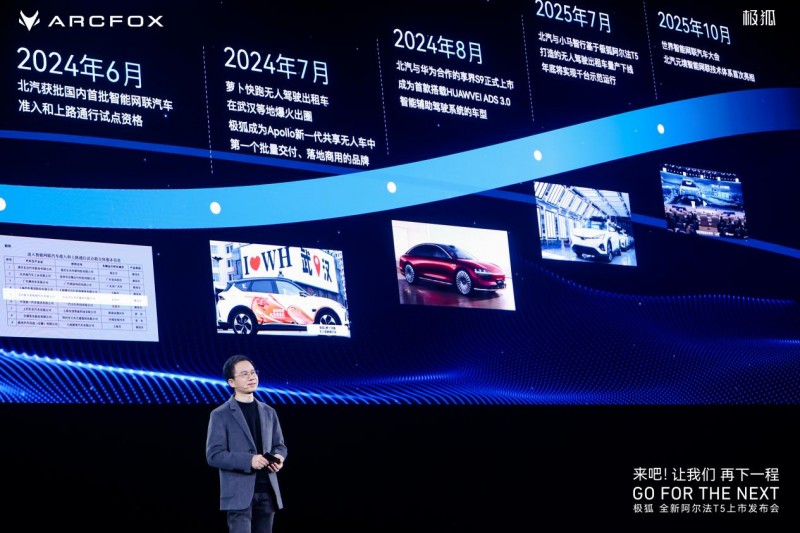
北汽元境智能正式发布 车辆升级“全域智能体”
Zhong Jin Zai Xian· 2025-10-29 12:05
Core Viewpoint - The launch of the new Alpha T5 by BAIC Arcfox showcases the "BAIC Yuanzhi Intelligent" system, representing the latest technological achievements in the field of intelligent connected vehicles, integrating research, innovation, and collaboration [1] Group 1: Technology Framework - The core principle of the Yuanzhi Intelligent technology is "full-domain integration," enabling vehicles to evolve into "full-domain intelligent entities" through shared central models and collaborative multi-agent systems [3] - Yuanzhi Intelligent consists of three levels of integration: 1. "Cabin-Driving Integration," where the intelligent cockpit and driving share a central model, enhancing data transmission efficiency and user experience [4] 2. "Cross-Ecological AI Integration," allowing vehicles to understand user intentions and emotions, transforming them into proactive assistants [6] 3. "Real and Virtual World Integration," utilizing real data and AI-generated scenarios to enhance the driving model's adaptability in complex conditions [6] Group 2: Product Offerings - BAIC introduced two flagship products: Yuanzhi Driving and Yuanzhi Cabin, with three versions of Yuanzhi Driving (Pro, Max, Ultra) catering to different levels of autonomous driving from L2 to L4 [7] - The Pro version supports 128-256T computing power for various safety and navigation functions, while the Max version, with 400-600T, can handle more complex scenarios and is expandable to L3 [7] - The Ultra version, exceeding 1000T, is designed for L4 autonomous taxi services, ensuring safety and reliability through advanced system redundancy and algorithms [7] Group 3: Safety and Testing - BAIC emphasizes a "life protection" development philosophy, establishing a comprehensive safety testing system that covers the entire development and operational process [8] - The company has conducted over 50 million kilometers of testing for its Yuanzhi Driving system across various terrains and conditions to ensure high safety standards [8] Group 4: User Experience and AI Integration - The Yuanzhi Cabin is designed as a "context engine" that adapts to user preferences and environmental conditions, providing integrated services and emotional value [10] - The system has integrated over 15 domain-specific intelligent agents, achieving over 880 million user interactions, with an average of over 40,000 daily active requests [11] - BAIC aims to create a comprehensive intelligent travel experience, focusing on safety and integration, while also launching the "BAIC Shenqing Power" technology brand for new intelligent connected vehicles [11]


Goheal揭上市公司并购重组中的协同效应:如何在短期内创造最大化价值?
Sou Hu Cai Jing· 2025-05-26 08:19
Core Insights - The rise of AI models and industry chain restructuring is triggering a new wave of mergers and acquisitions (M&A) in the capital market, with over 120 major asset restructuring announcements in the A-share market in the first three quarters of 2024, 40% of which emphasize "short-term synergy" expectations [1][6] - Synergy effects are increasingly recognized as a critical variable in capital operations, moving beyond mere numbers on a presentation to become a key factor in determining market value [1][6] Group 1: Synergy Definition and Importance - Synergy is described as the expectation that the combined value of two companies will be greater than the sum of their individual values, exemplified by improved procurement negotiations and market coverage through strategic acquisitions [6] - Successful realization of synergy can lead to significant improvements in financial reports and higher market valuations, but achieving this is often challenging in practice [6][7] Group 2: Challenges in Achieving Synergy - Three main challenges are identified: time lag between synergy realization and investor expectations, cultural mismatches between merging companies, and incentive misalignments among existing teams [7] - A case study illustrates that a well-structured "lightning synergy" mechanism can lead to significant cost savings and stock price increases shortly after an acquisition [7][8] Group 3: Trends in M&A Strategy - There is a growing trend for acquirers to leverage "synergy IP" to create value anchors, such as using "channel integration" as a market theme and establishing "quarterly synergy KPIs" for investor tracking [8][9] - The concept of "AI synergy" is emerging, where AI models can quickly analyze user behavior data to design effective marketing strategies, significantly enhancing synergy realization [9][10] Group 4: The Role of Brand Assets - Brand asset synergy is highlighted as a crucial area, particularly in consumer-facing industries, where brand perception can drive significant value beyond financial integration [10][12] - The importance of storytelling in M&A is emphasized, as effective communication of synergy can enhance market perception and investor confidence [9][10] Group 5: Final Thoughts on M&A and Synergy - The ultimate measure of successful synergy lies in its impact on profit margins and stock price responses, prompting a reevaluation of the true purpose of M&A—whether for short-term gains or long-term industry advancement [12]