
AI容器技术

Search documents
华为联合三大高校发布并开源AI容器技术Flex:ai,助力破解算力资源利用难题
Xin Lang Ke Ji· 2025-11-24 14:03
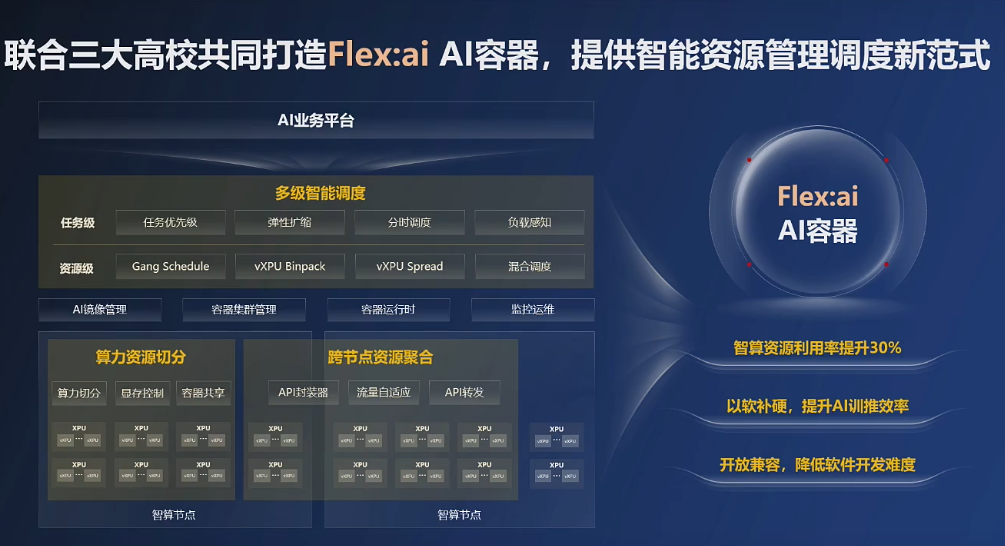
Core Insights - Huawei officially launched the AI container technology Flex:ai at the 2025 AI Container Application Landing and Development Forum, in collaboration with Shanghai Jiao Tong University, Xi'an Jiaotong University, and Xiamen University, to address the low utilization of computing resources in the AI industry [1][2] Group 1: Technology Overview - The Flex:ai technology aims to tackle the issue of "computing resource waste" in the AI industry, where small model tasks monopolize entire cards, leading to resource idleness, while large model tasks face insufficient computing power [1] - Flex:ai is built on the Kubernetes container orchestration platform, enabling precise matching of AI workloads with computing resources through refined management and intelligent scheduling of GPU and NPU resources, significantly improving computing resource utilization [1] Group 2: Key Technological Breakthroughs - A collaboration with Shanghai Jiao Tong University led to the development of the XPU pooling framework, which allows a single GPU or NPU card to be divided into multiple virtual computing units, increasing overall computing utilization by 30% in small model training and inference scenarios [2] - A partnership with Xiamen University resulted in cross-node remote virtualization technology, which aggregates idle XPU computing resources within a cluster to form a "shared computing pool," facilitating the integration of general-purpose and intelligent computing resources [2] - The Hi Scheduler intelligent scheduler, developed in collaboration with Xi'an Jiaotong University, addresses the challenge of unified scheduling of heterogeneous computing resources, ensuring stable operation of AI workloads even under fluctuating loads [2]
永信至诚(688244.SH):在AI容器技术领域的相关技术和产品已在多个行业领域实现应用落地
Ge Long Hui· 2025-11-24 08:35
Core Viewpoint - The company has established a comprehensive technical reserve in the AI container technology field, which is applied in various AI-related products and platforms [1] Group 1: AI Container Technology - The company has developed a unified AI computing power scheduling platform based on container technology, which allows for centralized management of computing power across multiple servers [1] - This platform supports fine-grained allocation of GPU computing power and memory, enhancing the effective utilization of expensive GPU resources [1] - The company's AI container technology and related products have been implemented across multiple industry sectors [1] Group 2: Applications and Benefits - The AI computing power scheduling platform supports algorithm development, model training, scientific research, and competitions [1] - The technology acts as an "AI computing power scheduling expert," enabling flexible allocation and optimization of computing resources [1]

华为发布AI容器技术Flex:AI,国产算力再次突破
China Post Securities· 2025-11-24 05:50
Investment Rating - The industry investment rating is "Outperform the Market" and is maintained [1] Core Insights - The report highlights the launch of Huawei's AI container technology Flex:ai, which addresses the low utilization efficiency of computing power in the industry, currently averaging only 30% to 40%. Flex:ai enhances utilization by 30% through precise segmentation of GPU/NPU resources [4][5] - The report emphasizes the unique advantages of Flex:ai over Nvidia's Run:ai, particularly in virtualization and intelligent scheduling, which can optimize resource allocation for AI workloads [5][6] - The development of Flex:ai is seen as a significant step in strengthening domestic computing power capabilities, promoting a complete open-source ecosystem for AI tools [6][7] Summary by Sections Industry Overview - The closing index is at 5068.36, with a 52-week high of 5841.52 and a low of 3963.29 [1] Performance Analysis - The relative performance of the computer industry compared to the CSI 300 index shows fluctuations, with a notable decline of 13% from November 2024 to November 2025 [3] Key Developments - Huawei's Flex:ai is positioned to significantly improve AI cluster computing efficiency and reduce migration barriers for AI models, reinforcing the software capabilities in the domestic computing landscape [6][7] - The report suggests monitoring companies involved in AI containers and domestic computing power, including BoRui Data, Haohan Deep, and others [7]
华为联合三大高校发布并开源AI容器技术Flex:ai
Jing Ji Guan Cha Wang· 2025-11-22 06:17
Core Insights - The AI container technology Flex:ai was launched by Huawei during the 2025 AI Container Application Implementation and Development Forum in Shanghai, aimed at addressing the low utilization of computing resources in the AI industry [1][2] - Huawei, in collaboration with Shanghai Jiao Tong University, Xi'an Jiaotong University, and Xiamen University, announced the open-sourcing of this technology to tackle the challenges of computing resource utilization [1] Group 1: Technology and Development - Flex:ai utilizes XPU pooling and scheduling software built on the Kubernetes container orchestration platform, allowing for precise management and intelligent scheduling of GPU and NPU resources to significantly enhance computing resource utilization [1] - The technology integrates research strengths from three universities and Huawei, achieving three core breakthroughs: splitting computing resources to serve multiple AI workloads, aggregating idle computing resources across nodes, and implementing multi-level intelligent scheduling for precise matching of AI workloads and computing resources [1] Group 2: Industry Impact - The open-source nature of Flex:ai will provide developers from academia and industry with access to all core technological capabilities, fostering the construction of standards for heterogeneous computing virtualization and AI application platform integration [2] - This initiative aims to create standardized solutions for efficient computing resource utilization, thereby injecting strong momentum into the high-quality development of the global AI industry [2]
华为大动作!AI新技术
Zhong Guo Zheng Quan Bao· 2025-11-21 12:59
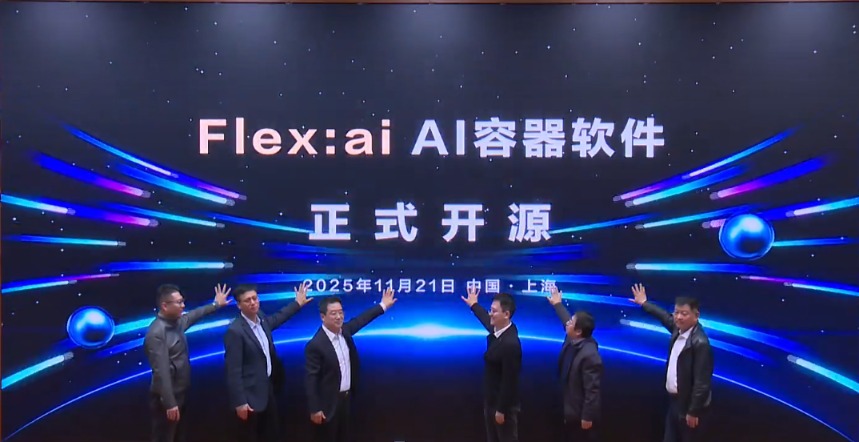
Core Insights - Huawei's Vice President Zhou Yuefeng announced the launch of AI container technology Flex:ai at the 2025 AI Container Application Implementation and Development Forum in Shanghai, aiming to address the challenges of computing resource utilization [1] - The technology is designed to package model code and runtime environments into lightweight images, facilitating seamless cross-platform migration and addressing deployment inconsistencies [1] - Gartner predicts that by 2027, over 75% of AI applications will be deployed using container technology, highlighting the growing importance of this technology in the AI industry [1] Group 1 - The Flex:ai technology allows for on-demand mounting of GPU and NPU resources, enhancing overall resource utilization in clusters [1] - The AI industry is experiencing rapid growth, leading to a significant demand for computing power, while global resource utilization remains low, resulting in substantial waste [1] - Issues such as small model tasks monopolizing resources and large model tasks lacking sufficient computing power contribute to the inefficiency in resource allocation [1] Group 2 - Flex:ai is built on the Kubernetes container orchestration platform, enabling precise management and intelligent scheduling of GPU and NPU resources [2] - The software aims to match AI workloads with computing resources effectively, significantly improving utilization rates [2] - Huawei plans to collaborate with academic institutions to continuously enhance the Flex:ai software, making AI technology more accessible to users and developers [2]
华为联合高校发布并开源AI容器技术 助力算力利用效率提升
Zheng Quan Shi Bao Wang· 2025-11-21 11:17
Core Insights - Huawei officially launched the AI container technology Flex:ai at the 2025 AI Container Application Implementation and Development Forum, aiming to address the low utilization of computing resources in the AI industry [1] Group 1: Technology Development - Flex:ai is a software for pooling and scheduling XPU resources, built on the Kubernetes container orchestration platform, which aims to enhance the utilization of AI workloads and computing resources [1] - The technology integrates research capabilities from three major universities and Huawei, achieving breakthroughs in three core technologies [1] Group 2: Resource Optimization - The XPU pooling framework developed in collaboration with Shanghai Jiao Tong University allows a single GPU or NPU card to be divided into multiple virtual computing units, improving overall computing utilization by 30% in scenarios where small AI models are trained [2] - A cross-node virtualization technology developed with Xiamen University aggregates idle XPU resources within a cluster to form a "shared computing pool," enabling general servers to forward AI workloads to remote GPU/NPU cards [2] Group 3: Intelligent Scheduling - The Hi Scheduler, developed with Xi'an Jiaotong University, provides intelligent scheduling for heterogeneous computing resources, ensuring optimal resource allocation for AI workloads even under fluctuating loads [3] - The comprehensive open-source nature of Flex:ai will allow developers from various sectors to access core technological capabilities, promoting the establishment of standardized solutions for efficient computing resource utilization in the global AI industry [3]
见证历史!华为 重大发布
Zhong Guo Ji Jin Bao· 2025-11-21 09:49
Core Insights - Huawei has officially launched a groundbreaking AI technology called Flex:ai, which can enhance the average utilization rate of computing resources by 30% in AI workloads where full card computing power is not utilized [1][3] - Flex:ai is a software for pooling and scheduling various types of processors (XPU) based on Kubernetes, and it is set to be open-sourced to the Moqing community, contributing to a complete ModelEngine open-source ecosystem [1][6] - The technology aims to facilitate the industrial application of AI, with Huawei's VP stating that it can unlock the potential of infrastructure and accelerate the democratization of AI [1][6] Group 1: Flex:ai Capabilities - Flex:ai presents three key capabilities: resource slicing, multi-level intelligent scheduling, and cross-node resource aggregation [3][5] - The technology allows for the slicing of a single GPU/NPU card into multiple virtual computing units, achieving a precision of 10%, enabling multiple AI workloads to run simultaneously on a single card [4][5] - Flex:ai's intelligent scheduling can automatically sense cluster loads and resource states, optimizing the allocation of virtualized GPU and NPU resources based on workload priority and requirements [5][6] Group 2: Competitive Advantages - Compared to Nvidia's Run:ai technology, Flex:ai has two unique advantages: virtualization and intelligent scheduling [5][7] - The "remote virtualization" feature allows for the aggregation of idle XPU resources across the cluster into a "shared computing pool," providing ample support for high-demand AI workloads [5][9] - Flex:ai can also ensure that high-priority AI workloads receive the necessary computing resources, even reallocating resources from lower-priority tasks when needed [5][6] Group 3: Ecosystem Development - The release and open-sourcing of Flex:ai will help Huawei build a complete ModelEngine open-source ecosystem, which includes previously released tools like Nexent, AppEngine, DataMate, and UCM [6][9] - The ModelEngine platform offers a one-stop service for data preprocessing, model training, optimization, and deployment, catering to the needs of large model training and inference [6][9] - The open-source nature of Flex:ai encourages collaboration among developers from academia and industry to establish standards for heterogeneous computing virtualization and AI application integration [9]

见证历史!华为,重大发布
Zhong Guo Ji Jin Bao· 2025-11-21 09:42
Core Insights - Huawei has officially launched a groundbreaking AI technology called Flex:ai, which can enhance the average utilization rate of computing resources by 30% in AI workloads where full card computing power is not utilized [1] Group 1: Flex:ai Overview - Flex:ai is a software for pooling and scheduling various types of processors (XPU) built on Kubernetes, similar to Nvidia's Run:ai technology, but with two unique advantages [1] - The technology is positioned as a crucial tool for the industrialization of AI, with Huawei planning to open-source it to the Magic Engine community to build a complete ModelEngine open-source ecosystem [1] Group 2: Key Capabilities of Flex:ai - Flex:ai addresses the need for AI container technology, which is essential in the era of large models, by providing lightweight virtualization that allows seamless migration of model code and runtime environments [2] - The technology can dynamically mount GPU and NPU resources, enhancing overall resource utilization in clusters [2] - It is projected that by 2027, over 75% of AI workloads will be deployed and run using container technology [2] Group 3: Resource Management and Scheduling - Flex:ai can partition a single GPU/NPU card into multiple virtual computing units with a precision of 10%, allowing multiple AI workloads to run simultaneously on a single card [3] - The technology features unique virtualization capabilities, including "remote virtualization," which aggregates idle XPU resources across the cluster into a "shared computing pool" [5] - Flex:ai's intelligent scheduling can automatically sense cluster load and resource status, optimizing resource allocation based on workload priority and requirements [6] Group 4: ModelEngine Open-source Ecosystem - The release and open-sourcing of Flex:ai will support Huawei in building a comprehensive ModelEngine open-source ecosystem, which includes previously released tools like Nexent, AppEngine, DataMate, and UCM [7] - ModelEngine serves as an AI platform for model training, inference, and application development, providing a one-stop service from data preprocessing to model deployment [7] Group 5: Industry Application and Collaboration - Flex:ai is designed to facilitate the practical application of AI container technology across various industries, addressing the diverse needs of AI workloads [9] - The open-source nature of Flex:ai encourages collaboration among academia, industry, and developers to establish standards for heterogeneous computing virtualization and AI application integration [9]
指数持续承压后短线面变盘节点,AI方向再迎新催化
Xin Lang Cai Jing· 2025-11-21 01:31
Group 1: Lithium Battery Sector - The lithium battery sector is experiencing increased differentiation, with lithium mining stocks strengthening while core stocks of lithium hexafluorophosphate are declining sharply [1] - Carbonate lithium prices continue to rise, leading to strong performance in lithium mining stocks such as ZG Shares and DWS Shares, which hit the daily limit [1] - However, core stocks like Tianji Shares and Duofluo Duo both closed at the daily limit down, indicating a potential shift in the sector's overall trend towards differentiation [1] Group 2: AI Applications - Google's new multimodal AI model, Gemini 3.0 Pro Image, represents a significant update, functioning as an inference model that internally reasons before generating images, which may accelerate the commercialization of multimodal AI [2] - The update of the second-generation Nano Banana reinforces the certainty of industry trends, particularly benefiting sectors such as advertising, media, and gaming [2] - Huawei is set to release its open-source AI container technology, Flex:ai, at a forum in Shanghai, aiming to unify and efficiently manage various computing resources, which could lead to market movements in this direction [2]