
Flex:ai

Search documents
计算机行业周报 20251222-20251226:华为 2026 会反转吗?智谱和 minimax 对比研究!-20251227
Shenwan Hongyuan Securities· 2025-12-27 13:23
Investment Rating - The report maintains an optimistic outlook for the AI computing industry in 2026, particularly focusing on Huawei's advancements and opportunities in the sector [3][4]. Core Insights - 2026 is projected to be a pivotal year for the domestic AI computing industry, with Huawei expected to unveil a series of new products and technologies that the market has not yet fully reacted to [3][4]. - Huawei's Ascend 950 series, including the Ascend 950PR and Ascend 950DT chips, is set to significantly enhance AI computing capabilities, with a focus on cost-effective solutions and high performance [4][9]. - The report highlights the importance of storage and connectivity in the evolution of AI computing chips, with Huawei making substantial innovations in these areas [4][9]. - The IPOs of Zhiyuan and MiniMax mark significant milestones in the AI model startup landscape, representing different business models in the sector [3][37]. Summary by Sections Huawei's Computing Innovations - Huawei is positioned as a comprehensive ICT manufacturer, integrating various components from semiconductor supply chains to software ecosystems, which is expected to lead to system-level advancements [4][7]. - The Ascend 950 series is designed to support industry-standard low-precision data formats, significantly improving training efficiency and inference throughput [7][9]. - The upcoming Atlas 950 supernode, based on the Ascend 950DT chip, is expected to achieve unprecedented performance metrics, including an FP8 computing power of 8 EFLOPS and an interconnect bandwidth of 16 PB/s [22][23]. Zhiyuan and MiniMax Comparison - Zhiyuan, backed by Tsinghua University, focuses on B2B localized deployment, achieving rapid revenue growth with a projected revenue of 3.1 billion yuan in 2024, reflecting a year-on-year increase of 150.9% [39][44]. - MiniMax, established in 2021, emphasizes efficient model architecture and rapid commercialization of consumer products, with a significant portion of its revenue coming from overseas markets [50][51]. - Both companies represent distinct paths in the AI model startup ecosystem, with Zhiyuan focusing on enterprise solutions and MiniMax targeting consumer applications [63].
下一个“AI卖铲人”:算力调度是推理盈利关键,向量数据库成刚需
Hua Er Jie Jian Wen· 2025-12-24 04:17
Core Insights - The report highlights the emergence of AI infrastructure software (AI Infra) as a critical enabler for the deployment of generative AI applications, marking a golden development period for infrastructure software [1] - Unlike the model training phase dominated by tech giants, the inference and application deployment stages present new commercial opportunities for independent software vendors [1] - Key products in this space include computing scheduling software and data-related software, with computing scheduling capabilities directly impacting the profitability of model inference services [1][2] Computing Scheduling - AI Infra is designed to efficiently manage and optimize AI workloads, focusing on large-scale training and inference tasks [2] - Cost control is crucial in the context of a price war among domestic models, with Deepseek V3 pricing significantly lower than overseas counterparts [5] - Major companies like Huawei and Alibaba have developed advanced computing scheduling platforms that enhance resource utilization and reduce GPU requirements significantly [5][6] - For instance, Huawei's Flex:ai improves utilization by 30%, while Alibaba's Aegaeon reduces GPU usage by 82% through token-level dynamic scheduling [5][6] Profitability Analysis - The report indicates that optimizing computing scheduling can serve as a hidden lever for improving gross margins, with a potential increase from 52% to 80% in gross margin by enhancing single-card throughput [6] - The sensitivity analysis shows that a 10% improvement in throughput can lead to a gross margin increase of 2-7 percentage points [6] Vector Databases - The rise of RAG (Retrieval-Augmented Generation) technology has made vector databases a necessity for enterprises, with Gartner predicting a 68% adoption rate by 2025 [10] - Vector databases are essential for supporting high-speed retrieval of massive datasets, which is critical for RAG applications [10] - The demand for vector databases is expected to surge, driven by a tenfold increase in token consumption from API integrations with large models [11] Database Landscape - The data architecture is shifting from "analysis-first" to "real-time operations + analysis collaboration," emphasizing the need for low-latency processing [12][15] - MongoDB is positioned well in the market due to its low entry barriers and adaptability to unstructured data, with significant revenue growth projected [16] - Snowflake and Databricks are expanding their offerings to include full-stack tools, with both companies reporting substantial revenue growth and customer retention rates [17] Storage Architecture - The transition to real-time AI inference is reshaping storage architecture, with a focus on reducing IO latency [18] - NVIDIA's SCADA solution demonstrates significant improvements in IO scheduling efficiency, highlighting the importance of storage performance in AI applications [18][19]


计算机行业周报:AI Infra:重点关注数据层软件及MaaS-20251129
Shenwan Hongyuan Securities· 2025-11-29 15:20
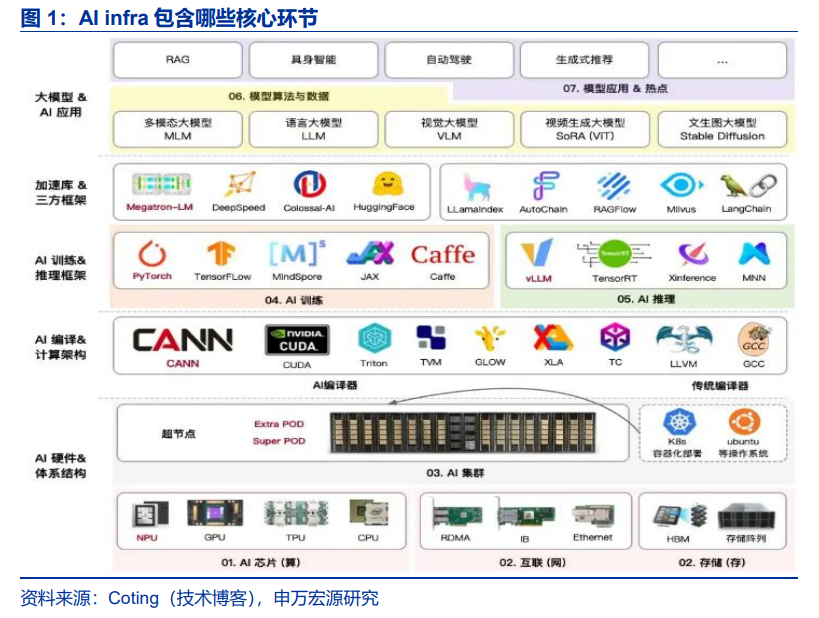
Investment Rating - The report rates the industry as "Overweight," indicating a positive outlook for the sector's performance compared to the overall market [61]. Core Insights - The report emphasizes the importance of AI Infrastructure (AI Infra) as a foundational system for AI workloads, which includes computing power, storage, and networking [5][11]. - The AI Infra market in China is projected to grow significantly, reaching CNY 3.45 billion in 2024 and CNY 6.73 billion in 2025, representing a year-on-year growth of 95.1% [7][10]. - Key players in the AI Infra space include both domestic and international companies, with a focus on data layer software and models [4][36]. Summary by Sections AI Infra Overview - AI Infra is defined as the hardware and software systems designed to support AI workloads, aiming for efficient and large-scale AI model training and inference [5][11]. - The infrastructure consists of several layers, including computing, storage, and networking, with a focus on optimizing AI model performance [8][11]. Market Growth and Trends - The AI Infra market is expected to see rapid growth, with a significant increase in the number of AI applications anticipated in 2024 [29][32]. - The demand for private deployment and data integration solutions is rising, particularly in sectors with stringent data security requirements [29][36]. Key Players and Technologies - Major players in the AI Infra market include Alibaba Cloud, Huawei Cloud, and various startups focusing on Machine as a Service (MaaS) [12][13]. - Technologies such as virtualization and containerization are central to the computing management layer, enhancing resource utilization and efficiency [12][22]. Investment Opportunities - The report identifies several investment targets across different categories, including AIGC applications, digital economy leaders, and data infrastructure [52][53]. - Companies like Snowflake and MongoDB are highlighted as international benchmarks for data layer software, with strong revenue growth trends [36][38]. Future Outlook - AI infrastructure providers are expected to maintain high growth potential due to their critical role in supporting AI applications and the increasing integration of AI into traditional industries [51].



算力利用率提升30% 万兴科技(300624.SZ)等华为云合作方或受益
智通财经网· 2025-11-27 01:16
Group 1 - Huawei officially launched and open-sourced its innovative AI container technology Flex:ai, which can enhance the average utilization rate of computing resources by 30% through precise management and intelligent scheduling of GPU and NPU resources [1] - The average utilization rate of computing resources in the industry currently ranges from 30% to 40%, indicating a significant opportunity for improvement [1] - The high computing costs and the need for optimization in computing resources are identified as bottlenecks restricting the development of the AI industry [1] Group 2 - Wanjun Technology (300624.SZ) is a leading player in China's digital creative software sector, with a global presence in over 200 countries and regions, and has surpassed 2 billion active users [2] - Wanjun Technology has collaborated with Huawei Cloud on multiple levels, including computing power, AI technology, and product application deployment [2] - The AI server call volume of Wanjun Technology exceeded 800 million times in the first three quarters of this year, reflecting a high user enthusiasm for AI [2]

算力利用率提升30%,华为与三大高校开源Flex:ai
Feng Huang Wang· 2025-11-26 13:49
Core Insights - Huawei, in collaboration with Shanghai Jiao Tong University, Xi'an Jiaotong University, and Xiamen University, has launched and open-sourced the AI container technology Flex:ai, aimed at making AI more accessible and efficient for enterprises and households [1][2] Group 1: Technology and Development - Flex:ai technology focuses on virtualization and resource pooling to achieve fine-grained management and intelligent scheduling of computing resources, addressing the challenges of AI deployment in various sectors, particularly healthcare [1] - The technology aims to enhance resource utilization, as demonstrated by testing data showing an increase in resource utilization from 20% to 80% through virtualization and scheduling optimization [1] - The open-source nature of Flex:ai allows for integration with mainstream frameworks like Kubernetes, promoting compatibility with heterogeneous computing resources [2] Group 2: Challenges and Solutions - Key challenges identified include low resource utilization during AI inference, particularly in hospitals where servers are underutilized during off-peak hours [3] - Solutions proposed include dynamic scaling, task migration, and fine-grained resource allocation, with initial experiments showing a resource overhead of less than 5% during fault migration and performance isolation [3] - The development of a hierarchical scheduling mechanism is underway to improve resource allocation and ensure fairness in multi-tenant environments [1][3]
算力迎来“量子跃迁”!计算机ETF(159998)昨日再获净申购超1500万份,云计算ETF天弘(517390)连续两日反弹
2 1 Shi Ji Jing Ji Bao Dao· 2025-11-26 01:32
Group 1: A-Share Market Performance - The A-share market experienced a rebound, with the ChiNext Index rising nearly 2%, driven by active concepts such as AI applications and optical communications [1] - The Computer ETF (159998) saw a rise and has rebounded for two consecutive days, with notable gains in constituent stocks like Shiji Information (over 7%) and Weining Health (over 5%) [1] - The Computer ETF recorded a net subscription of 15.6 million units yesterday, marking a total net inflow exceeding 69 million yuan over the past five trading days [1] Group 2: Cloud Computing and AI Developments - The Tianhong Cloud Computing ETF (517390) continued its upward trend, with a year-to-date share growth rate of 380.36% as of November 24 [1] - The Computer ETF tracks the CSI Computer Theme Index, which encompasses both hardware and software sectors, reflecting the overall performance of the computer industry [1] - The Tianhong Cloud Computing ETF uniquely tracks the CSI Shanghai-Hong Kong-Shenzhen Cloud Computing Industry Index, providing access to competitive cloud computing assets across A-shares and Hong Kong stocks [1] Group 3: Quantum Computing and AI Software Innovations - Shanghai Jiao Tong University launched the world's first quantum scientific computing platform, UnitaryLab, aimed at overcoming traditional computing limitations [2] - Huawei introduced Flex:ai AI container software, which utilizes power slicing technology to enhance GPU/NPU utilization, allowing multiple AI workloads to run simultaneously [2] - Domestic computing capabilities are advancing, with Huawei's Flex:ai focusing on improving AI cluster efficiency and reducing migration barriers, reinforcing the software layer's role in addressing hardware limitations [2]

华为发布开源AI容器技术Flex:ai:让闲置算力“动起来”,把一张卡切给多任务使用丨最前线
3 6 Ke· 2025-11-25 13:54
Core Viewpoint - The simultaneous occurrence of "insufficient computing power" and "wasted computing power" is highlighted, with Huawei's release of the AI container technology Flex:ai aimed at improving computing resource utilization through three technological innovations [1] Group 1: Flex:ai Overview - Huawei officially launched the Flex:ai technology at the 2025 AI Container Application Landing and Development Forum, which includes the open-sourcing of the XPU pooling and scheduling software [1][2] - Flex:ai is built on Kubernetes and focuses on the refined management and intelligent scheduling of GPU, NPU, and other intelligent computing resources, consolidating scattered computing power into a "resource pool" [1][2] Group 2: Core Capabilities of Flex:ai - The XPU pooling framework, developed in collaboration with Shanghai Jiao Tong University, allows a single GPU or NPU card to be split into multiple virtual computing units with 10% precision, increasing overall computing utilization by 30% in small model training and inference scenarios [2] - The cross-node remote virtualization technology, developed with Xiamen University, aggregates idle XPU computing power across different machines to form a "shared computing pool," enabling general servers without intelligent computing capabilities to access remote GPU/NPU resources for AI calculations [2] - The Hi Scheduler intelligent scheduler, developed with Xi'an Jiaotong University, addresses the challenge of unified scheduling of heterogeneous computing resources by automatically selecting suitable local or remote resources based on task priority and computing requirements, achieving time-sharing reuse and global optimal scheduling [2] Group 3: Open Source Initiative - Huawei's decision to fully open source Flex:ai aims to provide all core technological capabilities to developers across academia and industry, promoting the construction of standards for heterogeneous computing virtualization and AI application platform integration [2]
创业板人工智能ETF南方(159382)上涨4.19%,国产算力再获重要突破,机构:AI引领的中国股票上涨远非泡沫
Xin Lang Cai Jing· 2025-11-25 02:27
Core Viewpoint - The launch of Huawei's Flex:ai technology is expected to significantly enhance AI computing efficiency and drive growth in the AI sector, supported by favorable government policies and increasing investor interest in Chinese tech stocks [1][2][3]. Group 1: Market Performance - As of November 25, 2025, the Southern AI ETF (159382) rose by 4.19%, with a trading volume of 30.83 million yuan [1]. - The underlying index, the Southern AI Index, increased by 4.44%, with notable gains from constituent stocks such as Changxin Bochuang (up 14.31%) and Guangku Technology (up 13.39%) [1]. - Over the past five trading days, the Southern AI ETF has seen a net inflow of 496 million yuan [1]. Group 2: Technological Developments - Huawei's Flex:ai technology, introduced at the AI container application forum, aims to improve the average utilization rate of computing resources, which currently stands at only 30% to 40% [1]. - Flex:ai utilizes a Kubernetes-based platform to create a pool of virtual computing units from a single GPU/NPU, allowing for more efficient workload management and a potential 30% increase in resource utilization [1]. Group 3: Policy Support - The Guangdong provincial government has launched a development plan for the digital economy, emphasizing the importance of AI and robotics innovation from 2025 to 2027 [2]. - The plan includes initiatives to support the development of general and specialized AI models and aims to establish a demonstration zone for AI applications, targeting a core industry scale of over 440 billion yuan by 2027 [2]. Group 4: Investment Sentiment - Goldman Sachs has indicated that the rise of AI-driven Chinese stocks is not a bubble, as there remains significant potential for tech companies to enhance valuations and profitability through AI applications [3]. - There is a growing interest among global investors, particularly from emerging markets, in exploring investment opportunities within the Chinese market [3].

华为联合三大高校发布并开源AI容器技术Flex:ai,助力破解算力资源利用难题
Xin Lang Ke Ji· 2025-11-24 14:03
Core Insights - Huawei officially launched the AI container technology Flex:ai at the 2025 AI Container Application Landing and Development Forum, in collaboration with Shanghai Jiao Tong University, Xi'an Jiaotong University, and Xiamen University, to address the low utilization of computing resources in the AI industry [1][2] Group 1: Technology Overview - The Flex:ai technology aims to tackle the issue of "computing resource waste" in the AI industry, where small model tasks monopolize entire cards, leading to resource idleness, while large model tasks face insufficient computing power [1] - Flex:ai is built on the Kubernetes container orchestration platform, enabling precise matching of AI workloads with computing resources through refined management and intelligent scheduling of GPU and NPU resources, significantly improving computing resource utilization [1] Group 2: Key Technological Breakthroughs - A collaboration with Shanghai Jiao Tong University led to the development of the XPU pooling framework, which allows a single GPU or NPU card to be divided into multiple virtual computing units, increasing overall computing utilization by 30% in small model training and inference scenarios [2] - A partnership with Xiamen University resulted in cross-node remote virtualization technology, which aggregates idle XPU computing resources within a cluster to form a "shared computing pool," facilitating the integration of general-purpose and intelligent computing resources [2] - The Hi Scheduler intelligent scheduler, developed in collaboration with Xi'an Jiaotong University, addresses the challenge of unified scheduling of heterogeneous computing resources, ensuring stable operation of AI workloads even under fluctuating loads [2]
华为发布AI容器技术Flex:AI,国产算力再次突破
China Post Securities· 2025-11-24 05:50
Investment Rating - The industry investment rating is "Outperform the Market" and is maintained [1] Core Insights - The report highlights the launch of Huawei's AI container technology Flex:ai, which addresses the low utilization efficiency of computing power in the industry, currently averaging only 30% to 40%. Flex:ai enhances utilization by 30% through precise segmentation of GPU/NPU resources [4][5] - The report emphasizes the unique advantages of Flex:ai over Nvidia's Run:ai, particularly in virtualization and intelligent scheduling, which can optimize resource allocation for AI workloads [5][6] - The development of Flex:ai is seen as a significant step in strengthening domestic computing power capabilities, promoting a complete open-source ecosystem for AI tools [6][7] Summary by Sections Industry Overview - The closing index is at 5068.36, with a 52-week high of 5841.52 and a low of 3963.29 [1] Performance Analysis - The relative performance of the computer industry compared to the CSI 300 index shows fluctuations, with a notable decline of 13% from November 2024 to November 2025 [3] Key Developments - Huawei's Flex:ai is positioned to significantly improve AI cluster computing efficiency and reduce migration barriers for AI models, reinforcing the software capabilities in the domestic computing landscape [6][7] - The report suggests monitoring companies involved in AI containers and domestic computing power, including BoRui Data, Haohan Deep, and others [7]