AI视频应用

Search documents
周五停牌!“入主”三年后 河南国资欲“脱手”中威电子
Shang Hai Zheng Quan Bao· 2025-12-04 21:38
Core Viewpoint - The company Zhongwei Electronics is undergoing a potential change in control as its major shareholder, Xinxiang Investment Fund No. 1, is planning to transfer control, which may lead to a change in the actual controller of the company [2]. Group 1: Company Overview - Zhongwei Electronics operates in the video surveillance sector of the security industry, focusing on AI video applications and providing IoT solutions [5]. - The company has developed core technologies including video structuring, cloud technology, big data analysis, and IoT perception and transmission [5]. - The company aims to offer standardized and replicable system solutions for various sectors such as smart highways, smart transportation, and smart city management [5]. Group 2: Shareholder Changes - In August 2020, the actual controller Shi Xugang planned to transfer control of Zhongwei Electronics to Xinxiang Investment Fund No. 1, which is ultimately controlled by the People's Government of Xinxiang City, Henan Province [5]. - The transfer of control was completed in May 2022, with Xinxiang Investment Fund No. 1 officially becoming the controlling shareholder [5]. - During the period of Henan state-owned assets' control, Zhongwei Electronics experienced two leadership changes [5]. Group 3: Leadership Changes - Li Yice became the new chairman of Zhongwei Electronics in July 2022 but resigned before completing three years due to work adjustments [6]. - Liu Yang was elected as the new chairman in March 2025, bringing experience in digital industry planning and capital operations [6]. Group 4: Financial Performance - Zhongwei Electronics has faced significant challenges in the security industry, resulting in poor financial performance with six losses in seven years [6]. - For the first three quarters of 2025, the company reported revenue of 71.1 million yuan, a year-on-year decline of 34.47%, and a net profit attributable to shareholders of -43.3 million yuan, which represents a 14% reduction in losses compared to the previous year [7].


周五停牌!300270或“易主”
Shang Hai Zheng Quan Bao· 2025-12-04 15:35
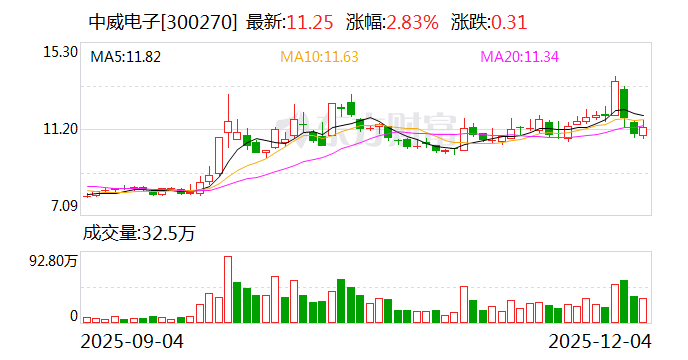
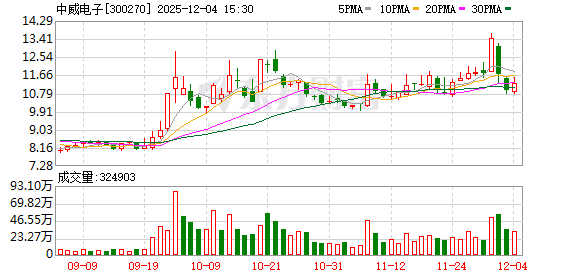
Group 1 - The controlling shareholder of Zhongwei Electronics is planning to change the company's control, which may lead to a change in the actual controller [2] - Zhongwei Electronics' stock was suspended from trading on December 5, 2025, due to the announcement regarding the potential change in control [2] - The company's stock price experienced a strong increase since September 2025, with a closing price of 11.25 yuan per share and a market capitalization of 3.407 billion yuan as of December 4, 2025 [2] Group 2 - Zhongwei Electronics operates in the video surveillance sector of the security industry, focusing on AI video applications and providing IoT solutions [5] - The company was taken over by the Xinxiang Investment Fund No. 1, which is controlled by the Henan Xinxiang Municipal Government, after a two-year process that began in August 2020 [5] - During the period of Henan state-owned assets' control, Zhongwei Electronics underwent two leadership changes, with Liu Yang becoming the chairman in March 2025 [5][6] Group 3 - The security industry has faced significant challenges, leading to poor performance for Zhongwei Electronics, which has reported losses in six out of the last seven years [6] - For the first three quarters of 2025, Zhongwei Electronics reported revenue of 71.1015 million yuan, a year-on-year decrease of 34.47%, and a net profit attributable to shareholders of -43.3178 million yuan, reflecting a 14.00% reduction in losses compared to the previous year [7]
“百度不做”,仅仅一年,李彦宏反悔了
Sou Hu Cai Jing· 2025-10-20 08:59
Core Viewpoint - The rapid evolution of AI video applications, particularly following the release of OpenAI's Sora 2, has prompted major Chinese tech companies, including Baidu, to pivot towards developing their own AI video models despite initial hesitations [1][4][24] Group 1: Industry Dynamics - The launch of Sora 2 has ignited competition among major players in the AI video space, with companies like Baidu and Google quickly promoting their own models [2][3] - Prior to Sora's release, Chinese tech giants were focused on catching up with GPT-4 rather than developing their own video generation models, reflecting a broader industry anxiety about capabilities [10][12] - The competitive landscape has shifted significantly, with over 20 video AI models now available in the Chinese market, indicating a rapid increase in development and deployment [12] Group 2: Technological Advancements - Sora distinguishes itself by achieving a level of realism in video generation that adheres to physical rules, setting a new standard for detail and authenticity in AI-generated content [5][9] - The evolution of video AI models is characterized by improvements in video quality and user editing capabilities, enhancing the overall user experience [15][16] - The integration of real-time audio generation in AI video tools addresses previous limitations, allowing for more dynamic and engaging content creation [16] Group 3: Market Opportunities - The potential for monetization in AI video applications is becoming clearer, with Sora 2 showcasing capabilities that could attract a large user base and create new revenue streams [18][22] - The user-friendly design of Sora 2 encourages widespread adoption, with features that allow for easy video creation and personalization, positioning it as a competitive platform in the market [22][24] - The success of platforms like TikTok suggests that the AI video market may consolidate around a few dominant players, intensifying competition as companies strive to establish themselves as leaders [24]



中威电子(300270) - 300270中威电子投资者关系管理信息20250514
2025-05-14 09:12
Group 1: Core Technology Advantages - The company's core technology advantages are reflected in five key areas: deep accumulation in video technology, intelligent algorithms and big data analysis capabilities, IoT perception and system integration advantages, smart hardware and scenario-based solutions, and integrated services and market expansion capabilities [1]. Group 2: Financial Performance - In 2024, the company has not yet turned a profit, but the operating situation has improved, with a reduction in the loss margin compared to the previous year. Revenue has increased, and the gross profit margin has improved [2]. - The gross profit margin for 2024 is 26.39%, slightly up from 23.67% in 2023, primarily due to accelerated technological iterations in the video surveillance field and competitive pricing strategies [4]. Group 3: Cost Reduction and Efficiency Improvement - The company has implemented cost reduction measures such as procurement negotiations and inventory management, which have effectively lowered procurement costs and inventory backlog [2]. - The deployment of the PMS project management platform has optimized resource allocation and reduced delay risks through real-time monitoring [2]. Group 4: Research and Development Investment - In 2024, the company invested 20.0273 million yuan in R&D, accounting for 10.97% of total revenue. The focus will be on integrating products with digital technologies in smart highways and upgrading solutions for smart parks [4]. - Despite a 31.22% year-on-year decrease in R&D expenses, the company has optimized processes to lower marginal costs and concentrated resources on high-potential areas, ensuring no negative impact on innovation [5]. Group 5: Future Growth and Profit Distribution - Future profit growth points are expected to come from deepening core business, expanding into emerging fields, and innovating business models while improving operational efficiency and cash flow [5]. - The company will not distribute profits for 2024 due to negative retained earnings, but has a three-year shareholder dividend plan in place [4].
中金《秒懂研报》| AI视频,如何破浪前行?
中金点睛· 2025-04-04 00:05
Core Viewpoint - The article discusses the rise of AI video applications, highlighting the commercial opportunities and challenges in both B-end and C-end markets, driven by advancements in AI technology and user engagement [1][3][11]. Group 1: Technological Breakthroughs and Commercialization - The emergence of DiTs architecture marks a pivotal point in video generation technology, balancing quality, stability, speed, and cost, thus laying the foundation for AI video applications [3]. - The commercial exploration phase has begun, with companies like Kuaishou launching paid models that have attracted over 6 million users and generated 65 million videos from June to December 10 [3][4]. Group 2: B-end Applications Opportunities and Challenges - In the film industry, AI video applications can enhance script analysis, special effects, and post-production processes, significantly improving efficiency [3][4]. - Despite the potential, B-end applications face challenges such as high costs for model training and tool acquisition, as well as the need for skilled labor for post-production adjustments [7][8]. - Acceptance of AI-generated content in the B-end remains uncertain, with platforms requiring disclosure of AI usage and industry associations advocating for worker protections [10]. Group 3: C-end Applications Opportunities and Challenges - C-end users show high enthusiasm for AI video applications, with significant engagement on social media platforms like Bilibili, where AI-generated videos have garnered millions of views [11]. - However, the quality and diversity of C-end AI videos are lacking, with only a few top videos achieving high viewership [12]. - Key challenges include user preferences for relatable or purely virtual content, the need for improved quality and quantity of AI-generated videos, and concerns over copyright and content labeling [14].