AI计算能力

Search documents
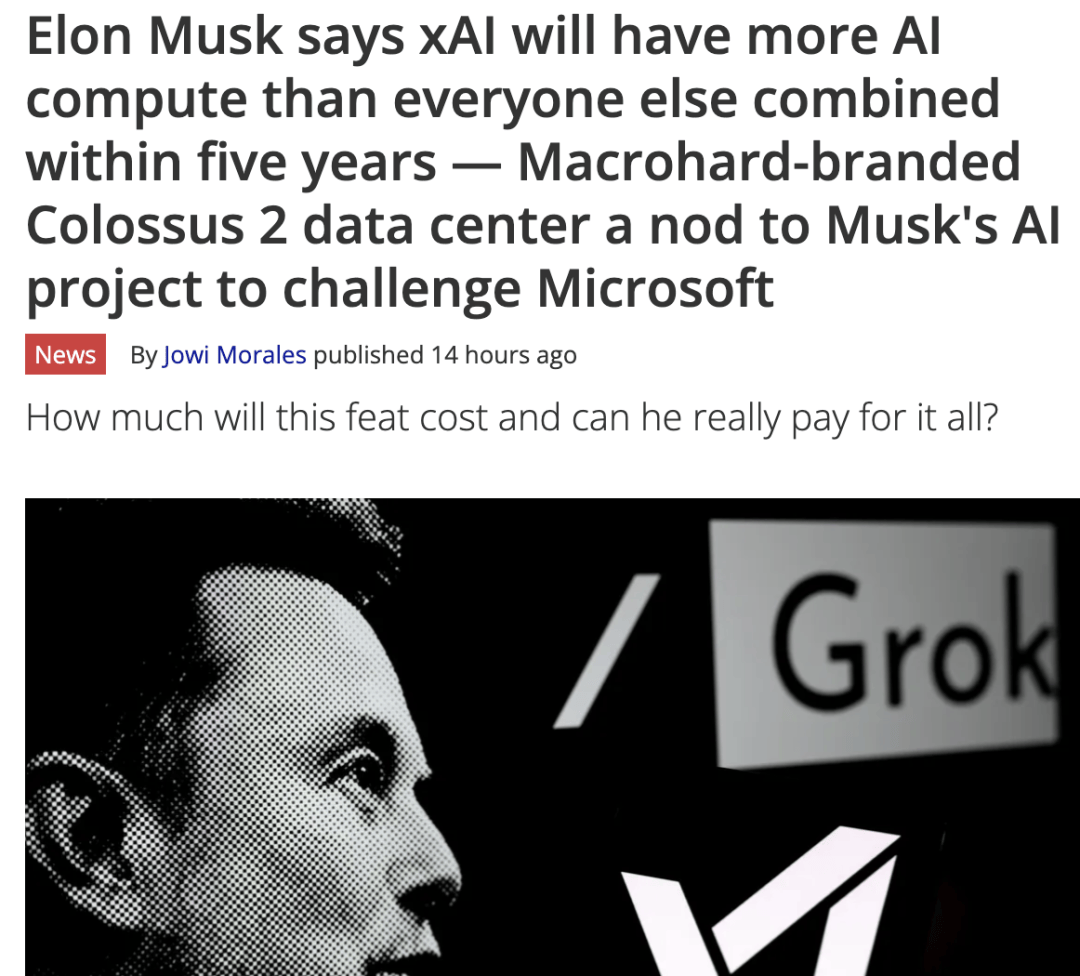
马斯克豪赌算力:xAI五年欲超全球总和,Colossus 2成烧钱引擎
Sou Hu Cai Jing· 2025-12-27 06:01
Core Insights - xAI is rapidly advancing its large-scale computing infrastructure, with a stable power capacity of approximately 390 MW at its Colossus 2 data center in Tennessee, nearing the 400 MW mark [1] - Elon Musk stated that within five years, xAI's AI computing power will surpass the total of all other companies combined [4] - By the end of 2025, xAI plans to have over 230,000 GPUs for training its Grok series models, aiming to deploy AI acceleration units equivalent to 50 million H100 performance levels by 2030 [4] Infrastructure Development - xAI is procuring a 2 GW gas power plant from overseas to support future single-point large-scale AI training demands [1] - The company is implementing energy efficiency optimization systems, including liquid cooling and waste heat recovery [4] Strategic Initiatives - xAI is initiating a new round of financing to support its ambitious growth and infrastructure plans [4] - The company is developing an all-stack AI software project internally codenamed "Macrohard" [4]

美国应该向中国出售 Blackwell 芯片吗
2025-12-10 01:57
Summary of Key Points from the Conference Call Industry and Company Involved - **Industry**: AI Chip Manufacturing and Export Controls - **Company**: NVIDIA, specifically regarding its B30A AI chip Core Points and Arguments 1. **Export Consideration**: The U.S. is contemplating allowing the export of NVIDIA's B30A chip to China, which would provide capabilities similar to the B300 at half the performance and cost [1][2][46] 2. **Policy Shift**: Approving the B30A export would mark a significant shift from the Trump administration's export control strategy aimed at denying advanced AI compute to strategic rivals [2][5] 3. **Supply Inelasticity**: If supply is inelastic, fewer AI chips may be sold to U.S. and global customers, potentially allowing Chinese companies to capture market share from U.S. firms [2][11] 4. **Access to AI Supercomputers**: Chinese AI labs would gain access to supercomputers comparable to U.S. labs at a similar cost, with B30A training clusters estimated to cost about 20% more than those based on the B300 [4][35] 5. **Diminished U.S. Advantage**: The U.S. AI compute advantage over China could shrink dramatically from 31x to less than 4x if B30As are exported, and could even flip to a 1.1x advantage for China in aggressive export scenarios [5][11] 6. **Demand Fulfillment Argument**: A key argument for allowing B30A exports is that it would satisfy Chinese demand for AI compute, which Huawei and other companies cannot meet due to U.S. export controls on semiconductor manufacturing equipment [11][12] 7. **Long-term Strategy**: Restricting exports of powerful AI chips like the B30A is seen as the best way to maintain the U.S.'s AI compute advantage in the short term and to halt China's domestic AI chip manufacturing expansion in the long term [13][19] 8. **Recent Developments**: Chinese regulators have banned purchases of NVIDIA's H20 chip, which may create an opportunity for the U.S. to promote B30A sales to limit market opportunities for Chinese competitors [25][26] Other Important but Overlooked Content 1. **Performance Comparison**: The B30A is expected to outperform the H20 chip by more than 12 times and exceed U.S. export control performance thresholds by over 18 times [46][47] 2. **Cost Efficiency**: The B30A is speculated to have a price-performance ratio similar to the best AI chips on the market, being priced at about half that of the B300 [49][35] 3. **Potential Risks**: Allowing B30A exports could accelerate China's AI development and undermine U.S. advantages in the global market, while doing little to change China's long-term goal of achieving self-sufficiency in advanced AI chips [26][28] This summary encapsulates the critical insights and implications discussed in the conference call regarding the potential export of NVIDIA's B30A chip to China and its broader impact on the AI chip industry and U.S.-China relations.

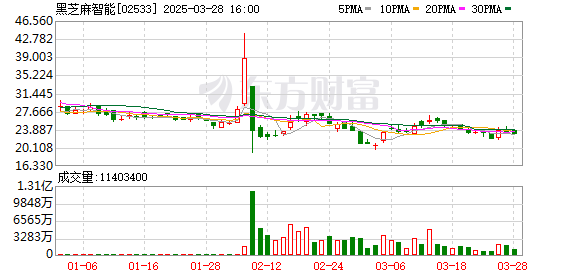
黑芝麻智能创始人单记章:智能驾驶最重要的是安全可靠的AI计算能力
Xin Hua Cai Jing· 2025-03-29 12:05
Group 1 - The core focus of the article is on the advancements in AI computing capabilities for intelligent driving, emphasizing the shift from data-driven to knowledge-driven algorithms [2] - The founder and CEO of Black Sesame Technology, Shan Jizhang, highlighted that the year 2023 is seen as the year of large-scale mass production for intelligent driving, driven by end-to-end algorithms and high-performance AI chips [2] - A significant challenge identified is the bandwidth limitation following breakthroughs in computing power, with future advancements expected to focus on improving bandwidth [2] Group 2 - Black Sesame Technology has strategically developed foundational chips, including the A1000 chip launched in 2020 and the C1296 chip introduced in 2023, which is crucial for central computing in electronic and electrical architecture [3] - The company has upgraded its intelligent driving capabilities with the C1236 chip, based on 7nm technology, enabling comprehensive urban Navigation on Autopilot (NOA) functions [3] - The latest A2000 chip, which has been delivered to clients, represents a significant breakthrough in AI computing efficiency and supports data closed-loop and multi-chip high-speed interconnection [4]