GDP实际增速

Search documents
张军:告别经济“温差”,要避免增长过于结构性
Di Yi Cai Jing Zi Xun· 2026-02-23 04:04
Core Viewpoint - The article discusses the current state of the Chinese economy, emphasizing that while it has achieved significant growth and development, there are challenges ahead that require careful policy adjustments to maintain sustainable growth before reaching the status of a moderately developed country [2][3]. Economic Development - China's economy has lifted nearly 800 million people out of poverty and developed a comprehensive infrastructure network, including advanced highways, high-speed rail, and telecommunications [3]. - The manufacturing sector has evolved from simple processing to advanced capabilities, with significant achievements in artificial intelligence, electric vehicles, and biomedicine [3]. - Despite these advancements, there remains a considerable gap between current development and long-term planning goals, necessitating a reasonable growth rate over the next decade [3][4]. GDP Growth Projections - To increase per capita GDP from approximately $14,000 to over $25,000 by 2035, an annual nominal growth rate of about 6% is required, considering a projected annual population decline of 0.35% [4]. - In 2025, actual GDP growth is projected at 5%, with nominal growth at only 3.9%, indicating a discrepancy between actual growth and economic conditions [4][5]. Structural Growth Issues - The growth has become increasingly concentrated in a few sectors, such as new energy vehicles and artificial intelligence, leading to a cooling macroeconomic environment despite a 5% actual GDP growth [5]. - The trend of shrinking total demand and income flow has resulted in deflationary pressures, causing nominal GDP growth to lag behind actual GDP growth [5]. Policy Recommendations - Economic policies should focus on balancing structural growth risks and maintaining macroeconomic stability, rather than solely targeting actual GDP growth rates [5][6]. - The central bank's monetary policy should prioritize price stability and actual unemployment, aligning with the practices of most central banks globally [5][6]. - A shift in focus from quantity-based monetary tools to price-based tools is necessary to alleviate macroeconomic tightening pressures and support a return to normal economic conditions [6].

郑州、榆林、洛阳、太原,这四个百强市一季度经济增量为负
Sou Hu Cai Jing· 2025-05-15 01:14
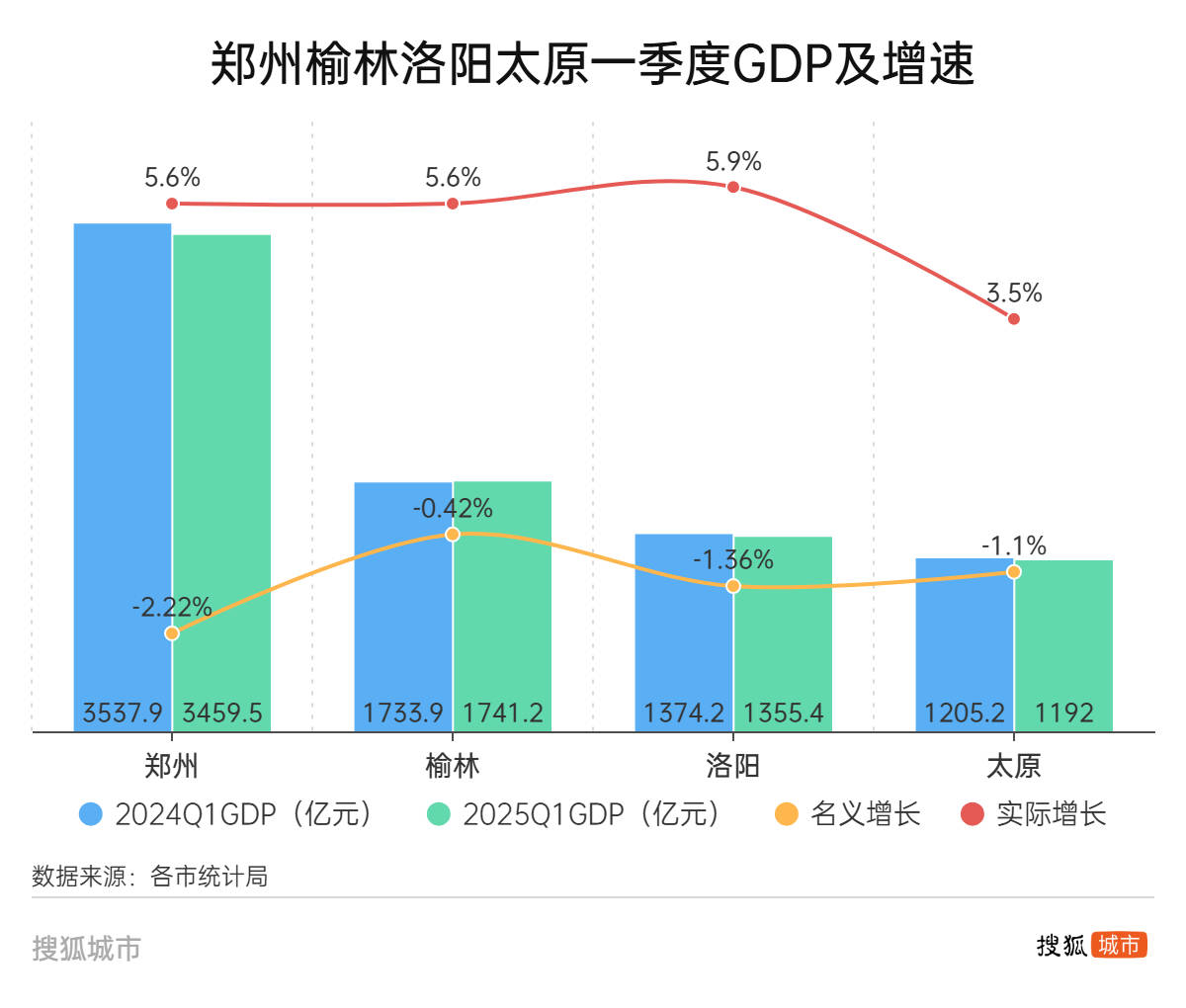
Group 1 - The nominal GDP growth rates for cities such as Zhengzhou, Yulin, Luoyang, and Taiyuan have turned negative compared to the same period last year, with Taiyuan experiencing the largest drop in ranking, falling 8 places to 64th [3] - Zhengzhou, Yulin, and Luoyang also reported negative nominal growth rates of -2.22%, -0.42%, and -1.36% respectively, with Zhengzhou ranking last among the top 100 cities [3] - Despite negative nominal growth, the actual GDP growth rates for these cities were positive, with Zhengzhou and Yulin at 5.6%, Luoyang at 5.9%, and Taiyuan at 3.5% [4][6] Group 2 - Zhengzhou's industrial output and consumer spending showed positive signs, with industrial value-added growth of 8.8% and retail sales growth of 5.7% in the first quarter [8] - Luoyang faces significant challenges in industrial transformation, having experienced negative GDP growth for two consecutive years, with a need to restructure its industrial base to avoid being left behind [12][15] - Taiyuan's economy is heavily reliant on coal prices, which have been declining, leading to a decrease in railway freight volume and industrial output, indicating a need for diversification [13][14] Group 3 - Yulin is making strides in industrial transformation, with over 80% of its industrial output coming from energy industries, and is developing new sectors such as hydrogen energy and low-altitude economy [14][15] - The cities facing negative growth have shown some positive developments, such as Zhengzhou's automotive manufacturing growth of 26.9% and Taiyuan's private investment growth of 45.5% [15] - The overall economic recovery for these cities hinges on industrial transformation, increased fixed asset investment, and consumer promotion [15]