
物价目标

Search documents
居民增收计划、养老金上涨、支持AI开源社区……45个关键词读懂2026政府工作报告
经济观察报· 2026-03-05 09:11
Economic Growth - The GDP growth target for 2026 is set at 4.5% to 5%, reflecting a pragmatic policy approach and considering both internal and external pressures on the economy [4][5] - The adjustment in the growth target aims to balance quality and reasonable growth, laying a foundation for high-quality economic development [5] Fiscal Policy - The proposed deficit rate for 2026 is around 4%, with a deficit scale of 5.89 trillion yuan, an increase of 230 billion yuan from the previous year [7] - Public budget expenditure is expected to reach 30 trillion yuan for the first time, with a focus on optimizing expenditure structure to support consumption and improve living standards [9][10] Tax and Financial Reforms - The government plans to advance tax and financial system reforms, including increasing the proportion of state-owned capital returns and enhancing local tax systems [12] - The emphasis on zero-based budgeting aims to optimize fund allocation and improve the efficiency of fiscal spending [12] Employment and Income - The urban survey unemployment rate target is set at around 5.5%, reflecting the need for policies to stabilize employment amid structural pressures [18] - The government aims to synchronize resident income growth with economic growth, emphasizing measures to increase income for low-income groups and improve social security systems [20][22] Environmental Goals - The target for reducing carbon dioxide emissions per unit of GDP is set at around 3.8%, aligning with the goal of achieving carbon peak by 2030 [26][27] - The shift from energy consumption control to carbon emission control reflects the need for a more precise approach to managing carbon emissions [27][28] State-Owned Enterprise Reforms - The government plans to implement a systematic approach to deepen state-owned enterprise reforms, focusing on optimizing the layout of state-owned capital and structural adjustments [29][30] - The emphasis on improving the modern enterprise system aims to enhance corporate governance and promote market-oriented reforms [31] Open Economy - The government intends to further expand high-level opening-up, focusing on service sector liberalization and enhancing international cooperation [35][36] - The approach aims to balance reform depth with security, promoting a competitive and fair business environment [36] Agricultural and Rural Development - The government is set to promote agricultural insurance development and enhance comprehensive disaster prevention capabilities in agriculture [59] - Policies will focus on improving rural elderly care services and implementing long-term care insurance systems to address the challenges of an aging population [45][47] Capital Market Stability - Measures to stabilize the stock market include comprehensive policies to enhance market confidence and promote active trading [54] - The government aims to improve the mechanism for long-term capital entering the market, ensuring a stable and healthy capital market [63] Innovation and Technology - The government plans to cultivate emerging and future industries, encouraging state-owned enterprises to lead in opening application scenarios for new technologies [69][70] - Support for artificial intelligence and open-source community development is expected to drive innovation and commercialization in various sectors [75]

罗志恒:2026年地方经济怎么干
Di Yi Cai Jing· 2026-02-25 03:41
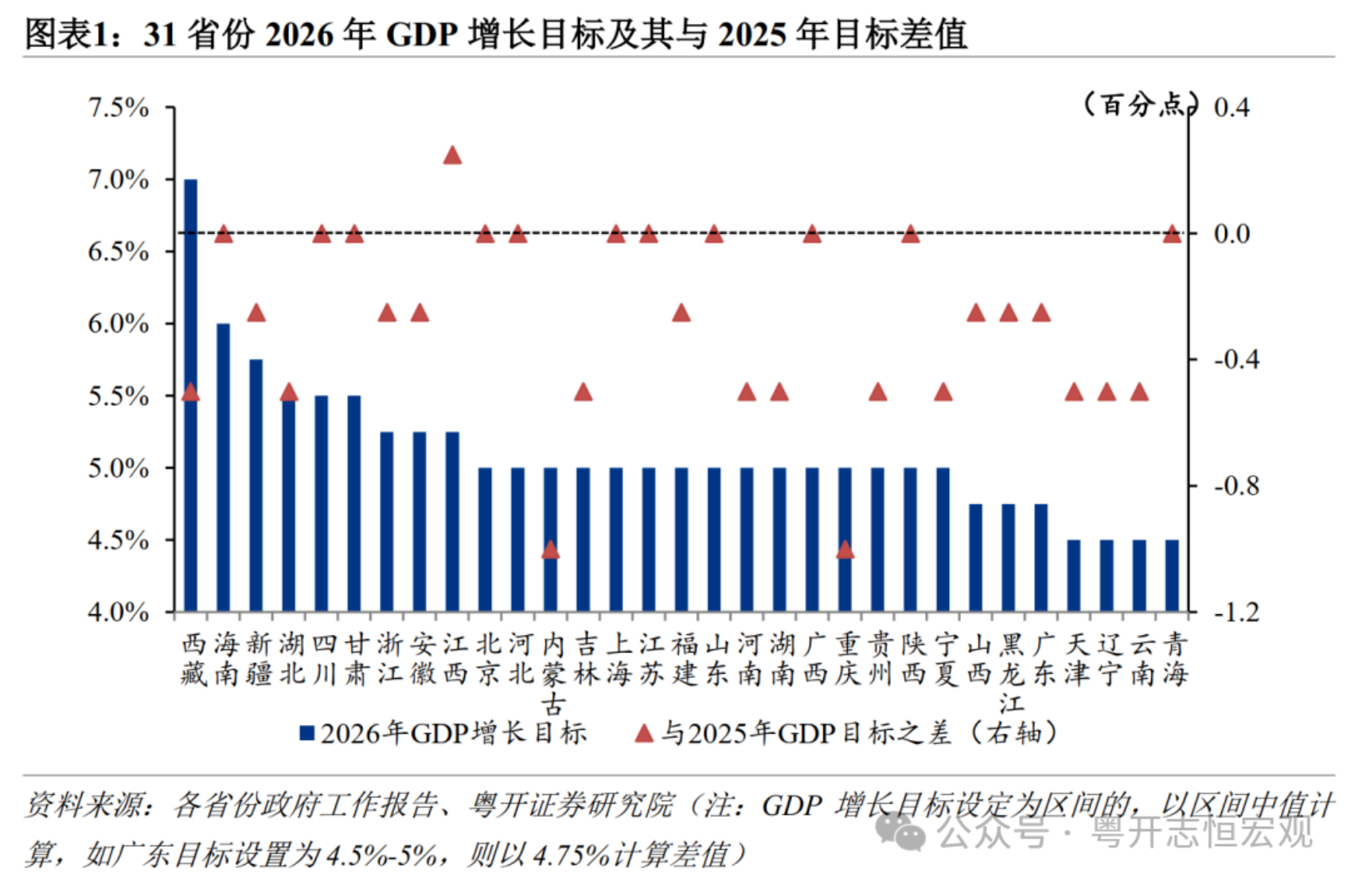
Core Viewpoint - Multiple provinces have adjusted their GDP growth and fiscal revenue targets for 2026, reflecting a shift towards quality development over speed, with an emphasis on sustainable economic growth and risk prevention [1][2][3]. GDP Growth Targets - The average GDP growth target for 31 provinces in 2026 is set at 5.04%, down by 0.2 percentage points from 2025 [2]. - 24 provinces have set their GDP growth targets between 4.5% and 5.5%, with Tibet leading at over 7% due to major infrastructure investments [2][3]. - Jiangxi is the only province to raise its growth target, from around 5% to 5%-5.5%, driven by advancements in new energy and equipment manufacturing [3]. Fiscal Revenue Targets - The average growth target for general public budget revenue across 31 provinces is 2.7%, a decrease of 0.1 percentage points from 2025 [10]. - 23 provinces have set their fiscal revenue growth targets between 2% and 4%, with Xinjiang aiming for a 10% increase, the highest among provinces [10][11]. - Major economic provinces like Guangdong and Jiangsu have set their fiscal revenue growth targets at 3% and 2%, respectively, which are lower than their GDP growth targets [11][14]. Industrial and Investment Goals - Most provinces have set industrial value-added growth targets above 5%, with Tibet aiming for the highest at 15% [16]. - Investment growth targets have been adjusted downwards in many provinces, reflecting a transition from investment-driven to consumption and innovation-driven growth [18]. - Guangdong has set a 5% investment growth target for 2026, aiming to stabilize and optimize investment structures [18]. Consumer and Employment Expectations - Retail sales growth targets have been lowered in most provinces, with 15 out of 19 provinces reducing their targets [21]. - Employment targets remain largely unchanged, with many provinces maintaining their urban employment goals around 5.5% [25].
张军:告别经济“温差”,要避免增长过于结构性
Di Yi Cai Jing Zi Xun· 2026-02-23 04:04
Core Viewpoint - The article discusses the current state of the Chinese economy, emphasizing that while it has achieved significant growth and development, there are challenges ahead that require careful policy adjustments to maintain sustainable growth before reaching the status of a moderately developed country [2][3]. Economic Development - China's economy has lifted nearly 800 million people out of poverty and developed a comprehensive infrastructure network, including advanced highways, high-speed rail, and telecommunications [3]. - The manufacturing sector has evolved from simple processing to advanced capabilities, with significant achievements in artificial intelligence, electric vehicles, and biomedicine [3]. - Despite these advancements, there remains a considerable gap between current development and long-term planning goals, necessitating a reasonable growth rate over the next decade [3][4]. GDP Growth Projections - To increase per capita GDP from approximately $14,000 to over $25,000 by 2035, an annual nominal growth rate of about 6% is required, considering a projected annual population decline of 0.35% [4]. - In 2025, actual GDP growth is projected at 5%, with nominal growth at only 3.9%, indicating a discrepancy between actual growth and economic conditions [4][5]. Structural Growth Issues - The growth has become increasingly concentrated in a few sectors, such as new energy vehicles and artificial intelligence, leading to a cooling macroeconomic environment despite a 5% actual GDP growth [5]. - The trend of shrinking total demand and income flow has resulted in deflationary pressures, causing nominal GDP growth to lag behind actual GDP growth [5]. Policy Recommendations - Economic policies should focus on balancing structural growth risks and maintaining macroeconomic stability, rather than solely targeting actual GDP growth rates [5][6]. - The central bank's monetary policy should prioritize price stability and actual unemployment, aligning with the practices of most central banks globally [5][6]. - A shift in focus from quantity-based monetary tools to price-based tools is necessary to alleviate macroeconomic tightening pressures and support a return to normal economic conditions [6].

日本央行审议委员田村直树:若经济和物价与日本央行的预测一致,将加息
Jin Rong Jie· 2026-02-13 03:45
Core Viewpoint - The Bank of Japan's committee member, Naoki Tamura, believes that Japan's recent inflation is becoming sticky, indicating a potential shift in monetary policy [1] Group 1: Inflation and Economic Outlook - Japan's inflation is stabilizing, but there is a need to remain cautious due to the recent depreciation of the yen [1] - The Bank of Japan may consider raising interest rates if economic and price developments align with their forecasts [1] - Food prices are expected to continue rising, contributing to the overall inflationary pressure [1]
日本央行审议委员田村直树:预计今年工资增长将达到与2%物价目标相符的水平
Jin Rong Jie· 2026-02-13 03:45
Group 1 - The Bank of Japan's policy board member, Naoki Tamura, anticipates that wage growth this year will align with the 2% inflation target [1] - Potential inflation is gradually rising and is very close to stabilizing above the target level [1] - A key factor in determining whether the Bank of Japan's price target is achieved is whether inflation stabilizes above that target level [1]
日本央行行长植田和男:日本的实际利率仍处于极低水平
Sou Hu Cai Jing· 2025-12-25 04:38
Group 1 - The uncertainty surrounding the U.S. economy and tariff impacts is still present but is diminishing [1] - The downside risks to the U.S. economy are decreasing [1] - The Japanese labor market remains tight, and corporate profits are expected to stay at high levels despite tariff impacts [1] Group 2 - A moderate synchronization of wage and inflation increases is likely to continue [1] - The likelihood of the baseline forecast becoming a reality is increasing [1] - Adjusting monetary support will help achieve price targets and promote sustained economic growth [1]
日本央行高田创:需要进一步调整货币宽松政策,物价目标已基本实现!最初对关税影响的担忧已有所缓解,必须留意日本通胀可能超预期的风险
Sou Hu Cai Jing· 2025-10-20 04:15
Group 1 - The core viewpoint is that the Bank of Japan, represented by Governor Haruhiko Kuroda, indicates a need for further adjustments to the monetary easing policy as the inflation target has been largely achieved [1] - Initial concerns regarding the impact of tariffs have eased, suggesting a more stable economic outlook [1] - There is a cautionary note regarding the potential for inflation in Japan to exceed expectations, highlighting the need for vigilance [1]

日本央行副行长内田真一:美日贸易协议已经降低不确定性,因此从定义上来说经济持久触及我们物价目标的可能性已然升高。
news flash· 2025-07-23 05:38
Core Viewpoint - The trade agreement between the U.S. and Japan has reduced uncertainty, thereby increasing the likelihood that the economy will persistently reach the inflation target set by the Bank of Japan [1] Group 1 - The U.S.-Japan trade agreement is seen as a factor that lowers economic uncertainty [1] - The likelihood of the economy consistently hitting the inflation target has increased as a result of this agreement [1]
欧洲央行行长拉加德:欧洲央行全力致力于实现物价目标。
news flash· 2025-07-04 05:28
Core Viewpoint - The President of the European Central Bank, Christine Lagarde, emphasized the ECB's commitment to achieving its price stability target [1] Group 1 - The ECB is fully dedicated to its price stability objectives, indicating a strong focus on controlling inflation [1]
日本央行行长植田和男:不愿就正在进行中的贸易谈判提供具体意见或评论
news flash· 2025-07-01 14:12
Group 1 - The core viewpoint is that the current potential inflation level in Japan remains below the central bank's price target, indicating that the economy has not yet fully achieved the desired inflation state [1] - The Bank of Japan will assess inflation dynamics based on three key factors, which are not specified in the statement [1] - The central bank maintains a neutral stance on sensitive issues, refraining from providing specific comments on ongoing trade negotiations [1]