GDP排名竞争

Search documents
GDP第十城,没有易主!
3 6 Ke· 2026-02-06 02:49
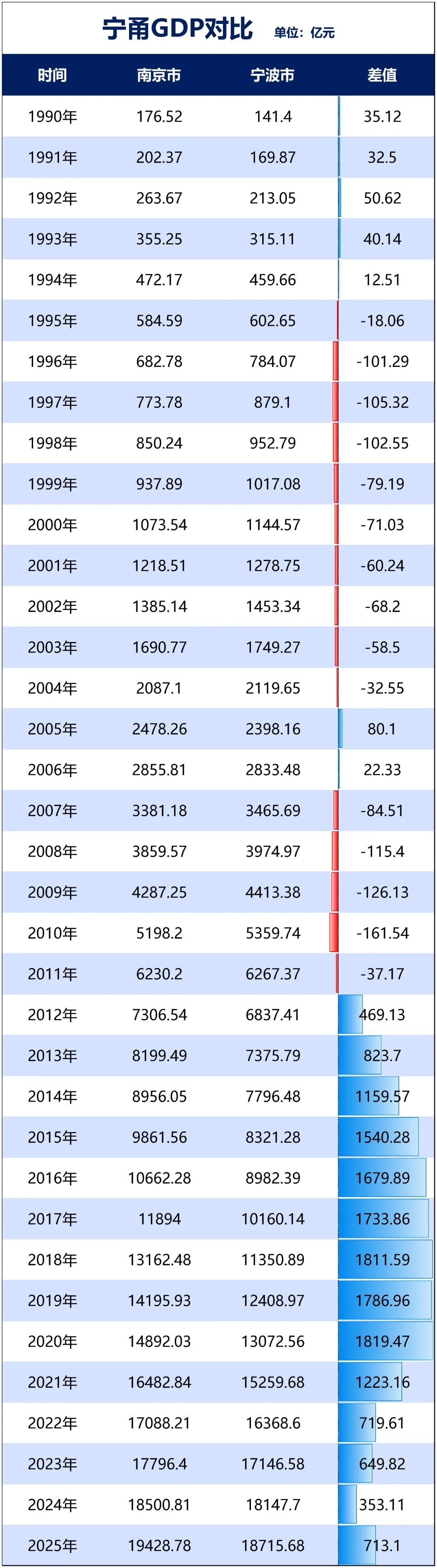
Core Viewpoint - Nanjing has successfully maintained its position in the top ten cities by GDP, showing a significant performance compared to Ningbo, with a GDP of 19,428.78 billion yuan in 2025, growing by 5.2% year-on-year, while Ningbo's GDP was 18,716 billion yuan, growing by 4.9% [1][6]. Economic Performance - Nanjing's GDP growth of 5.2% exceeds the national average by 0.2 percentage points, while Ningbo's growth lags behind the national average by 0.1 percentage points [1]. - The GDP increment for Nanjing was 927.97 billion yuan, compared to Ningbo's 567.98 billion yuan, widening the gap between the two cities [1]. Historical Comparison - Historical data shows that Nanjing and Ningbo have alternated in leading positions since 1990, with Nanjing regaining the lead in 2011 after a period of decline due to the global financial crisis [6][7]. - By 2020, the gap between Nanjing and Ningbo had reached 1,819.47 billion yuan, but by 2024, it narrowed to 353.11 billion yuan, the smallest since 2012 [6][7]. Industrial and Trade Analysis - Ningbo's industrial growth has slowed, with a secondary industry value added of 7,866 billion yuan in 2025, growing by only 4.0%, while Nanjing's industrial output grew by 5.8% [7]. - Ningbo's foreign trade has also been affected, with a total import and export scale of 14,561.5 billion yuan in 2025, growing by just 2.6%, resulting in a drop in its ranking to sixth place in terms of trade volume [7][8]. Future Outlook - Despite Nanjing's current advantage, there are indications that Ningbo may eventually surpass Nanjing in GDP due to its strong industrial base [16][17]. - Nanjing's strengths lie in its comprehensive capabilities in education, science, and technology, while Ningbo excels in manufacturing, which could influence future GDP rankings [19][20]. Industrial Strengths - Nanjing has six industries with revenues exceeding 100 billion yuan, with the leading sector being computer and electronic equipment manufacturing [23]. - Ningbo, on the other hand, has seven such industries, with a notable presence in the automotive sector, and has a significant number of national-level manufacturing champions [24][26]. Trade Dependencies - Ningbo's reliance on foreign trade, particularly with the U.S., poses a risk, as a significant portion of its exports is directed towards the American market [14][15][28].

房价要破“2”,GDP要被宁波超越!南京,难了
Sou Hu Cai Jing· 2025-08-27 06:18
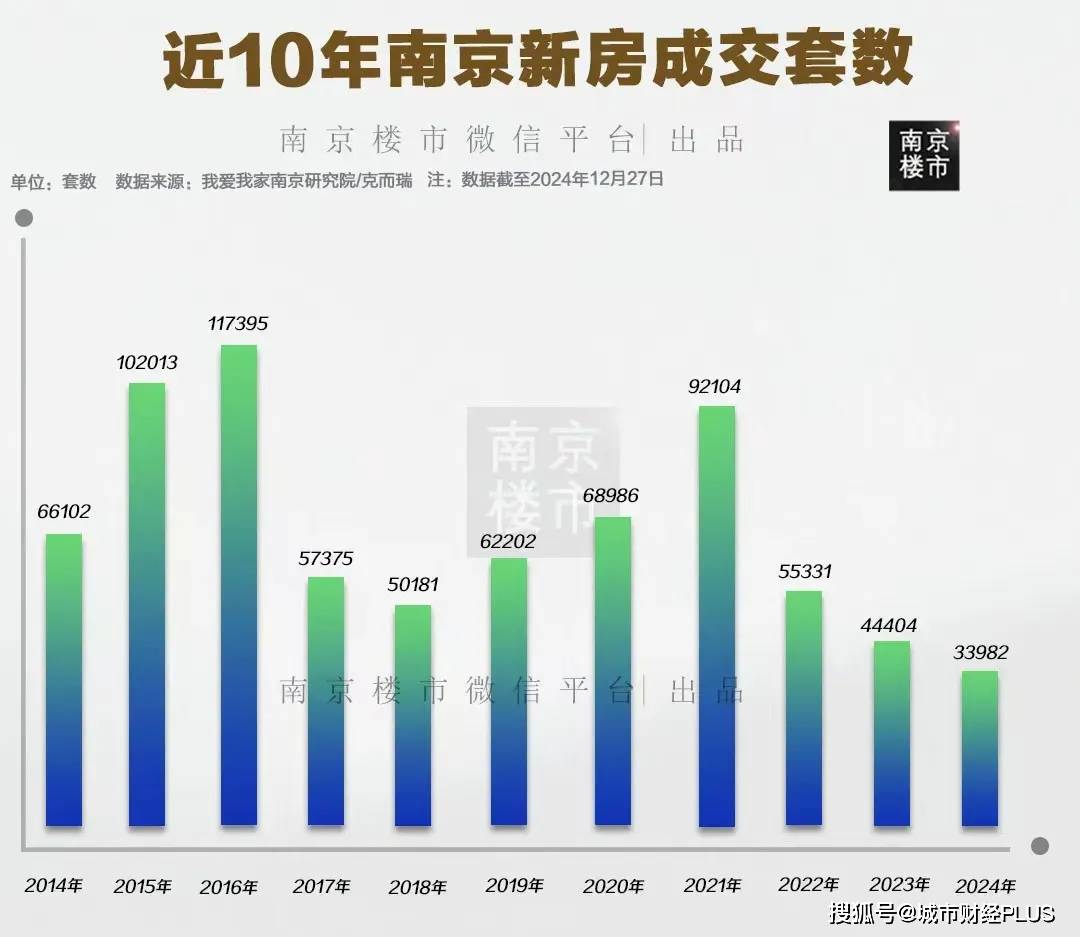
Group 1 - The core viewpoint of the article highlights the stark contrast between the booming sports enthusiasm in China and the declining real estate market in Nanjing, indicating a broader trend of falling property prices across various cities in the country [1][18]. - Nanjing's new home transaction volume peaked in 2016 at 117,395 units but has since declined, with a significant drop to 33,982 units projected for 2024 [1]. - The second-hand housing market in Nanjing also peaked in 2016 at 151,600 units, with a subsequent decline, falling below 100,000 units in recent years [3]. Group 2 - Nanjing's second-hand housing prices reached a peak average of 35,246 yuan per square meter in 2021, but have since fallen below 30,000 yuan in 2023 and are projected to drop to 23,661 yuan in 2024, marking a 20% decrease [5]. - In July 2024, Nanjing's second-hand home transactions totaled 7,263 units, reflecting a 2.6% month-on-month decline, indicating a significant contraction in the market [5]. - The article notes that the psychological threshold of 20,000 yuan per square meter is not just a numerical barrier but also represents a shift in market sentiment, with varying reactions from buyers [7]. Group 3 - The article discusses the broader trend of declining property prices across major cities, including Shenzhen, Xiamen, and Ningbo, with significant price drops observed [9][12][15]. - The underlying logic for the price declines is attributed to property prices exceeding the purchasing power of residents, leading to a market correction since 2021 [18]. - Data from the National Bureau of Statistics indicates that in April 2025, 45 cities experienced a decline in new home prices, with 64 cities seeing a drop in second-hand home prices, reflecting a widespread market downturn [19]. Group 4 - Nanjing faces increasing pressure from neighboring cities like Ningbo, which is closing the gap in GDP rankings, with projections suggesting Ningbo may surpass Nanjing in the near future [20][24]. - Key economic indicators show that while Nanjing has a higher GDP and total retail sales, Ningbo outperforms in several critical metrics, including industrial revenue and export volume [27][39]. - The article emphasizes that the strength of Ningbo's private economy and industrial base positions it favorably for future growth compared to Nanjing [35][39].