
IORB

Search documents
德意志银行:如果美联储FOMC会议纪要提及IORB和资产购买,将带来市场波动。
Sou Hu Cai Jing· 2025-11-19 18:20
Core Viewpoint - Deutsche Bank indicates that if the FOMC meeting minutes mention Interest on Reserve Balances (IORB) and asset purchases, it will lead to market volatility [1] Group 1 - Deutsche Bank's analysis suggests that specific references in the FOMC meeting minutes could significantly impact market dynamics [1]

德意志银行:如果美联储FOMC会议纪要提及IORB和资产购买,将带来市场波动
Sou Hu Cai Jing· 2025-11-19 17:24
Core Insights - Deutsche Bank indicates that if the Federal Reserve's FOMC meeting minutes mention Interest on Reserve Balances (IORB) and asset purchases, it could lead to market volatility [1] Group 1 - The potential mention of IORB in the FOMC minutes is highlighted as a significant factor that could influence market reactions [1] - Asset purchases are also noted as a key topic that may contribute to market fluctuations if discussed in the meeting minutes [1]
Arthur Hayes 博文:SRF 的启用与隐性量化宽松
Sou Hu Cai Jing· 2025-11-05 04:25
Group 1 - The article discusses the inevitability of government debt and the political incentives behind it, emphasizing that governments prefer to issue debt rather than raise taxes to fund expenditures [2][3] - It highlights the relationship between government borrowing and the Federal Reserve's balance sheet, suggesting that an increase in government debt will lead to an increase in the money supply, benefiting the liquidity of the dollar and potentially driving up the prices of Bitcoin and other cryptocurrencies [3][32] - The article outlines the projected federal deficits, estimating around $2 trillion annually, and discusses the implications for U.S. Treasury bond issuance and financing [6][7] Group 2 - The article identifies the primary buyers of U.S. debt, including foreign central banks, the private sector, and commercial banks, concluding that the marginal buyers are RV hedge funds, particularly those based in the Cayman Islands [9][14][12] - It explains the trading strategies of RV funds, which involve buying U.S. Treasury bonds and financing these purchases through repurchase agreements (repos) [19][21] - The article discusses the role of the Federal Reserve in managing short-term interest rates and how it influences the liquidity in the market, particularly through tools like the Standing Repo Facility (SRF) [22][28] Group 3 - The article warns of a potential liquidity crisis if RV funds cannot secure financing at favorable rates, which would hinder their ability to purchase U.S. debt and impact government financing [27][26] - It introduces the concept of "stealth quantitative easing," suggesting that the SRF will become a primary channel for injecting liquidity into the financial system without being labeled as traditional quantitative easing [32][31] - The article concludes that the current market stagnation presents opportunities, particularly as the government prepares to release additional liquidity once operations resume, which could reignite interest in cryptocurrencies [33]

美联储资产负债表:缩表可能持续至明年-US_Economics_and_Rates_Strategy_Fed_Balance_Sheet__Balance_sheet_reduction_likely_continues_into_next_year
2025-10-15 03:14
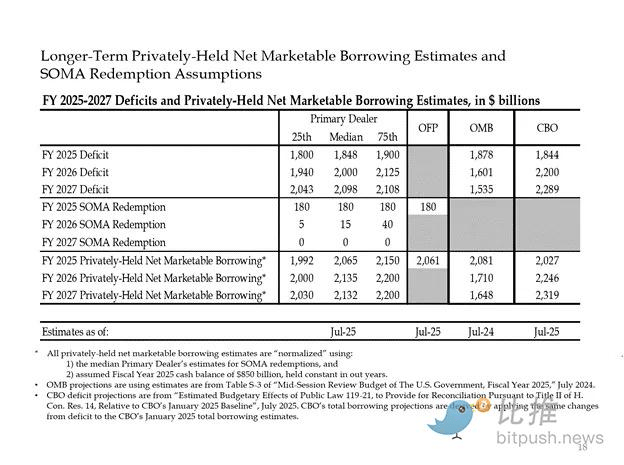
Summary of Key Points from the Conference Call Industry Overview - The discussion primarily revolves around the Federal Reserve's balance sheet strategy and its implications for the U.S. economy and financial markets. Core Insights and Arguments 1. **Balance Sheet Reduction Timeline** - The Federal Reserve's balance sheet reduction is expected to continue until June 2026, with a possibility of an earlier conclusion if the effective federal funds rate (EFFR) rises more quickly than anticipated [1][10][12]. 2. **Current Reserve Levels** - Bank reserves have declined to approximately $3 trillion, down from over $3.3 trillion earlier in the summer. This decline is attributed to the rebuilding of the Treasury cash account (TGA) after the debt ceiling increase in July [12][10]. 3. **Future Reserve Projections** - By May/June 2026, reserves are projected to be around $2.7-$2.8 trillion, which aligns with the "roughly ample" reserve level indicated by Governor Waller [10][12]. 4. **Repo Market Conditions** - Fed officials are currently comfortable with the pressures in the repo market, as bank reserves are still considered abundant. The effective federal funds rate has moved 2 basis points closer to the interest on reserves balance (IORB), but there remains a sufficient gap [4][10]. 5. **Indicators for Ending Balance Sheet Runoff** - A significant shift in the EFFR relative to IORB and changes in reserve adequacy indicators will be critical in determining when the Fed may consider halting balance sheet runoff [5][4]. 6. **Impact of T-Bill Supply** - The recent increase in the effective federal funds rate is largely attributed to an increase in T-bill supply, indicating that the system retains ample liquidity at the right price [11][10]. 7. **Gradual Reserve Decline** - The decline in reserves is expected to be gradual moving forward, primarily driven by continued balance sheet shrinking, with the asset side of the Fed's balance sheet decreasing by approximately $20 billion per month, mainly due to mortgage-backed securities [12][10]. Additional Important Insights 1. **Monitoring Money Market Conditions** - Fed officials emphasized the importance of monitoring money market conditions as reserves continue to decline, suggesting that there is still room for further reduction [12]. 2. **Repo Balances** - Reverse repo balances are expected to remain close to zero into the next year, indicating a stable liquidity environment [12]. 3. **Economic Growth and Demand for Reserves** - As the economy grows, there will naturally be an increasing demand for Federal Reserve liabilities, including currency and reserves, which could influence future monetary policy decisions [5]. 4. **Visual Data Representation** - Figures illustrating the trends in bank reserves and the effective federal funds rate relative to IORB were presented, highlighting the current state and projections for the future [6][8][14]. This summary encapsulates the key points discussed in the conference call regarding the Federal Reserve's balance sheet strategy and its implications for the financial markets and economy.
