
MaaS(Model as a Service)

Search documents
智谱张鹏,6年跑出490亿大模型第一股
3 6 Ke· 2026-01-09 02:19
Core Insights - Beijing Zhiyu Huazhang Technology Co., Ltd. (智谱) officially listed on the Hong Kong Stock Exchange on January 8, marking it as the world's first publicly traded company focused on General Artificial Intelligence (AGI) foundational models [1] - The company's CEO, Zhang Peng, transformed a technical vision into a business valued at over HKD 50 billion within seven years, highlighting a significant milestone for China's AGI industry [1] Group 1: IPO and Market Performance - On its first trading day, Zhiyu's market capitalization exceeded HKD 57 billion, with shares closing at HKD 131.5, reflecting a maximum intraday increase of 13.17% [2] - The IPO was highly successful, with a subscription rate of 1,159.46 times for the public offering and 15.28 times for the international offering, indicating strong market recognition [2] - The total funds raised from the IPO surpassed HKD 4.3 billion, excluding the "green shoe" option [2] Group 2: Business Model and Revenue Strategy - Zhiyu's initial survival strategy focused on localized deployment to meet customized needs of government and enterprise clients, a sector often overlooked by larger companies [3] - The company aims to diversify its revenue structure by increasing the proportion of income from its Model as a Service (MaaS) platform while maintaining a solid base from localized deployments [3] - Zhiyu's software tools and model business have already generated an annual recurring revenue (ARR) exceeding RMB 100 million (approximately USD 14 million), with plans to increase API revenue to 50% of total income [3] Group 3: Research and Development Investment - The company has committed significant resources to R&D, with investments of RMB 84.4 million, RMB 528.9 million, and RMB 2.195 billion planned for 2022, 2023, and 2024 respectively, totaling around RMB 4.4 billion [2] - R&D personnel constitute 74% of the workforce, supporting rapid iterations of the GLM series models every 2-3 months [2] Group 4: Strategic Partnerships and Ecosystem Expansion - Zhiyu has established partnerships with local governments and enterprises, such as the collaboration with Huafa Group in Zhuhai to create a city-level GLM model space [5] - The company is also expanding its reach internationally, having launched a national-level MaaS platform and AI talent training lab in Malaysia [7][6] Group 5: AGI Vision and Future Directions - The ultimate goal of Zhiyu remains the realization of AGI, with ongoing investments in technology exploration and research [4] - The company has begun to explore the Agent field as part of its AGI strategy, viewing it as a critical component in the path to achieving AGI [8] - Future iterations of the AutoGLM series are expected to enhance capabilities in multimodal and embodied intelligence, with applications across various devices [8]
“全球大模型第一股”来了!智谱(02513)港交所敲钟 市值528亿港元
智通财经网· 2026-01-08 03:29
Core Viewpoint - The listing of Beijing Zhiyu Huazhang Technology Co., Ltd. on January 8, 2026, marks the first public offering of a company focused on General Artificial Intelligence (AGI) foundational models, highlighting China's leadership in this sector [1][9]. Company Overview - Zhiyu is recognized as one of the earliest companies in China to engage in large model research, having developed the GLM framework and released several pioneering models, including the first hundred-billion model and the first open-source trillion model [3]. - The company has achieved significant technological advancements, maintaining a competitive edge in the global market by adapting its GLM architecture to over 40 domestic chipsets [3]. Financial Performance - The company reported revenues of 57.4 million, 124.5 million, and 312.4 million yuan for the years 2022 to 2024, with a compound annual growth rate of 130%. In the first half of 2025, revenue reached 191 million yuan, reflecting a year-on-year growth of 325% [8]. - Gross margins for the same period were 54.6%, 64.6%, and 56.3%, with a gross margin of 50% in the first half of 2025 [8]. Research and Development - The company plans to allocate approximately 70% (around 2.9 billion HKD) of the net proceeds from its IPO to further research and development in AGI foundational models, reinforcing its competitive position [7]. - R&D expenditures from 2022 to 2025 are projected to total around 4.4 billion yuan, with a significant focus on rapid model iteration every 2-3 months [4]. Market Position and Strategy - Zhiyu is positioned as the largest independent developer of general large models in China, with a Model as a Service (MaaS) approach that has attracted over 300,000 enterprises and application developers [8]. - The company has established a standardized product system centered on MaaS, which includes API calls, model subscriptions, and localized deployments, enabling it to deliver general intelligence capabilities rather than single-use applications [8]. Industry Context - The global AI market is projected to grow from 189 billion USD in 2023 to 4.8 trillion USD by 2033, indicating a 25-fold increase over the next decade [9]. - With the implementation of national standards for AI large models, China's AGI development is entering a more structured phase, positioning large models as key drivers of efficiency and innovation across various industries [9].

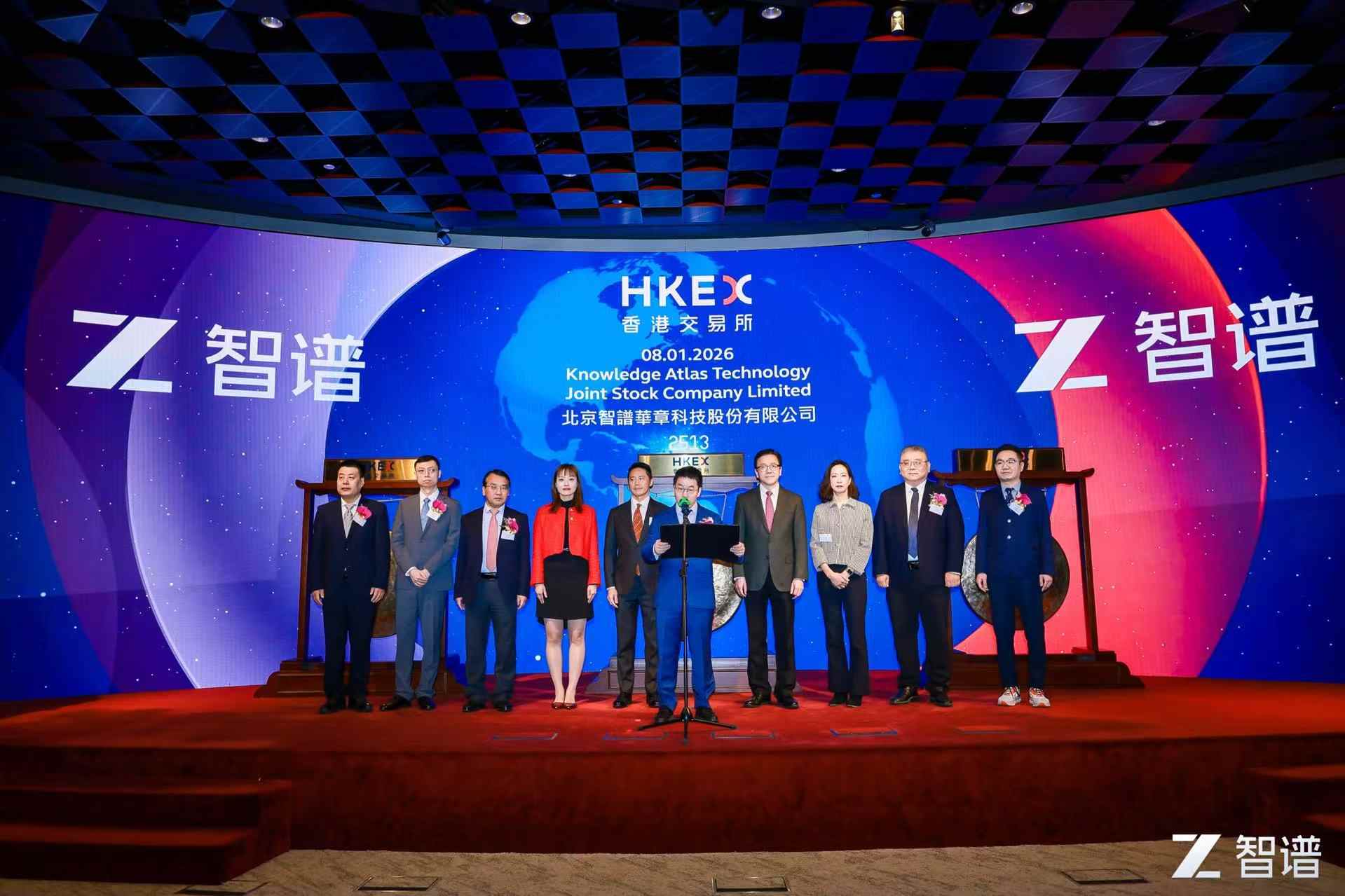
刚刚,“全球大模型第一股”花落中国,智谱正式登陆港交所!
Sou Hu Cai Jing· 2026-01-08 02:36
Core Viewpoint - The listing of Beijing Zhiyuan Huazhang Technology Co., Ltd. (智谱) on the Hong Kong Stock Exchange marks the first public offering of a company focused on General Artificial Intelligence (AGI) foundational models, highlighting China's leadership in this emerging sector [1][9]. Group 1: Company Overview - Zhiyuan is recognized as one of the earliest companies in China to engage in large model research, having developed the GLM framework, which has achieved significant milestones in model capabilities [3]. - The company has established a comprehensive model system, being the first to release various significant models, including the first hundred billion model and the first open-source trillion model in China [3]. - As of September 30, 2025, Zhiyuan has empowered over 12,000 enterprise clients and more than 45 million developers, making it the largest independent general large model provider in China [7]. Group 2: Financial Performance - Zhiyuan's revenue from 2022 to 2024 showed a compound annual growth rate (CAGR) of 130%, with revenues of 57.4 million, 124.5 million, and 312.4 million respectively [7]. - The company reported a revenue of 191 million in the first half of 2025, representing a year-on-year growth of 325% [7]. - The gross margin for the years 2022 to 2024 was 54.6%, 64.6%, and 56.3%, with a gross margin of 50% in the first half of 2025 [7]. Group 3: Research and Development - The company has committed significant resources to R&D, with investments of 84.4 million, 528.9 million, and 2.195 billion from 2022 to 2024, totaling approximately 4.4 billion [4]. - R&D personnel constitute 74% of the workforce, enabling rapid iterations of the GLM series models every 2-3 months [4]. - The upcoming GLM-4.7 model has achieved top rankings in both open-source and domestic model assessments, showcasing its competitive edge [4]. Group 4: Business Model and Strategy - Zhiyuan operates on a Model as a Service (MaaS) model, providing standardized products that include API calls, model subscriptions, and localized deployments [8]. - The company has seen significant growth in its MaaS platform, which has attracted over 3 million enterprises and developers, making it one of the most active large model API platforms in China [8]. - Approximately 70% of the funds raised from the IPO will be allocated to further R&D in general AI foundational models, reinforcing the company's competitive position [6]. Group 5: Market Position and Future Outlook - The global AI market is projected to grow from $189 billion in 2023 to $4.8 trillion by 2033, indicating a 25-fold increase over the next decade [9]. - With the implementation of national standards for AI foundational models, China's AGI development is entering a more structured phase, positioning companies like Zhiyuan for significant growth [9]. - The successful IPO of Zhiyuan signifies a new phase for Chinese AGI companies, allowing them to compete on a global scale with established international players [9].
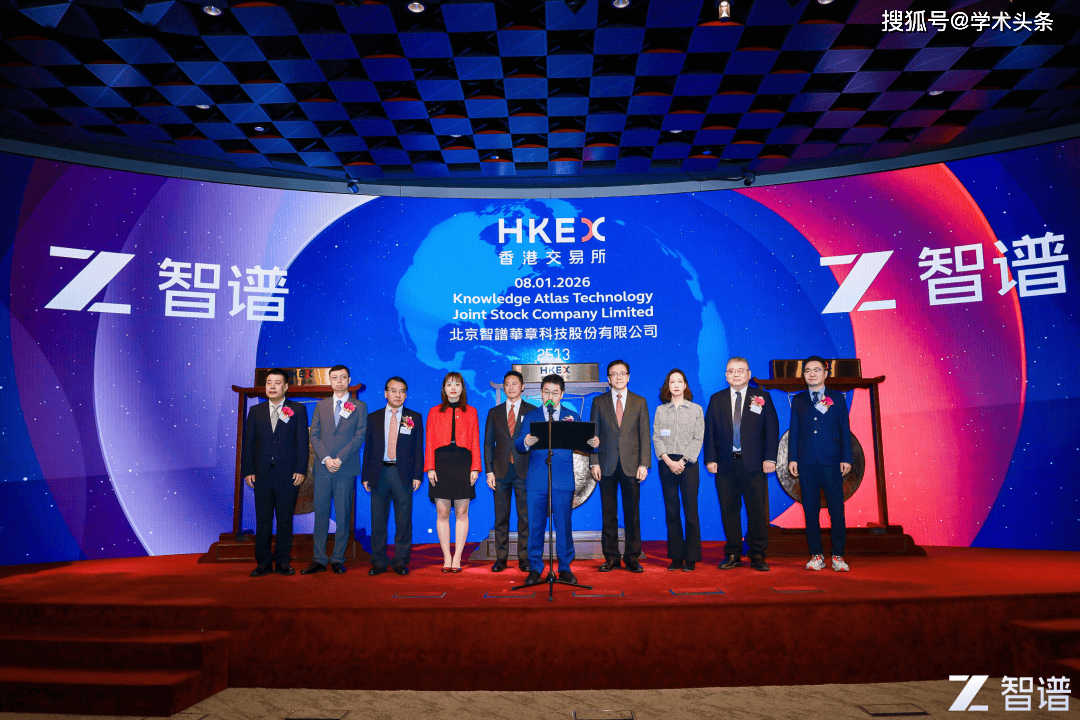
刚刚,智谱敲钟上市了,市值达528亿港元
Sou Hu Cai Jing· 2026-01-08 02:20
Core Insights - The company Zhiyuan Huazhang Technology Co., Ltd. (02513.HK) officially listed on the Hong Kong Stock Exchange on January 8, 2026, becoming the world's first publicly traded company focused on general artificial intelligence (AGI) based models [2][4] - The IPO was highly successful, with a subscription rate of 1159.46 times for the public offering and 15.28 times for the international offering, raising over 4.3 billion HKD [4] - The company aims to lead in AGI development, with its GLM model architecture recognized as a significant advancement in the field [6][10] Company Overview - Zhiyuan is one of the earliest companies in China to engage in large model research, having developed a comprehensive model system that includes various pioneering models [6][10] - The company has maintained a high level of R&D investment, with projected cumulative R&D expenditures of approximately 4.4 billion HKD from 2022 to 2025, and a workforce where 74% are dedicated to R&D [7][9] - The company has achieved significant commercial success, ranking first among independent general large model developers in China and second globally, with a revenue CAGR of 130% from 2022 to 2024 [11] Business Model and Growth - Zhiyuan has established a Model as a Service (MaaS) platform, which has become a key growth driver, serving over 300,000 enterprises and developers [12] - The company plans to allocate 70% of the net proceeds from its IPO (approximately 2.9 billion HKD) to further R&D in general AI models, enhancing its competitive edge [9] - The global AI market is projected to grow significantly, with estimates suggesting a rise from 189 billion USD in 2023 to 4.8 trillion USD by 2033, indicating a robust environment for AI investments [13]

一文读懂Minimax招股说明书:领先的通用多模态大模型平台,AI原生应用矩阵+开放式生态驱动商业化落地
EBSCN· 2026-01-07 06:19
1. Report Industry Investment Rating No relevant content provided. 2. Core Views of the Report - The company is one of the core providers of general multi-modal large models and entered the stage of large-scale commercialization in 2025. It is positioned as a provider of general multi-modal large models and AI-native applications, with deep technical accumulation in voice generation, multi-round dialogue, and multi-modal interaction. It is in the first echelon among domestic general large model manufacturers [3]. - The company's business model is centered around self-developed general large models, and its revenue growth is continuously driven by the increasing volume of model calls. In 2025, its revenue continued the high-growth trend. The company has comprehensive competitive advantages, including continuous iteration of general multi-modal model capabilities, parallel product and commercialization paths for B and C ends, a platform-based and scalable business model, and a management and R & D team with long-term experience in the AI field [4][5]. 3. Summary According to the Table of Contents 3.1 Company Overview 3.1.1 Growth Review - The company was founded in 2021, focusing on general artificial intelligence and the research and development of self-developed large language models and multi-modal models. It has gradually built a relatively complete general multi-modal model system and application matrix. As of before the IPO, it had completed about 7 rounds of financing, with a cumulative financing amount exceeding $1.5 billion. The actual controller of the company is Dr. Yanjunjie, and Alibaba is the largest external institutional shareholder [13][15][18]. 3.1.2 Main Business - **AI-native products (mainly ToC)**: The company has launched a number of AI-native applications for individual users, including MiniMax (intelligent Agent), Hailuo AI (multi-modal content creation), MiniMax Voice (voice synthesis and interaction), and Talkie/Xingye (AI character companionship and interaction), aiming to achieve commercialization through subscriptions, virtual content consumption, and the spillover of capabilities in the medium to long term [21][22][23]. - **Open platform and other AI enterprise services (ToB/developers)**: The company provides services such as model ability opening API (MaaS), enterprise-specific reasoning resource pools, model authorization and deployment, and cross-industry enterprise solution support to enterprises and developers, with various charging methods [28]. - **Business model - MaaS**: The company provides self-developed general large model capabilities to external customers in the form of cloud services. The user scale and core operating indicators are driven by AI-native products (ToC) and the open platform (ToB) [33]. - **Pricing strategy**: The company adopts a multi-dimensional and hierarchical pricing strategy. The ToC end mainly uses a monthly subscription system, supplemented by prepaid points or virtual item recharge; the ToB end uses API packages and token-based pay-as-you-go billing [35]. - **Customer structure**: The company's customers are diverse and international, with enterprise customers as the core revenue source. The customer concentration has been continuously decreasing, and the company uses multiple channels to acquire customers and signs framework agreements to ensure long-term stable customer relationships [41]. 3.1.3 Financial Analysis - **Revenue**: The company's revenue has grown rapidly since the start of commercialization. AI-native products (ToC) contribute the current main revenue scale, and the open platform and enterprise services (ToB) are growing rapidly. Overseas revenue accounts for a high proportion [48]. - **Gross profit and expense ratio**: The company's overall gross profit margin has been significantly repaired, and the expense ratio has been rapidly converging. The company maintains high R & D investment to support long-term competitiveness [55]. 3.2 Industry Overview 3.2.1 Technological Evolution Trends of Large Models - **Scaling Law**: The focus has shifted from simply expanding scale to improving training efficiency and generalization ability under controllable costs and stability [62]. - **Cost reduction**: The unit cost of intelligence has been continuously decreasing through model structure optimization, reasoning acceleration, and computing power scheduling improvement [62]. - **Agent application**: Large models have evolved from single-point generation to Agents with task decomposition, tool invocation, and multi-step execution capabilities [62]. - **Multi-modal**: The multi-modal capabilities of text, voice, image, and video are accelerating integration, moving from multi-model splicing to unified modeling [62]. 3.2.2 Changes in the Market Pattern of Large Model Applications - The application market of large models shows a hierarchical structure, with different levels having different representative products, target users, core capabilities, commercialization models, and competition points [63][64]. 3.2.3 Market Size and Competition Pattern of Large Models - **Market size**: The global large model market is in a stage of rapid growth, with the market size expected to increase from about $10.7 billion in 2024 to about $206.5 billion in 2029, with a CAGR of 80.7% [68]. - **Market structure**: The large model-related revenue is divided into MaaS and application, with the application layer having a higher growth rate and becoming the core engine of market expansion [69]. - **Competition pattern**: The large model industry chain shows a hierarchical competition structure, with the basic model and MaaS layer dominated by a few leading manufacturers, and the application and Agent layer showing a diversified competition situation [69]. 3.3 Core Competitiveness 3.3.1 Long - term Barriers Built by a Full - Modal Unified Base and Engineering Efficiency Advantages - **Full-modal capabilities**: The company uses a full-modal integrated approach, which can output consistent and scalable intelligent capabilities in various scenarios, reducing cross-modal development and integration costs [71]. - **Model algorithm innovation**: The company focuses on performance, cost, and deployability, using architectures such as MoE, linear attention mechanisms, and CISPO reinforcement learning algorithms [71]. - **Cost advantage**: The company has the ability to systematically reduce costs in training and reasoning, providing more competitive pricing strategies and broader customer coverage [71]. 3.3.2 Strategy and Commercialization: Scalable Architecture + Dual - Wheel Drive of ToC/ToB to Amplify Scale Effects - **Scalable architecture**: The company uses a highly modular and horizontally scalable system architecture, which can maintain system stability and delivery quality with the growth of token calls and the expansion of the customer base [72]. - **Commercialization path**: The company adopts a parallel strategy of AI-native products and MaaS, balancing growth elasticity and revenue certainty [72]. - **Open platform and customer stickiness**: The company's open platform has become a key hub in its business model, with customers deeply embedding model capabilities into their products, increasing migration costs and forming a technology lock - in effect [72]. 3.4 Historical Financial Situation - **Consolidated income statement**: The report shows the company's income, cost, gross profit, and other items from 2022 to 2025, reflecting the company's operating performance and profitability changes [74]. - **Consolidated balance sheet**: It presents the company's assets, liabilities, and equity at different times, reflecting the company's financial position [75]. - **Consolidated cash flow statement**: It shows the company's cash inflows and outflows from operating, investing, and financing activities, reflecting the company's cash generation and utilization capabilities [78][79]. - **Profit statement breakdown**: It details the company's revenue and cost composition, including AI-native products and open platform and other AI-based enterprise services [80][81].