
Supply and demand balance

Search documents
钨专家交流20260303
2026-03-04 14:17
Summary of Tungsten Industry Conference Call Industry Overview - The tungsten industry is projected to generate approximately 190 billion yuan in revenue (+40%) and 20 billion yuan in profit (+50%) by 2025, with a mining profit margin of 46%, significantly higher than smelting (3%) and processing stages [2][3][4]. Key Insights - **Market Dynamics**: By September 2025, end-users shifted from concerns about inventory devaluation to defensive measures against supply disruptions, leading to a continuous price increase driven by cash prepayments for raw materials [2][5]. - **Export Trends**: In 2025, hard alloy exports are expected to decline by 17% to about 25,000 tons, while tungsten powder and APT exports may drop by around 50%. Conversely, imports of tungsten ore are anticipated to increase by over 50% [2][4]. - **Consumption Growth**: Tungsten consumption is projected to reach approximately 70,000 tons (+9%) in 2025, with significant demand growth in semiconductor-grade hexafluorotungsten, which is expected to surge from 2,000 tons to over 5,000 tons [2][8]. - **Recycled Tungsten**: The recycled tungsten market is expected to grow by 30% in 2024 due to high prices stimulating inventory release, but is projected to decline in 2025 as historical inventory is depleted [2][10][11]. Supply Chain Insights - **Mining and Production**: The annual tungsten ore production is estimated at around 130,000 tons in 2025, with a year-on-year growth of less than 1%. The average industry profit margin is expected to be around 10.5%, with mining margins significantly higher than those in smelting and processing [3][19]. - **International Supply**: Limited overseas mining increments are anticipated, with the Vietnam Mashan mine reducing production to 3,000 tons, and recovery expected to take two years. Central Asia and South Korea projects are unlikely to contribute effectively in the short term [2][16][17]. Price Dynamics - **Price Transmission**: The price transmission from upstream to downstream is currently smooth, driven by strong willingness from downstream users to secure raw materials amid high supply disruption risks [6][7]. - **Market Support**: The price support is attributed to the willingness of end-users to pay upfront for raw materials, indicating a stronger focus on securing supply rather than worrying about inventory devaluation [5][6]. Future Outlook - **Demand and Supply Balance**: The tungsten market is expected to remain in a tight balance, with domestic consumption growing faster than overseas, leading to a projected global consumption growth of about 2.5% to 3% [19][20]. - **Military Consumption**: Historically, military consumption accounts for about 10% to 15% of the tungsten market, but specific forecasts for 2025 or 2026 are not available due to data sensitivity [21]. - **Stockpiling Behavior**: There is a noticeable trend of downstream users increasing their raw material and supply inventories, driven by longer order visibility and a cautious approach to procurement [22]. Additional Considerations - **Environmental Impact**: Environmental regulations are not currently a major constraint on tungsten recycling, as the industry has matured and improved its resource and energy utilization [14]. - **Recycling Channels**: The primary recycling channels include cutting tools, with a high recovery rate, while mining tools have a lower recovery rate [12][13]. This summary encapsulates the key points discussed during the conference call regarding the tungsten industry, highlighting the projected growth, market dynamics, and future outlook.
ILZSG:2025年全球锌市场供应短缺3.3万吨,而铅市场供应过剩7.0万吨
Wen Hua Cai Jing· 2026-02-26 12:36
Zinc Market Summary - In 2025, the global refined zinc consumption is projected to reach 1,386.3 million tons, up from 1,360.8 million tons in 2024, with December consumption at 1,239.8 million tons compared to 1,214.9 million tons in November [2][4] - The global zinc market is expected to face a supply shortage of 33,000 tons in 2025, an improvement from a shortage of 69,000 tons in 2024, primarily due to production growth lagging behind demand [2][4] - Global refined zinc production is anticipated to grow by 2.1% in 2025, driven by a 6.1% increase in China's output, while production outside China is expected to decline by 1.6% [2][4] - The global mined zinc production is projected to increase by 5.4%, supported by growth in Australia, China, India, Iran, Peru, South Africa, and the Democratic Republic of Congo [2][3] Lead Market Summary - In 2025, the global refined lead consumption is expected to reach 1,356.3 million tons, an increase from 1,335.5 million tons in the previous year, with December consumption at 1,158.1 million tons compared to 1,150.8 million tons in November [5][6][9] - The global lead market is projected to have a supply surplus of 70,000 tons in 2025, widening from a surplus of 61,000 tons in 2024, as production growth outpaces demand [6][9] - Global mined lead production is expected to grow by 0.8%, with increases in China, India, Peru, Turkey, and Europe, while production in Australia, Kazakhstan, and the United States is anticipated to decline [7][9] - Refined lead production is projected to increase by 1.6%, benefiting from production increases in Canada, China, India, Mexico, and Brazil [8]


石油分析_尽管全球供应过剩格局不变,但因经合组织库存下降,我们上调价格预测;地缘政治风险持续Oil Analyst_ Raising Our Price Forecast on Lower OECD Stocks Despite Same Global Surplus; Geopolitical Risks Persist
2026-02-24 14:16
Summary of the Oil Market Analysis Industry Overview - The report focuses on the oil market, specifically analyzing Brent and WTI prices, supply and demand dynamics, and geopolitical risks affecting the oil industry [2][8][49]. Key Points and Arguments Price Forecast Adjustments - The Brent price forecast for Q4 2026 has been raised by $6 to $60/bbl due to lower OECD stocks, despite maintaining a global surplus [2][9]. - The forecast for WTI in Q4 2026 is adjusted to $56/bbl [2][9]. - Prices are expected to rise to an average of $65/bbl for Brent and $61/bbl for WTI in 2027, with a recovery to $70/bbl and $66/bbl by December 2027 [2][43]. Supply and Demand Dynamics - The global oil surplus for 2026 is maintained at 2.3 million barrels per day (mb/d), assuming no major supply disruptions [2][28]. - It is projected that only 19% of the 2026 global inventory builds will materialize in OECD commercial stocks, down from 27% previously [2][19]. - A significant portion of the surplus (25%) is expected to come from Russia/Iran crude building up at sea [2][19]. Geopolitical Risks - The report highlights potential upside risks to oil prices due to geopolitical tensions, particularly concerning Iran and the Strait of Hormuz [49][62]. - A hypothetical 1mb/d supply disruption from Iran could increase Brent prices by $8 [2][49]. - The report discusses various scenarios, including intensified sanctions on Russia and potential sanctions relief for Iran, which could significantly impact supply and prices [71][72]. Inventory and Production Insights - OECD commercial crude stocks have remained stable, contrary to expectations of large builds, due to supply disruptions, particularly in Kazakhstan [2][8]. - The report anticipates a gradual increase in OPEC production in Q2 2026 as OECD stocks have not built up [2][28]. - The analysis indicates that the demand for oil is expected to grow by 1.2 mb/d in both 2026 and 2027, reflecting robust global demand [78][80]. Long-term Outlook - The long-term forecast for Brent and WTI prices is set at $75/bbl and $71/bbl respectively by 2030, driven by ongoing demand growth following years of low investment in long-cycle projects [2][45]. Additional Important Insights - The report emphasizes the importance of geopolitical factors in shaping oil prices and market dynamics, particularly the concentration of Iranian exports and the strategic significance of the Strait of Hormuz [56][62]. - The analysis includes detailed statistics on oil production and exports from Iran, highlighting the stability of Iranian production despite geopolitical tensions [50][53]. - The report also discusses the implications of potential supply disruptions and the overall balance of supply and demand in the global oil market [2][28][49]. This comprehensive analysis provides valuable insights into the current state and future outlook of the oil market, highlighting key factors that investors should consider when making decisions.

dbg markets:原油市场波动加剧,供需平衡面临哪些新变量?
Sou Hu Cai Jing· 2026-02-11 19:13
Group 1 - The core viewpoint of the articles emphasizes that the price formation mechanism in the energy market is primarily driven by supply and demand fundamentals, but short-term fluctuations are influenced by multiple factors [1][3] - Recent oil price trends have shown high volatility, with Brent crude oil prices fluctuating between $67 and $70, experiencing a single-day drop of 2% before quickly rebounding, indicating rapid adjustments by market participants in response to information shocks [1] - The Short-Term Outlook report from the U.S. Energy Information Administration provides a benchmark expectation for the market, with its prediction for the average crude oil price in 2026 serving as an important reference for analyzing current price levels [1][3] Group 2 - Analyzing supply and demand fundamentals requires distinguishing between short-term disturbances and long-term trends, with supply adjustments by major oil-producing countries directly impacting market balance [3] - Demand is closely linked to global economic growth expectations, particularly the industrial activity levels and transportation needs of major consuming countries, suggesting potential pressures from either relatively abundant supply or slowing demand growth [3] - Inventory data serves as a crucial window for observing supply-demand balance, with current market focus on whether seasonal inventory changes will be disrupted by abnormal factors [3] Group 3 - Geopolitical risks remain a potential variable in the energy market, as changes in key oil-producing regions, transportation security, and international trade relations can influence supply expectations and, consequently, prices [3] - Technically, oil prices often exhibit strong support or resistance characteristics near key round numbers, with current price levels showing a premium compared to the outlook report's annual expectations, reflecting immediate supply-demand tightness or risk premium considerations [3] - The ongoing seasonal demand changes and new capacity additions will continue to drive the price towards long-term equilibrium levels [3]

Why Beazer Homes Stock Just Crashed
Yahoo Finance· 2026-01-30 18:41
Core Insights - Beazer Homes' stock dropped 11% after a disappointing fiscal Q1 2026 earnings report, with losses of $1.13 per share and sales of $363.5 million, significantly worse than analyst expectations of a $0.50 loss per share and $423.2 million in sales [1][3]. Financial Performance - The company experienced a 22% decline in revenue due to a 23% decrease in home sales during the quarter [3]. - Despite the drop in unit sales, earnings did not decline as sharply, indicating that Beazer did not significantly reduce prices to move inventory [3]. Management Commentary - CEO Allan Merrill attributed the poor results to "persistent demand challenges and elevated incentives in the market" [3]. - Management aims to improve margins while maintaining prices and cutting costs, with hopes of avoiding further litigation-related charges that previously cost $0.23 per share in additional losses [4]. Market Outlook - Merrill noted that national builders' slowing starts and lower mortgage rates could help balance supply and demand in 2026, potentially boosting profits [5]. - New orders fell 18% in Q1, but this decline was less severe than the drop in home closings, suggesting some stabilization [5]. Analyst Projections - Wall Street analysts forecast a profit of $1.43 per share for the full year, representing a 25% decrease, indicating expectations of worsening conditions before improvement [6]. - Given the current price-to-earnings ratio of 15 and ongoing business decline, it may be premature to invest in Beazer stock [6].

中国材料月度追踪_基本金属 2026 年基本面趋稳-China Materials Monthly Tracker Base metals entering 2026 with firmer fundamentals
2025-12-08 15:36
Summary of Key Points from the Conference Call Industry Overview - **Base Metals**: The base metals sector is entering 2026 with firmer fundamentals, indicating a positive outlook for prices and demand [1] - **Cobalt**: The Democratic Republic of Congo's (DRC) cobalt export ban continues, supporting a price recovery that has doubled year-to-date. A proposed quota system may allow for regulated supply, but production is expected to remain stable due to its byproduct nature from copper mining [2] - **Aluminium**: China's production ceiling is expected to limit domestic supply growth to +0.5% year-on-year in 2026, while overseas supply additions are modest at +3% year-on-year. Demand growth is driven by electric vehicles (EVs) and grid investments, leading to a projected market deficit in 2026 and a widening deficit in 2027 [3] - **Copper**: China's top copper smelters have agreed to cut capacity by 10% in 2026 to address overcapacity and negative processing fees. Treatment and refining charges turned negative in 2025 due to tight supply [4] - **Iron Ore**: The Simandou iron ore mine in Guinea shipped its first consignment of 200,000 tons to China, which may reduce China's reliance on Australian and Brazilian imports and potentially weigh on prices [5] Investment Recommendations - **Preferred Materials**: Aluminium is favored due to low inventories and a production cap. Gold is also recommended amid the current macroeconomic backdrop. The long-term outlook for construction materials is positive, contingent on supply-side reforms and earnings improvements [6][9] Price Trends and Estimates - **Commodity Prices**: Base metal prices remain strong due to robust demand and tight supply. Recent price changes include: - **Copper**: Shanghai Copper Spot at USD 12,561, up 3% over 5 days, and LME Copper Spot at USD 11,214, up 4% [10] - **Aluminium**: Shanghai Aluminium Spot at USD 3,070, up 1% over 5 days, and LME Aluminium Spot at USD 2,835, up 2% [10] - **Cobalt**: Shanghai Cobalt Spot at CNY 58,689, up 3% over 5 days [10] - **Gold**: Gold Spot at USD 4,217, up 1% over 5 days [10] Future Price Estimates - **Aluminium**: Expected prices are USD 2,750/t in 2026 and USD 2,850/t in 2027 [3] - **Copper**: Projected prices are USD 4.50/lb in 2025 and USD 5.02/lb in 2026 [11] - **Cobalt**: Estimated to rise to USD 17.69/lb in 2026 [11] - **Gold**: Expected to reach USD 4,600/oz in 2027 [11] Analyst Coverage - Analysts from HSBC covering the metals and mining sector include Howard Lau, Jonathan Brandt, Shilan Modi, and others, providing insights into various commodities and market dynamics [7][8] Conclusion - The overall sentiment in the base metals sector is optimistic, with expected price increases and strategic shifts in supply dynamics. Investment in aluminium and gold is recommended, while monitoring the impacts of regulatory changes in cobalt and iron ore supply is crucial for future strategies [6][9]

中国铝行业 2026 展望-供应趋紧遇上需求韧性-China Aluminium Sector-2026 outlook_ Tightening supply meets resilient demand
2025-12-02 06:57
Summary of Key Points from the Aluminium Sector Conference Call Industry Overview - **Industry**: Aluminium Sector in China - **Outlook for 2026**: The market is expected to experience tightening supply against resilient demand, with aluminium prices projected to rise by 6% year-on-year, indicating a constructive outlook for prices and profitability [1][19][10]. Core Insights - **Supply Dynamics**: - China's production ceiling limits domestic supply growth to approximately 0.5% year-on-year in 2026, while overseas supply is expected to grow by 3% [2][52]. - The aluminium market is moving towards a tighter balance due to constrained supply and modest overseas additions, with a significant reliance on secondary aluminium and imports to meet domestic demand [13][14][52]. - Unplanned disruptions, such as reduced output at Century Aluminium's Iceland smelter and potential power supply instability at South32's Mozal smelter, contribute to supply tightness [2][64]. - **Demand Drivers**: - Demand growth in China is anchored by the electric vehicle (EV) sector and grid investment, with EV demand expected to grow by approximately 20% in 2026 [3][33]. - Grid investment, particularly in ultra-high voltage (UHV) transmission lines, is anticipated to provide a steady source of demand for aluminium [34]. - Despite a decline in solar installation intensity, the segment still contributes significantly to overall demand [3]. Financial Performance and Recommendations - **Company Ratings**: - Buy ratings maintained for China Hongqiao and Chalco, with target prices raised to HKD37.40 and HKD12.30 respectively [4][10]. - China Hongqiao offers an attractive valuation with a dividend yield of approximately 7% [4]. Price and Margin Expectations - **Price Projections**: - SHFE aluminium prices are expected to reach RMB22,000 per ton in 2026, reflecting a 6.4% year-on-year increase, while LME prices are projected at USD2,750 per ton [15][19]. - The margin environment is expected to improve due to lower raw material costs, with stable power tariffs and adequate supply of bauxite, alumina, and carbon anodes [22][29]. Additional Insights - **Structural Changes**: - The aluminium market is characterized by structural supply constraints rather than cyclical fluctuations, with China's capacity capped at 45 million tons [2][52]. - The global primary aluminium demand is projected to rise by 1.8% in 2026, while supply growth is limited to 1.6% [13]. - **Inventory Levels**: - Low inventories in both China and the global market indicate minimal buffer against supply disruptions, reinforcing the potential for price increases [14][19]. - **Long-term Trends**: - The shift towards electrification and the gradual substitution of copper with aluminium in various applications are expected to support long-term demand growth [33][35]. This summary encapsulates the key points discussed in the conference call regarding the aluminium sector, highlighting the interplay between supply constraints, demand drivers, and financial performance expectations.

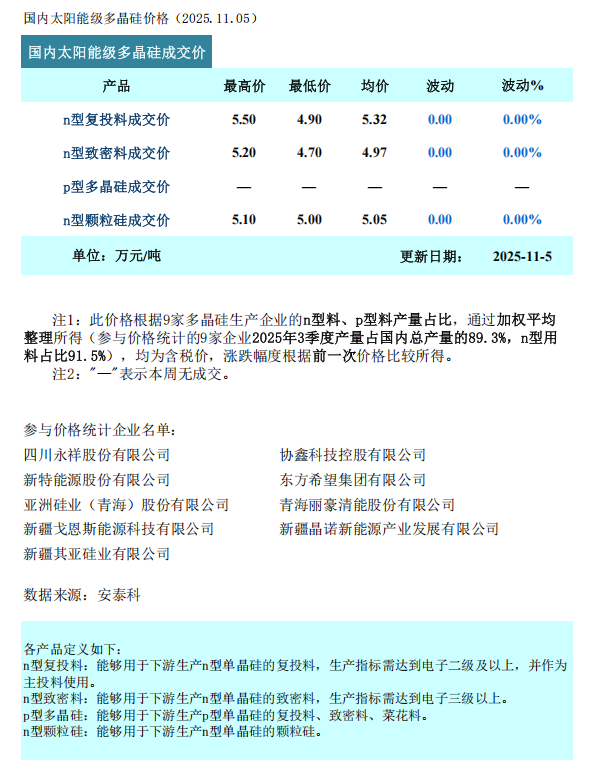
硅业分会:多晶硅供应预期收缩 市场走势持稳
智通财经网· 2025-11-05 07:52
Core Insights - The domestic polysilicon market is experiencing a weak and stable trend, with slight increases in transaction activity and a stable pricing environment due to supply-side production cuts and supportive policies [1][2]. Group 1: Pricing Trends - The transaction price range for n-type reprocessed material is between 49,000 to 55,000 yuan/ton, with an average price of 53,200 yuan/ton, remaining flat week-on-week [1]. - The transaction price range for n-type granular silicon is between 50,000 to 51,000 yuan/ton, with an average price of 50,500 yuan/ton, also remaining flat week-on-week [1]. - The overall polysilicon market is still in a state of oversupply despite the supply contraction, with high industry inventory and weak end-user demand limiting price increases [2]. Group 2: Supply Dynamics - Currently, there are 11 domestic polysilicon producers, with two major companies expected to reduce production and undergo maintenance, leading to a significant estimated decrease in total output by 12.4% month-on-month [2]. - The production plan for domestic polysilicon in November is expected to drop below 120,000 tons, primarily due to rising electricity costs during the dry season in the southwestern region [1]. Group 3: Policy Developments - The new national standard for energy consumption limits for polysilicon and germanium products is in the consultation phase, which is expected to promote capacity clearance and industry upgrades once officially implemented [1].
瑞银:全球石油和炼油市场展望
瑞银· 2025-06-27 02:04
Investment Rating - The report provides a bullish outlook on the oil market, indicating a modestly bullish positioning on oil [17]. Core Insights - The global oil market is expected to experience a surplus in 2025 and 2026, with quarterly global oil supply and demand balances projected [25]. - Global oil demand is anticipated to grow by 0.7 million barrels per day (Mb/d) in 2025 and 0.8 Mb/d in 2026, with total demand reaching approximately 106.2 Mb/d by 2030 [34][37]. - The report forecasts Brent crude oil prices to average $65.99 per barrel in 2025, with a gradual increase to $75.00 by 2028 [3]. Summary by Sections Oil Price Forecast - The UBS forecast for Brent crude oil prices is $74.97 in 1Q25, declining to $62.00 in 3Q25 and 4Q25, before recovering to $65.99 in 2025 [3]. Global Oil Supply and Demand - Global oil supply is projected to grow by 1.4 Mb/d in 2025 and 0.8 Mb/d in 2026, with significant contributions from non-OPEC+ countries [50][53]. - The total global oil demand is expected to reach 103.9 Mb/d in 2025, with the US contributing 20.5 Mb/d [129]. Geopolitical Factors - The report highlights the impact of geopolitical tensions, particularly in the Persian Gulf, on oil supply and pricing, with a risk premium expected to remain elevated due to potential disruptions [11][5]. OPEC+ Dynamics - OPEC+ is expected to gradually unwind production cuts, with a cumulative increase of 2.2 Mb/d planned, affecting global supply dynamics [64][66]. Inventory Trends - Global observed oil inventories rose by 25 million barrels in March, indicating a build-up in supply [104]. Capex and Project Developments - Global upstream capital expenditure is expected to increase by 2% in 2025, reflecting ongoing investments in oil and gas projects [121]. Regional Demand Insights - The report notes that US gasoline demand is projected to align with 2024 levels in 2Q25, indicating stable consumption patterns [43]. Long-term Outlook - The long-term oil price forecast suggests a gradual increase in prices, with a breakeven price for various regions and types of oil production outlined [124].
摩根大通:铁矿石-全球动荡中价格坚挺;维持 2025 年目标价 100 美元 吨。
摩根· 2025-05-08 01:49
Investment Rating - The report maintains an iron ore price forecast of $100/t for 2025, indicating a stable outlook amidst global economic challenges [1][5][14]. Core Insights - Global steel output has started the year relatively flat, with a decrease of 0.4% in Q1 2025, driven by a 1.7% decline in the Rest of the World (RoW) while China saw a slight increase of 0.6% [1][4][11]. - The forecast for global steel production in 2025 has been revised down from a growth of 20 million tons (Mt) to a decline of 5 Mt, primarily due to reduced expectations for RoW production [1][4][14]. - Iron ore supply has faced disruptions due to severe weather conditions in Australia, leading to a reduction of 10 Mt in Australian supply forecasts for 2025 [1][4][28]. - Despite these challenges, iron ore prices have shown resilience, remaining near $100/t, with only slight fluctuations following tariff announcements [1][4][5]. Summary by Sections Global Steel Production - Global steel output is down 0.4% year-to-date (YTD) in Q1 2025, with China showing a positive trend in April [4][19]. - The report anticipates a contraction in crude steel production in China by 1.5% in 2025, with a total output forecast of 990 Mt [7][8][14]. Iron Ore Supply and Demand - Iron ore supply disruptions in Q1 2025 have led to a significant decrease in Australian production forecasts, with China’s port stocks adjusting to meet demand [1][4][11]. - The report highlights a balanced supply-demand scenario, with iron ore prices expected to remain stable at $100/t due to cost curve support and an unchanged outlook for China [1][5][28]. Price Forecasts - The price forecast for iron ore remains unchanged at $100/t for 2025, reflecting a stable market despite external economic pressures [5][14][28]. - The report notes that the medium-term outlook may see a loosening of supply-demand dynamics as new projects come online, particularly from Simandou starting in Q2 2026 [5][28].