
医保管理

Search documents
专项整治强根基 廉政护航医保情——县医疗保障局2025年党风廉政建设工作纪实
Xin Lang Cai Jing· 2026-02-05 20:15
Core Viewpoint - The county's medical insurance bureau is implementing a special rectification initiative as a key measure for party conduct and integrity construction, aiming to address industry irregularities and enhance the integrity framework for high-quality development in medical insurance [1]. Group 1: Responsibility and Accountability - The initiative focuses on tightening responsibility by collaborating with six departments to issue a special rectification work plan, identifying ten key areas for rectification and 32 specific tasks, with 13 special meetings and 8 progress meetings held to ensure accountability [1]. - The special rectification is integrated into the party's integrity responsibility list, aligning it with core tasks such as medical insurance service and fund supervision for coordinated advancement [1]. Group 2: Problem-Oriented Approach - A comprehensive inspection targeting high-risk areas such as illegal charges by designated medical institutions and collusion between insurance personnel has led to the identification of 319 issues, with 318 rectified [2]. - The initiative includes strict accountability measures, resulting in four administrative cases, 14 problem clues sent to market supervision departments, one case transferred to public security, and 25 individuals held accountable [2]. Group 3: Long-term Mechanism Establishment - The strategy combines immediate corrections with long-term governance, integrating integrity requirements into all aspects of medical insurance fund supervision and management [3]. - A total of 26 key positions underwent integrity risk assessments, identifying 60 risk points and establishing 74 preventive measures, creating a comprehensive risk control system [3]. Group 4: Zero Tolerance Policy - The initiative emphasizes a "zero tolerance" approach to strengthen the integrity defense line, focusing on critical areas to prevent corruption [4].


以有力监管守护群众“看病钱”
Xin Lang Cai Jing· 2026-01-19 18:10
Core Insights - The article highlights the efforts of Xining City's Chengxi District Discipline Inspection Commission in enhancing the management of medical insurance funds through a special rectification initiative, recovering a total of 2.0127 million yuan in misappropriated funds and penalties by 2025 [1] Group 1: Supervision and Collaboration - The Chengxi District has established a collaborative mechanism between government oversight and social supervision, forming a team of social supervisors for medical insurance funds [1] - Over 2,550 mutual recognitions of inspection results have been conducted, saving the public over 393,000 yuan in costs [1] - An investment of 788,000 yuan has been made to integrate an intelligent medical insurance supervision system into local livelihood projects, ensuring comprehensive oversight of designated medical institutions [1] Group 2: Political Supervision and Coverage - The commission has strengthened political supervision by implementing targeted deployments and leadership responsibilities, successfully including five village health clinics as designated medical insurance providers, achieving full coverage at the village level [1] - The mobilization for insurance participation has been effectively advanced, with 94,700 urban and rural residents enrolled for the 2026 medical insurance, leading to the highest participation rate in Xining City [1] Group 3: Enforcement and Accountability - The Chengxi District maintains a "zero tolerance" approach towards violations, intensifying the investigation of cases to ensure the safety of medical insurance funds [1] - Since last year, 15 problem leads in the medical field have been investigated, resulting in 15 cases filed, nine individuals receiving disciplinary actions, and three disciplinary inspection recommendations issued [1]
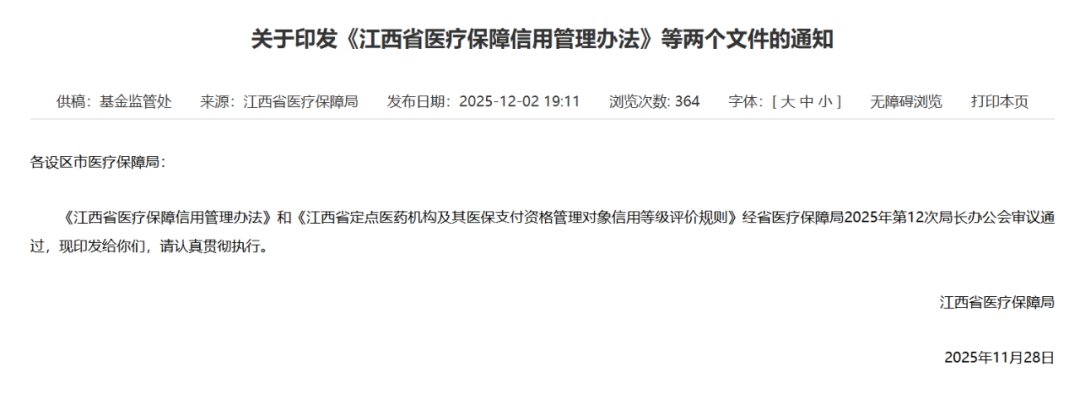
江西重新修订医保信用管理办法 D级定点药店将列入重点整治对象
Xin Lang Cai Jing· 2025-12-04 11:25
Core Viewpoint - The Jiangxi Provincial Medical Insurance Bureau has issued the "Interim Measures for Medical Security Credit Management" to enhance the credit management system for medical insurance, with Yichun and Fuzhou designated as pilot cities for this initiative [2][8]. Group 1: Credit Management Framework - The revised management measures clarify the subjects of credit evaluation, including nine types of entities, and focus on the management of medical insurance payment qualification for designated medical institutions [9]. - The credit evaluation method will implement dynamic management within a rating cycle, with unified evaluation rules established by the provincial medical insurance bureau [3][9]. - The management measures include a tiered management approach, allowing for the suspension or termination of medical insurance payment qualifications for entities identified as untrustworthy [3][9]. Group 2: Penalties and Incentives - For entities rated as D-level, the medical insurance administrative department will implement several measures, including mandatory rectification, public disclosure of untrustworthy information, and increased monitoring frequency [10]. - Entities rated A will receive public recognition, credit file documentation, and potential rewards in internal performance evaluations, while B-rated entities will be managed normally [11]. - C and D-rated entities may face suspension of their medical insurance payment qualifications and will be subject to administrative penalties for non-compliance with medical insurance registration and payment obligations [11][12].
南京开展医保基金管理突出问题专项整治
Nan Jing Ri Bao· 2025-11-20 03:18
Group 1 - The article highlights the convenience and benefits of the new insurance service for newborns, allowing parents to settle medical expenses easily through their health insurance cards [1] - The establishment of "newborn insurance service stations" in medical institutions aims to ensure that every newborn is insured, promoting timely enrollment for parents [1] - The city's health insurance fund management has been improved through a special rectification campaign, focusing on safeguarding public funds and enhancing service efficiency [1] Group 2 - The article discusses the issues of fraud and misuse of health insurance funds, emphasizing the need for stricter regulation and oversight in the sector [2] - A series of self-inspections and corrections have been initiated, resulting in the identification of 109 issues and the referral of 76 suspicious cases [2] - Collaborative mechanisms among various departments have been established to address key issues in health insurance fund management [2] Group 3 - The article reports on the disciplinary actions taken against 143 individuals involved in violations related to health insurance funds, with 16 individuals detained [3] - A specific case of embezzlement involving nearly 2 million yuan has been highlighted, showcasing the effectiveness of the ongoing rectification efforts [3] - Recommendations for improving internal regulations and closing loopholes have been issued to prevent future misconduct [3] Group 4 - The implementation of a big data monitoring platform aims to enhance the oversight of health insurance fund operations, allowing for quick identification and response to anomalies [4] - The platform has been effective in detecting unusual prescription patterns and facilitating comprehensive inspections [4] - The transition from manual checks to intelligent monitoring is being pursued to improve efficiency and accountability in fund management [4] Group 5 - The article mentions a reduction in medical service fees for various tests, resulting in significant savings for patients [5] - The initiative to lower prices for medical services is part of a broader "benefit action" aimed at making healthcare more affordable [5] - Overall, the reduction in testing fees has led to a decrease of 213 million yuan compared to the previous year [5]
【省医保局】陕西医保织密全民“一人一档”数据网
Shan Xi Ri Bao· 2025-11-12 00:16
Core Insights - The province is advancing the "one person, one file" construction of the universal insurance database, which is significant for expanding insurance coverage, providing health services throughout the life cycle, managing medical insurance funds, and promoting overall public health [1][2] Group 1: Insurance Coverage Expansion - The "one person, one file" initiative transitions from a "broad mobilization" approach to "precise policies," effectively identifying uninsured and intermittently insured individuals [1] - Dynamic monitoring and comparative analysis of insurance data help clarify the insurance base, supporting targeted policy formulation and improving insurance quality [1] - Key groups such as newborns, students, and migrant populations are prioritized to ensure comprehensive coverage [1] Group 2: Medical Insurance Fund Management - The "one person, one file" system enhances data accuracy and consistency, providing solid support for fund budgeting, operational monitoring, and risk assessment [2] - Clear personal insurance trajectories strengthen fund supervision, preventing fraud and ensuring the safety of medical funds [2] - The initiative promotes a shift in medical insurance management from a decentralized, passive, and vague approach to a centralized, proactive, and precise one, laying a foundation for a multi-tiered social security system and achieving the goal of universal health [2]
广西梧州:协调联动 织密医保基金防护网
Zhong Yang Ji Wei Guo Jia Jian Wei Wang Zhan· 2025-11-11 08:19
Group 1 - The core viewpoint emphasizes the importance of the Guangxi Zhuang Autonomous Region's Wuzhou City Discipline Inspection Commission and Supervisory Commission in managing issues related to medical insurance fund management as a key focus for enhancing supervision in the public welfare sector [1] - The establishment of a collaborative mechanism between the Discipline Inspection Commission and the municipal medical insurance department aims to ensure the safe and standardized operation of medical insurance funds, thereby protecting the health rights of the public [1] - Regular meetings and a communication coordination mechanism have been established to report on progress and address challenges, enhancing information sharing and the transfer of leads among departments [1] Group 2 - The Discipline Inspection Commission has initiated self-examination and correction actions regarding illegal use of medical insurance funds, identifying and rectifying prominent issues while urging the recovery of misused funds [1] - A collaborative action framework involving the Discipline Inspection Commission, medical insurance, and multiple departments has been formed to focus on key targets and issues related to medical insurance fund management [1] - The analysis of systemic and deep-rooted issues has led to the issuance of over 74 recommendations and suggestions aimed at improving the management of medical insurance contributions and the use of funds by designated medical institutions [2]
每天限额50元,防医保欺诈不能成了刁难民众
Xin Jing Bao· 2025-11-11 05:48
Core Viewpoint - The recent announcement by the Xinxiang Medical Insurance Bureau to impose daily reimbursement limits of 50 yuan for residents and 150 yuan for employees has raised concerns about its impact on patients' access to necessary medical care [1][2][3] Group 1: Policy Announcement - The Xinxiang Medical Insurance Bureau issued a notice limiting daily reimbursement for medical expenses to 50 yuan for residents and 150 yuan for employees, citing concerns over the sustainability of the medical insurance fund [1] - The bureau's rationale for this limit is to prevent fraudulent practices by hospitals and pharmacies, although the effectiveness of this measure is questioned [1][3] Group 2: Impact on Patients - The low reimbursement limits effectively restrict access to medical care for many patients, particularly those with chronic conditions who require ongoing treatment and medication [2][3] - Patients may face difficult choices, such as either covering the excess costs out of pocket or reducing their medication intake, which could compromise their health [2][3] Group 3: Criticism of the Approach - The approach taken by the local medical insurance department has been criticized for being inflexible and not considering the actual medical needs of patients, leading to a situation where patients feel trapped between adhering to rules and seeking necessary care [3] - The "one-size-fits-all" limit does not effectively target fraudulent activities and instead creates unnecessary barriers for legitimate patients seeking medical attention [3]
严查欺诈骗保!国家医保局开展“百日行动”
Xin Hua Wang· 2025-10-02 08:22
Core Points - The National Medical Insurance Administration (NMIA) is launching a nationwide "100-day action" to combat illegal activities related to the misuse of medical insurance funds, particularly focusing on the resale of returned drugs, excessive prescriptions, and fraudulent claims for maternity benefits [1] Group 1: Key Focus Areas - The "100-day action" will run from September 24, 2025, to December 31, 2025, targeting three main issues: resale of returned drugs, excessive prescriptions, and fraudulent maternity benefit claims [1] - In addressing the resale of returned drugs, the action will focus on investigating practices such as falsifying prescriptions, misuse of medical insurance vouchers, and illegal sales of medical insurance drugs by both medical institutions and insured individuals [1] - For excessive prescription issues, the action will monitor abnormal prescription and purchase behaviors using drug traceability data, particularly focusing on cases that exceed clinically reasonable usage [1] Group 2: Implementation and Coordination - The NMIA emphasizes the importance of digital empowerment, enhanced coordination, and strict legal enforcement to ensure the effective implementation of the "100-day action" [1] - Local medical insurance departments are required to strengthen their efforts in addressing these issues and ensure that the objectives of the "100-day action" are met [1]
滨州:“医保价格掌上通”以数字化工具驱动医药价格管理效能升级
Zhong Guo Fa Zhan Wang· 2025-09-26 11:31
Core Insights - The article discusses the launch of the "Medical Insurance Price Mobile Access" system by the Binzhou Medical Insurance Bureau in Shandong Province, aimed at addressing the issues of high drug prices and difficult price comparisons faced by the public [1][4] Group 1: System Features and Functionality - The system has established seamless connections with over 3,800 designated medical institutions, providing access to price information for 65,500 types of drugs, 22,700 types of consumables, and 5,731 medical service items [1] - It features a unified medical insurance price database that aggregates data from hospitals and pharmacies, covering three dimensions: drugs, medical consumables, and diagnostic services, while including core indicators such as purchase price, selling price, and quantity [2] - The system promotes price transparency through a public query function, allowing users to compare prices across different institutions and facilitating better decision-making [2] Group 2: User-Centric Design - The mobile application includes four core functions: "Precise Search" for comprehensive price information, "Smart Comparison" for easy price comparisons between institutions, "Convenient Search" for locating nearby medical facilities, and "Timely Feedback" for users to report pricing issues [3] - The system aims to enhance user experience by ensuring that the public can easily access and compare medical prices, thereby improving overall satisfaction with medical services [3] Group 3: Regulatory and Analytical Support - A PC-based analysis platform has been developed to enhance regulatory efficiency, providing visual representations of key areas such as centralized procurement and price monitoring [3] - This platform supports the medical insurance department in making informed decisions by offering robust data analysis capabilities, thereby improving the overall management of medical prices [3] Group 4: Future Directions - The Binzhou Medical Insurance Bureau plans to expand the application and influence of the "Medical Insurance Price Mobile Access" system, exploring coverage for more medical categories and striving for an upgrade in price management [4] - The focus remains on enhancing service levels to ensure that the public experiences greater satisfaction and a sense of well-being in the medical price management process [4]
【宝鸡】多管齐下 为医保基金筑起一道道“防护网”
Shan Xi Ri Bao· 2025-07-29 23:57
Core Insights - The article highlights the improvements in the healthcare insurance system in Baoji City, emphasizing reduced costs and increased transparency for patients [1][2][3][4][5][6] Group 1: Fund Management and Efficiency - Baoji City has implemented a multi-faceted approach to enhance the safety and efficiency of the medical insurance fund, including revenue generation, scientific management, and regulatory measures [1][2][3] - The average monthly contribution for employed individuals has increased by 550 yuan, resulting in an additional 120 million yuan in the employee medical insurance fund over the year [2] - The city has achieved a participation rate of 96.8%, with 3.1034 million insured individuals [2] Group 2: Cost Reduction and Patient Benefits - The introduction of a disease-based payment reform has led to a 10.5% decrease in average hospitalization costs, with a 14% reduction in medical insurance fund expenditures and an 8% decrease in personal financial burden [3] - The cumulative balance of the urban residents' medical insurance fund can cover 7.35 months of payments, placing Baoji City in a leading position within the province [4] Group 3: Smart Regulation and Oversight - The launch of a smart medical insurance regulatory platform has improved oversight of 1,380 retail pharmacies, significantly reducing fund expenditures by 466.4 million yuan, a 40% decrease [5] - The platform allows for real-time tracking of drug prices and sources, enhancing transparency and consumer protection [5] Group 4: Anti-Corruption Measures - Baoji City has intensified efforts to combat fraud in the medical insurance sector through stringent regulatory measures, including joint inspections and smart monitoring [6] - The city has adopted a comprehensive approach to safeguard the medical insurance fund, ensuring that resources are used effectively and efficiently [6]