
电动汽车充电

Search documents
到2027年底满足超8000万辆电动汽车充电需求——充电服务能力如何“倍增”
Xin Hua Wang· 2025-11-17 23:39
Core Insights - The National Development and Reform Commission and five other departments have jointly issued the "Three-Year Doubling Action Plan for Electric Vehicle Charging Facility Service Capacity (2025-2027)", aiming to double the charging service capacity by the end of 2027 [2][3] Summary by Sections Charging Infrastructure Development - By the end of 2027, the plan aims to establish 28 million charging facilities nationwide, providing over 300 million kilowatts of public charging capacity to meet the charging needs of over 80 million electric vehicles [2] - The action plan is expected to drive over 200 billion yuan in investment in charging facility equipment manufacturing and construction [2] Spatial Layout and Functionality - The plan emphasizes the need to improve the construction of charging facilities in rural areas, where the infrastructure is currently lacking compared to urban areas [3] - It proposes adding at least 14,000 direct current charging guns in townships without public charging stations by the end of 2027, ensuring comprehensive coverage of public charging facilities in rural areas [3] - The average power of public charging facilities in China is currently only 45.5 kilowatts, which is insufficient for high-demand scenarios during holidays [4] - The plan includes the construction of 40,000 "super-fast combined" charging guns with over 60 kilowatts in key cities and highway service areas by 2027 [4] Innovation and Interaction - The plan promotes the expansion of vehicle-grid interaction pilot programs, allowing electric vehicles to connect with the power grid for smart charging and bidirectional energy flow [5][6] - The NIO battery swap station in Nanjing exemplifies this innovation, enabling battery swapping and reverse energy delivery to the grid [5][6] Community Charging Solutions - The "Unified Construction and Service" model is being piloted in residential areas, allowing residents to charge their vehicles conveniently without incurring installation costs [7][8] - By the end of 2027, the plan aims to establish 1,000 "Unified Construction and Service" pilot communities, significantly enhancing the access and safety of private charging stations [8]
充电服务能力如何“倍增”
Ren Min Ri Bao· 2025-11-17 23:11
Core Viewpoint - The National Development and Reform Commission and five other departments have jointly issued the "Three-Year Doubling Action Plan for Electric Vehicle Charging Facility Service Capacity (2025-2027)", aiming to double the charging service capacity by the end of 2027 [2][3]. Summary by Sections Charging Infrastructure Development - By the end of 2027, the plan aims to establish 28 million charging facilities nationwide, providing over 300 million kilowatts of public charging capacity to meet the charging needs of over 80 million electric vehicles, effectively doubling the service capacity [3]. - The action plan is expected to stimulate over 200 billion yuan in investment in charging facility equipment manufacturing and construction [3]. Spatial Layout and Functionality - The current charging service capacity is relatively sufficient in urban areas, but rural areas face challenges due to weaker power grids and lower electric vehicle ownership [4]. - The plan emphasizes the need to enhance charging infrastructure in rural areas, with a target of adding at least 14,000 direct current charging guns in townships without existing public charging stations by 2027 [5]. - The average power of public charging facilities is currently 45.5 kilowatts, which is inadequate for high-demand scenarios during holidays; thus, the plan includes the construction of 40,000 high-power charging guns (over 60 kilowatts) in key cities and highway service areas [6]. Innovation and Interaction - The plan promotes the expansion of vehicle-grid interaction pilot projects, which allow electric vehicles to connect with the power grid for smart charging and discharging [7][8]. - The dual-direction charging stations can charge during low-demand periods and discharge during peak times, generating additional revenue for operators [7]. Inclusivity and Community Engagement - The "Unified Construction and Service" model is being piloted in residential areas to address charging difficulties, allowing residents to charge their vehicles conveniently at home without incurring installation costs [9][10]. - By the end of 2027, the plan aims to establish 1,000 pilot communities under this model, significantly improving the access and safety of private charging stations [10].

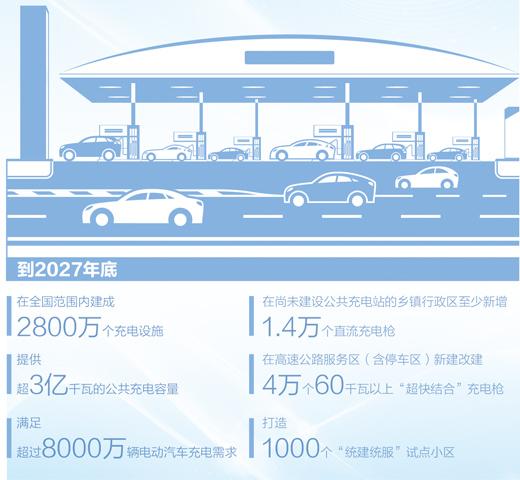
充电服务能力如何“倍增”(经济聚焦)
Ren Min Ri Bao· 2025-11-17 22:40
Core Insights - The National Development and Reform Commission and five other departments have launched the "Three-Year Doubling Action Plan for Electric Vehicle Charging Facility Service Capacity (2025-2027)", aiming to double the charging service capacity by the end of 2027 [3][5] - By 2027, the plan targets the establishment of 28 million charging facilities nationwide, providing over 300 million kilowatts of public charging capacity to meet the charging needs of over 80 million electric vehicles [3][5] - The plan is expected to stimulate over 200 billion yuan in investment in charging facility equipment manufacturing and construction [3][5] Infrastructure Development - The current charging service capacity is relatively sufficient in urban areas, but rural areas face challenges due to weaker power grids and lower electric vehicle ownership [4][5] - The plan includes adding at least 14,000 direct current charging guns in townships without public charging stations by 2027, aiming for comprehensive coverage of public charging facilities in rural areas [5][6] - The average power of public charging facilities in China is currently only 45.5 kilowatts, which is insufficient for high-demand scenarios during holidays [6] Technological Innovation - The plan emphasizes the need for high-power charging facilities, with a goal to build 40,000 charging guns of 60 kilowatts or more at highway service areas by 2027 [6] - The introduction of vehicle-grid interaction technology is highlighted, allowing electric vehicles to discharge energy back to the grid during peak hours, thus enhancing grid stability [7][8] Community Engagement - The "Unified Construction and Service" model is being piloted in residential areas, allowing for the installation of charging facilities without residents bearing the costs [9][10] - By 2027, the plan aims to establish 1,000 pilot residential communities under this model, significantly improving the accessibility and management of private charging stations [10]
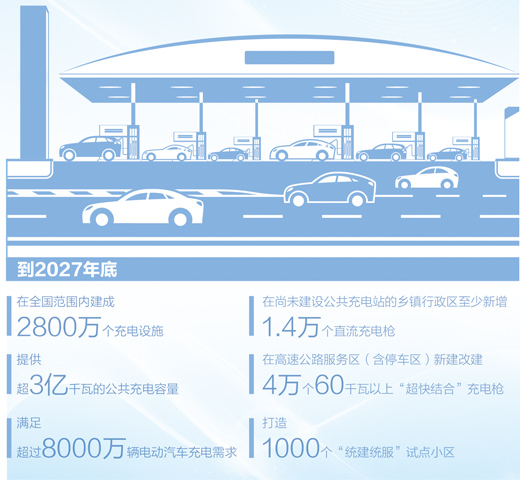
到2027年底满足超8000万辆电动汽车充电需求 充电服务能力如何“倍增”(经济聚焦)
Ren Min Ri Bao· 2025-11-17 21:51
国家发展改革委等6部门日前联合印发《电动汽车充电设施服务能力"三年倍增"行动方案(2025—2027 年)》,明确到2027年底,实现充电服务能力翻倍增长。充电设施空间布局将迎来怎样的调整?技术上 会有哪些新突破?居住区充电将有哪些新变化?记者进行了采访。 ——编者 全球一半以上的新能源汽车行驶在中国。截至今年6月底,全国新能源汽车保有量达3689万辆,仅今年 上半年就新注册登记新能源汽车562.2万辆。随着新能源汽车保有量持续增长,充电需求大幅攀升。尽 管充电基础设施快速发展,但在节假日等出行高峰期,不免出现"排队等桩""里程焦虑"等现象。公共充 电网络布局不均衡、居住区服务供给不充分、运营管理质效有待提升等问题亟须破解。 充电设施作为新能源汽车产业的关键支撑,其服务能力直接影响消费者的购买信心。国家发展改革委等 部门日前联合印发《电动汽车充电设施服务能力"三年倍增"行动方案(2025—2027年)》,提出到2027 年底,在全国范围内建成2800万个充电设施,提供超3亿千瓦的公共充电容量,满足超过8000万辆电动 汽车充电需求,实现充电服务能力的翻倍增长。 国家发展改革委能源研究所副研究员付毕安表示,行动 ...
EVgo (EVGO) Upgraded to Buy: Here's Why
ZACKS· 2025-11-14 18:03
Core Viewpoint - EVgo Inc. (EVGO) has received an upgrade to a Zacks Rank 2 (Buy) due to an upward trend in earnings estimates, which is a significant factor influencing stock prices [1][3]. Earnings Estimates and Stock Price Movement - The Zacks rating system is based on the Zacks Consensus Estimate, which reflects EPS estimates from sell-side analysts for the current and following years [1][2]. - Changes in a company's future earnings potential, as indicated by earnings estimate revisions, are strongly correlated with near-term stock price movements [4][6]. - Rising earnings estimates for EVgo suggest an improvement in the company's underlying business, which could lead to increased stock prices as investors respond positively [5][10]. Zacks Rank System - The Zacks Rank system classifies stocks into five groups based on earnings estimates, with Zacks Rank 1 (Strong Buy) to Zacks Rank 5 (Strong Sell) [7]. - Historically, Zacks Rank 1 stocks have generated an average annual return of +25% since 1988, indicating the effectiveness of the system [7]. - EVgo's upgrade to Zacks Rank 2 places it in the top 20% of Zacks-covered stocks, suggesting potential for market-beating returns in the near term [10]. Recent Performance of EVgo - For the fiscal year ending December 2025, EVgo is expected to earn -$0.41 per share, with no year-over-year change [8]. - Over the past three months, the Zacks Consensus Estimate for EVgo has increased by 15.3%, reflecting positive sentiment among analysts [8].


EVgo (EVGO) - 2025 Q3 - Earnings Call Transcript
2025-11-10 14:02
Financial Data and Key Metrics Changes - Total revenue for Q3 2025 was $92 million, representing a 37% year-over-year increase [23] - Adjusted EBITDA was negative $5 million, showing a $4 million improvement compared to Q3 2024 [24] - Charging network gross margin increased to 35%, up one percentage point from the previous year [23] Business Line Data and Key Metrics Changes - Charging network revenues reached $56 million, a 33% increase year-over-year [23] - Extend revenues were $32 million, delivering growth of 46% [23] - Insular revenues were approximately $5 million, up 27% [23] Market Data and Key Metrics Changes - Total energy dispensed on EVgo's network grew to 350 GWh over the trailing 12 months, a 13-fold increase since 2021 [22] - The number of stalls in operation increased to 4,590, a 2.7 times increase compared to the end of 2021 [22] Company Strategy and Development Direction - The company aims to achieve break-even adjusted EBITDA in Q4 2025, marking a significant milestone [30] - EVgo plans to deploy up to 5,000 stalls annually by 2029 without needing additional equity capital [21] - The focus is on site selection and maximizing returns on capital, differentiating from competitors who may prioritize federal grants over optimal site locations [55] Management's Comments on Operating Environment and Future Outlook - Management expressed optimism about EV sales forecasts, suggesting that actual sales may exceed current predictions due to improved vehicle affordability and performance [34] - The company anticipates continued growth in charging revenue, projecting three to four times annualized growth from current levels [9] - Management acknowledged seasonality in throughput and charge rates, particularly in winter months, but expects to see overall growth in the charging network's profitability [52] Other Important Information - The company has received $41 million from the DOE loan to accelerate the build-out of EV charging infrastructure [4] - EVgo's average daily throughput per stall has increased more than six-fold from less than 50 kWh in Q1 2022 to 295 kWh in Q3 2025 [12] - The company is actively enhancing its charging technology and infrastructure to improve performance and reduce costs [16][19] Q&A Session Summary Question: EV demand outlook and its impact on development - Management noted that the number of EVs has grown significantly, and while forecasts may fluctuate, they expect higher sales than current predictions due to improved vehicle quality and affordability [34] Question: Tesla charging on the network with new cables - Management indicated that early usage data shows increased Tesla driver engagement at retrofit sites, with plans for a broader rollout in 2026 [37][38] Question: Guidance for stall deployment in 2026 - Management confirmed that the guidance for 2026 remains valid, with expectations for a doubling of public and dedicated stalls compared to 2025 [44] Question: Impact of contract closeout on future revenue - Management clarified that the contract closeout would not impact the previously provided stall guidance, as the majority of the growth is expected from public stalls [80] Question: Charging network gross margin expansion - Management explained that while margins are expanding, seasonality affects Q3 margins, and they expect continued improvement in Q4 [82]
EVgo (EVGO) - 2025 Q3 - Earnings Call Transcript
2025-11-10 14:02
Financial Data and Key Metrics Changes - Total revenue for Q3 2025 was $92 million, representing a 37% year-over-year increase [24] - Adjusted EBITDA was negative $5 million, an improvement of $4 million compared to Q3 2024 [24] - Charging network gross margin increased to 35%, up one percentage point from the previous year [24] Business Line Data and Key Metrics Changes - Charging network revenues reached $56 million, a 33% increase year-over-year [24] - eXtend revenues were $32 million, delivering growth of 46% [24] - Insular revenues were approximately $5 million, up 27% [24] Market Data and Key Metrics Changes - Total energy dispensed on EVgo's network grew to 350 gigawatt-hours over the trailing 12 months, a 13-fold increase since 2021 [22] - The number of stalls in operation increased to 4,590, a 2.7 times increase compared to the end of 2021 [22] Company Strategy and Development Direction - EVgo aims to achieve break-even adjusted EBITDA in Q4 2025, with a long-term goal of $500 million in adjusted EBITDA by 2029 [11][30] - The company is focused on expanding its charging network, with plans to deploy up to 5,000 stalls annually by 2029 without needing additional equity capital [20][21] - EVgo is enhancing its next-generation charging architecture to lower gross capex per stall by over 25% by 2029 [16] Management's Comments on Operating Environment and Future Outlook - Management expressed confidence in the growth of EV sales, citing an increase in the number of battery electric vehicle models available [34] - The company anticipates continued strong demand for its charging services, driven by the increasing number of EVs on the road and the expansion of affordable vehicles [8] - Management noted that the charging network's profitability is expected to improve as throughput per stall increases and fixed costs are leveraged [10][24] Other Important Information - EVgo has received a $41 million advance from the DOE loan to accelerate the build-out of EV charging infrastructure [4] - The company has expanded its pilot for NACS connectors, with approximately 100 cables installed, and is seeing increased Tesla charging on its network [6][20] Q&A Session Summary Question: EV demand outlook and its impact on development - Management noted that the number of EVs on the road has grown significantly, and they expect higher sales than current forecasts suggest due to improved vehicle affordability and performance [34][35] Question: Uptick in Tesla charging on the network - Management indicated that it is too early to quantify the impact but noted higher usage at sites with newly installed NACS cables [36][37] Question: Guidance for stall deployment in 2026 - Management confirmed that the guidance for 2026 remains valid, with expectations of doubling the number of public and dedicated stalls compared to 2025 [44][45] Question: Ancillary revenue impact from contract closeout - Management clarified that the contract closeout would not impact prior stall guidance, and they are still working with other partners in the autonomous vehicle space [82] Question: Charging network gross margin expansion - Management explained that while margins are expanding, seasonality affects Q3 margins, and they expect further improvement in Q4 [84][86]
电动汽车充电设施超1800万个
Ren Min Ri Bao· 2025-11-06 22:11
Group 1 - The total number of electric vehicle charging facilities in China reached 18.063 million by the end of September, representing a year-on-year growth of 54.5% [1] - The total rated power of public charging facilities nationwide is approximately 200 million kilowatts, an increase of 59.2% since the beginning of the year, with an average power of 44.4 kilowatts, up 26.9% [1] - By 2027, the goal is to establish 28 million charging facilities to meet the charging needs of over 80 million electric vehicles, with a focus on encouraging fair market competition and supporting the development of private enterprises in the charging sector [1] Group 2 - The number of high-power charging facilities with a single-gun charging power greater than 250 kilowatts has accelerated, with over 37,000 units now in operation [2] - Intelligent charging technology is advancing, with 17 provinces conducting large-scale pilot applications for vehicle-to-grid interaction, resulting in the establishment of 3,832 bidirectional charging and discharging stations [2]
电动汽车充电设施超1800万个 大功率充电设施加快普及
Ren Min Ri Bao· 2025-11-06 21:55
Core Insights - The total number of electric vehicle charging facilities in China reached 18.063 million by the end of September, representing a year-on-year growth of 54.5% [1] - The National Energy Administration has been enhancing the policy framework and expanding the scale of charging facilities to support the promotion of new energy vehicles [1] - The total rated power of public charging facilities nationwide is approximately 200 million kilowatts, an increase of 59.2% since the beginning of the year [1] Charging Infrastructure Development - A total of 68,000 charging facilities have been built in highway service areas [1] - The average power of charging facilities is about 44.4 kilowatts, which has increased by 26.9% since the beginning of the year, indicating significant improvements in charging efficiency [1] - By 2027, the goal is to establish 28 million charging facilities to meet the charging needs of over 80 million electric vehicles [1] Market Participation and Competition - The recent action plan encourages fair market competition and supports the development of the private sector in the charging field [1] - Among the top ten charging operators in the country, eight are private enterprises, which account for 70.7% of the public charging stations operated [1] Technological Advancements - High-power charging facilities with a single-gun charging power greater than 250 kilowatts are being rapidly adopted, with over 37,000 units established nationwide [2] - Smart charging technology is advancing, with 17 provinces conducting large-scale pilot applications for vehicle-to-grid interaction, resulting in the establishment of 3,832 bidirectional charging and discharging stations [2]
中国电动汽车充电设施总数超1800万个
Ren Min Ri Bao· 2025-11-06 20:41
Core Insights - As of September 30, 2023, China has a total of 18.063 million electric vehicle charging facilities, marking a year-on-year increase of 54.5%, effectively supporting the charging needs of 40 million new energy vehicles nationwide [1] - The National Energy Administration has been enhancing the policy framework and expanding the scale of charging facilities, which has significantly supported the promotion of new energy vehicles [1] - The total rated power of public charging facilities across the country reached approximately 200 million kilowatts, a 59.2% increase from the beginning of the year, with average power increasing by 26.9% to about 44.4 kilowatts [1] Charging Infrastructure Development - A recent action plan aims to establish 28 million charging facilities by the end of 2027 to meet the charging needs of over 80 million electric vehicles [1] - The plan encourages fair market competition and supports the development of the private sector in the charging field, with 8 out of the top 10 charging operators being private enterprises, accounting for 70.7% of the public charging stations [1] Technological Advancements - High-power charging facilities with a single-gun charging power greater than 250 kilowatts are rapidly being adopted, with over 37,000 units established nationwide, significantly enhancing charging speed [2] - Smart charging technology is making progress, with 17 provinces conducting large-scale pilot applications of vehicle-to-grid interaction, establishing 3,832 bidirectional charging and discharging stations [2] - The National Energy Administration plans to continue improving the charging infrastructure network and enhance operational management to better meet the needs of consumers purchasing and using new energy vehicles [2]