Database

Search documents
2025零售数据底座创新大会召开
Zhong Guo Jing Ji Wang· 2025-09-01 09:25
Group 1 - The demand for cloud databases has surged due to the need to handle massive amounts of unstructured data in generative AI applications [1][2] - OceanBase's cloud database product, OB Cloud, has served over 200 leading retail enterprises in various sectors, including apparel, food service, fast-moving consumer goods, and direct-to-consumer [1] - The retail industry is shifting from broad traffic operations to deep user value exploration, with over 90% of enterprises believing AI will significantly enhance productivity [1] Group 2 - OceanBase, founded in 2010, launched its integrated cloud database platform OB Cloud in 2022, aiming to assist various industries in transitioning to a digital intelligence era [2] - OB Cloud utilizes technologies like vector fusion queries to enable deep understanding of unstructured data such as images, videos, and text comments, facilitating features like image search and intelligent product recommendations [2] - The "Integrated Cloud Database White Paper" released at the conference emphasizes the transition of integrated cloud databases from "cost centers" to "growth engines," highlighting the need for companies to focus on six dimensions for technology selection [2]
OceanBase CEO杨冰:零售下一轮竞争,本质是“数据底座能力”的竞争
Sou Hu Cai Jing· 2025-08-29 15:44
Core Insights - The retail industry is undergoing a transformation where data infrastructure is shifting from a "cost center" to a "growth engine" [1] - Over 90% of enterprises believe that generative AI will enhance productivity, but traditional architectures face challenges such as data latency and system fragmentation [1][3] - A robust data foundation is essential for supporting real-time decision-making and AI applications in retail [4] Group 1: Industry Trends - Retail has moved from extensive traffic operations to deep user value exploration, with AI integrated across the entire supply chain [1] - The need for a data foundation that can handle "pulse-like surges" in traffic and serve as a "real-time decision engine" is critical [3][4] - The competition in retail is fundamentally about the capabilities of the data foundation, emphasizing the importance of ecosystem collaboration [5] Group 2: Technological Advancements - OceanBase's HTAP foundation has enabled companies like Haidilao to streamline their membership operations and achieve personalized recommendations [3] - The OB Cloud platform has reduced scaling time by 90% for companies like Pop Mart, allowing them to handle a hundredfold increase in traffic with high availability [3] - OB Cloud is focusing on deep integration of AI with databases, enhancing the understanding of unstructured data such as images and text [4] Group 3: Market Impact - OceanBase has served over 200 leading retail clients across various sectors, demonstrating the scalability of its solutions [4] - The global expansion of OB Cloud has reached over 50 regions, with a customer growth rate of 130%, showcasing the adaptability of Chinese technology [5] - The future of retail efficiency and innovation may be redefined as more companies adopt these transformative technologies [5]

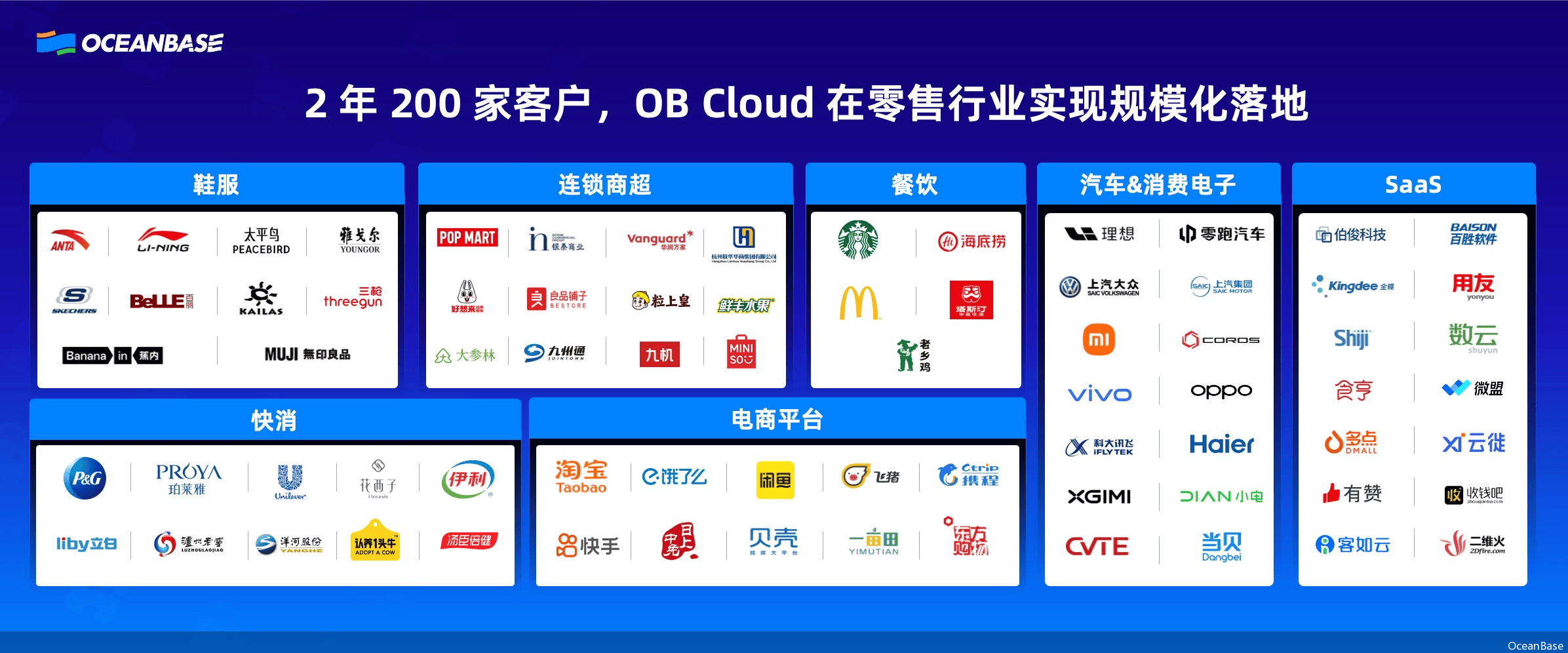
OB Cloud两年服务200家零售企业,海底捞泡泡玛特等首选一体化架构
Guan Cha Zhe Wang· 2025-08-29 05:15
Core Insights - The retail industry is facing dual challenges of fluctuating traffic and AI transformation, necessitating a stable and efficient data foundation for success [1][3] - OceanBase Cloud (OB Cloud) aims to deepen its presence in the new retail sector by providing integrated cloud database solutions [1][4] Industry Trends - The retail sector is shifting from broad traffic operations to deep user value exploration, with over 90% of companies believing that generative AI will enhance productivity [3] - Traditional architectures face issues such as data latency and system fragmentation, hindering real-time decision-making and AI innovation [3] Company Developments - OB Cloud has developed four core capabilities to address retail challenges: integration of transaction and analysis, multi-model data fusion, vectorized query for AI applications, and multi-cloud native deployment [4] - The platform has demonstrated significant performance improvements, such as a 90% reduction in scaling time for high traffic scenarios and a 45% increase in real-time computing power for member systems [4][5] Case Studies - Haidilao utilized OB Cloud to manage high concurrency in its membership system, achieving stable operations that support over 80% of its total revenue [4][6] - The integration of OB Cloud in Haidilao's inventory system allows for real-time stock calculations and proactive decision-making, reducing response time from days to minutes [5] AI Integration - OB Cloud is focusing on deep integration of AI with databases, enhancing capabilities to understand unstructured data such as images and text [6] - The platform enables features like visual search and intelligent recommendation systems, improving customer experience and operational efficiency [6] Market Position - OB Cloud has served over 200 leading retail enterprises, including Li Ning and Haidilao, and is becoming a key infrastructure for the digital transformation of the retail industry [6][7] - The company has established a global presence across more than 50 regions, with a customer growth rate of 130% [7] Research Insights - A white paper released at the conference highlights the transition of integrated cloud databases from cost centers to growth engines, emphasizing the need for businesses to focus on architecture design and AI capabilities [7]

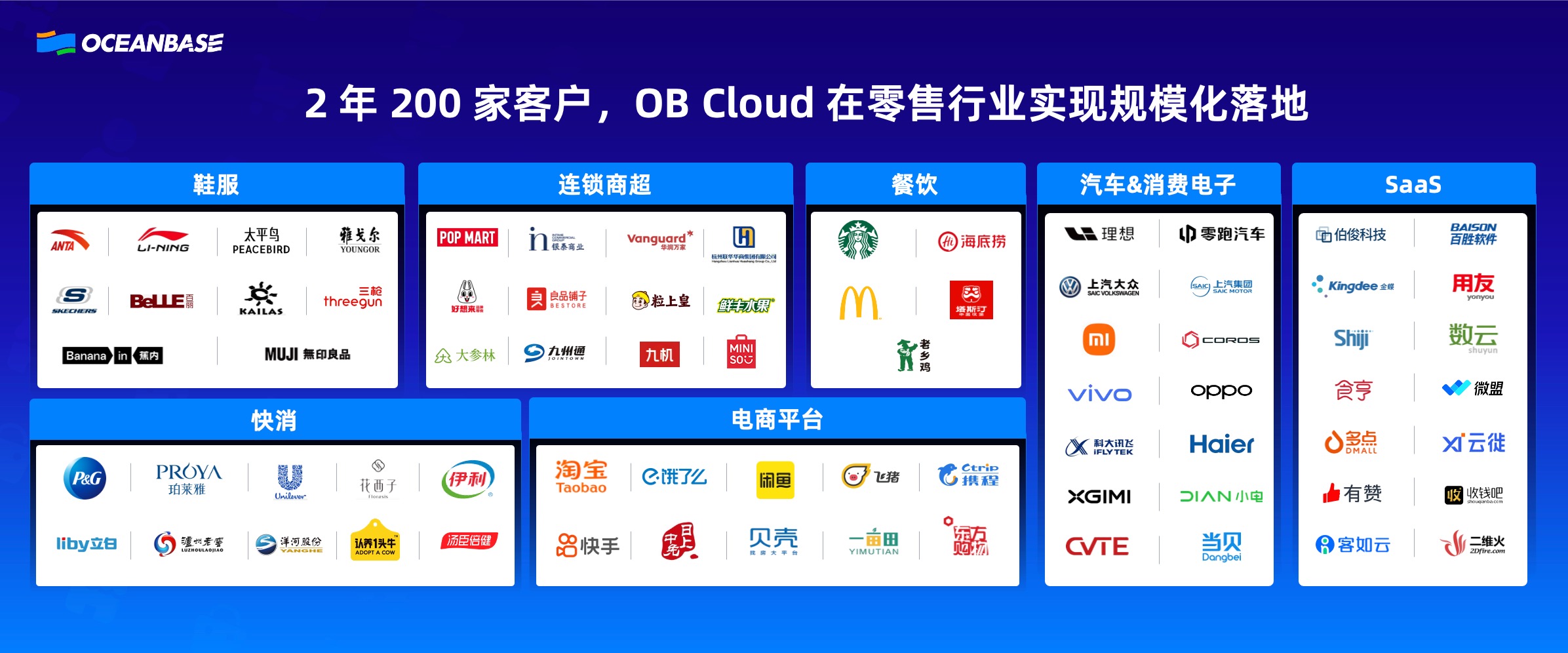
人工智能应用带动云数据库需求激增
Xin Hua Cai Jing· 2025-08-28 14:37
Group 1 - The core viewpoint of the article highlights the increasing demand for cloud databases driven by the need to process vast amounts of unstructured data in generative artificial intelligence applications [1] - OceanBase's cloud database product, OB Cloud, has served over 200 leading retail enterprises, including Li Ning, Anta, Haidilao, and Pop Mart, covering various retail sectors such as footwear, dining, fast-moving consumer goods, and DTC [1] - The retail industry is shifting from extensive traffic operations to deep user value exploration, with over 90% of enterprises believing that generative AI will enhance productivity [1] Group 2 - OceanBase, a fully self-developed distributed database founded in 2010, launched the integrated cloud database platform OB Cloud in 2022 to support various industries in their digital transformation [2] - The integrated cloud database is transitioning from a "cost center" to a "growth engine," capable of handling traffic surges during events like promotions and live broadcasts through linear scaling [2] - The next round of competition in the retail industry is fundamentally about the capability of the "data foundation," emphasizing the importance of ecosystem collaboration for success [2]
一体化云数据库从“成本中心”转向“增长引擎”
Guo Ji Jin Rong Bao· 2025-08-28 12:21
Core Insights - The first "2025 Retail Data Foundation Innovation Conference" was held in Shanghai, where the "Integrated Cloud Database White Paper" was released, marking the first authoritative report on the value of integrated cloud databases in the retail industry [1] - The white paper emphasizes that integrated cloud databases are transitioning from a "cost center" to a "growth engine" in the era of "second-level decision-making" and "centimeter-level insights" [1] - Key business scenarios analyzed include consumer services, supply chain management, and omnichannel operations, with case studies from 12 leading companies such as Pop Mart and Li Ning [1] Industry Challenges and Opportunities - The retail industry is facing dual challenges from pulse-like traffic impacts and AI transformations, necessitating a stable, efficient data foundation that supports AI applications [3] - Over 90% of companies believe generative AI will enhance productivity, yet traditional architectures suffer from data delays, system fragmentation, and resource redundancy, hindering real-time decision-making and AI innovation [3] - The retail sector must address three core challenges: managing "pulse-like traffic surges," transforming data into a "real-time decision engine," and evolving AI from a "value-add" to a "core infrastructure" [3]
速递|千亿估值加持,Databricks新一轮融资10亿美元,为Agent时代打造“水与电”
Z Potentials· 2025-08-20 04:19
Core Viewpoint - Databricks is raising $1 billion in a new funding round at a valuation of $100 billion, focusing on advancing its AI Agent database and platform [2][3]. Funding and Financials - The recent funding round is led by Thrive and Insight Partners, with Databricks having raised approximately $20 billion since its inception in 2013 [2]. - The company completed a record $10 billion financing in January at a valuation of $62 billion, which was later surpassed by OpenAI's $40 billion financing in March [2]. Product Development - Databricks plans to invest heavily in its AI Agent database, named Lakebase, which was launched in June and is based on the open-source Postgres database [4]. - The total addressable market (TAM) for the database market is estimated at $105 billion, with a significant portion of databases now being created by AI agents, increasing from 30% to 80% in one year [4][5]. Competitive Advantage - The differentiation of Lakebase from competitors like Supabase lies in its "separation of compute and storage" architecture, allowing for cost-effective database creation [6]. - The second focus of investment is the AI Agent platform, Agent Bricks, which aims to provide reliable solutions for everyday business tasks rather than pursuing superintelligent AI [6][7]. Talent Acquisition - Databricks is also raising additional funds to compete for AI talent, acknowledging the high costs associated with hiring in this field [8].

MongoDB 即将迎来 GARP 时刻
美股研究社· 2025-08-14 10:01
Core Viewpoint - MongoDB is positioned as a leading choice for non-relational data projects, becoming an industry standard for developers needing flexible data storage solutions [1][2]. Group 1: Business Model and Revenue Sources - MongoDB's business model consists of three main revenue sources: Atlas, Enterprise Advanced, and Professional Services [2]. - Atlas is the core business, accounting for approximately 72% of total revenue in Q1 FY2026, with a year-over-year growth rate of 26% [2][7]. - Enterprise Advanced, which is a downloadable software for non-cloud applications, has seen slower growth, with a year-over-year increase of only 7% [3]. Group 2: Financial Performance - In the last quarter, MongoDB's total revenue grew by 22% year-over-year, surpassing analyst expectations of around 15% [7]. - The company reported a non-GAAP gross margin decrease from 75% to 74%, which is considered normal fluctuation [9]. - The company has a strong balance sheet with total liabilities under $600 million and current assets exceeding $2.8 billion [12]. Group 3: Future Growth and Valuation - Analysts expect MongoDB's revenue to grow from $2 billion to $2.3 billion by the end of FY2026, with free cash flow projected to reach approximately $550 million, reflecting a nearly 30% increase [12][15]. - The expected price-to-free cash flow ratio is projected to decrease from 40x to a more acceptable 31x, making the stock potentially attractive for investors [13][14]. - The company is anticipated to maintain a compound annual growth rate (CAGR) of around 15% to 20% due to the increasing demand for non-structured data driven by digitalization and cloud computing trends [13][16]. Group 4: Challenges and Risks - MongoDB faces challenges related to significant equity dilution and high valuation, which could hinder capital appreciation [12][16]. - The reliance on the emergence of new non-structured data and a stable macroeconomic environment is crucial for continued growth [16].


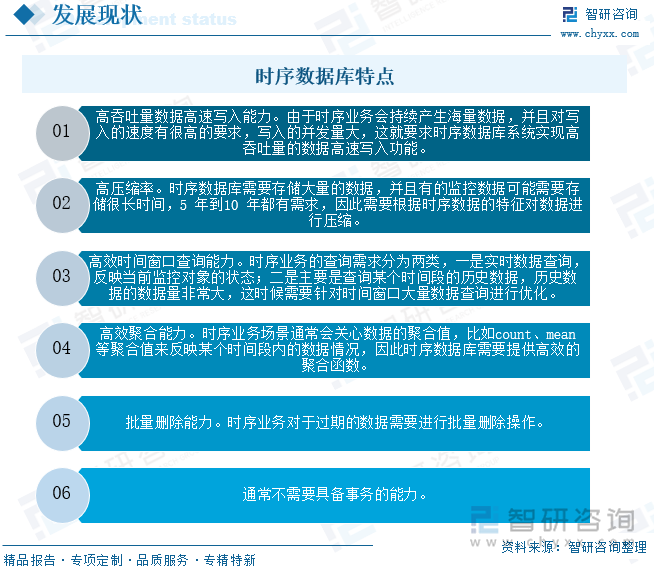
研判2025!中国时序数据库行业市场数量、竞争格局及未来趋势分析:受益于物联网设备激增,时序数据库发展迅速[图]
Chan Ye Xin Xi Wang· 2025-08-13 01:11
Core Viewpoint - The time series database (TSDB) industry is experiencing rapid growth driven by the exponential increase in time series data generated by IoT devices and cloud platforms, with the global market expected to grow from $388 million in 2024 to $776 million by 2031 [1][10]. Group 1: Industry Overview - Time series databases are specialized databases designed for storing and managing time series data, optimizing the ingestion, processing, and storage of timestamped data [2][3]. - The emergence of smart hardware, smart manufacturing, smart cities, and smart healthcare has led to a significant increase in time series data generation [1][9]. - Traditional relational databases and NoSQL databases face challenges in handling the high volume and concurrency of time series data, leading to the development of time series databases [1][10]. Group 2: Market Size and Trends - The global time series database software market is projected to reach $776 million by 2031, growing from $388 million in 2024 [10]. - As of June 2025, there are 41 time series databases globally, a decrease of 14 from the previous year, indicating increased industry concentration [14]. - In China, the number of time series databases is 17, down by 10 from the previous year, reflecting a competitive market landscape [16]. Group 3: Competitive Landscape - The industry features a mix of open-source and commercial models, with foreign markets leaning towards open-source solutions while domestic markets favor commercial offerings [18]. - Major domestic time series databases include Tdengine, KaiwuDB, DolphinDB, and openGemini, which play significant roles in driving industry development [20][21]. Group 4: Development Trends - Future trends indicate a deep integration of time series databases with artificial intelligence, enhancing capabilities for fault prediction and trend analysis [23][29]. - The adoption of cloud-native technologies is expected to grow, allowing for flexible resource management and cost reduction [25][29]. - The deployment of time series databases at the edge will facilitate real-time data processing and decision-making in IoT applications [26][29]. - There is a movement towards multi-model integration, enabling the management of diverse data types within time series databases [27][29].
研判2025!中国图数据库行业市场规模、数量、竞争格局及未来趋势分析:市场规模高速增长,产品数量呈现收缩态势,市场集中度提升[图]
Chan Ye Xin Xi Wang· 2025-08-12 01:05
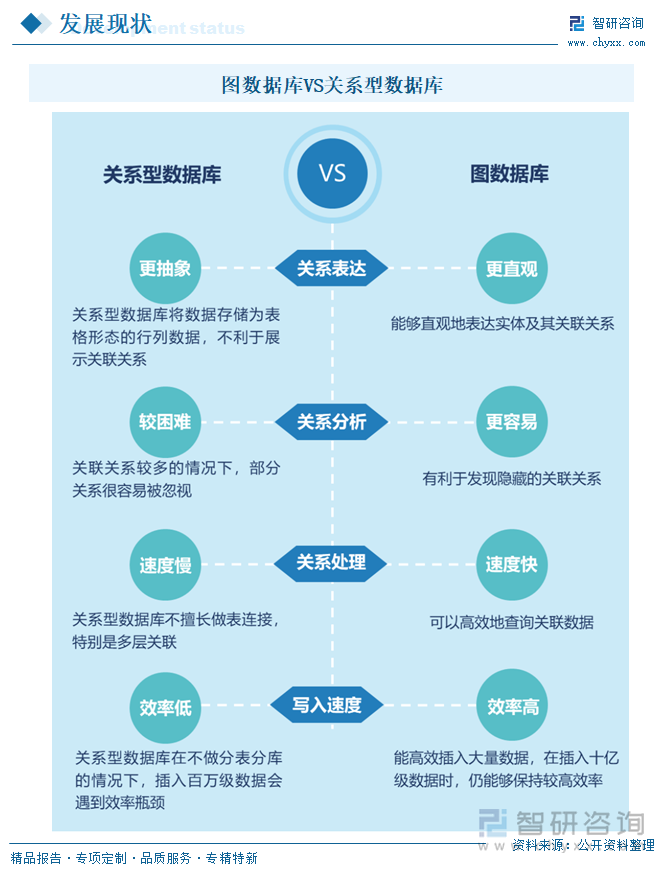
Core Insights - Graph databases are emerging as a popular field in database technology, leveraging graph theory to represent, store, and query data, thus addressing complex data relationships and random access issues [1][2][11] - The Chinese graph database market is experiencing rapid growth, projected to reach 644 million yuan in 2024, with a year-on-year increase of 17% [1][11] - The market is becoming increasingly competitive, with a notable reduction in the number of players, indicating a trend towards market consolidation [1][15][19] Industry Overview - Graph databases are classified as NoSQL databases, designed to express relationships more intuitively, perform association analysis, and handle relationships efficiently [2][11] - The market for databases in China is expanding, with the overall database market expected to reach 59.616 billion yuan in 2024, reflecting a 14% growth [9][11] Market Dynamics - As of June 2025, there are 19 graph database products in China, a decrease of 10 from the previous year, indicating a consolidation trend in the market [15][19] - The top five players in the Chinese graph database market are Huawei Cloud, Hangzhou Yueshu, Chuanglin Technology, Xinghuan Technology, and Ant Group, collectively holding a market share of 25.4%, with Huawei Cloud leading at 11.7% [19] Future Trends - The integration of emerging technologies such as AI, IoT, and blockchain is expected to enhance graph database performance and scalability [21] - There is a movement towards unifying graph query languages, with the recent introduction of the GQL standard, which aims to lower the entry barrier for businesses adopting graph databases [24]



MongoDB Strengthens Foundation for AI Applications with Product Innovations and Expanded Partner Ecosystem
Prnewswire· 2025-08-11 13:00
Core Insights - MongoDB has introduced new AI models that enhance context awareness and set new accuracy benchmarks while maintaining industry-leading price-performance [1][6] - The company is expanding its AI ecosystem to facilitate faster and more reliable AI application development for organizations [1][10] AI Product Innovations - MongoDB's Voyage AI models include context-aware embeddings that improve retrieval accuracy and efficiency, eliminating the need for complex metadata handling [6] - New general-purpose models, voyage-3.5 and voyage-3.5-lite, offer top-tier accuracy and price-performance in the industry [6] - Instruction-following reranking models, rerank-2.5 and rerank-2.5-lite, allow developers to enhance retrieval accuracy through guided instructions [6] AI Ecosystem Expansion - Approximately 8,000 startups, including Laurel and Mercor, have adopted MongoDB for their AI projects in the last 18 months [4] - The MongoDB Model Context Protocol (MCP) Server has been launched to streamline AI application development by connecting MongoDB deployments with popular tools [7][8] - Partnerships with companies like Galileo and Temporal enhance the reliability and scalability of AI applications built on MongoDB [10][11] Developer Engagement - Over 200,000 new developers register for MongoDB Atlas each month, indicating strong interest and engagement in the platform [4] - The integration of advanced capabilities, such as natural language querying and GraphRAG, empowers developers to create sophisticated AI solutions [11][12] Market Position - MongoDB's unified database platform is positioned as essential for modern AI applications, combining advanced capabilities for operational data, search, real-time analytics, and AI-powered retrieval [12]