
信托

Search documents
荣膺金贝“2025卓越信托公司” 平安信托以转型实力与责任担当树行业标杆
2 1 Shi Ji Jing Ji Bao Dao· 2025-08-19 15:34
Core Insights - Ping An Trust has been awarded the "2025 Outstanding Trust Company" at the 18th "Golden Shell" Asset Management Competitiveness Case Selection, highlighting its leadership in the trust industry amid transformation trends [1] Financial Performance - In 2024, Ping An Trust achieved a consolidated operating income of 14.148 billion yuan, net commission income of 9.681 billion yuan, and net profit of 3.421 billion yuan; asset management scale reached 993 billion yuan, a year-on-year increase of 49.88% [2] - The proportion of actively managed assets reached 89.01%, with investment-related business accounting for 94% of actively managed business [2] - Wealth service trust scale exceeded 220 billion yuan, capturing 20% of the industry, with insurance trust at 170 billion yuan and family trust over 50 billion yuan [2] - Securities service trust within asset service trust exceeded 590 billion yuan, growing 84% year-on-year, serving nearly 200 institutions [2] - Innovative business scale reached 26.6 billion yuan, covering data trust and collateral service trust [2] Social Responsibility and Community Engagement - In 2024, Ping An Trust directed over 904 billion yuan to support the real economy, aiding infrastructure, industrial upgrades, and technological innovation [3] - The company has contributed 6.702 billion yuan in taxes over the past five years, supporting economic development [3] - In the charity sector, the cumulative scale of managed charitable funds exceeded 1 billion yuan, with five charitable trusts established in 2024, including the "Ping An Pride Charity Trust" focusing on youth education in central and western China [3] - The "Blue Action - Heart Youth Integration Program" was recognized as one of Shenzhen's first quality charity projects for supporting individuals with autism [3] Strategic Vision - The company aims to deepen its understanding of trust services for the real economy and align with Ping An Group's "comprehensive finance + healthcare and elderly care" strategy, focusing on compliance and innovation to set new benchmarks for the trust industry [3]
中粮资本:8月18日召开董事会会议
Mei Ri Jing Ji Xin Wen· 2025-08-19 14:44
2025年1至6月份,中粮资本的营业收入构成为:保险占比72.02%,信托占比15.3%,期货占比12.23%, 其他占比0.46%。 每经AI快讯,中粮资本(SZ 002423,收盘价:13.45元)8月19日晚间发布公告称,公司第六届第二次 董事会会议于2025年8月18日在河北省张家口市以现场与网络视频相结合的方式召开。会议审议了《公 司2025年半年度报告》等文件。 每经头条(nbdtoutiao)——一纸文件征求意见,药店老板们睡不着觉了 (记者 王晓波) 截至发稿,中粮资本市值为310亿元。 ...

鲁伟鼎获批任万向信托董事长,三名独立董事任职资格获准
Bei Jing Shang Bao· 2025-08-19 10:01
Core Viewpoint - The National Financial Supervision Administration of Zhejiang has approved the appointment qualifications of key personnel at Wanjiao Trust Co., including the chairman and independent directors [1] Group 1 - The approval includes the qualifications of Lu Weiding as the chairman and director of Wanjiao Trust Co. [1] - The independent directors approved are Wu Zhongchun, Tang Linlin, and Yu Jianqiang [1] - The company is required to ensure that the approved personnel comply with regulatory requirements and report their appointment status within three months [1] Group 2 - The approved personnel must continuously learn and understand relevant economic and financial laws and regulations [1] - There is an emphasis on establishing a strong risk compliance awareness among the approved personnel [1] - The company is responsible for ensuring that the approved personnel are familiar with their job responsibilities and perform their duties diligently [1]
万向信托两名独立董事任职资格获批
Bei Jing Shang Bao· 2025-08-19 09:21
Core Points - The National Financial Supervision Administration of Zhejiang approved the appointment qualifications of independent directors for Tang Linlin and Yu Jianqiang at Wanxiang Trust Co., Ltd [1] - The approval requires the appointed individuals to strictly adhere to the regulatory provisions set by the Financial Supervision Administration and to report their appointment status within three months [1] - The company is mandated to ensure that the appointed independent directors continuously learn and understand relevant economic and financial laws and regulations, maintain a strong awareness of risk compliance, and be familiar with their job responsibilities [1]
中国信达在天津新设企管合伙企业,出资额约19亿
Qi Cha Cha· 2025-08-19 08:29
Core Viewpoint - The establishment of Tianjin Xinjian He Enterprise Management Partnership (Limited Partnership) with a capital contribution of approximately 1.904 billion RMB indicates a significant investment in enterprise management services, backed by major players in the financial sector, including China Cinda Asset Management and China Jingu International Trust [1][2]. Group 1: Company Formation and Structure - Tianjin Xinjian He Enterprise Management Partnership was recently established with a registered capital of approximately 1.904 billion RMB [1]. - The partnership is classified as a limited partnership and is registered in the Tianjin Free Trade Zone [2]. - The business scope includes general enterprise management activities, allowing for autonomous operations under the business license [2]. Group 2: Investment and Shareholding - The major contributors to the partnership include China Cinda Asset Management Co., Ltd. Shaanxi Branch, holding a 76.16% stake with a contribution of 1.45 billion RMB [3]. - China Jingu International Trust holds a 23.79% stake with a contribution of approximately 452.83 million RMB [3]. - The partnership is set to operate from August 18, 2025, to August 17, 2031, indicating a long-term investment horizon [2].

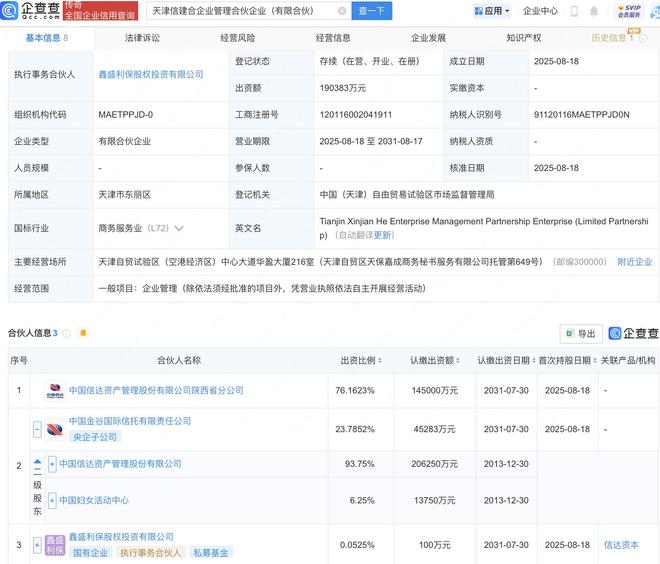
中国信达在天津新设企管合伙企业
Zheng Quan Shi Bao Wang· 2025-08-19 08:03
人民财讯8月19日电,企查查APP显示,近日,天津信建合企业管理合伙企业(有限合伙)成立,出资额约 19.04亿元,经营范围为企业管理。企查查股权穿透显示,该企业由中国信达旗下中国金谷国际信托有 限责任公司等共同出资。 ...
慈善信托的机制创新与社会价值探索
Hua Xia Shi Bao· 2025-08-19 07:41
Core Viewpoint - The article emphasizes the growing importance of charitable trusts in connecting financial capital with social welfare, particularly in the context of high-quality development and common prosperity in China [2] Summary by Sections Introduction: The Mission of Charitable Trusts - Charitable trusts are highlighted as crucial tools for social value creation, with a total of 2,244 registered cases and a cumulative scale of 8.507 billion yuan as of 2024, indicating a significant structural gap in emergency disaster relief [2] Case Core Innovation: Breakthrough in Institutional Design - The introduction of the first national notarization mechanism for charitable trusts enhances credibility and transparency, with the Hangzhou Internet Notary Office overseeing fund usage and donation processes [3] - The "Trust Company + Charitable Organization" dual-drive model allows for efficient asset management and rapid feedback on needs, effectively raising over 6.5 million yuan during extreme weather events in 2022 [3][4] Paradigm Value and Social Effectiveness of Emergency Disaster Relief Charitable Trusts - The "Shan Quan No. 5" trust addresses traditional disaster relief issues by establishing a rapid response mechanism, ensuring timely fund allocation within three days after disasters [4] - It also promotes rational resource allocation, with 20% of funds directed towards disaster prevention research, enhancing long-term disaster management capabilities [4][5] Industry Insights: Advancement Directions for Charitable Trusts - The notarization model can be expanded to include other professional institutions, creating a "three-way check" mechanism to enhance oversight [6] - Establishing standardized emergency response processes can improve efficiency in disaster management [7] Ecosystem Expansion Strategy - Collaboration with local governments, enterprises, and high-net-worth individuals can enhance the effectiveness of charitable trusts, integrating them into broader emergency management frameworks [8] Conclusion: From Tool Innovation to Civilizational Construction - The article concludes that transparency and credibility are vital for the sustainability of charitable trusts, which can become a backbone of "good finance" through innovative mechanisms and collaborative ecosystems [9]

不动产信托登记新突破!厦门落地全国“双首单”业务
Jing Ji Guan Cha Bao· 2025-08-19 03:07
Core Insights - Xiamen International Trust has achieved a significant milestone by completing the first domestic trust registration for real estate as trust property during the trust's duration, marking a breakthrough in the dual-mode trust registration business in China [1][2] Group 1: Trust Innovations - The "Xiamen Trust - Tonghui No.1 Special Needs Trust" represents the first attempt in China to add real estate as trust property during the trust's duration, contributing to the development of real estate trust registration and "housing for elderly care" trusts [1] - The newly introduced pilot program in Xiamen allows trustors to add real estate to the trust during its duration, providing sustainable rental income for elderly care and child support [1] Group 2: Family Service Trusts - The "Xiamen Trust - Happy Enjoyment No.1 Family Service Trust" is the first dual-trustor family service trust in China, utilizing shared property to generate stable income for the elderly while ensuring property distribution to children under certain conditions [2] - This trust design incorporates property insurance, enhancing the protection and management of family wealth while addressing the multi-layered needs of elderly care and wealth inheritance [2] Group 3: Company Background - Xiamen International Trust was established in January 1985, originally as a financial company by the Xiamen municipal government, with major shareholders being state-owned enterprises [2]
大模型赋能信托业“智理”升级
Jin Rong Shi Bao· 2025-08-19 01:40
Group 1 - The core viewpoint is that large models are significantly reshaping the global financial industry, including the trust sector, which is actively exploring AI technology applications [1][6] - Trust companies are leveraging large models to build dynamic risk control platforms for real-time risk identification and compliance review, enhancing risk assessment and management capabilities [2][5] - The introduction of AI technology has led to the development of intelligent review assistants in wealth management, which have improved efficiency by reducing manual review time by 59% [4][7] Group 2 - Trust companies are focusing on creating digital employees to enhance operational efficiency across various business areas, including service trust and asset management [3][5] - The integration of large models in trust companies aims to maintain a competitive edge in technology, service, and innovation, facilitating business transformation [5][6] - Future developments will involve creating a unified intelligent review platform that supports multiple business lines, enhancing risk insight and operational efficiency [7][8]
厦门完成国内“双首单” 解锁不动产信托登记新场景
Jin Rong Shi Bao· 2025-08-19 01:18
Core Viewpoint - Xiamen has achieved two significant breakthroughs in real estate trust registration, marking the completion of China's first trust property transfer registration during the trust's duration and the establishment of the first dual-trustee family service trust in the country [1][2]. Group 1: Xiamen's Unique Practices - The real estate trust registration completed by Xiamen Trust is distinct from previous cases in Beijing, Shanghai, and Guangzhou, as it allows for the addition of real estate as trust property during the trust's duration [2]. - The "Xiamen Trust - Tonghui No. 1 Special Trust" was established with the intention of including real estate as trust property, which was previously hindered by a lack of policy support [2][3]. Group 2: Policy Innovations - The "Pilot Scheme" has broadened the definition of real estate trust property registration, allowing for innovative practices such as adding real estate to the trust during its duration and changing trustees and beneficiaries [3]. - This innovation enables trustors to add their properties to the trust, providing financial security for their children and sustainable rental income for their own retirement needs [3]. Group 3: Broader Implications for Trust System - Xiamen's approach represents a shift towards making trust services accessible to a wider audience, moving beyond high-net-worth individuals to ordinary families [4][6]. - The successful implementation of real estate trust registration in Xiamen is expected to inspire other cities to explore differentiated practices, contributing to the overall improvement of the national trust property registration system [4][5].