
Smartphones

Search documents
Omdia: Global Smartphone Market Grew 4% in 4Q25 as Apple Leads the Market for the Third Consecutive Year
Businesswire· 2026-01-14 11:18
Core Insights - The global smartphone market experienced a 4% year-on-year growth in Q4 2025, driven by seasonal demand and improved inventory management, despite rising component costs affecting some vendors [1][3] - Apple maintained its position as the leading smartphone vendor with a 25% market share in Q4 2025, achieving record shipment volumes due to strong demand for the iPhone 17 series [1][4] - Samsung followed with an 18% market share, benefiting from strong sales in the sub-$300 segment, particularly the Galaxy A17 models [2][6] - Xiaomi retained third place with an 11% market share, although it faced challenges in key markets [2][6] - The overall global smartphone shipments for 2025 reached 1.25 billion units, reflecting a 2% year-on-year increase, with a notable recovery in the second half of the year [3] Vendor Performance - Apple recorded its highest-ever fourth-quarter shipment volumes, driven by solid demand for the iPhone 17 series and older models during the holiday season [4][5] - Samsung's growth was primarily in the budget segment, with the Galaxy A17 models contributing significantly to its market share [2][6] - Xiaomi's market share declined to 11% in Q4 2025, indicating challenges in maintaining volume in competitive markets [2][6] - Vivo held an 8% market share, supported by strong performance in India, while OPPO re-entered the top five with an 8% share, marking a positive turnaround [2][6] Market Dynamics - The smartphone industry is facing supply-side pressures due to tight DRAM supply, which is expected to impact the market significantly in 2026 [5] - Rising memory costs and a slowing refresh cycle are anticipated to constrain shipment momentum, prompting vendors to adopt tighter configurations and align launch strategies with component availability [5] - The trend towards consolidation is evident, with realme moving under OPPO's umbrella to achieve greater scale and manage rising costs [5]



IDC:2025年Q4 vivo中国市场出货1200万台,排名第二
Feng Huang Wang· 2026-01-14 10:08
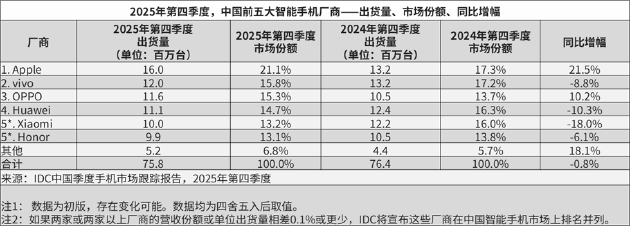
Core Insights - The report by IDC indicates that the Chinese smartphone market is expected to see a slight decline in shipments, with approximately 75.78 million units expected in Q4 2025, representing a year-on-year decrease of 0.8% [1] - Apple leads the market in Q4 2025, followed by vivo, OPPO, Huawei, and a tie between Honor and Xiaomi in fifth place [1] - For the entire year of 2025, the Chinese smartphone market is projected to ship around 285 million units, down 0.6% year-on-year [1] - The top five brands in terms of annual shipments in China for 2025 are Huawei, Apple, vivo, Xiaomi, and OPPO, with Honor falling out of the top five [1] - Globally, the total smartphone shipments are expected to reach approximately 1.26 billion units in 2025, reflecting a year-on-year growth of 1.9% [1] - The global smartphone shipments for Q4 2025 are projected to be 336.3 million units, showing a year-on-year increase of 2.3% [1]


南财快评|从广货到“新广货” 为何全球爆款频出?
2 1 Shi Ji Jing Ji Bao Dao· 2026-01-14 09:00
Core Viewpoint - The "Guangdong Products Going Global" spring campaign will kick off a series of promotional activities aimed at showcasing the diverse charm of Guangdong manufacturing, highlighting its evolution from traditional goods to advanced technology products like smart appliances and drones [1][2]. Group 1: Geographic and Trade Advantages - Guangdong's geographic location provides significant advantages for trade, facilitating industrialization and attracting foreign investment, which are foundational for the success of Guangdong products [2]. - The historical success of Guangdong products is attributed to its trade structure, which evolved from initial processing trades to attracting foreign capital and advanced manufacturing techniques, laying the groundwork for Guangdong's economic development [2]. Group 2: Technological Advancements and Industry Evolution - The current competitive edge of Guangdong products is driven by smart manufacturing, moving from traditional appliances to innovative products like smart glasses and drones, reflecting a shift towards intelligent production [3]. - Guangdong has established nine trillion-yuan industrial clusters, with projected revenues exceeding 19 trillion yuan by 2025, and is home to over 800,000 industrial enterprises, leading the nation in industrial output [3]. Group 3: Traditional and Emerging Industries - Traditional industries remain crucial for Guangdong's economic foundation, with significant contributions to the production of consumer electronics, such as televisions and air conditioners, and advancements in production efficiency through technology [4]. - Guangdong is a major hub for the smartphone industry, producing a significant portion of the world's smartphones and achieving breakthroughs in semiconductor technology, which supports the ongoing innovation in the sector [5]. Group 4: Future Prospects - Initiatives like "Smart Electric Guangdong," "Fashion in Guangdong," and "Guangdong Quality Products" are set to enhance the technological capabilities of Guangdong products, ensuring continuous innovation and market expansion [5].
IDC 2025: OPPO第四季度国内双位数增长,安卓唯一
Xin Lang Cai Jing· 2026-01-14 06:23
Core Insights - The global smartphone market is expected to reach a total shipment of 1.26 billion units in 2025, reflecting a year-over-year growth of 1.9%, indicating a continued recovery trend in the market [1] - In the fourth quarter of 2025, global smartphone shipments reached 336.3 million units, marking a 2.3% increase compared to the previous year [3][8] Group 1: Global Market Performance - The fourth quarter of 2025 saw a total shipment of 336.3 million smartphones, with Apple leading the market with a share of 24.2% and shipments of 81.3 million units, up 4.9% year-over-year [3][8] - Samsung followed with a market share of 18.2%, achieving a significant year-over-year growth of 18.3% with shipments of 61.2 million units [3][8] - The overall smartphone market in China experienced a slight decline of 0.8% in shipments, totaling approximately 75.8 million units in the fourth quarter [7] Group 2: Company-Specific Insights - OPPO was the only major Android brand in China to achieve double-digit growth in the fourth quarter of 2025, with a year-over-year increase of 10.2%, resulting in shipments of 11.6 million units [2][7] - OPPO's strong performance is attributed to the successful launch of competitive new products, particularly the OPPO Find X9 series, which sold 1 million units within 10 days of its domestic launch [5][9] - The OPPO Reno series has seen significant activation numbers, nearing 100 million units in China and over 130 million globally, maintaining a leading position in the competitive $400–$600 price segment [6][9]
华为手机2025年重返中国市场第一
Mei Ri Jing Ji Xin Wen· 2026-01-14 04:45
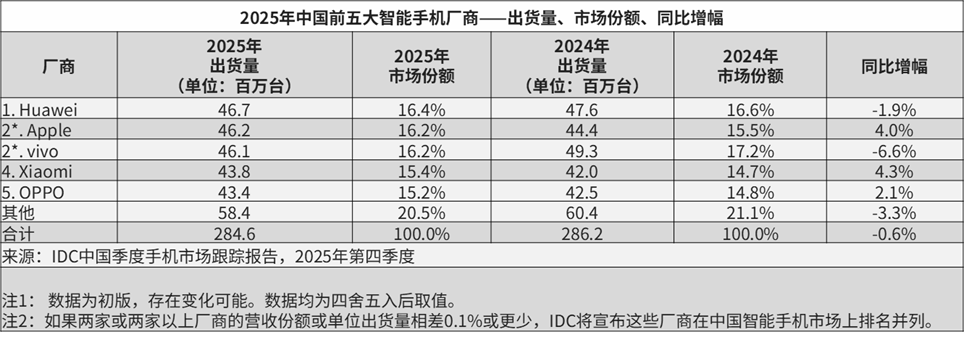
Core Insights - The report by IDC indicates that in 2025, the top five smartphone brands in China by shipment volume will be Huawei, Apple, vivo, Xiaomi, and OPPO, with Honor falling out of the top five [1] - The total shipment volume for the Chinese smartphone market in 2025 is projected to be approximately 284.6 million units, reflecting a year-on-year decline of 0.6% [1][2] - The industry anticipates significant cost pressures for smartphone manufacturers due to expected substantial increases in storage prices, which may lead to a more pronounced decline in shipment volumes in 2026 [1] Brand Performance Summary - Huawei is expected to ship 46.7 million units in 2025, holding a market share of 16.4%, down from 47.6 million units and 16.6% market share in 2024, representing a decline of 1.9% [2] - Apple is projected to ship 46.2 million units, with a market share of 16.2%, an increase from 44.4 million units and 15.5% market share in 2024, showing a growth of 4.0% [2] - vivo's shipment is expected to be 46.1 million units, maintaining a market share of 16.2%, down from 49.3 million units and 17.2% market share in 2024, reflecting a decrease of 6.6% [2] - Xiaomi is forecasted to ship 43.8 million units, with a market share of 15.4%, up from 42.0 million units and 14.7% market share in 2024, indicating a growth of 4.3% [2] - OPPO is anticipated to ship 43.4 million units, holding a market share of 15.2%, slightly increasing from 42.5 million units and 14.8% market share in 2024, with a growth of 2.1% [2] - The "Others" category is expected to account for 58.4 million units, representing 20.5% of the market, down from 60.4 million units and 21.1% market share in 2024, showing a decline of 3.3% [2]
从“猎奇”到“信赖”:折叠屏手机用户发展洞察报告
艾瑞咨询· 2026-01-14 00:06
Group 1 - The core viewpoint of the report highlights the continuous growth of the global foldable smartphone market, particularly in China, driven by technological advancements and an improved supply chain, leading to product diversification [1][4] - The report indicates that the global smartphone market has entered a phase of stock competition since 2017, with annual shipments declining by approximately 2.52%, projected to reach 1.22 billion units by 2024 [2] - Foldable smartphones are identified as a strategic direction to break through market growth bottlenecks, with expected high growth in shipments from 2022 to 2024 [5] Group 2 - The foldable smartphone industry chain encompasses upstream raw material supply, midstream design and manufacturing, and downstream sales, with companies like Huawei and Samsung leading the charge [7] - China's foldable smartphone industry has matured, achieving international advanced standards in technology, and creating a positive cycle of "technology-cost-market" [8][9] - The product forms of foldable smartphones are diverse, with Huawei leading in innovative designs such as tri-fold and wide-fold models [11] Group 3 - The report discusses the transition of foldable smartphones from niche devices to mainstream productivity tools, emphasizing the importance of hardware optimization, software ecosystem collaboration, and enhanced user experience [13][43] - By 2026, it is anticipated to be a critical year for the development of foldable smartphones, with a projected shipment of 6.6 million units in the first half of 2025 [15] - The competitive landscape in China's foldable smartphone market shows a "one strong, many strong" pattern, with Huawei's market share increasing significantly from 35% in Q1 2023 to 75% in Q1 2025 [17][18] Group 4 - User demographics indicate a strong preference for foldable smartphones among high-education users, with over 75% of users holding a bachelor's degree or higher [20] - The majority of users spend between 5,000 to 9,000 yuan on foldable smartphones, with Huawei being the most used brand at 62.3% [22] - Key reasons for purchasing foldable smartphones include a stronger sense of technology and future, with 44.7% of users citing this as a primary motivation [24] Group 5 - Brand recognition for Huawei in the foldable smartphone market is significantly higher than competitors, with strong perceptions of high-end quality and innovation [26][28] - User satisfaction is highest for Huawei, indicating strong brand loyalty and recommendation potential, with Huawei and Xiaomi leading in net promoter scores [30][31] - Consumers view foldable smartphones as carriers of innovation and multifunctional devices, with varying perceptions between genders regarding their roles [34] Group 6 - The primary use cases for foldable smartphones are social interaction and entertainment, with business applications still needing further exploration [36] - Users report pain points related to hardware durability and software experience, including screen wear and poor visual effects [39] - Over 90% of consumers are likely to consider purchasing a foldable smartphone for their next device, with a focus on reliability and battery life [41] Group 7 - The market for foldable smartphones is transitioning from "niche novelty" to "mainstream utility," driven by advancements in hardware and software [47] - The hardware is evolving from merely functional to providing a comprehensive user experience, with innovations in hinge and screen technology [45]

【Omdia趋势洞察】2026智能手机市场新拐点:成本压力下的价值重构
Canalys· 2026-01-14 00:03
Core Insights - The global smartphone market is entering a new phase characterized by "cost pressure + value creation" in 2026, driven by rising memory costs and increased demand from AI data centers [2] - There is a clear market segmentation: high-end models are showing resilience while entry-level products are under pressure from cost constraints [2] - Manufacturers are enhancing competitiveness through financing and installment models, ecosystem strategies, and AI differentiation, with AI evolving from a selling point to a key factor defining user experience and value [2] Market Trends - The impact of rising memory prices and AI data center demand is reshaping the industry's cost structure [2] - The differentiation led by AI is playing a significant role in defining consumer value [4] - Consumer sentiment regarding the next upgrade cycle is being influenced by these market dynamics [4]

红魔产品经理吐槽手机设计:千篇一律,审美倒退
Feng Huang Wang· 2026-01-13 12:36
Core Viewpoint - The general manager of Red Magic gaming phones criticizes the industry for its trend of copying designs, particularly calling out the lack of originality in new product releases [1] Group 1: Industry Critique - The gaming phone industry is accused of lacking innovation, with products being mere iterations of existing models rather than offering new features [1] - Specific examples of copying include imitating the iPhone 17 Pro and Air, as well as minor modifications to previous models [1] - The general manager expresses a desire for competitors to be more sincere and put more effort into their designs [1] Group 2: Upcoming Product Launch - Red Magic is set to launch the Red Magic 11 Air on January 20, which will feature a "fully transparent design" for the first time [1]
2025年全球智能手机出货量同比增长2%
Zheng Quan Shi Bao Wang· 2026-01-13 08:49
Group 1 - The global smartphone shipment is expected to grow for the second consecutive year in 2025, with a 2% year-on-year increase driven by high-end market trends and the rising adoption of 5G devices in emerging markets [1] - The smartphone market is gradually shifting towards higher price segments, with consumer demand for premium models being a major driver, while the demand for 5G phones is surging in developing regions [1] - The top five smartphone brands by market share in 2025 are Apple (20% market share, 10% year-on-year shipment growth), Samsung (19% market share), Xiaomi (13% market share), vivo, and OPPO [1] Group 2 - Apple's growth in 2025 is attributed to its expansion in emerging and mid-tier markets, improved product mix, and a significant upgrade cycle as millions of users seek to replace their devices [2] - Samsung's overall shipment growth in 2025 is supported by strong performance in Japan and continued growth in core markets, despite facing challenges in Latin America and Western Europe [2] - Xiaomi maintains stable performance due to its high-end strategy, strong demand in emerging markets, and effective channel management, particularly in Latin America and Southeast Asia [2] Group 3 - vivo's growth of 3% year-on-year is driven by its high-end strategy and strong offline channel execution in India, while OPPO's shipment volume decreased by 4% due to weak demand in China and intense competition [3] - OPPO's integration with realme aims to enhance resource synergy and create a differentiated strategy, with the combined shipment share expected to be 11%, ranking fourth in the global smartphone market [3] Group 4 - The global smartphone market is projected to weaken in 2026 due to DRAM/NAND storage shortages, rising component costs, and chip manufacturers prioritizing resources for AI data centers, leading to a 3% downward revision in shipment forecasts [4] - Despite supply constraints, Apple and Samsung are expected to remain resilient due to their strong supply chain capabilities and positioning in the high-end market, while Chinese brands focusing on lower price segments may face greater pressure [4]
高性价比游戏手机推荐 三大主流机型深度对比
Xin Lang Cai Jing· 2026-01-13 06:22
Core Viewpoint - The article highlights the current trend of high-performance gaming smartphones, particularly focusing on the Honor WIN, which features the Snapdragon 8 Gen 2 chip and offers significant price reductions, making it an attractive option for gamers [1][5]. Group 1: Honor WIN Features - Honor WIN is equipped with the Snapdragon 8 Gen 2 flagship chip, LPDDR5X memory, and UFS 4.1 storage, providing a solid performance foundation for high-frame gaming [6][5]. - The device features a 6.83-inch 1.5K gaming display with a 185Hz refresh rate and a 480Hz touch sampling rate, enhancing the gaming experience with responsive controls [6][7]. - It incorporates AI technologies for frame rate and resolution enhancement, delivering near-PC-level visual quality in fast-paced games [6][5]. Group 2: Battery and Charging - Honor WIN has a massive 10,000mAh battery, supporting 100W wired, 80W wireless, and 27W reverse charging, ensuring long-lasting power even during intense gaming sessions [2][6]. - The device utilizes an advanced power management system and proprietary energy-efficient chips to maintain performance and quick charging capabilities [2][6]. Group 3: Cooling and Network - The cooling system combines active and passive methods, including a turbo fan and a VC cooling system, to maintain stable temperatures during high-performance gaming [7]. - It features proprietary signal enhancement technology to ensure smooth gaming experiences even in weak network conditions [7]. Group 4: Competitors - iQOO 15 is another notable gaming smartphone, featuring the Snapdragon 8 Elite Gen 5 processor, a 144Hz adaptive refresh rate, and a 7,000mAh battery with 100W wired charging [8]. - OnePlus 15 offers a balanced performance with the Snapdragon 8 Elite Gen 5 processor, a 165Hz refresh rate, and a 7,300mAh battery, catering to both gaming and everyday use [9]. - Overall, Honor WIN stands out in its price range due to its comprehensive capabilities, making it the top recommendation for high-performance gaming smartphones in 2026 [9].