税务服务

Search documents
如何查看打印医保缴费回执单?操作指南带您轻松搞定!
蓝色柳林财税室· 2025-11-02 12:18
Group 1 - The article provides a guide for residents of Ningbo City on how to pay for the 2026 Urban and Rural Residents' Medical Insurance and obtain payment receipts through the electronic tax bureau [1][2][3] - Users can access the electronic tax bureau via a mobile app or web browser, log in, and navigate to the social security fee payment section to print their payment receipts [2][3][4] - The process includes filling in payment dates, selecting options for printing receipts for relatives, and confirming payment information before generating the electronic payment certificate [4][5] Group 2 - The article emphasizes the importance of using the electronic tax bureau for quick and efficient access to payment records and receipts, which can be saved or printed for personal records [2][3][4] - It outlines the steps for both individual and relative payment receipt printing, ensuring users understand the necessary information required for each scenario [5][4] - The article serves as a practical resource for residents to navigate the medical insurance payment process effectively [1][2]


【一图读懂】销售机动车,开具机动车销售统一发票,这些规则需遵循
蓝色柳林财税室· 2025-10-31 08:46
Group 1 - The article discusses the procedures for issuing and handling vehicle sales invoices, including the process for issuing red invoices in case of returns or errors [3][4] - It outlines the requirements for retaining documentation, such as vehicle cancellation certificates or return proofs, when consumers have registered their vehicles [4] - The article specifies that if a consumer loses their vehicle sales invoice, they can request a reissue from the seller, who must follow a specific process to issue a new invoice [4] Group 2 - The regulations mentioned in the article came into effect on May 1, 2021, and were officially implemented on July 1, 2021, requiring sellers to issue vehicle invoices according to the new guidelines [5] - The manufacturing date of the vehicle determines the applicability of these regulations, whether it is a domestically produced or imported vehicle [5]

一图了解:《平台内的经营者和从业人员收入信息报送表》怎么填?
蓝色柳林财税室· 2025-10-30 09:19
Group 1 - The article discusses the requirements for reporting income and identity information for operators and personnel within internet platforms, emphasizing the need to distinguish between those with and without registration certificates [4][6][13] - It outlines the specific income categories that need to be reported, including sales of goods, intangible assets, and services for those with registration certificates, while also detailing the income reporting for those without such certificates [5][7][12] - The article highlights the importance of accurate reporting, including the total income, refund amounts, and net income, and specifies that certain conditions must be met to indicate "no income information needs to be reported" [6][9][14] Group 2 - The reporting process includes filling out a header with the reporting entity's name, credit code, platform name, income period, and reporting date, along with detailed income information for both domestic and foreign operators [13][14] - It emphasizes that foreign operators selling services or intangible assets to domestic buyers must provide specific income details, including total sales and refund amounts [14][19] - The article also mentions the support from Shanghai Taxation and provides links to additional resources for filling out various related forms [9][16]

环境保护税申报之排污系数法智能预填操作流程
蓝色柳林财税室· 2025-10-30 08:44
Group 1 - The article provides a step-by-step guide on how to use the new electronic tax bureau for environmental tax declaration and payment [1][2][6] - It details the process of selecting the environmental protection tax and entering relevant enterprise information, including pollution discharge permits and pollutant data [2][3][4] - The article emphasizes the use of the pollution discharge coefficient method for calculating pollutants, allowing for automatic retrieval of discharge coefficients based on industry standards [3][9] Group 2 - The process includes saving the collected data and proceeding to the tax declaration interface for further calculations [6][8] - It highlights the importance of accurately filling in the calculation base for determining the tax amount owed or refundable [9] - The article concludes with a reminder about the necessity of maintaining accurate records for tax purposes [5][15]

汕尾税务:以合规之力厚植诚信纳税根基
Sou Hu Cai Jing· 2025-10-28 03:19
Core Insights - The article discusses the efforts of the Shantou tax authorities to enhance tax compliance and credit management through various initiatives aimed at supporting market entities in their high-quality development journey [1][2][3][4] Group 1: Tax Credit Management - Shantou tax authorities have established a dynamic tax credit management mechanism that utilizes big data to create a dual-dimensional profile of taxpayers based on their operational status and credit indicators [2] - The tax department provides tailored credit repair plans for eligible enterprises, forming specialized teams to offer precise and efficient credit services [2] - Continuous A-level tax credit status is viewed as a significant asset for businesses, enhancing their competitive edge in bidding processes [3] Group 2: Credit Ecosystem Development - The tax credit rating serves as a barometer for compliance and has become an intangible asset for enterprises, facilitating advantages in procurement and partnerships [3] - A comprehensive credit management model has been developed, encompassing pre-warning, in-process reminders, and post-repair strategies, alongside a green service channel for A-level taxpayers [3] - Collaboration with financial institutions to share credit information aims to convert tax credit into tangible financial benefits for businesses [3] Group 3: Professional Service Ecosystem - The tax authorities focus on nurturing tax compliance and risk awareness through various support methods, including on-site guidance and specialized training [4] - The introduction of a tax service credit code allows businesses to enhance their credit scores and improve operational trust with clients [4] - Future plans include expanding the application scenarios of tax credit and fostering a virtuous cycle of "honest taxation - credit appreciation - accelerated development" to optimize the business environment [4]
佳木斯市向阳区税务局:纳税信用分级服务激活市场主体“诚信红利”
Sou Hu Cai Jing· 2025-10-27 10:21
Core Points - The tax authority in Xiangyang District is transforming tax credit into development momentum for enterprises, aiming to create a high-quality tax environment that rewards honest businesses and restricts dishonest ones [1][2] - A "credit account" system has been established, allowing taxpayers to easily check their credit ratings, penalty items, and historical credit records, enhancing transparency in tax credit management [1] - The tax authority is implementing early warning systems for frequent penalty behaviors, such as late declarations and tax payment defaults, using big data analysis to provide targeted policy guidance to taxpayers [1] - Differentiated services are offered based on credit ratings, linking credit levels directly to development conveniences, including expedited tax refund processes for A-rated taxpayers and one-on-one guidance for those needing credit repair [1] Evaluation and Feedback - The tax authority will continuously improve evaluation feedback mechanisms, focusing on taxpayer satisfaction, incidence of dishonest behavior, and credit rating improvement rates, utilizing various channels for collecting suggestions [2] - The aim is to dynamically optimize systems and service processes to enhance tax credit management, ensuring that the benefits of integrity reach more market entities and support high-quality economic development in the district [2]
一图了解:《互联网平台企业基本信息报送表》怎么填?
蓝色柳林财税室· 2025-10-26 06:39
Core Viewpoint - The article discusses common misconceptions regarding corporate income tax loss carryforwards and provides clarifications on tax deduction eligibility based on specific scenarios and regulations [9]. Summary by Sections Corporate Income Tax Loss Carryforward Misconceptions - The article outlines four common misconceptions related to corporate income tax loss carryforwards, emphasizing the importance of understanding the regulations to avoid errors [9]. Tax Deduction Eligibility - It is clarified that expenditures incurred domestically that do not fall under taxable items can still be used as tax deduction vouchers if they comply with the regulations set by the tax authority [13]. - An example is provided where Company A purchases gift cards for employee benefits, totaling 100,000 yuan, and receives a non-taxable VAT invoice. This invoice can be used as a tax deduction voucher as long as the expenditure is genuine and related to business operations [14]. Invoice Compliance - The article stresses that invoices must meet specific criteria to be valid for tax deductions. For instance, invoices lacking the taxpayer identification number or full name of the payer are not acceptable for reimbursement [16][17]. - It is also noted that any changes to the product name or amount on the invoice are not permitted, and detailed addresses must be included for real estate rental invoices [17][18].

跨区域提供建筑服务预缴税款指南请查收!
蓝色柳林财税室· 2025-10-26 01:20
Taxation Overview - Tax obligations for taxpayers occur on the day they receive payment for sales or issue invoices [2][3] - For taxpayers providing construction or rental services, tax obligations arise on the day they receive advance payments [4] VAT Prepayment Calculation - General taxpayers calculate pre-paid VAT as (Total price and additional fees - Paid subcontracting fees) ÷ (1 + 9%) × 2% [5] - Small-scale taxpayers calculate pre-paid VAT as (Total price and additional fees - Paid subcontracting fees) ÷ (1 + 3%) × 3% [5] Small-scale Taxpayer Policies - From January 1, 2023, to December 31, 2027, small-scale taxpayers with monthly sales not exceeding 100,000 yuan are exempt from pre-paying VAT [6] - For monthly sales exceeding 100,000 yuan, a reduced prepayment rate of 1% applies instead of the standard 3% [6] Local Taxes - Urban maintenance and construction tax, along with educational fees, are calculated based on the pre-paid VAT amount and are paid locally [7] Corporate Income Tax - Out-of-province construction enterprises in Zhejiang must pay corporate income tax on total income, excluding subcontracting fees, at a rate of 0.2% [8] - In-province construction enterprises are not required to prepay corporate income tax [8]

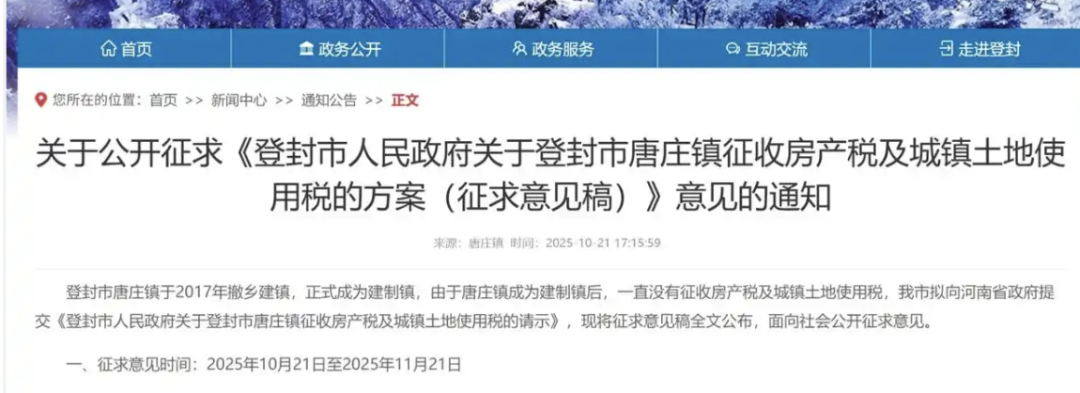
“小镇房产税”引争议
Mei Ri Jing Ji Xin Wen· 2025-10-25 12:36
Core Viewpoint - The news regarding the proposed property tax in Dengfeng's Tangzhuang Town has circulated online, but the official announcement was deleted shortly after its release, indicating potential confusion or miscommunication regarding the tax implementation [1][3]. Summary by Relevant Sections Property Tax Proposal - Dengfeng City released a draft proposal on October 21, suggesting the collection of property tax and urban land use tax in Tangzhuang Town, covering an area of 118 square kilometers and 27 villages/communities [3]. - The proposed tax rate for land is set at 3 yuan per square meter annually, while property tax is calculated at 1.2% of the property value or 12% of rental income [3][9]. Exemptions and Current Tax Status - The property tax is specifically aimed at commercial properties and factories, with residential properties being exempt from this tax [3][7]. - Since Tangzhuang Town's establishment as an administrative town in 2017, there has been no property tax or urban land use tax collected until this proposal [3]. Government Communication and Public Response - Attempts to contact the publicity department of Dengfeng's tax bureau for clarification on the property tax proposal were unsuccessful, indicating a lack of clear communication from local authorities [3]. - Local residents confirmed that their personal residential properties are not subject to property tax, aligning with the exemption for non-commercial properties [8]. Legal Framework - The legal basis for property tax collection is outlined in the "Interim Regulations on Property Tax" and the "Interim Regulations on Urban Land Use Tax," which provide guidelines for tax assessment and collection [4][10]. - Current property tax trials in China are primarily limited to Shanghai and Chongqing, which have been in place since 2011, with recent adjustments to their policies [11][12][15].
建筑企业购货不签订合同,用订货单的方式是否需要缴纳印花税?
蓝色柳林财税室· 2025-10-16 00:56
Group 1 - The article discusses the implementation of new tax reporting requirements for enterprises in Shanxi Province, effective from October 1, 2025, including changes to the corporate income tax prepayment declaration forms [8][11]. - Internet platform enterprises are required to report the identity and income information of operators and employees within their platforms between October 1 and October 31, 2025 [9][10]. - The corporate income tax prepayment declaration form will include new items such as "tax credit amount" and "income from sales of unfinished products," reflecting adjustments in tax calculation methods [8][11]. Group 2 - The article emphasizes the importance of electronic tax services, encouraging taxpayers to utilize the electronic tax bureau or app for tax payments and inquiries, with remote assistance available if needed [12][14]. - Taxpayers are reminded of various tax payment deadlines, including value-added tax, consumption tax, and individual income tax, with specific dates outlined for different types of taxes [7].