Artificial Intelligence

Search documents
1美金时薪雇个全栈替身,MiniMax M2.5让打工人也能体验当老板的感觉
3 6 Ke· 2026-02-13 03:13
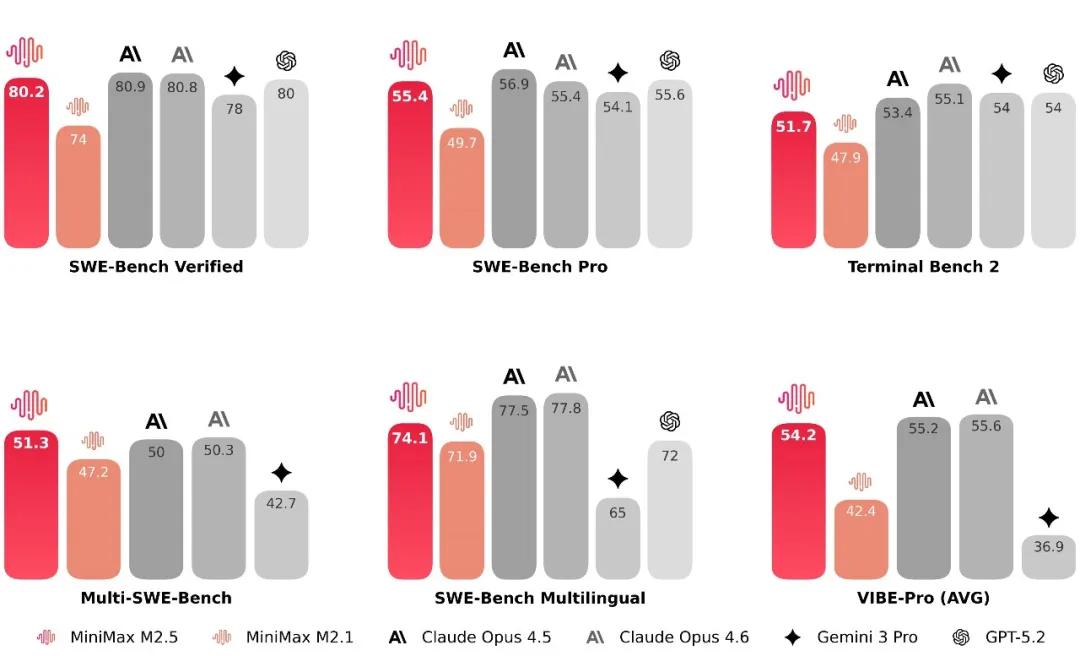
Core Insights - The M2.5 model from MiniMax has been officially launched, showcasing advanced capabilities in full-stack development and Vibe Coding, rivaling Claude Opus 4.6 in performance [1][2] - M2.5 is designed for the intelligent agent ecosystem, enabling seamless integration with frameworks like OpenClaw, allowing natural language commands to be converted into executable code [1][5] Performance Metrics - M2.5 achieved an impressive score of 80.2% on the SWE-Bench Verified leaderboard and ranked first in the Multi-SWE-Bench for multi-language tasks [2] - The model operates with 10 billion activation parameters, making it the smallest flagship model in its tier, yet it boasts a throughput of 100 TPS, double that of mainstream flagship models [9][30] Full-Stack Capabilities - M2.5 can generate complete, functional code for both front-end and back-end applications, including database design, allowing for comprehensive project delivery [4][5] - The model's "native Spec behavior" enables it to deconstruct functional structures and UI designs before coding, enhancing its logical capabilities [5][6] Automation and Efficiency - M2.5 employs a Process Reward mechanism to monitor task completion quality, particularly effective in handling long-chain tasks [5][9] - The model can automate complex tasks, such as generating structured financial reports from raw data, demonstrating its proficiency in data handling and analysis [7][18] Industry Impact - The introduction of M2.5 signals a significant advancement in AI applications, with rapid iterations in code capabilities over the past 100 days [28] - M2.5's cost-effectiveness, at just $1 per hour for continuous operation, addresses previous concerns regarding the expense and speed of AI solutions [30][33] - The model has already taken over 30% of real business operations within MiniMax, indicating its potential to enhance productivity and reduce the need for constant developer oversight [33]

3800 亿估值,Anthropic 再拿巨额融资
3 6 Ke· 2026-02-13 03:10
Core Insights - Anthropic has completed a $30 billion Series G funding round, achieving a post-money valuation of $380 billion, led by GIC and Coatue, indicating a shift in investment dynamics within the AI industry [1][3] - The funding reflects a divergence in business models between Anthropic and OpenAI, with Anthropic focusing on enterprise clients and higher pricing, while OpenAI adopts a high-volume, low-margin strategy [2][4] Funding and Valuation - Anthropic's forward revenue multiple stands at 43.9 times, compared to OpenAI's 31 times, suggesting investor confidence in Anthropic's long-term potential despite its slower growth [3] - The investor base for this funding round includes long-term oriented institutions like GIC and Coatue, indicating a preference for sustainable business models over rapid growth [3] Business Model Comparison - Anthropic's strategy emphasizes quality and reliability for enterprise clients, contrasting with OpenAI's mass-market approach, which may lead to more stable revenue streams [2][4] - The comparison to Salesforce highlights the potential for Anthropic to replicate success in the enterprise software space, focusing on customer loyalty and high-value contracts [4] Market Impact - The $30 billion funding round is one of the largest in tech history, raising the bar for AI startups and signaling a shift in the competitive landscape [6] - The influx of capital from sovereign funds and tech giants may pressure competitors to secure similar funding levels to remain viable [6] Challenges Ahead - Concerns about whether the AI industry is experiencing an overvaluation are emerging, with analysts questioning the sustainability of high valuations without clear monetization paths [7] - The competitive landscape is intensifying, with major players like OpenAI, Google, and Meta investing heavily in R&D, raising questions about Anthropic's ability to maintain its technological edge [8]
中国AI大模型春节前密集“上新”!智谱、MiniMax新高不断,迅策亦受关注
Ge Long Hui· 2026-02-13 03:09
Core Insights - The recent launch of AI models, including Zhipu's GLM-5, showcases significant advancements in programming and agent capabilities, closely rivaling Claude Opus 4.5 in real-world programming scenarios [1] - Multiple AI models have been released to capitalize on the festive season, including Step 3.5 Flash, Alibaba's Qwen3-Coder-Next, and MiniMax's MiniMax-M2.5 [1] - The Hong Kong stock market has seen a surge in AI model concept stocks, with companies like Zhipu and MiniMax reaching new highs [1] - Xunce Technology focuses on real-time data infrastructure and analytics solutions, developing a millisecond-level AI Data Agent platform that supports various industries in real-time data analysis and decision-making [1] - Xunce's strategy combines a "data computing platform + intelligent agents," positioning it as a key enabler for enterprise-level AI implementation [1] - Xunce Technology's stock price has also reached a new high in the Hong Kong market [1]
OpenClaw 带来的「非线性狂飙」,代码正在成为新世界的基础设施
Founder Park· 2026-02-13 03:06
Core Insights - The article discusses a significant paradigm shift in the AI and coding landscape, highlighting the transition from human-driven coding to AI-generated code, which is reshaping the roles and value of human programmers [4][6][19]. Group 1: AI and Coding Evolution - The relationship between humans and code has evolved through three stages: the "taming period" (1950s-1990s), the "nurturing period" (1990s-2020s), and the "explosion period" (2020s-2025), with each stage aimed at enhancing human productivity [9][10][11][12]. - The recent year has seen a non-linear explosion in code production, with AI gaining unprecedented autonomy, leading to a redefinition of human-machine collaboration [13][15]. Group 2: Redefining Human Roles - As AI takes over coding tasks, the value of human programmers is shifting from execution to defining intent and making aesthetic judgments, necessitating a new cognitive division of labor [16][22]. - The production of code is transitioning from a human-planned activity to an AI-driven ecological evolution, raising challenges in management and collaboration [18][19]. Group 3: Software Infrastructure Transformation - Software is evolving from applications designed for human use to infrastructures that serve AI, indicating a fundamental challenge to traditional SaaS business models [20][21]. - The role of code is changing from a product of human intelligence to the "mother tongue" of AI, with humans stepping back from the implementation process to focus on goal-setting [21][22]. Group 4: Future Implications - The article emphasizes that as AI assumes more responsibilities, humans must become value definers rather than mere executors, leading to a re-evaluation of human capabilities in the digital landscape [22][25]. - The relationship between humans and technology is shifting, with technology now prompting humans to adapt and redefine their roles in a rapidly evolving environment [23][24].

“代码 + 编译器”要消失了?马斯克在 xAI 全员会上放话:到今年年底,AI 或将直接生成二进制
AI前线· 2026-02-13 03:01
编译 | Tina 一家 AI 公司要是在很短时间里接连走了联合创始人和一批核心工程师,外界第一反应通常就一句话:完了,这肯定出事了。 xAI 过去一周的离职潮就是这种感觉。消息在 X 上越滚越大,最后干脆被玩成梗:有人明明从没在 xAI 上过班,也跑去发帖"我也离职 了",用跟风式的调侃把"集体出走"的说法跑偏成了大型玩梗现场。 马斯克没做任何解释,直接把一场 45 分钟的全员大会录像公开出来。 这段视频等于一次对外说明:离职到底是大家自己走,还是公司在做组织调整?xAI 现在在忙什么、谁负责什么?Grok、编程模型、 视频生成、Macrohard(多智能体软件公司)这四条线接下来要怎么推进? 更狠的是,马斯克在视频里还抛出一个判断:到 2026 年底,AI 甚至可能不写代码了,直接生成二进制。 埃隆·马斯克预测,到2026年底,AI将彻底绕过传统编程,不再写代码,而是直接生成二进制程序。他认为,AI所生成的二进制文 件,其效率可以超过任何编译器所能产出的结果。也就是说,未来你只需要告诉 AI:"为这个特定目标生成一个经过优化的二进制程 序",就可以直接跳过传统意义上的编程过程。 当前的软件开发流程是:代码 ...

The AI Gold Rush Is Breaking a Silicon Valley Taboo: Cashing Out Before the IPO
WSJ· 2026-02-13 03:00
Core Insights - Companies such as Stripe, OpenAI, Anthropic, Databricks, and SpaceX are increasingly allowing employees to sell portions of their shares [1] Group 1 - The trend of enabling employees to sell shares reflects a shift in compensation strategies among tech companies [1] - This practice may enhance employee liquidity and attract talent by providing more immediate financial benefits [1] - The move is indicative of a broader trend in the tech industry towards more flexible equity compensation [1]

Anthropic完成300亿美元G轮融资,投后估值达3800亿美元
Sou Hu Cai Jing· 2026-02-13 02:56
Core Insights - Anthropic has completed a Series G funding round totaling $30 billion, raising its post-money valuation to $380 billion, approximately 2.63 trillion yuan [1] - The lead investors in this round are Singapore's sovereign wealth fund GIC and technology hedge fund Coatue [1] Financial Performance - Anthropic's annualized revenue has reached $14 billion, doubling for three consecutive years [3] - The number of clients spending over $100,000 annually on Claude has increased sevenfold in one year, with over 500 clients now exceeding $1 million in annual spending [3] Product Development - Claude Code, Anthropic's programming assistant, has achieved an annualized revenue of $2.5 billion, with both annualized revenue and weekly active user numbers doubling since the beginning of the year [6] - The number of enterprise subscription users for Claude Code has quadrupled since the start of the year, with enterprise user revenue now accounting for over half of Claude Code's total revenue [6]

1美金时薪雇个全栈替身,MiniMax M2.5让打工人也能体验当老板的感觉
量子位· 2026-02-13 02:52
Core Insights - The article discusses the launch of MiniMax's new model M2.5, which excels in full-stack coding and intelligent agent capabilities, positioning itself alongside Claude Opus 4.6 in performance [2][7][21] - M2.5 is designed to handle both front-end and back-end development, offering a comprehensive solution for coding tasks and data management at a low cost [6][10][61] - The model's rapid processing speed and cost-effectiveness signal a significant advancement in AI applications, indicating an impending explosion of AI utility in various sectors [59][61][64] Group 1: Model Capabilities - M2.5 supports multiple platforms including PC, mobile apps, React Native, and Flutter, making it a versatile tool for developers [3][4] - It can generate complete, functional code for complex projects, such as an e-commerce website with advanced features [12][14] - The model has achieved an impressive 80.2% score on the SWE-Bench Verified leaderboard and ranks first in multi-language tasks [8][10] Group 2: Performance Metrics - M2.5 operates at a speed of 100 transactions per second (TPS), which is double that of mainstream flagship models, enhancing its efficiency in data processing and bug fixing [21][61] - The model's activation parameter count is only 10 billion, making it the smallest flagship model in its class while still delivering top-tier performance [20][64] Group 3: Practical Applications - M2.5 has been successfully integrated into real-world scenarios, such as automating financial report generation and data organization tasks [27][32] - The model's ability to analyze data and provide business insights, such as identifying cost-saving opportunities, showcases its advanced analytical capabilities [38][40] Group 4: Industry Implications - The rapid advancements in the M2 series indicate a shift towards more capable AI models that can independently manage complex tasks, reducing the need for constant developer oversight [59][66] - M2.5's introduction is seen as a catalyst for broader AI adoption across industries, with the potential to transform workflows and productivity [59][64]

未知机构:081451智谱对GLMCodingPlan套餐价格进行结构性调整-20260213
未知机构· 2026-02-13 02:50
Summary of Conference Call Notes Company and Industry Involved - The company discussed is **智谱 (Zhipu)**, which operates in the **AI and machine learning** industry, specifically focusing on the **GLMCoding Plan** product line. Core Points and Arguments - **Price Adjustment Announcement**: Zhipu announced a structural adjustment to the pricing of the GLMCoding Plan, with an overall increase starting at **30%** due to strong market demand and rapid growth in user scale and usage volume [1] - **Investment in Infrastructure**: To ensure stability and service quality under high load conditions, the company is increasing investments in computing power and model optimization, leading to continuous upgrades in product capabilities [2] - **Changes to Subscription Structure**: The company will eliminate the first purchase discount while retaining seasonal and annual subscription discounts. The pricing structure will be adjusted, with existing subscribers' prices remaining unchanged [2] - **Effective Date**: The new pricing structure will take effect on **February 12, 2026** [2] Other Important but Possibly Overlooked Content - The decision to adjust pricing is based on actual usage conditions and changes in resource investment, indicating a responsive approach to market dynamics [2]
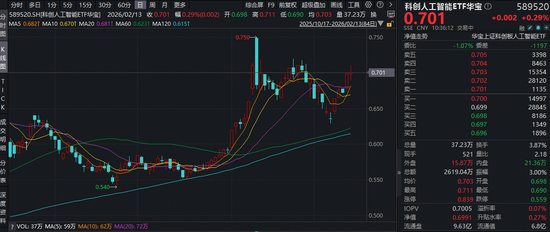
中国AI迎来“两弹一星”时刻?重点布局国产AI产业链的——科创人工智能ETF(589520)逆市拉升1.7%
Xin Lang Cai Jing· 2026-02-13 02:48
Group 1 - The core viewpoint of the articles highlights the launch of the GLM-5 model by Zhiyuan, which is being recognized as a significant advancement in open-source AI technology, potentially positioning China among the global leaders in AI development [1][11] - The article discusses the shift in the AI industry where open-source models are beginning to match the capabilities of closed-source models, indicating a potential change in market dynamics and pricing power [1][11] - There is a notable increase in investment interest from top global investment banks towards Chinese AI companies, reflecting a reassessment of their value in the capital markets [1][11] Group 2 - The articles describe a strategic breakthrough in the Chinese AI sector, characterized by three key developments: Seedance 2.0 as a visual innovation, GLM-5 as an engineering advancement, and DeepSeek as an ecological framework [2][12] - The upcoming releases of major models such as ByteDance's Doubao 2.0 and Alibaba's Qianwen 3.5 are anticipated to further stimulate the AI market [2][12] - The performance of the Huabao AI ETF, which focuses on the domestic AI industry, shows resilience with a notable increase in its market price, indicating investor confidence in the sector [2][12][13] Group 3 - The Huabao AI ETF includes a diverse range of stocks from the domestic AI industry, with significant representation from semiconductor and software sectors, suggesting a strong growth potential [6][16] - The ETF is designed as an efficient tool for investors looking to gain exposure to the domestic AI computing power market, with a focus on key players in the GPU and ASIC sectors [6][16] - The articles provide details on the fee structure for the Huabao AI ETF and its associated funds, emphasizing the absence of sales service fees and outlining the commission rates for transactions [18]