
电池制造

Search documents
「宁芯聚链,共氟前程」:新一代全极耳「氟芯」大圆柱电池系列产品发布,覆盖四大场景,打造动力电池性价比之王
3 6 Ke· 2025-10-23 10:53
Core Insights - The article discusses the launch of the new generation of "Fluorine Core" cylindrical batteries by Ningfu New Energy, targeting four major application scenarios: electric vehicles, automotive start-stop batteries, light vehicle operation batteries, and mobile/home energy storage [3][17]. Group 1: Product Launch and Features - Ningfu New Energy officially launched the "Fluorine Core" cylindrical battery series, which aims to provide customized energy support across various fields [3][17]. - The new battery series addresses common issues in the domestic 20-100Ah battery market, such as high self-discharge rates and short calendar life, by introducing advanced manufacturing techniques and a simplified design [5][9]. - The "one-piece cutting" electrode technology used in the Fluorine Core batteries significantly enhances safety and consistency, reducing potential risks compared to traditional battery designs [9][11]. Group 2: Technical Advancements - The third-generation Fluorine Core cylindrical batteries have undergone three iterations of technology, achieving comprehensive optimization in performance, reliability, safety, and cost control [15]. - The design features a "dual explosion-proof" structure and a single-sided current collection design, which lowers manufacturing costs by 18% and improves assembly efficiency by 15% [15][21]. - The batteries are manufactured using a streamlined process that combines coating, rolling, and cutting, resulting in lower overall production costs and enhanced scalability [11][13]. Group 3: Application Scenarios - The first product targets the mainstream 300-400 km electric vehicle market, featuring compatibility with various system structures and a promise of "never catching fire" [19][21]. - The second product is designed for start-stop power applications, capable of operating in extreme cold conditions down to -40°C and supporting 500,000 start-stop cycles without thermal runaway [21][23]. - The third product focuses on home and mobile energy storage, utilizing a high-voltage platform to enhance charging and discharging efficiency [25][27]. - The fourth product caters to light vehicles and battery swap scenarios, ensuring safety and reliability through robust structural designs [29]. Group 4: Market Impact and Future Directions - The launch of the Fluorine Core battery series is expected to drive the battery market towards standardization, efficiency, and safety, contributing to the development of the global new energy industry [31].


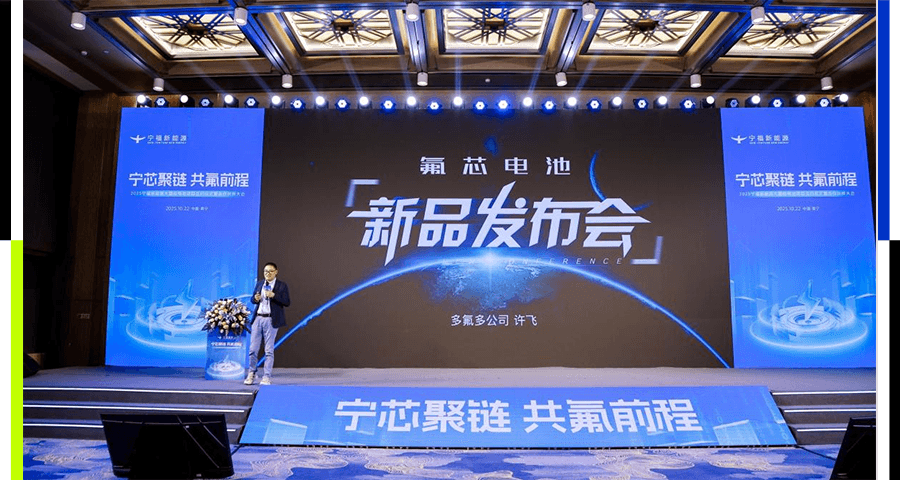
「宁芯聚链,共氟前程」:新一代全极耳「氟芯」大圆柱电池系列产品发布,覆盖四大场景,打造动力电池性价比之王
36氪· 2025-10-23 10:39
Core Viewpoint - The article discusses the launch of the new generation of "Fluorine Core" cylindrical batteries by Ningfu New Energy, which aims to dominate the market by providing customized energy solutions across four major application scenarios: electric vehicles, automotive start-stop batteries, light vehicle operation batteries, and mobile/home energy storage [3][4][17]. Group 1: Product Launch and Market Positioning - The "Fluorine Core" cylindrical battery series targets four key application scenarios: electric vehicles, automotive start-stop batteries, light vehicle operation batteries, and mobile/home energy storage, providing tailored energy support for various fields [4][17]. - The new battery series addresses common industry issues such as high self-discharge rates, short calendar life, low efficiency, and safety risks, by redefining the product and market choices within the 20-100Ah range [6][14]. - The company claims to have created a new category within the market, offering leading products across different market segments, thus establishing a new standard for the industry [6][14]. Group 2: Technological Advancements - The "Fluorine Core" cylindrical battery utilizes an "integrated cutting" electrode technology, which minimizes the total cutting perimeter for electrodes of the same capacity, enhancing safety and consistency compared to traditional battery designs [8][10]. - The manufacturing process has been simplified through the use of integrated coating, rolling, and cutting, which not only improves production efficiency but also significantly reduces overall manufacturing costs, providing a competitive edge in mass production [10][12]. - The third-generation "Fluorine Core" cylindrical battery has achieved comprehensive optimization in performance, reliability, safety, and cost control, with 80 patents granted, forming a self-controlled technology system [14]. Group 3: Safety Features and Performance - The battery features a "dual explosion-proof" structure and a single-side current collection design, which significantly reduces PACK manufacturing costs by 18% and improves assembly efficiency by 15% [14]. - The battery is designed to ensure "zero failure" safety, with a robust thermal and electrical separation structure, and includes special smoke venting channels to enhance safety during operation [21][23]. - The company emphasizes that the battery can operate effectively in extreme conditions, such as -40°C, while maintaining safety and performance standards [23][28]. Group 4: Application Scenarios and Product Specifications - The first product targets the mainstream 300-400 km electric vehicle market, featuring compatibility with various system structures and a long lifecycle of at least 10 years or 250,000 km [19][21]. - The second product is designed for start-stop applications, capable of operating in extreme cold and supporting up to 500,000 start-stop cycles without thermal runaway [21][23]. - The third product focuses on home and mobile energy storage, utilizing a high-voltage platform to enhance charging and discharging efficiency [24][26]. - The fourth product caters to light vehicles and battery swapping scenarios, ensuring safety and reliability through robust structural designs and advanced sealing technologies [30][28]. Group 5: Future Outlook - With the full release of the "Fluorine Core" battery series and the advancement of the Ningfu New Energy project, the company aims to drive the battery market towards standardization, efficiency, and safety, contributing significantly to the development of the new energy industry in China and globally [32].
京东新车“埃安UT super”核心配置曝光
Xin Lang Cai Jing· 2025-10-23 10:36
Core Viewpoint - JD.com has updated its "National Good Car" page, introducing the new model named "Aion UT Super," highlighting its core configurations in terms of range and safety [1] Summary by Categories Product Features - The Aion UT Super is equipped with a 500KM range battery, marking the first time in its class to feature such a large battery capacity, leveraging CATL's chocolate battery swapping technology [1] - The vehicle includes a battery health monitoring system and supports a flexible energy replenishment model that allows for charging, swapping, renting, and selling [1] Safety Features - The model is equipped with an Automatic Emergency Braking (AEB) system that can actively stop the vehicle when it detects obstacles or erroneous operations while reversing [1]


“宁芯聚链,共氟前程”:新一代全极耳“氟芯”大圆柱电池系列产品发布,覆盖四大场景,打造动力电池性价比之王
3 6 Ke· 2025-10-23 09:44
Core Viewpoint - The signing ceremony for the 2025 Ningfu New Energy large cylindrical battery project was held in Nanning, Guangxi, where the new generation of all-tab "Fluorine Core" large cylindrical battery series was officially launched, targeting four major application scenarios: electric vehicles, automotive start-stop batteries, light vehicle operation batteries, and mobile/home energy storage [2][13]. Group 1: Product Development and Innovation - The current domestic market for 20-100Ah batteries faces issues such as high self-discharge, short calendar life, low efficiency, and safety risks due to product inconsistency and unreliable technology [4]. - The "one-piece cutting" electrode technology used in the Fluorine Core large cylindrical battery significantly enhances safety and consistency, achieving the shortest total cutting perimeter for electrodes of the same capacity [6][8]. - The third-generation all-tab large cylindrical battery has undergone three iterations of technology, optimizing performance, reliability, safety, and cost control, with 80 patents granted [12]. Group 2: Application Scenarios - The Fluorine Core battery series covers four major application scenarios, providing customized energy support for electric vehicles, automotive start-stop systems, light vehicle operations, and mobile/home energy storage [13]. - The battery is designed to meet the needs of mainstream electric vehicles with a range of 300-400 km, featuring universal compatibility and durability [16]. - For extreme cold conditions, the Fluorine Core battery incorporates special additives to enhance performance at low temperatures, ensuring reliable operation even at -40°C [18]. Group 3: Safety and Reliability - The Fluorine Core battery features a dual-side explosion-proof design and a thermal-electric separation structure, ensuring high-pressure connections are stable and safe [15]. - The design of the battery pack includes multiple safety features, such as a metal shell and dual-seal structure, to prevent thermal runaway and ensure structural stability [23][25]. - The company emphasizes the importance of user-centric design, aiming to provide the best product delivery and create value for users [25]. Group 4: Market Positioning and Future Outlook - The launch of the Fluorine Core battery series and the Ningfu New Energy project aims to drive the battery market towards standardization, efficiency, and safety, contributing to the development of the new energy industry in China and globally [27].
宁德时代三季度储能出货约36GWh!587Ah 产品占比会逐步提升
中关村储能产业技术联盟· 2025-10-23 07:23
Core Viewpoint - The article highlights the strong financial performance of CATL in Q3 2025, with significant growth in revenue and net profit, driven by the increasing demand for energy storage and battery products in various sectors, including data centers and electric vehicles [2][9]. Financial Performance - In the first three quarters of 2025, CATL achieved a revenue of 283.07 billion yuan, a year-on-year increase of 9.28%, and a net profit attributable to shareholders of 49.03 billion yuan, up 36.2% [2]. - For Q3 2025 alone, the revenue was 104.2 billion yuan, reflecting a 12.9% year-on-year growth, while the net profit reached 18.55 billion yuan, marking a 41.21% increase [2][9]. Product and Market Strategy - CATL reported a total shipment of nearly 180 GWh for power and energy storage in Q3, with energy storage accounting for approximately 20% of the total [3][9]. - The company is accelerating the production of its 587Ah energy storage cells, which are designed to balance energy density, safety, and longevity, anticipating an increase in the product's market share [4][11]. Industry Trends - The energy storage business model is maturing, with growing economic viability and rapid demand growth both domestically and internationally, particularly driven by the expansion of AI data centers that require stable green power sources [5][11]. - The safety and reliability of large-scale energy storage systems are critical, with a focus on achieving a failure rate of PPB (parts per billion) to ensure long-term operational safety [6][11]. Inventory and Supply Chain - The increase in inventory by 8 billion yuan is attributed to the expansion of business scale and preparations for future deliveries, with inventory turnover days remaining stable, indicating normal operational flow [8][10]. Sodium Battery Development - CATL's sodium-ion battery has advantages in low-temperature performance, carbon footprint, and safety, and is being developed for various applications, including passenger and commercial vehicles [7][10].

民生证券:维持宁德时代“推荐”评级,深化产业生态,构建多元增长引擎
Xin Lang Cai Jing· 2025-10-23 07:20
Core Viewpoint - Ningde Times reported a net profit attributable to shareholders of 49.034 billion yuan for the first three quarters of 2025, representing a year-on-year increase of 36.20% [1] Financial Performance - In Q3 alone, the net profit attributable to shareholders reached 18.549 billion yuan, marking a year-on-year growth of 41.21% [1] - The Q3 single Wh non-recurring net profit is approximately 0.1 yuan, maintaining stability quarter-on-quarter, showcasing industry-leading profitability [1] Capacity and Demand - The company's capacity utilization remains high, with a robust order backlog; as of the end of Q3, contract liabilities reached 40.678 billion yuan, an increase of nearly 4 billion yuan quarter-on-quarter, indicating strong demand [1] - To meet the strong demand, the company is accelerating its global capacity expansion, with the Shandong Jining base expected to add over 100 GWh of energy storage capacity by 2026 [1] International Operations - The overseas factory in Germany has achieved profitability, while the first phase of the Hungarian factory is expected to be completed by the end of 2025 [1] Technological Advancements - The company aims to achieve small-scale production of all-solid-state batteries by 2027, continuing to lead the direction of technological development in the industry [1] Profit Forecast - Due to the strong demand in both power and energy storage businesses, the company has revised its net profit forecasts for 2025-2027 to 69.9 billion, 91.2 billion, and 115.9 billion yuan, with year-on-year growth rates of 37.7%, 30.6%, and 27.1% respectively [1] - The current price-to-earnings ratios are projected to be 24, 19, and 15 times for the respective years [1] Investment Rating - The company's global layout and technological innovation advantages continue to strengthen, maintaining a "recommended" rating [1]
多氟多发布新一代全极耳“氟芯”大圆柱电池 大幅度推升动力电池性价比
Quan Jing Wang· 2025-10-23 07:13
Core Viewpoint - The company, Duofluor, launched its new generation of "Fluor Core" cylindrical batteries, targeting four key application scenarios: electric vehicles, automotive start-stop batteries, light vehicle operation batteries, and mobile/home energy storage [2][15]. Group 1: Product Launch and Features - The "Fluor Core" cylindrical battery series is designed to provide customized energy support across various fields, addressing common issues in the 20-100Ah battery market such as high self-discharge and short lifespan [4][15]. - The new battery features a unique "one-piece cutting" electrode process, enhancing safety and consistency while reducing manufacturing costs by 18% [6][12]. - The company has achieved full-load production at its two bases in Jiaozuo and Nanning, with 80 patents granted, establishing a self-controlled technology system [12]. Group 2: Technical Innovations - The cylindrical battery's design includes a simplified aluminum shell structure that addresses issues like rust and leakage, enhancing safety and reliability [10]. - The battery employs a dual-side explosion-proof design and a special smoke venting channel, ensuring safety even under extreme conditions [17][24]. - The use of modified lithium iron phosphate materials improves cycle life and performance, meeting the demands for at least 10 years or 250,000 kilometers of use [17]. Group 3: Market Positioning and Applications - The "Fluor Core" battery series targets four main application scenarios, including mainstream electric vehicles with a range of 300-400 km, automotive start-stop systems, and home energy storage solutions [15][19]. - The company aims to provide tailored solutions for various market segments, including new national standard electric bicycles and battery swap scenarios [26][24]. - Partnerships with major players like SAIC-GM Wuling and Aima Technology highlight the battery's recognition and acceptance in the market [27]. Group 4: Market Performance and Future Outlook - The company's stock has seen a significant increase of over 60% in the past three months, reflecting positive market sentiment towards its technological advancements and business prospects [29]. - Institutional investors have shown strong interest, with a net purchase of 177 million yuan by specialized institutional seats [29]. - The company anticipates a production capacity exceeding 20GWh by the end of 2025, driven by increasing demand and improved profitability from lithium hexafluorophosphate prices [29][30].
看好重卡电气化趋势和储能强劲需求,瑞银大幅上调宁德时代目标价
Hua Er Jie Jian Wen· 2025-10-23 07:03
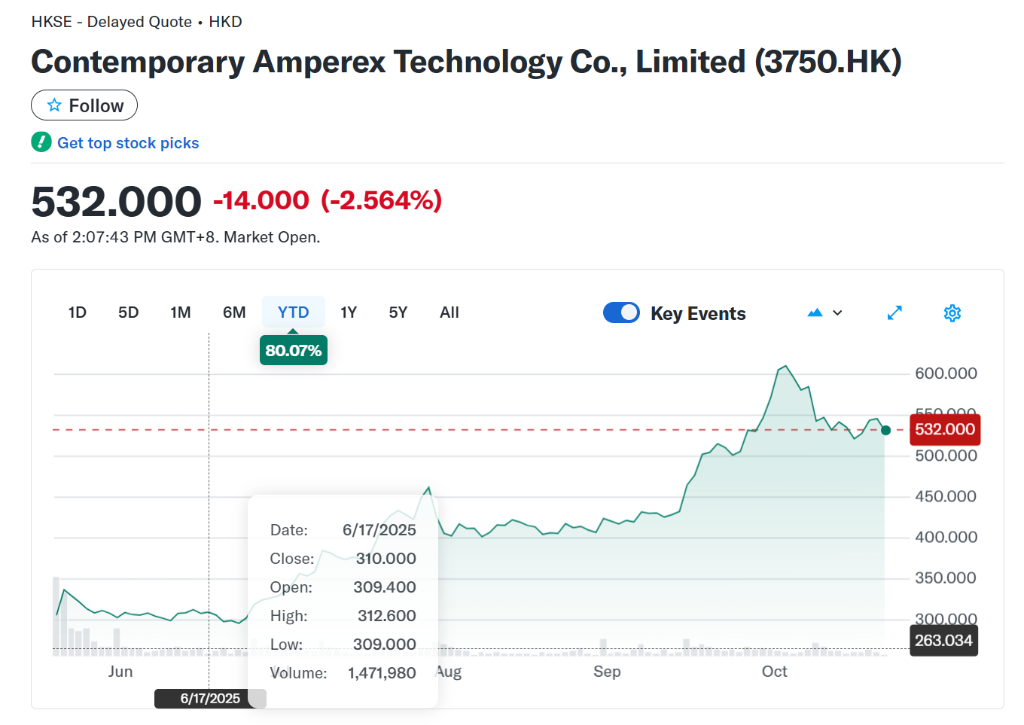
Core Viewpoint - UBS significantly raised the target price for CATL's Hong Kong stock from HKD 495 to HKD 640, citing electric heavy trucks and energy storage systems as key growth drivers for the company [1][4]. Group 1: Growth Drivers - The normalization of lithium prices and the decline in battery costs have made battery applications more economically viable, opening up key markets [4]. - Improvements in battery swap infrastructure for electric heavy trucks are making them more popular, while the demand for energy storage is being driven by traditional renewable energy installations and a new surge in demand from AI data centers [4][5]. - UBS has increased its profit forecasts for CATL by 7% and 11% for 2025 and 2026, respectively, expecting battery sales to reach 638 GWh and 790 GWh in those years [4]. Group 2: Profitability and Sales Expansion - Future profit growth for CATL is expected to rely more on sales expansion rather than an increase in unit profit margins, with a net profit margin of 17.8% and a stable unit profit of RMB 112 per kWh as of Q3 2025 [5][6]. - The company’s growth engine will be driven by actual shipment volumes rather than cost compression [5]. Group 3: Market Share and Storage Demand - Investors are advised to closely monitor CATL's market share in the domestic electric vehicle market, which has decreased by 3 percentage points this year due to capacity constraints and the rise of budget electric vehicles [7]. - Despite potential challenges from a 25% tariff on storage products planned by the U.S. in 2026, CATL is expected to remain largely unaffected due to strong demand from AI data centers and its competitive position in storage products [7]. Group 4: Valuation Logic - UBS has revised CATL's valuation method, increasing the price-to-earnings ratio from 26x to 30x, aligning it with the average valuation levels of other tech leaders like BYD, LG Energy, Xiaomi, TSMC, and Tencent [9]. - This new benchmark reflects CATL's global technological leadership and the anticipated growth in the European market following the launch of its Hungarian factory in early 2026 [9].
研报掘金丨中邮证券:维持宁德时代“增持”评级,“全球化+产品创新矩阵”构筑长期护城河
Ge Long Hui· 2025-10-23 06:24
Core Viewpoint - The report from Zhongyou Securities highlights that CATL achieved a net profit attributable to shareholders of 49.034 billion yuan in the first three quarters of 2025, representing a year-on-year increase of 36.20% [1] Financial Performance - In Q3, CATL's net profit attributable to shareholders reached 18.549 billion yuan, showing a year-on-year increase of 41.21% and a quarter-on-quarter increase of 12.26% [1] - The total battery shipments for power and energy storage in Q3 approached 180 GWh, with energy storage accounting for approximately 20% of the total [1] Operational Highlights - The company's battery unit gross profit and net profit remained relatively stable quarter-on-quarter [1] - The construction in progress amounted to 37.366 billion yuan, with a quarter-on-quarter increase of approximately 2.3 billion yuan [1] - CATL continues to advance its domestic and international expansion projects [1] Product Development - The company is systematically advancing multiple heavyweight products to create an innovative matrix for all scenarios [1] - The overseas export ratio of the total shipments is about 20% [1] Rating - The report maintains an "Overweight" rating for CATL [1]
大行评级丨瑞银:上调宁德时代H股目标价至640港元 上调今明两年盈利预测
Ge Long Hui· 2025-10-23 03:00
该行相信电动车加快出口,加上海外产能持续提升,将支持宁德时代的国际化扩张。利润方面,该行指 宁德时代第三季的净利润率已达17.8%,单位利润维持于每千瓦时112元,预期未来盈利增长更多来自 销量提升。 瑞银发表报告,将宁德时代H股目标价由495港元上调至640港元,相当预测明年市盈率30倍,维持"买 入"评级,同时将2025及2026年盈利预测分别上调7%及11%,并预期集团的电池销量分别达638及790吉 瓦时;该行认为从估值角度而言,宁德时代A股更具吸引力。 ...