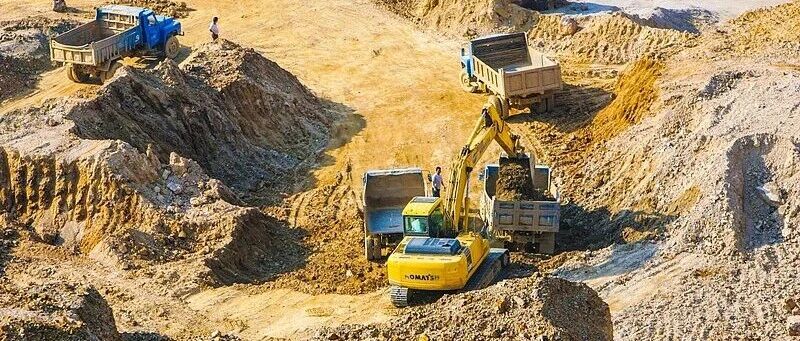
稀土

Search documents
美国考虑对华实施软件相关出口限制
制裁名单· 2025-10-24 01:15
Group 1 - The article highlights the escalating economic and trade tensions between China and the United States, particularly in the areas of rare earths, software export controls, and tariffs, which cast a shadow over the upcoming high-level talks [1] Group 2 - The U.S. is considering expanding software export restrictions to China, focusing on products that utilize American software, particularly in sensitive areas like drones and satellites, as a response to China's export controls on rare earths [2] - In retaliation, China announced export controls on rare earths and related technologies, asserting that this measure is to safeguard national security and global supply chain stability, while also imposing special port fees on U.S. vessels as a countermeasure [3] Group 3 - Upcoming talks between Chinese Vice Premier He Lifeng and U.S. Treasury Secretary Scott Behnke in Malaysia are expected to pave the way for a potential meeting at the end of the month, although recent actions by both sides have complicated negotiations [4] Group 4 - The core conflict between China and the U.S. has shifted from trade deficits to a struggle for technological hegemony and control over strategic resources, with the U.S. aiming to curb China's advancements in AI and high-end manufacturing through software restrictions, while China leverages its dominance in the rare earth supply chain [5]


美企成功提炼高纯度稀土,在打破中国垄断上迈出了历史性一步?
Sou Hu Cai Jing· 2025-10-24 00:54
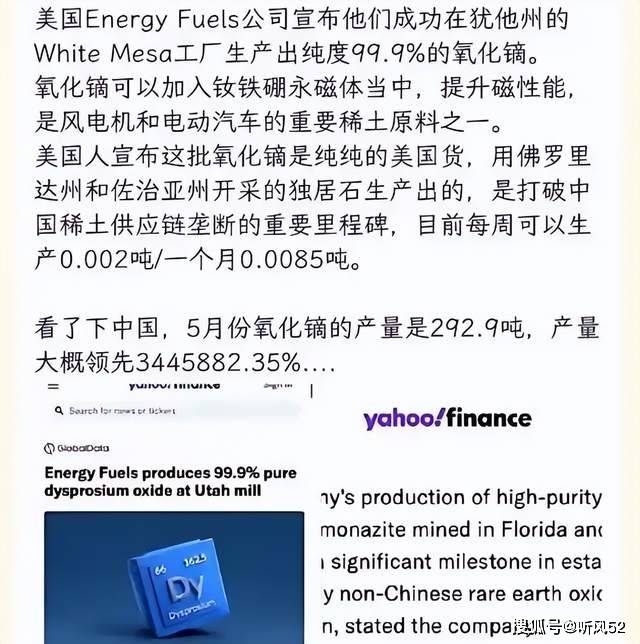
Core Viewpoint - Energy Fuels has announced a significant breakthrough in extracting high-purity rare earth elements, claiming to achieve 99.999% purity, which is seen as a challenge to China's dominance in the rare earth market [1][3] Cost Analysis - The extraction technology used by Energy Fuels, known as "molecular recognition extraction," requires specialized high-cost extraction agents priced over $200 per gram, leading to a production cost of approximately $20 million per kilogram of dysprosium, which is about 50 times higher than China's production cost of under 3,000 RMB per kilogram [5][7] - The high costs associated with this technology could significantly increase the price of military equipment, such as the F-35 fighter jet, by approximately 3 million RMB per aircraft if this extraction method were to be used [5] Production Capacity Comparison - The current output from Energy Fuels is less than 100 grams in a laboratory setting, while a single production line in China can produce 200 tons of high-purity rare earth products daily, highlighting a vast disparity in production capabilities [7][10] - The transition from laboratory success to industrial-scale production involves overcoming numerous challenges, including equipment scaling, process stability, wastewater treatment, and energy consumption [7] Industry Strengths of China - China dominates the global rare earth market, accounting for 85% of the refining and separation output, due to a well-established and complete industrial chain developed over decades [10][12] - Technological advancements in China have improved mining recovery rates from 60% to over 90%, alongside effective wastewater recycling, showcasing real progress in the industry [10] - The comprehensive industrial chain in China encompasses mining, refining, material processing, and end-use applications, providing a significant competitive advantage [10] Strategic Moves by China - In response to international competition, China is adjusting its export control lists and increasing research and development investments to enhance its technological capabilities [12][14] - China is also establishing rare earth processing facilities in countries like Tanzania and Burundi to secure resource supply and export mature technologies [12] Conclusion on Manufacturing - The case illustrates that true manufacturing breakthroughs rely on solid technological foundations, industrial chain development, and industrialization capabilities rather than mere announcements or laboratory results [14]
冲击中国稀土地位?美澳签85亿协议,却露软肋:12种矿产依赖进口
Sou Hu Cai Jing· 2025-10-24 00:18
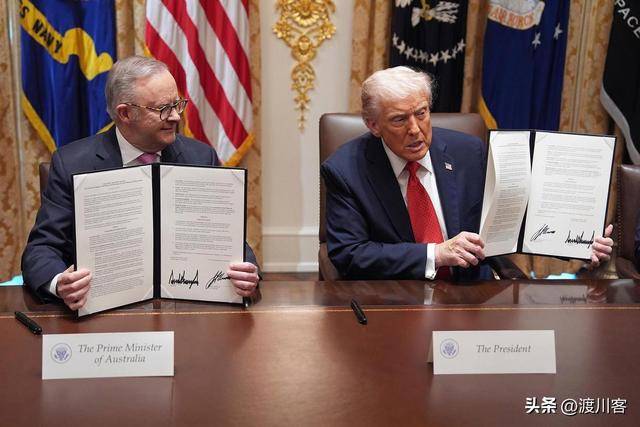
Core Viewpoint - The recent $8.5 billion rare earth agreement between the US and Australia is seen as largely symbolic, with significant challenges remaining for the US to reduce its dependence on China for rare earth materials [2][6][22]. Group 1: Agreement Details - The agreement was signed on October 20, with Trump expressing confidence that the US would have an abundance of rare earths within a year [2]. - The deal involves both countries committing $1 billion each over six months to stimulate private investment in rare earth processing facilities [11][24]. - The agreement is perceived as a facade, with Australia’s Prime Minister Albanese aware that the timeline for achieving independence from China is unrealistic [11][24]. Group 2: Current Industry Landscape - The US is heavily reliant on imports for 12 critical minerals, with rare earths being 100% imported, despite having domestic mining resources [6][19]. - China dominates the rare earth supply chain, controlling over 90% of the refining and processing, and holding a significant number of patents [4][22]. - Japan's historical attempts to reduce reliance on China for rare earths have shown limited success, with current dependence still at 58% despite significant investments [13][15]. Group 3: Production Capacity - Lynas, the largest rare earth producer outside of China, has a processing capacity of 5,000 tons per year, while Chinese companies can produce significantly more, with one company alone producing 50,000 to 60,000 tons in 2023 [17][19]. - The US's attempts to build a domestic supply chain have faced numerous obstacles, including environmental regulations and a lack of investment from major corporations [19][21]. Group 4: Future Outlook - The projected timeline for the US to establish a complete rare earth supply chain is estimated to take over a decade and require more than $250 billion, which is not feasible given the rapid pace of technological advancement [21][26]. - The recent agreement is viewed as insufficient to address the underlying issues of supply chain dependency on China, with experts suggesting that mere agreements will not resolve the complexities of the industry [22][26].

黄金一夜暴跌6%,稀土过山车!有色的投资逻辑彻底变了?
Sou Hu Cai Jing· 2025-10-23 22:13
Core Insights - The recent volatility in precious metals, including a 6% drop in gold prices, indicates a potential shift in investment logic for non-ferrous metals, prompting investors to reassess opportunities amidst market fluctuations [1][2][6]. Group 1: Precious Metals - Gold experienced a dramatic decline after reaching a historical high of $4380 per ounce, with a notable single-day drop of 6% on October 21, 2025, highlighting the risks in the current market [1][6]. - The price of silver is supported by its dual role as both an industrial and financial asset, with a projected global supply-demand gap of 4633 tons in 2024, primarily driven by solar energy demand [8][10]. - The investment logic for gold is influenced by three main factors: expectations of Federal Reserve interest rate cuts, rising geopolitical risks, and ongoing central bank purchases, which provide structural support [5][6]. Group 2: Industrial Metals - Copper is viewed as a critical component in the global green energy transition and AI technology revolution, with expectations that its price could exceed $10,000 per ton by 2026 [11]. - The recent fluctuations in rare earth prices, which rose by 12.72% and then fell by 11.69% in October, underscore their strategic importance in modern technology and industrial applications [12]. Group 3: Investment Strategies - Investors are encouraged to utilize professional tools and resources to navigate the complexities of the non-ferrous metals market, with options like actively managed funds and ETFs providing different exposure strategies [13][16]. - The combination of active and passive investment strategies is recommended for investors to capture overall industry opportunities while focusing on high-potential segments [17].
美国尚有后手,不给稀土就动金融核弹?新加坡劝告中方:勿反抗
Sou Hu Cai Jing· 2025-10-23 19:49
Group 1 - The U.S. is escalating trade tensions with China, threatening to raise tariffs to 155% if a fair trade agreement is not reached, but this could harm the U.S. more than China due to changes in trade structure [2] - The U.S. is attempting to build a rare earth supply chain with Australia, investing billions, but the timeline and feasibility of achieving independence from China in this sector are questioned [4][7] - The U.S. reliance on China for aircraft parts is significant, with over 1,800 Boeing planes in China, and any supply cuts could backfire on U.S. companies like Boeing [5] Group 2 - Singapore's advice to China to avoid a self-sufficient development path suggests a bias, as it benefits from its own self-sufficiency initiatives while advising China against similar strategies [8] - The concept of the U.S. using a "financial nuclear option" against China is challenged by the reality of the U.S. financial system's vulnerabilities, including a downgraded credit rating and increasing national debt [9][10] - China's industrial system is robust, making complete decoupling unrealistic, and it is advancing in key technology sectors, which positions it well against U.S. pressures [11]
美国警告断供就踢出SWIFT,中国稀土管制升级直击美国军工与芯片命门
Sou Hu Cai Jing· 2025-10-23 18:58
Core Viewpoint - The international competition over rare earth elements has intensified, particularly following China's announcement of export controls, which significantly impacts the U.S. high-tech sector [1][4]. Group 1: Background of U.S.-China Technology Competition - The U.S. has initiated comprehensive technology restrictions against China, including high-end chip bans and efforts to isolate Huawei, indicating a clear intent to block China's technological advancements [3]. - Initially, China adopted a restrained approach, hoping to gain leverage in future negotiations, but the increasing aggressiveness of U.S. strategies led to a shift in China's stance [3][6]. Group 2: China's Export Control Announcement - On October 9, 2025, China's Ministry of Commerce announced stricter controls on rare earth exports, including new regulations on five elements and stringent approvals for semiconductor-related exports, with military-related exports being largely denied [4]. - China dominates the global rare earth market, producing 65% of the world's supply and holding 49% of reserves, with a market share of 85% in refining and separation technologies [4]. Group 3: U.S. Response and Reactions - Following China's announcement, the U.S. experienced panic, with trade representatives attempting to reach out to China but receiving no response for three days, leading to a drastic change in U.S. tone from arrogance to humility [5]. - U.S. Treasury Secretary offered to extend tariff exemptions in exchange for easing export controls, but China remained resolute in its strategy [5]. Group 4: Implications for U.S. Military and Industry - The U.S. military heavily relies on rare earth elements, with 87% of core military equipment dependent on these resources, making any disruption in supply a significant risk for U.S. defense production [6]. - The U.S. threats to exclude Chinese companies from global markets and the SWIFT payment system are seen as largely bluster, given the critical dependence on rare earths for military capabilities [5][6]. Group 5: Global Supply Chain and Market Reactions - Countries like Australia and Canada are calling for the development of local supply chains, but experts believe it will take 5 to 10 years to close the gap with China due to high technical barriers [8]. - The rare earth price surged by 30% following the announcement, causing declines in U.S. chip stocks and raising concerns among defense contractors [11]. Group 6: Strategic Developments and Future Outlook - China is expanding its currency swap agreements and has seen a doubling in cross-border settlements in RMB, indicating a move towards financial independence from the U.S. [11]. - The historical context of China's previous export restrictions in 2010, which led to a tenfold price increase, suggests that current policies are more structured and less susceptible to WTO intervention [12]. - The ongoing rare earth competition is expected to accelerate the internationalization of the RMB and contribute to a multipolar global economic landscape [13].

刚拿下稀土订单,特朗普又要开第二枪,全球收到通知,中国被布局
Sou Hu Cai Jing· 2025-10-23 17:55
Core Insights - The recent actions by the U.S. regarding tungsten and rare earth minerals reflect a strategic attempt to compete with China in critical mineral resources, particularly in Kazakhstan's undeveloped tungsten mines and through a significant rare earth supply agreement with Australia [1][4][9] Group 1: Tungsten Mining - The U.S. is attempting to negotiate access to a large undeveloped tungsten mine in Kazakhstan, which is crucial for producing strategic materials like armor-piercing ammunition, with 80% of global production currently in China [1] - The U.S. strategy involves using capital and political pressure to secure resources, but China has already established a foothold in Kazakhstan with operational tungsten processing plants, indicating a significant head start in production capabilities [2][8] - Kazakhstan prefers partnerships that promote long-term industrial development, job creation, and technology transfer, which aligns more closely with China's comprehensive industrial chain approach compared to the U.S. model of resource extraction [2][8] Group 2: Rare Earth Elements - The U.S. signed an $8.5 billion supply agreement with Australia for rare earth elements, aiming to reduce dependence on China, but faces challenges in the entire supply chain, particularly in refining and processing capabilities [4][6] - China's dominance in rare earths is not only due to its reserves but also its advanced refining and separation technologies, which the U.S. lacks after decades of industry decline [4][6] - The U.S. strategy appears to be politically motivated, aiming to create a narrative of success in the face of competition with China, despite the significant technological and market gaps that remain [6][9] Group 3: Geopolitical Dynamics - The U.S. approach of combining high-level diplomacy with threats of tariffs has been met with skepticism in Central Asia, where countries like Kazakhstan are wary of such tactics [2][8] - The ongoing competition for control over critical minerals highlights the importance of a complete supply chain, where the ability to process and refine materials is as crucial as the extraction of raw resources [11] - The disparity between U.S. ambitions and actual capabilities in securing a stable supply chain for critical minerals underscores the challenges faced in reversing decades of industrial decline [9][11]
深夜狂飙!特朗普再出手?
Zheng Quan Shi Bao· 2025-10-23 15:37
Core Viewpoint - The Trump administration is negotiating with several U.S. quantum computing companies to replicate its previous investment model with Intel, seeking equity in exchange for federal funding support [1][4]. Group 1: Government Involvement - Companies involved in the negotiations include IonQ, Rigetti Computing, D-Wave Quantum, Quantum Computing, and Atom Computing, with some seeking a minimum funding amount of $10 million [4]. - The U.S. government previously invested $8.9 billion in Intel, acquiring 9.9% of its shares, making it one of Intel's largest shareholders [4]. - The U.S. Department of Defense agreed to purchase $400 million in preferred stock from MP Materials, becoming its largest shareholder, with the investment aimed at expanding rare earth processing capabilities [4]. Group 2: Market Reaction - Following the news, shares of several quantum computing companies surged, with IonQ up over 11%, D-Wave up over 20%, Rigetti up over 13%, and Quantum up over 10% [5]. - Specific stock performance includes D-Wave Quantum at $32.879 (+20.48%), Rigetti Computing at $40.910 (+13.45%), and IonQ at $61.725 (+11.32%) [6]. Group 3: Quantum Computing Landscape - Quantum computing is viewed as a critical next-generation technology capable of performing calculations that would take traditional computers billions of years [8]. - Despite the promising outlook, no company has yet achieved practical, large-scale commercial quantum computing [8]. - Major tech companies are investing in quantum computing, with Microsoft announcing breakthroughs in quantum chip development and PsiQuantum completing a $1 billion Series E funding round to build the first commercially viable fault-tolerant quantum computer [9].
美澳的稀土豪赌,为何专家直接泼了十年冷水?
Sou Hu Cai Jing· 2025-10-23 15:00
Core Points - The signing of an $8.5 billion agreement between the U.S. and Australia aims to enhance the supply chain for critical minerals and rare earths, addressing concerns over reliance on China [1][3] - The agreement includes a commitment of over $1 billion from each country to initiate projects within six months, with the U.S. Department of Defense funding a gallium refinery in Western Australia [1][3] U.S.-Australia Cooperation - The U.S. and Australia plan to invest over $3 billion in critical mineral projects within six months, with an expected output value of $53 billion [3] - Australia ranks fourth globally in rare earth reserves and has significantly increased production in recent years, becoming the only country outside China to produce heavy rare earth elements [3][4] Challenges in Supply Chain Development - Experts express skepticism about the rapid improvement of the U.S. critical mineral supply, citing high energy costs, a shortage of technical talent, and environmental concerns as major obstacles [5][6] - Achieving self-sufficiency in gallium production is projected to take 5 to 10 years, requiring substantial investment [6] Economic Risks - A report from Goldman Sachs warns that a 10% disruption in industries reliant on rare earth elements could lead to a $150 billion loss for the U.S. economy [6] - The processing and refining costs of rare earth elements are high, contributing to China's continued dominance in the global market [6] Long-term Outlook - Experts believe that building a comprehensive rare earth supply chain will take 10 to 15 years, despite ongoing investments and policy support [8][10] - The rare earth competition is characterized as a long-term strategic battle involving time, technology, and patience [11]
中国稀土集团:严格落实出口管制政策
财联社· 2025-10-23 13:13
会议采用"现场+视频"方式召开,集团公司总部各部门负责人在主会场参会,各直属机构、直管企业及其子企业领导班子在分会场视频参 会。 下载财联社APP获取更多资讯 会议强调,要深刻领会党的二十届四中全会关于当前国内外形势的科学判断和对未来发展方向的战略擘画,善于在挑战中寻求机遇,在困难 中锻炼能力,统筹高质量发展与高水平安全实现良性互动。要强化整合推进,优化产业布局结构;强化科技创新,持续增强核心功能和核心 竞争力;强化企业能力建设,着力提升经营管理质效;强化深化改革攻坚,持续提升企业治理水平;强化风险防范化解,夯实发展根基,以 更加坚定的决心和更加有力的措施,推动集团公司高质量发展迈上新台阶。 会议要求,各单位必须进一步强化责任担当,以时不我待的紧迫感和使命感,将各项工作抓实抓细抓出成效。要加强党建引领强担当,加强 作风建设保落实,抓好巡视工作明纪律,以高质量党建引领保障年度任务目标全面完成。 会议部署了四季度重点工作,强调要严格落实出口管制政策,依法合规开展工作;抓好生产经营攻坚,全力稳产保供;抓好国企改革攻坚, 提升治理水平;抓好科技创新攻坚,增强发展动能;抓好项目推进攻坚,加快发展步伐;抓好风险防控攻坚, ...