Semiconductors

Search documents
台积电魏哲家:中国大陆机器人跳来跳去没用,好看而已
半导体行业观察· 2026-03-22 02:42
Core Viewpoint - TSMC Chairman Wei Zhejia emphasizes the importance of AI and robotics, stating that the real value lies in the "brain" of robots, which is predominantly developed by TSMC, accounting for 95% of the technology [2][5]. Group 1: Robotics and AI Development - Wei Zhejia highlights that the future of healthcare may involve robots providing services without the need for human intervention, suggesting that every elderly household will likely have a robot [4]. - He points out that the development of robots requires extensive training of their "brains" to meet human needs, and that TSMC plays a crucial role in this technology [5][6]. - The chairman humorously notes that the perception of robots as simple machines is misleading, as effective robots require numerous sensors and data to function properly [5]. Group 2: TSMC's Role in Semiconductor Technology - TSMC is currently focused on advancing AI technology, claiming that its semiconductor advancements have accelerated AI capabilities by 100 times over the past 20 years, with the company now operating at a 2-nanometer process [5]. - Wei Zhejia expresses a desire for TSMC-manufactured transistors to be used in robots, indicating a competitive stance against other manufacturers [5]. - He acknowledges the challenges faced by the medical profession and suggests that AI can significantly alleviate the workload of healthcare providers, especially in an aging society [6]. Group 3: Company Image and Challenges - Wei Zhejia expresses embarrassment over TSMC being fined by the labor bureau, ranking seventh in penalties, indicating a need for improvement in labor practices [6]. - He clarifies misconceptions about the company's work conditions, stating that the real stress lies with healthcare professionals rather than TSMC employees [6].



芯片太热了,要降降温
半导体行业观察· 2026-03-22 02:42
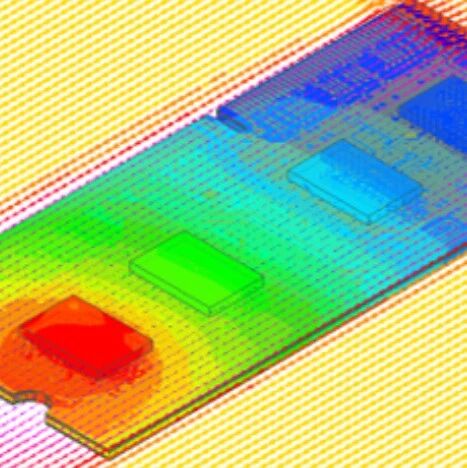
Core Viewpoint - The transition from air cooling to liquid cooling in high-power chips, such as GPUs, presents new thermal management challenges for nearby components that previously benefited from airflow [3][4][6]. Group 1: Cooling Technologies - Liquid cooling is effective for high-power chips but can create overheating issues for adjacent components due to the loss of airflow [3][4]. - Micro-cooling solutions are emerging to address localized cooling needs for specific components in constrained spaces [3][10]. - Alternative cooling technologies, such as heat pipes and vapor chambers, can be utilized when liquid cooling is not feasible [10]. Group 2: Thermal Analysis - Comprehensive thermal analysis of the entire circuit board is essential to ensure that all components, including those that previously did not require cooling, remain within safe temperature limits [4][19]. - The interaction between components on the circuit board affects thermal performance, necessitating a holistic approach to cooling solutions [8][9]. Group 3: Emerging Solutions - MEMS (Micro-Electro-Mechanical Systems) fans are being developed to provide localized cooling directly on chips, offering a quieter and more efficient alternative to traditional fans [15][16]. - Active cooling solutions, such as fans integrated into heat sinks, can enhance cooling efficiency by directing airflow to specific hotspots [17]. Group 4: Market Implications - As systems increasingly adopt liquid cooling and power levels rise, there will be a growing demand for auxiliary cooling solutions for chips that do not require full liquid cooling [19]. - The need for thorough circuit board analysis will remain critical in deploying any cooling solutions effectively [19].

芯片,涨价潮!
半导体行业观察· 2026-03-22 02:42
Core Viewpoint - The global semiconductor industry is experiencing a significant price increase driven by supply-demand imbalances and rising costs, with major companies like Texas Instruments, Infineon, and NXP leading the charge [2][3][4]. Group 1: Price Increases by Major Companies - Texas Instruments (TI) announced a price increase of 15%-85% across all product lines, with the highest increases in industrial control and automotive electronics, reflecting tight capacity and rising costs [3]. - Infineon is raising prices for power switches and related chips due to surging demand from AI data centers, with increases expected to be 5%-15% for mainstream models and potentially higher for premium products [4][5]. - NXP is also adjusting prices due to significant cost increases across the supply chain, although specific product categories and price ranges have not been disclosed [6]. Group 2: Broader Industry Trends - Other companies such as ON Semiconductor, Analog Devices, and Vishay are joining the price increase trend, indicating a widespread adjustment across the semiconductor sector [6][7]. - The price adjustments are largely attributed to rising costs of raw materials, energy, and logistics, which are affecting all players in the industry [8][12]. Group 3: Cost Pressures and Supply Chain Dynamics - The surge in prices is primarily driven by skyrocketing costs of key raw materials, particularly precious metals, which are essential for semiconductor manufacturing [12][13]. - The semiconductor industry is facing a structural shift in demand, particularly from AI servers and electric vehicles, which is exacerbating supply constraints and allowing manufacturers to raise prices [15][16]. Group 4: Impact of Foundry Price Increases - The collective price increases from wafer foundries are further pressuring chip manufacturers to adjust their pricing strategies, as foundries raise their rates due to increased operational costs [18][19]. - Major foundries like TSMC and Samsung are shifting focus to advanced processes, leading to a reduction in capacity for older nodes, which is tightening supply for essential components [21][22]. Group 5: Domestic Market Response - Domestic semiconductor companies in China are also raising prices in response to global trends, with many following suit to address rising costs and maintain profitability [9][10]. - The price adjustments among domestic firms reflect a shift from a price war to a value-driven approach, indicating a potential recovery in profit margins [11][24].





X @Elon Musk
Elon Musk· 2026-03-22 01:55
RT Steve Jurvetson (@FutureJurvetson)T͢E͢R͢A͢F͢A͢B͢ Launch ⌨Goal: adding a trillion watts of compute, 2x the entire U.S. electricity market, every year. A new 2nm fab to build ~1 billion AI chips/year. Most will be in space."We have an announcement to make: the most epic chip-building effort by far." — @ElonMusk tonightLive now ► https://t.co/7TBBDAE8Nf ...
X @The Economist
The Economist· 2026-03-22 00:20
Nvidia’s rise has been extraordinary even by Silicon Valley’s standards. How much higher can the AI chipmaker climb? https://t.co/S0PlnQ8XRz ...

What Happens to Your Investments If the Stock Market Crashes?
Yahoo Finance· 2026-03-21 23:35
Market Sentiment - More than half of U.S. investors feel pessimistic about the market's future, with 50% expressing concerns, an increase from 46% last week and 35% two weeks ago [1] Market Volatility and Historical Context - The market's long-term future remains positive, but short-term volatility can lead to significant losses, as evidenced by the S&P 500 losing over 50% of its value during the Great Recession from 2007 to 2009 [3] - An investment of $10,000 in an S&P 500 ETF in December 2007 would have been worth approximately $4,600 by March 2009 [3] Investment Strategy - Losing value in the market does not equate to losing money unless investments are sold for less than their purchase price; holding investments can allow for recovery [4] - A long-term investment strategy is beneficial, as an investment of $10,000 in an S&P 500 ETF held for 10 years would have more than doubled in value [5] - The market has a strong track record of recovering from crashes and recessions, but individual stocks may not perform equally well, emphasizing the importance of investing in stable companies [6]
Qualcomm Stockholders Back Board, Equity Plan; CEO Amon Highlights AI, Robotics and Data Center Push
Yahoo Finance· 2026-03-21 23:03
Core Insights - Qualcomm's annual meeting highlighted stockholder proposals, with one advocating for a lower threshold to call special meetings, which was not approved [1][3] - CEO Cristiano Amon outlined the company's strategy focusing on diversification, AI, and expansion into new markets, emphasizing Qualcomm's role as a leader in connected computing [6][14] Stockholder Proposals - Proposal Six aimed to amend governing documents to allow stockholders with 10% of outstanding shares to call special meetings, arguing current provisions act as "poison pills" [1] - Proposal Seven requested transparency on how Qualcomm manages risks associated with its significant revenue from China, emphasizing the need for better tracking of China-specific costs and assets [5] Company Strategy and Market Position - Amon described Qualcomm's strategy as anticipating change and investing in new technologies, with capabilities in high-performance computing, advanced connectivity, and AI processing [6] - The company is expanding beyond handsets into personal AI, wearables, PCs, automotive, edge networking, and industrial IoT, with a focus on advanced robotics and data centers [7][11] Product and Market Highlights - Snapdragon platforms are leading mobile innovation, with the Snapdragon 8 Elite Gen 5 being highlighted as the fastest mobile CPU [7] - Qualcomm expects around 150 Snapdragon-powered laptop designs to be commercialized by 2026 and has a significant presence in the automotive sector with its digital cockpit platform deployed in 75 million cars [9] Financial Performance and Future Outlook - Qualcomm aims for $22 billion in combined revenues from QCT, automotive, and IoT by fiscal 2029, with data center business expected to become financially material by fiscal 2027 [13] - The company returned approximately 100% of its free cash flow in fiscal 2025 and plans to continue this trend in fiscal 2026, alongside a dividend increase [13] Technological Advancements - Qualcomm is investing in next-generation technologies, including Wi-Fi 8 and AI-driven solutions for data centers, with a focus on enhancing memory bandwidth and power efficiency [10][12] - Amon emphasized the importance of 6G technology, predicting it will enable significant uplink speed increases and transform networks into AI networks [13]

Is Advanced Micro Devices, Inc. (AMD) A Good Stock To Buy Now?
Yahoo Finance· 2026-03-21 21:08
Core Thesis - Advanced Micro Devices, Inc. (AMD) is undergoing a significant transformation from a semiconductor vendor to a comprehensive AI infrastructure platform, which the market has yet to fully appreciate [2][5] Company Overview - AMD's shares were trading at $193.39 as of March 13th, with trailing and forward P/E ratios of 74.10 and 28.90 respectively [1] - The company operates internationally in the semiconductor industry, focusing on CPUs, GPUs, networking, and software [2] Strategic Positioning - AMD is positioning itself as a "second source" for hyperscalers and enterprise AI buyers, emphasizing flexibility and architectural diversity [2] - The company's EPYC CPUs and Instinct MI300/MI350 GPUs are central to its system-level strategy, optimizing performance, memory bandwidth, and energy efficiency [3] Competitive Advantage - AMD's integrated platforms enhance wallet share per deployment and foster deeper customer relationships, leading to faster and stickier follow-on adoption [4] - The software ecosystem, including the ROCm stack, reduces vendor lock-in and improves portability, appealing to buyers focused on flexibility [4] Financial Performance - The data center segment is AMD's largest and fastest-growing business, generating significant free cash flow for ongoing investments [4] - As hyperscalers adopt AMD-based AI instances, a growth flywheel is emerging, enhancing earnings potential [5] Market Outlook - AMD's entrenched customer relationships and financial resilience position it as a strong bullish investment in the AI sector, with potential for expanded market relevance and valuation as adoption increases [5]

Is NVIDIA Corporation (NVDA) A Good Stock To Buy Now?
Yahoo Finance· 2026-03-21 21:05
Group 1 - NVIDIA Corporation is transitioning from a semiconductor company to a foundational infrastructure provider for accelerated computing and artificial intelligence, evolving from gaming GPUs to a dominant platform for AI, data centers, and high-performance computing [2] - The Compute & Networking segment drives nearly 90% of NVIDIA's revenue and the majority of its operating profit, reflecting a structural shift towards AI infrastructure [3] - NVIDIA maintains an estimated 80–90% share of the AI training accelerator market, deeply embedded in the infrastructure of major cloud providers like Amazon Web Services, Microsoft Azure, and Google Cloud [4] Group 2 - The company's operational performance is strong, with FY2026 revenue projected to reach $215.9 billion, driven by the Data Center segment [4] - NVIDIA's profitability is robust, supported by high gross margins and significant free cash flow, with a substantial net cash position on its balance sheet [5] - The stock is viewed as undervalued relative to its growth trajectory, with a base-case valuation of approximately $300 per share based on normalized earnings and potential multiple expansion [6]
I Just Put More Than $10,000 Into These 3 Tech Stocks. Here's Why.
The Motley Fool· 2026-03-21 20:30
Group 1: Advanced Micro Devices (AMD) - AMD has formed GPU partnerships with OpenAI and Meta Platforms, with both companies committing to purchase AMD's GPUs and receiving warrants for about 10% of AMD's shares [3][4] - The warrants are contingent on AMD's stock hitting certain price thresholds, with the final tranche expected at $600, which is approximately three times AMD's current share price [4] - AMD is positioned to benefit from the increasing demand for high-performance CPUs in AI data centers, suggesting a potential shift in the GPU-to-CPU ratio that is not yet reflected in its stock price [5] Group 2: ServiceNow (NOW) - ServiceNow is viewed as a strong SaaS provider that has been undervalued due to fears of AI disruption, with its platform deeply integrated into customer workflows [8] - The company's generative AI suite, Now Assist, has seen rapid growth, with annual contract value reaching $600 million and projected to exceed $1 billion by year-end [9] - ServiceNow continues to grow revenue at over 20%, indicating it is more likely to be an AI winner rather than a loser, making its recent sell-off appear excessive [11] Group 3: Pinterest (PINS) - Pinterest is considered undervalued despite its transformation into a shopping discovery platform, with revenue growing by 14% last quarter [12][13] - The company has leveraged AI to enhance its platform with features like multimodal search and personalized curation, which are expected to improve user targeting and conversions [14] - Pinterest's forward price-to-earnings ratio is low, at about 11 times based on 2026 estimates, and it has the support of Elliott Investment Management, which invested $1 billion to facilitate a share repurchase plan [13][15]