Energy

Search documents
European Stocks Tumble at Open as Oil Surges
Barrons· 2026-03-09 08:55
Core Viewpoint - European stock markets opened sharply lower due to surging oil prices, driven by fears related to Iran [1] Group 1: Market Performance - Spain's IBEX 35 index fell by 3%, with major banks like Santander down 4.4% and BBVA down 3.5% [1] - The German DAX index decreased by 2.7%, led by Siemens Energy which slid 7.25% and Heidelberg Materials down 4.5% [1] - The French CAC 40 index dropped by 2.6% [1] - The Italian FTSE MIB index fell by 2.5%, with UniCredit declining by 4% [1] - The London FTSE 100 index was down 1.7%, impacted by a 5.1% drop in Rolls Royce, although gains from oil majors BP and Shell somewhat mitigated losses [1] - The Dutch AEX index decreased by 1.9%, with ASML, Europe's most valuable company, falling by 5% [1]
日本经济:能源冲击下的行业脆弱性Japan Economics-Energy Shock Sector Vulnerabilities
2026-03-09 05:18
Summary of Key Points from the Conference Call Industry Overview - The report focuses on the **energy sector in Japan**, particularly the vulnerabilities associated with fossil fuel dependency in various sectors [6][3]. Core Insights - **Sector Vulnerabilities**: - Sectors heavily reliant on oil and natural gas are at greater risk of disruption due to energy shocks [6][3]. - Agriculture and transport are significantly affected by crude oil prices, while the residential, commercial, and electricity sectors are more impacted by natural gas prices [6][3]. - **LNG Stability**: - Liquefied Natural Gas (LNG) supply in Japan is stable due to long-term contracts and diversified sources, mitigating some risks associated with energy price fluctuations [6][3]. - **Impact on Capital Formation**: - Changes in relative prices among energy sources may influence capital formation, particularly in transportation choices [6][3]. - **Inflation Effects**: - The duration of energy price shocks will determine the inflation impact, with food price inflation likely to worsen due to agriculture's dependence on crude oil and fertilizer disruptions [6][3]. - **Rail and Air Fare Adjustments**: - Rail fares will reflect energy price changes only after October, as adjustments occur biannually in April and October, while air and freight fares may respond more quickly [6][3]. Sector Exposure to Fossil Fuels - **Exhibit 1** illustrates the percentage exposure of various sectors to fossil fuels: - Agriculture: 0.39 EJ total fossil fuel use - Manufacturing: 5.04 EJ total fossil fuel use - Commerce/Pubs: 2.43 EJ total fossil fuel use - Residential: 2.35 EJ total fossil fuel use - Transport: 2.74 EJ total fossil fuel use [8][6]. Additional Important Points - The report includes a detailed methodology for calculating sector vulnerabilities based on the **Ministry of Economics, Trade, and Industry's** energy supply balance table for 2024 [7][6]. - Analysts involved in the report include Robert Alan Feldman, Ph.D., and Reiji Ogino, who can be contacted for further insights [4][12]. - The report emphasizes the importance of considering these vulnerabilities when making investment decisions in the energy sector [6][4].
X @Bloomberg
Bloomberg· 2026-03-09 04:25
Diverting oil via workaround pipelines is part of Saudi Arabia and the UAE's commitment to energy markets. But it may invite further attacks, writes @Javier Blas (via @opinion) https://t.co/bIBKT9IuTJ ...
New CEO Greg Abel's 18-Page Letter to Shareholders Is an Unprecedented Look Into the Future of Berkshire Hathaway. 3 Things Investors Should Know
The Motley Fool· 2026-03-08 07:05
Core Insights - New CEO Greg Abel has officially taken over from Warren Buffett, marking a significant leadership transition at Berkshire Hathaway with an 18-page letter to shareholders outlining his vision and the company's current state [1] Group 1: Corporate Structure and Leadership - Berkshire Hathaway consists of 51 non-insurance operating divisions across various sectors including insurance, energy, mortgages, and railroads [4] - The company will maintain a decentralized model, allowing leaders of each business greater autonomy and accountability, which is viewed as a competitive advantage [5] - Ajit Jain will continue to lead the insurance business, while Adam Johnson will oversee all consumer products, services, and retailing businesses, which include 32 non-insurance operating companies [5] Group 2: Investment Strategy - Abel will be responsible for capital allocation in Berkshire's large equities portfolio, which is primarily funded by the float from insurance operations [6] - The equities portfolio is expected to have "limited activity" moving forward, with four key stocks—Apple, American Express, Coca-Cola, and Moody's—likely to see minimal changes [7] - These four companies are viewed as long-term investments, although Abel did not rule out adjustments based on fundamental changes in their economic prospects [8] Group 3: Capital Distribution Policies - Berkshire Hathaway has a significant cash reserve of $370 billion, leading to speculation about potential capital distributions to shareholders [11] - The company will not initiate dividend payments unless it believes it can create more value through business investments, although the board reviews this policy annually [12] - Share repurchases will continue to be conducted when shares are trading below intrinsic value, with consideration for purchasing large blocks from major investors [13]


Stock Market Rally Attempt Depends On Iran War, Oil's Next Move
Investors· 2026-03-07 22:02
Market Overview - The stock market experienced significant volatility and losses due to the Iran war, with oil prices surging and raising global economic concerns [1] - The Dow Jones Industrial Average fell 3% last week, marking its worst performance in 11 months, while the small-cap Russell 2000 dropped 2.33% to a two-month low [1] - The S&P 500 index decreased by 2% and the Nasdaq composite by 1.2%, with the Nasdaq closing at its lowest level of 2026 [1] Oil Market Impact - U.S. crude oil futures surged 35.6% to $90.90 per barrel, the highest weekly gain since 1983, while U.S. natural gas futures increased by 11.4% [1] - European natural gas prices skyrocketed by 67%, significantly impacting fertilizer production [1] - U.S. gasoline futures rose by 20.2%, indicating a forthcoming increase in pump prices [1] Key Stocks and ETFs - Palantir Technologies stock rose 15.6% to 157.16, benefiting from a rebound in software and defense sectors [2] - General Dynamics stock increased by 1.8% to 363.49, approaching a buy point of 369.70 [2] - Broadcom stock gained 3.4% to 330.45, rebounding above its 200-day moving average [2] - The iShares Expanded Tech-Software Sector ETF (IGV) increased by 7.75%, while the VanEck Vectors Semiconductor ETF (SMH) fell by 6.35% [1] Sector Performance - Defense and energy stocks generally performed well, while airlines suffered due to disrupted flights and rising fuel costs [1] - The software sector continued to rebound, supported by positive earnings reports [1] - The CBOE Volatility Index (VIX) rose significantly, indicating increased market uncertainty [1]


X @Herbert Ong
Herbert Ong· 2026-03-07 00:14
🚨 William Blair: Tesla Energy Could Be Worth $120 BillionWilliam Blair analyst Jed Dorsheimer says the surge in AI data centers, now 2,100+ projects globally (~174 GW capacity), could boost demand for grid storage like Tesla’s Megapack.He estimates Tesla’s Energy segment alone could be worth about $31 per share (~$120B). $TSLA ...

Oil surge sparks Treasury market's worst weekly rout since ‘liberation day' chaos
MarketWatch· 2026-03-06 21:53
Core Insights - Global government bonds experienced significant declines due to rising oil prices, exacerbated by the ongoing conflict in Iran [1] Group 1 - The surge in oil prices has negatively impacted the bond market, leading to increased yields and decreased bond prices [1] - The conflict in Iran is contributing to market volatility, influencing investor sentiment and economic outlook [1] - Analysts are closely monitoring the situation as it unfolds, given its potential implications for inflation and interest rates [1]

Stocks Lower on $90 Oil, Weak Payrolls | Bloomberg Businessweek Daily 3/6/2026
Bloomberg Television· 2026-03-06 21:03
ANNOUNCER: THIS IS "BLOOMBERG BUSINESSWEEK DAILY." REPORTING FROM THE MAGAZINE THAT HELPS GLOBAL LEADERS STAY AHEAD WITH INSIGHT ON THE PEOPLE, COMPANIES, AND TRENDS SHAPING TODAY'S COMPLEX ECONOMY. PLUS, GLOBAL BUSINESS, FINANCE, AND TECH NEWS AS IT HAPPENS. "BLOOMBERG BUSINESSWEEK DAILY" WITH CAROL MASSAR AND TIM STENOVEC, LIVE ON BLOOMBERG RADIO, TELEVISION, YOUTUBE, AND BLOOMBERG ORIGINALS.CAROL: GOOD AFTERNOON ACROSS BLOOMBERG PLATFORMS. WELCOME TO "BLOOMBERG BUSINESSWEEK DAILY" ON THIS FRIDAY, MARCH 6 ...

Navigating the market as crude oil tops $90 per barrel
CNBC Television· 2026-03-06 19:17
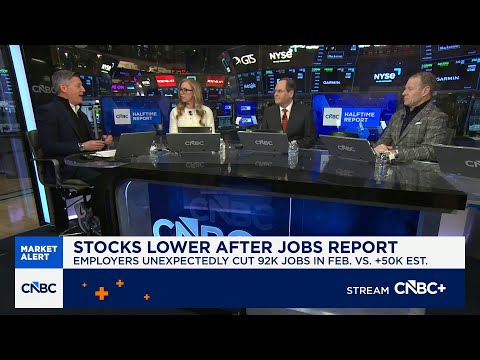
AGAIN WE DISCUSS AND DEBATE WITH THE INVESTMENT COMMITTEE. JOINING ME FOR THE HOUR TODAY, SHANNON ACOSTA JIM LEBENTHAL, STEPHEN WEISS AND JOSH BROWN. WE WILL TAKE YOU TO THE MARKETS.WE WERE WEAK OBVIOUSLY ACROSS THE BOARD OFF THE WORST LEVELS. BUT NONETHELESS, YOU DO HAVE ALMOST 1% OR MORE DECLINES FOR EVERYTHING, CLEARLY. BUT THE NASDAQ, WHICH IS ABOUT THREE QUARTERS OF 1% I MENTIONED.AND WHAT'S REALLY DRIVING THE ACTION TODAY, THE JOBS MISSED, THE OIL GAS PRICES ARE UP. QATAR WARNING THAT THE THE WAR COUL ...
Nasdaq Down Over 300 Points; US Economy Loses 92,000 Jobs In February
Benzinga· 2026-03-06 14:40
Market Overview - U.S. stocks experienced a decline, with the Nasdaq Composite dropping over 300 points on Friday. The Dow fell by 1.62% to 47,179.83, the NASDAQ decreased by 1.47% to 22,414.12, and the S&P 500 dropped by 1.38% to 6,736.10 [1] Employment Data - The U.S. economy reported a loss of 92,000 nonfarm payrolls in February 2026, a significant decrease from January's revised job gains of 126,000, and below economists' expectations of 59,000. The unemployment rate increased from 4.3% to 4.4%, surpassing forecasts of 4.3%. Average hourly earnings rose by 0.4% month-over-month, matching January's pace and exceeding consensus estimates of 0.3% [2] Commodity Market - In commodity trading, oil prices increased by 8.3% to $87.74, while gold rose by 0.4% to $5,099.00. Silver also saw a gain of 0.5% to $82.625, whereas copper experienced a slight decline of 0.1% to $5.7970 [3] European Market Performance - European shares declined, with the eurozone's STOXX 600 falling by 1.7%. Spain's IBEX 35 Index decreased by 1.6%, London's FTSE 100 dropped by 1.4%, Germany's DAX dipped by 1.7%, and France's CAC 40 fell by 1.5% during the session [4] Asian Market Performance - Asian markets closed mostly higher, with Japan's Nikkei 225 gaining 0.62%, Hong Kong's Hang Seng index increasing by 1.72%, China's Shanghai Composite rising by 0.38%, while India's BSE Sensex dipped by 1.37% [5]