
广播电视和网络视听

Search documents
数说“十四五”丨我国广播电视和网络视听行业取得长足发展
Yang Guang Wang· 2025-09-26 01:15
Core Insights - The Chinese broadcasting and network audiovisual industry has seen significant growth during the "14th Five-Year Plan" period, with over 1 billion users in both television and online audiovisual sectors [1][2] - The total revenue of the national broadcasting and audiovisual service industry is projected to reach 1.49 trillion yuan in 2024, representing a 61.96% increase compared to the end of the "13th Five-Year Plan" [1] Group 1 - The production and distribution of television dramas (including online dramas) exceeded 1,500, while animated films surpassed 3,500, and documentaries totaled over 350,000 hours during the "14th Five-Year Plan" [1] - The State Administration of Radio and Television has implemented measures to simplify television service fees and operations, achieving significant results in user experience [1] - The industry has seen a flourishing of creative production, with a variety of high-quality works emerging, contributing to a positive trend of continuous quality content [1] Group 2 - The administration is addressing industry pain points by promoting collaborative broadcasting and purchasing, as well as adjusting management policies for drama series to provide more creative space [2]
新华社权威速览·非凡“十四五”丨传播党的声音、服务人民群众,广播电视和网络视听行业五年成绩单来了
Xin Hua She· 2025-09-26 01:03
Core Viewpoint - During the "14th Five-Year Plan" period, the broadcasting and television industry in China has achieved significant results in promoting systematic reform and high-quality development, establishing the country as a major player in broadcasting, television, and online audiovisual sectors [1][22]. Group 1: Industry Development - The industry has focused on innovation and overcoming challenges, leading to a substantial increase in user base, content quality, and industrial scale [1][22]. - The export scale of audiovisual programs and services has grown by over 40% during the "14th Five-Year Plan" period, with Chinese audiovisual platforms reaching over 200 countries and regions globally [7][30]. Group 2: Content Creation and Regulation - The industry encourages cultural innovation and creativity among artists while preventing excessive commercialization and addressing issues like high actor salaries and unethical behavior [5][27]. - New regulations have been introduced to adjust the number of episodes in TV dramas and the intervals for seasonal broadcasts, providing a broader space for artistic creation [5][27]. Group 3: Technological Advancements - The shift towards ultra-high-definition (UHD) content has transformed the audiovisual landscape, with over 280 million UHD set-top boxes deployed for cable and IPTV [15][34]. - Key technologies in the UHD audiovisual field have led to the establishment of three national standards and 66 industry standards [15][34]. Group 4: Media Integration and AI - The industry is advancing the integration of various media platforms, enhancing the unique advantages of both large and small screens to create a synergistic communication effect [17][36]. - Plans are underway to build artificial intelligence models in the audiovisual field to promote high-value, large-scale application scenarios [17][36]. Group 5: Micro-Short Drama Sector - As of July this year, the user base for micro-short dramas reached 6.96 million, with 14 provinces implementing supportive policies for the sector [20][40]. - The industry is addressing public concerns regarding problematic content in micro-short dramas, such as unrealistic plots and sensational titles [20][40].

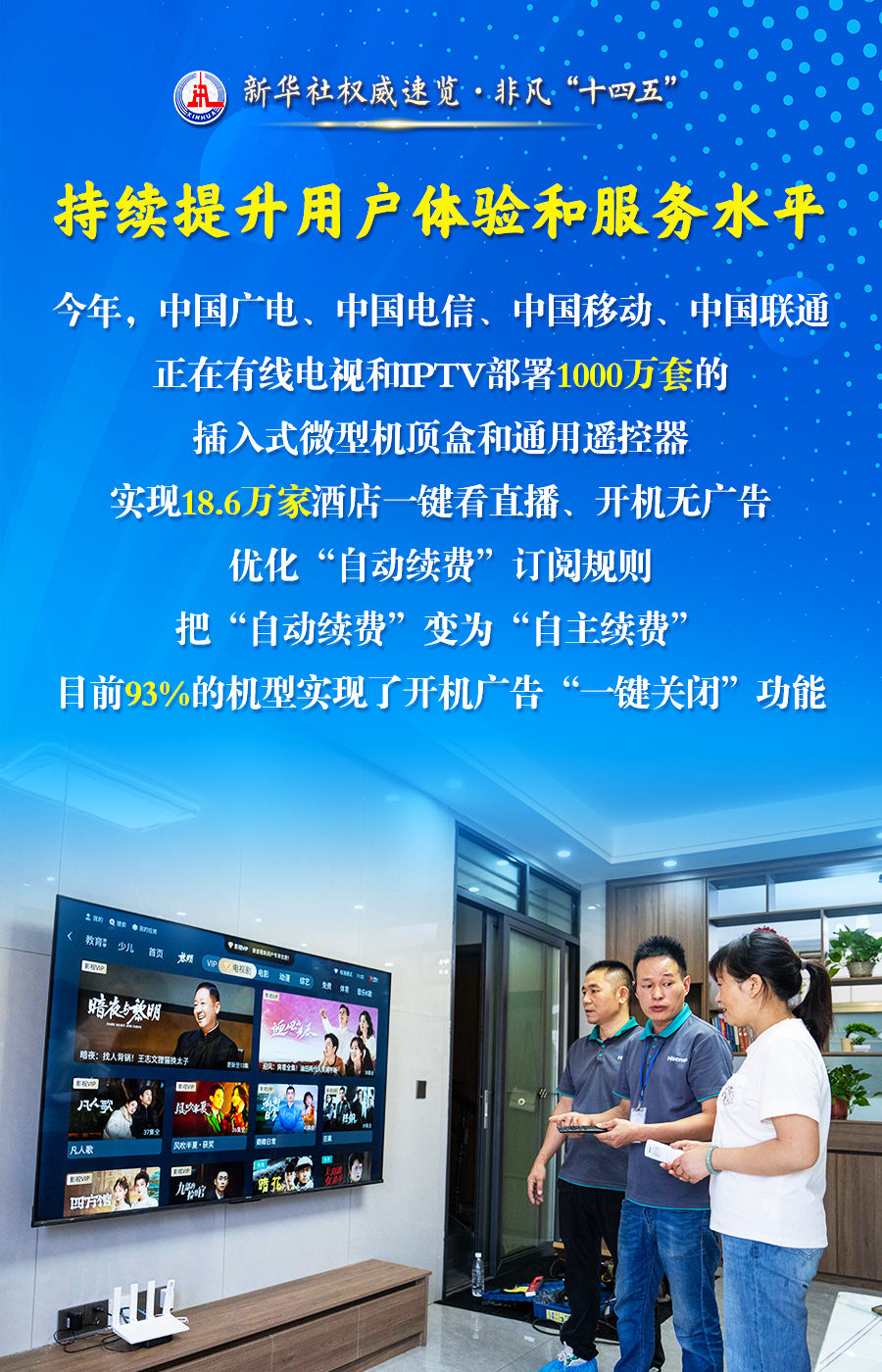
内容创作持续繁荣 我国已建成广播电视和网络视听大国
Ren Min Ri Bao· 2025-09-25 23:33
Core Viewpoint - The news highlights the significant achievements in the broadcasting and network audio-visual industry during the "14th Five-Year Plan" period, emphasizing China's emergence as a major player in this sector, both in terms of user base and content production [1] Group 1: Governance and User Experience - The "dual governance" initiative launched by the National Radio and Television Administration (NRTA) aims to enhance user experience and service quality, with a focus on achieving millions of micro set-top boxes and integrated TVs [2] - The NRTA has implemented measures to address user concerns, such as transforming "automatic renewal" into "self-renewal" and enabling 93% of smart TV models to disable startup ads with a single button [2] Group 2: Content Creation and Quality - The broadcasting and network audio-visual sectors have seen a flourishing of content creation, with a focus on high-quality productions that convey mainstream values and resonate emotionally with audiences [3] - Notable productions include various commemorative works for the 80th anniversary of the victory in the War of Resistance Against Japan, as well as successful series and documentaries that reflect traditional culture and contemporary society [3] Group 3: Regulatory Framework and Industry Environment - The NRTA is committed to creating a healthy and orderly development environment by strengthening policy support and regulatory frameworks, including the revision of key regulations like the "Television Drama Management Measures" [4] Group 4: Ultra-High Definition Development - The promotion of ultra-high definition (UHD) content is a priority, with new UHD channels launched across various provinces and a significant increase in UHD programming on major streaming platforms [5][6] - The total number of UHD set-top boxes for cable TV and IPTV has surpassed 280 million units, with ongoing efforts to establish standards for mobile UHD displays [6] Group 5: International Outreach and Cultural Exchange - The broadcasting sector has played a crucial role in promoting cultural dialogue and international friendship, with a 40% increase in the export scale of audio-visual programs during the "14th Five-Year Plan" [7] - Chinese audio-visual content has reached over 200 countries, generating significant overseas revenue, with notable successes in international viewership for specific programs [7][8]
非凡“十四五”丨传播党的声音、服务人民群众,广播电视和网络视听行业五年成绩单来了
Xin Hua She· 2025-09-25 23:03
Core Viewpoint - During the "14th Five-Year Plan" period, the broadcasting and television industry in China has achieved significant results in promoting systematic reform and high-quality development, establishing itself as a major player in user base, content, and industry scale in both broadcasting and online audiovisual sectors [1] Group 1: Industry Development - The broadcasting and television industry has focused on innovation and overcoming challenges, leading to substantial growth in user numbers, content quality, and industry scale [1] - The international export scale of audiovisual programs has increased by over 40% during the "14th Five-Year Plan" period, with Chinese audiovisual platforms reaching over 200 countries and regions [7] - The industry has seen a rise in the production of high-quality dramas, documentaries, and animations, with a notable increase in the quality and quantity of "national style" animations [13] Group 2: Technological Advancements - The industry has made significant strides in ultra-high-definition (UHD) content, with new productions of dramas, network dramas, and documentaries achieving basic UHD standards [15] - The total scale of UHD set-top boxes for cable TV and IPTV has exceeded 280 million units, indicating a strong market presence [15] - Key technologies in the UHD audiovisual field have led to the establishment of 3 national standards and 66 industry standards [15] Group 3: Policy and Regulation - The industry is implementing measures to create a better environment for audiovisual creation, encouraging cultural innovation while preventing excessive commercialization and high salaries for actors [5] - By the end of this year, provincial satellite TV stations will fully eliminate false medical advertisements, promoting a "Broadcasting and Television Content Renewal Plan" [17] - Support policies for the micro-short drama sector have been introduced in 14 provinces, addressing public concerns regarding problematic content [20]
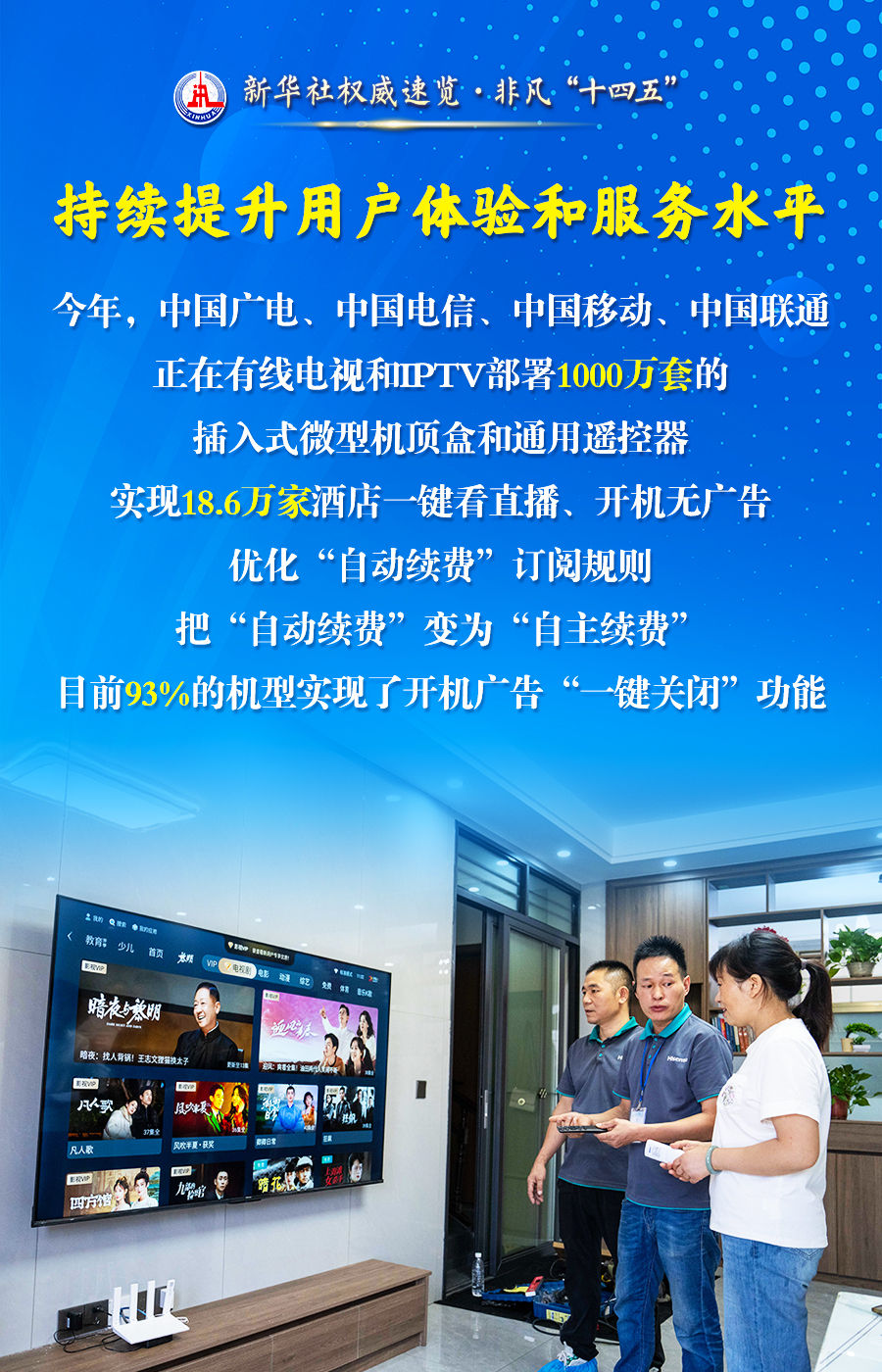
用户体验持续提升 内容创作持续繁荣 我国已建成广播电视和网络视听大国(权威发布·高质量完成“十四五”规划)
Ren Min Ri Bao· 2025-09-25 22:00
Core Viewpoint - The news highlights the significant achievements in the broadcasting and network audio-visual industry during the "14th Five-Year Plan" period, emphasizing China's emergence as a major player in this sector in terms of users, content, and industry scale [1]. Group 1: Governance and User Experience - The National Radio and Television Administration (NRTA) initiated a "dual governance" approach in August 2023, focusing on enhancing user experience and service levels [2]. - Key initiatives include the deployment of millions of micro set-top boxes and integrated TVs, the promotion of a unified remote control for TV viewing, and the expansion of services to various institutions such as hotels and hospitals [2]. - The NRTA has addressed user concerns regarding automatic renewal of subscriptions, shifting to a model of voluntary renewal, and has improved the management of startup advertisements on smart TVs, with 93% of models now allowing users to disable these ads [2]. Group 2: Content Creation and Quality - The broadcasting and network audio-visual sectors have seen a flourishing of content creation, with a focus on producing high-quality works that convey mainstream values and resonate emotionally with audiences [3]. - Notable productions include various commemorative works for the 80th anniversary of the victory in the War of Resistance Against Japan, as well as successful documentaries and animated series that reflect cultural heritage and contemporary themes [3]. - The NRTA is committed to fostering a conducive environment for creative works, aligning with the goals set forth in the 20th National Congress of the Communist Party of China [3][4]. Group 3: Ultra-High Definition Development - The development of ultra-high definition (UHD) broadcasting has been prioritized, with new policies supporting its expansion [5]. - By 2024, new UHD channels are being launched across various provinces, and major streaming platforms are increasing their UHD content offerings, with an expected average of over 40% of new programs being UHD by the end of the year [5]. - The total number of UHD set-top boxes for cable and IPTV has surpassed 280 million, and standards for mobile UHD displays are being established to enhance user experience [6]. Group 4: International Engagement and Cultural Exchange - The broadcasting and network audio-visual sectors are playing a crucial role in promoting cultural dialogue and international friendship, with significant growth in the export of audio-visual content [7]. - The NRTA has facilitated the global dissemination of Chinese programs, with exports increasing by over 40% during the "14th Five-Year Plan" period, and has reached audiences in over 200 countries [7]. - Collaborative initiatives with various countries and regions are being strengthened, including the establishment of forums and partnerships to enhance media cooperation [8].
传播党的声音、服务人民群众 广播电视和网络视听行业五年成绩单来了
Nan Fang Du Shi Bao· 2025-09-25 17:20
Core Viewpoint - During the "14th Five-Year Plan" period, the broadcasting and television industry in China has achieved significant results in promoting systematic reform and high-quality development, establishing itself as a major player in both broadcasting and online audiovisual sectors [1] Group 1: Industry Development - The broadcasting and television industry has focused on innovation and overcoming challenges, leading to a transformation in user engagement, content creation, and industry scale [1] - The international export scale of audiovisual programs has grown by over 40%, with Chinese audiovisual platforms reaching over 200 countries and regions [8] - The industry has seen a rise in the production of high-quality dramas, documentaries, and animations, reflecting cultural heritage and contemporary themes [13] Group 2: Technological Advancements - The shift towards ultra-high-definition (UHD) content has been significant, with over 280 million UHD set-top boxes deployed for cable and IPTV [16] - Key technologies in the UHD audiovisual field have led to the establishment of 3 national standards and 66 industry standards [16] Group 3: Policy and Regulation - The industry is implementing measures to prevent excessive commercialization and to address issues such as high actor salaries and inappropriate content [5][20] - Policies supporting the development of micro-short dramas have been introduced in 14 provinces, addressing public concerns regarding content quality [20] Group 4: Content Creation and Cultural Impact - The industry is encouraging cultural innovation and creativity among artists, providing a broader space for artistic expression [5] - A variety of programs, including dramas and cultural shows, are being produced to resonate with audiences and enhance cultural dialogue [8][13]
【“十四五”高质量发展答卷】广播电视和网络视听行业取得长足发展
Yang Shi Wang· 2025-09-25 17:07
Core Insights - The press conference held by the State Council Information Office on September 25 highlighted the achievements in the broadcasting, television, and online audio-visual industry during the "14th Five-Year Plan" period, emphasizing innovation and development [1] Industry Developments - The broadcasting and online audio-visual industry in China has made significant progress, focusing on maintaining integrity while innovating [1]
你的短剧霸总怕是留不住了!广电总局及时纠偏微短剧雷人剧情、霸总人设 分类分层管理办法也已经在路上
Mei Ri Jing Ji Xin Wen· 2025-09-25 15:23
Group 1: Achievements in Broadcasting and Network Audiovisual Development - China has become a major player in broadcasting and network audiovisual sectors, with over 1 billion users across various platforms including cable TV, IPTV, and internet TV, and 1.09 billion network audiovisual users [1] - Since the beginning of the 14th Five-Year Plan, over 1,500 TV dramas, more than 3,500 animated films, and over 350,000 hours of documentaries have been produced [1] - The total revenue of the broadcasting and audiovisual service industry is projected to reach 1.49 trillion yuan in 2024, marking a 61.96% increase from the end of the 13th Five-Year Plan [1] Group 2: Development Direction of Micro Short Dramas - The micro short drama sector is experiencing rapid growth, with user numbers reaching 696 million by July this year, and the market size expected to exceed 50 billion yuan [2] - The industry is focusing on three main directions: promoting high-quality content, encouraging public participation in creation, and expanding international exchanges [5] - A "Micro Short Drama+" action plan has been implemented to diversify themes and enhance the quality of micro short dramas [2] Group 3: Regulatory and Management Measures - The National Radio and Television Administration is establishing a classification and tiered management system for micro short dramas to ensure orderly development [2] - Ongoing efforts include addressing public concerns regarding problematic content and implementing a regulatory framework to support the healthy growth of the industry [3][5] - Measures to improve user experience include deploying 10 million micro set-top boxes and simplifying remote control operations across various platforms [6][7]
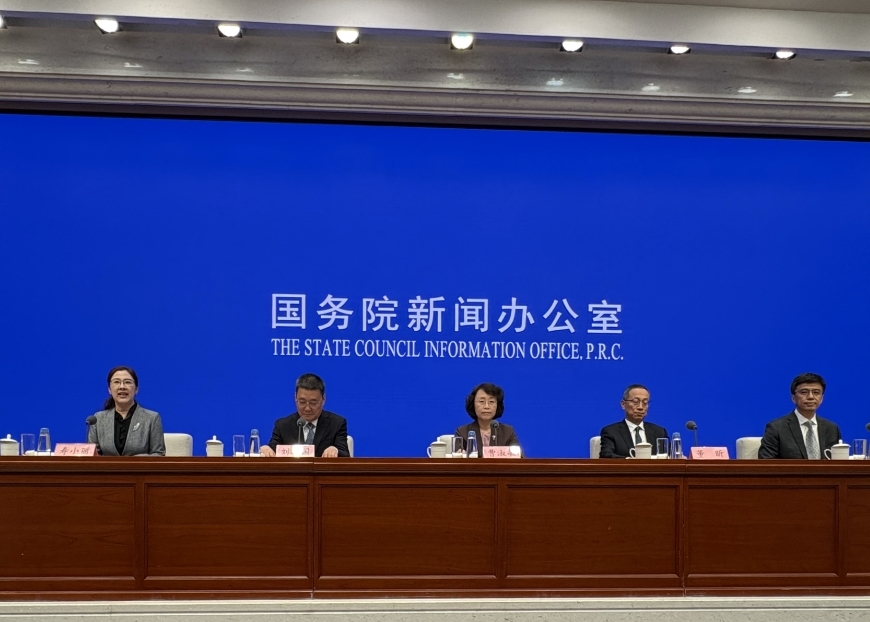
高质量完成“十四五”规划|推动广播电视和网络视听高质量发展——国新办发布会聚焦“十四五”时期广播电视和网络视听行业发展成效
Xin Hua She· 2025-09-25 15:17
Core Viewpoint - The development of broadcasting, television, and online audio-visual services is crucial for building a culturally strong nation, with significant achievements reported during the "14th Five-Year Plan" period [1] Group 1: Content Creation and Industry Growth - The total number of users for various television platforms exceeds 1 billion, with online audio-visual users reaching 1.09 billion; over 1,500 TV dramas, 3,500 animated films, and 350,000 hours of documentaries have been produced since the start of the "14th Five-Year Plan" [2] - The broadcasting and audio-visual industry has become a major player in terms of user base, content, and industry scale, marking China as a broadcasting and online audio-visual powerhouse [2] Group 2: Cultural and Artistic Contributions - A significant number of impactful audio-visual works have been produced, reinforcing mainstream ideological discourse and showcasing cultural heritage; series like "Our Rivers and Mountains" and "Return to Team" highlight the spirit of resistance [3] - The rise of micro-short dramas has emerged as a new form of popular art, supported by initiatives from the National Radio and Television Administration to enhance their integration into various sectors [3] Group 3: Service Improvement for Users - The National Radio and Television Administration has initiated reforms to address user concerns regarding complex billing and service issues, leading to the elimination of startup advertisements on set-top boxes and a reduction in bundled charges [4] - Enhanced user experience is being prioritized, with features like one-click ad cancellation and the transition from automatic to manual subscription renewals being implemented [4] Group 4: Technological Advancements - The trend towards ultra-high-definition (UHD) content is being embraced, with new productions in UHD and an expansion of UHD programming across various platforms [5] - AI technology is being widely adopted across 97% of provincial television stations, enhancing content creation and distribution processes [6] Group 5: International Outreach and Influence - The export scale of broadcasting and audio-visual services has grown by over 40%, with Chinese programs gaining popularity in more than 200 countries and regions [7] - Continuous efforts will be made to strengthen international cooperation and promote Chinese stories through rich content and advanced technology [7]
新华社权威速览·非凡“十四五” | 传播党的声音、服务人民群众,广播电视和网络视听行业五年成绩单来了
Xin Hua She· 2025-09-25 13:41
Group 1 - The broadcasting and television industry in China has achieved significant results during the "14th Five-Year Plan" period, becoming a major player in user base, content, and industry scale [1] - The industry is focusing on systematic transformation and high-quality development, emphasizing innovation and overcoming challenges [1] Group 2 - The government encourages cultural innovation and creativity within the industry, aiming to provide a broader space for artistic creation while preventing excessive commercialization and high salaries for actors [5] - The number of high-quality programs exported to over 100 countries and regions has increased, with service export scale growing by over 40% [8] Group 3 - A variety of high-quality dramas, documentaries, and animations have been produced, reflecting cultural heritage and contemporary themes [13] - The industry has seen a significant shift towards ultra-high-definition content, with over 280 million ultra-high-definition set-top boxes in use [16] Group 4 - The industry is implementing a "Broadcasting and Television Content Renewal Plan" to enhance news media and leverage the advantages of multi-screen integration [18] - By July of this year, the user base for micro-short dramas reached approximately 6.961 million, with 14 provinces implementing supportive policies for their development [20]