酒类零售

Search documents
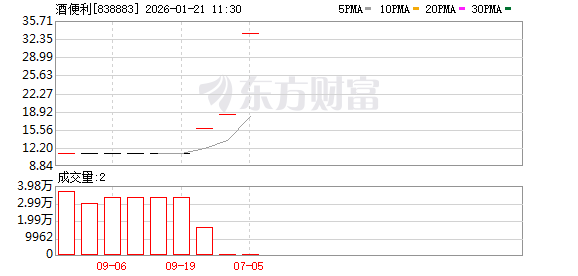
酒便利正式迎来新东家 创东方肖水龙成实控人
2 1 Shi Ji Jing Ji Bao Dao· 2026-01-21 04:45
Group 1 - The core point of the article is that the actual controller of Jiu Bian Li has changed due to the judicial auction of shares held by its former controlling shareholder, Henan Qiaohua Commercial Management Co., Ltd, which has been transferred to Chuang Dongfang Huake Equity Investment Partnership [2][3] - Chuang Dongfang Huake has officially become the controlling shareholder of Jiu Bian Li, holding a 51% stake [3] - The shares were auctioned for 68.4 million yuan, which is slightly over 70% of the assessed value [6] Group 2 - The new actual controller, Xiao Shui Long, is the founder of Chuang Dongfang Investment and has a background in investment management [7][8] - Chuang Dongfang Investment has been involved in the liquor business for several years, with brands such as Jiu Kuai Dao and Jiu Zhou Cheng [10] - Jiu Bian Li, established in 2010, reported its best performance in 2023 with annual revenue of 1.745 billion yuan and operates 228 stores [11][12] Group 3 - The revenue structure of Jiu Bian Li and Jiu Kuai Dao differs significantly, with Jiu Bian Li primarily generating income from direct sales to consumers, while Jiu Kuai Dao focuses on e-commerce distribution [13] - The acquisition report indicates that there is minimal revenue overlap between the two companies, with Jiu Bian Li's income primarily from offline sales [13] - Future business integration between the companies remains uncertain, but commitments have been made to avoid substantial competition between them [14]

华致酒行启动“优选供应链战略”
Zhong Guo Jing Ying Bao· 2026-01-14 12:41
Core Insights - The core focus of the news is the launch of the "Hua Zhi Selected Supply Chain Strategy" by Hua Zhi Wine, emphasizing quality and competitive pricing in the wine market [1][2]. Group 1: Strategic Initiatives - Hua Zhi Wine held a launch event for its "Hua Zhi Selected" supply chain strategy, which includes the establishment of the "Hua Zhi Selected Expert Committee" [1]. - The expert committee conducted a four-hour selection process for over fifty wine samples across four major flavor types, aiming to define and verify product quality [1]. - The strategy is positioned as a "new retail chain brand + supply chain service platform," focusing on superior quality-to-price ratio and leveraging existing systems for authenticity and brand development [1]. Group 2: Market Positioning - The "superior quality-to-price ratio" is a key selling point, aiming to offer better quality at the same price and more competitive pricing at the same quality level [1]. - The company plans to collaborate with famous wine manufacturers for cultural and creative co-branding, expanding product categories and introducing authoritative testing and public evaluations [2]. - The emphasis on a user-first approach and long-term consumer satisfaction is highlighted as a core value of the company [1].

华致酒行:截至2026年1月9日股东人数共计16549户
Zheng Quan Ri Bao· 2026-01-13 10:19
Group 1 - The core point of the article is that Huazhi Wine Company reported a total of 16,549 shareholders as of January 9, 2026 [2]
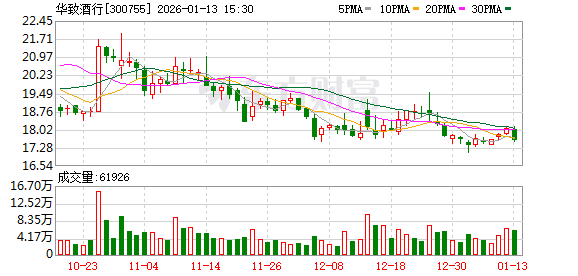
华致酒行跌2.77% 天风证券近2年高位下调评级为增持
Zhong Guo Jing Ji Wang· 2026-01-13 09:33
Core Viewpoint - Huazhi Wine's stock price has experienced fluctuations, with a recent closing price of 17.56 yuan, reflecting a decline of 2.77% [1]. Group 1: Stock Performance - On September 22, 2025, Huazhi Wine's stock price reached a nearly two-year high of 23.85 yuan [2]. - The recent report from Tianfeng Securities downgraded the profit forecast for Huazhi Wine and adjusted its rating to "overweight" [2]. Group 2: Analyst Insights - Tianfeng Securities previously maintained a "buy" rating in their May 28 report, which highlighted the company's short-term performance challenges and potential for profit recovery in 2025 [2].

华致酒行:将探索多元化投资者互动与回馈机制
Sou Hu Cai Jing· 2026-01-06 03:45
Group 1 - The company is closely monitoring the impact of Moutai's 1499i policy on its operations and is prepared to adapt its sales strategies accordingly [1] - The company emphasizes its commitment to authenticity and aims to provide high-quality products and services to consumers [1] - The company is considering exploring diverse investor interaction and feedback mechanisms, including potential discounts for shareholders on product purchases [1]
歪马送酒2025年售出超4.7亿瓶正品酒
Cai Jing Wang· 2025-12-27 08:53
Core Insights - The company, Yima Songjiu, announced that by 2025, its platform will cover over 200 cities nationwide, indicating significant expansion plans [1] - The company expects to sell over 470 million bottles of genuine wine in 2025, showcasing strong sales projections [1] - The number of orders for 15-minute delivery is projected to exceed 36 million, highlighting the company's focus on rapid delivery services [1]
1919已连续三年盈利,预计2025年突破140亿元规模
2 1 Shi Ji Jing Ji Bao Dao· 2025-12-26 05:05
Core Insights - Company 1919 has reported a net profit of 51.35 million yuan in 2023 and 48.12 million yuan in 2024, with 2025 also expected to be profitable, indicating a positive financial trend after three years of no financial disclosures [2] - The overall transaction scale of 1919 has grown from 11.579 billion yuan in 2023 to a projected 12.089 billion yuan in 2024, with a target to exceed 14 billion yuan in 2025, driven by a strategic partnership with Taobao Flash Purchase [2] - The company has undergone a fundamental transformation, moving towards a new development phase that emphasizes both scale and quality, largely due to strategic decisions made by founder Yang Lingjiang [2] Strategic Decisions - In 2023, 1919 decisively abandoned most of its premium liquor distribution rights, initiating a three-year inventory reduction strategy that helped avoid losses from declining liquor prices and significantly reduced financial costs associated with liquor procurement, achieving zero inventory for premium liquor [2] - The company has shifted away from heavy asset investments by reducing the number of directly operated stores and significantly increasing franchise stores, resulting in a decrease in the debt-to-asset ratio from 92% three years ago to below 20% now, leading to healthier financial and operational conditions while maintaining sales growth [3] New Business Model - Recently, 1919's founder Yang Lingjiang acquired a controlling stake of over 73% in the Hong Kong-listed company Yiyuan Wine Industry, which has led to speculation about the company's future direction [4] - The company is reportedly building a "F2B2C" (Factory to Business to Consumer) business model, utilizing the capital platform of Yiyuan Wine Industry to acquire established wineries, creating a matrix of various terminal types on the business side, and leveraging data-driven "instant satisfaction" and "lifestyle" services on the consumer side [4]
加盟商堵门讨债,杨陵江却砸1.4亿买港股酒企!1919在下一盘什么棋?
Xin Lang Cai Jing· 2025-12-26 03:34
Core Viewpoint - The acquisition of 73.63% of Yiyuan Wine Industry by Yang Lingjiang, founder of 1919 Wine Supply, for approximately 1.41 billion RMB (1.56 billion HKD) raises questions about the strategic direction of both companies amid a challenging market environment [3][11][12]. Group 1: Acquisition Details - Yang Lingjiang's acquisition of Yiyuan Wine Industry, known as the "first domestic winery stock," occurs during a period of significant operational challenges for both Yiyuan and 1919 [3][11]. - Yiyuan Wine Industry has faced financial difficulties, reporting losses of 600,000 RMB in 2022 and 41 million RMB in 2024, with a total market value of only 2.12 billion HKD prior to the acquisition [3][12]. - Despite a 151% increase in stock price this year, Yiyuan's stock remains at a low level, indicating potential for growth through strategic integration [3][12]. Group 2: Strategic Rationale - Industry expert Xiao Zhuqing suggests that the acquisition is driven by Yiyuan's asset value, integration potential, and capital operation expectations, despite its operational pressures [4][12]. - Yang's personal acquisition strategy allows for quick transaction execution and the establishment of an independent capital platform, which may help mitigate performance volatility [4][12]. - The acquisition coincides with 1919's ongoing debt issues, as franchisees have raised concerns over unpaid debts, which have been a source of public scrutiny [5][12]. Group 3: Financial Health and Transformation - Yang Lingjiang has publicly stated that 1919 has repaid nearly 6 billion RMB in debt, reducing its debt ratio from 92% to below 20%, with a net asset value of 1 billion RMB [5][13]. - The company is undergoing a significant business model transformation, shifting from traditional retail to an "instant retail + restaurant wine integration" model, which requires substantial upgrades across its 3,000 stores [5][13]. - The transition to a new business model has faced resistance from franchisees, who are concerned about the frequent changes and associated costs [6][15]. Group 4: Future Outlook - Yang has ambitious plans for 1919, aiming to establish it as a leading F2B2C company within five years and the largest global platform in the same category within ten years [7][14]. - The recent acquisition of Yiyuan Wine Industry is seen as a potential step towards simplifying the listing process for 1919, enhancing control and operational efficiency [7][14]. - However, the path to relisting is fraught with challenges, including the current downturn in the wine industry and regulatory hurdles for IPOs in Hong Kong [7][14].

左手“欠款”右手“豪购”!杨陵江收购怡园酒业,1919酒类直供是否重启上市?
Mei Ri Jing Ji Xin Wen· 2025-12-24 13:56
Core Viewpoint - The acquisition of a 73.63% stake in Yiyuan Winery by Yang Lingjiang, founder of 1919 Wine Supply, amidst financial difficulties faced by 1919, indicates a strategic move to leverage Yiyuan's assets and potential for industry consolidation during a challenging period for the wine industry [1][3][12]. Group 1: Acquisition Details - Yang Lingjiang's acquisition of Yiyuan Winery was disclosed on December 15, with an estimated transaction value of approximately 156 million HKD (around 141 million RMB) based on Yiyuan's stock price prior to suspension [2][12]. - Yiyuan Winery, the largest wine producer in Shanxi, has faced significant financial losses in recent years, including losses of 60,000 RMB in 2022 and 4.1 million RMB in 2024 [3][12]. Group 2: Industry Context - The wine industry is currently undergoing a deep adjustment, with companies like Huazhi Wine (A-share listed) also experiencing substantial performance declines [1][3]. - The market for high-end liquor has contracted significantly, prompting a shift in business models towards immediate retail and integrated consumption experiences [9][10]. Group 3: Financial Health and Strategy - Yang Lingjiang has reportedly reduced 1919's debt from 92% to below 20%, claiming the company is in its healthiest state historically, despite ongoing cash flow challenges [6][12]. - The company plans to eliminate 1,500 underperforming franchise stores by the end of the year as part of its transformation strategy [10][12]. Group 4: Future Prospects - There are speculations about the potential for 1919 Wine Supply to relaunch its IPO, with the acquisition of Yiyuan Winery possibly facilitating this process by providing a more favorable capital platform [12][14]. - Yang Lingjiang aims to develop 1919 into a leading F2B2C platform, with ambitious plans for product development and brand management over the next decade [11][12].
左手“欠款”右手“豪购”!杨陵江收购“国内酒庄第一股”
Mei Ri Jing Ji Xin Wen· 2025-12-23 14:36
Core Viewpoint - The founder of 1919, Yang Lingjiang, has acquired 73.63% of Yiyuan Wine Industry, marking a significant move amidst challenges faced by 1919, including debt issues with franchisees and a struggling industry [1][4][6]. Group 1: Acquisition Details - Yang Lingjiang's acquisition of Yiyuan Wine Industry was disclosed on December 15, with an estimated transaction value of approximately 1.56 billion HKD (around 141 million RMB) based on Yiyuan's stock price before suspension [4][6]. - Yiyuan Wine Industry, the first listed winery in China, has faced financial difficulties, reporting losses in recent years, including a loss of 4.1 million RMB in 2024 [6][12]. - The acquisition is seen as a strategic move to leverage Yiyuan's asset value and potential for industry consolidation during a challenging period for the wine sector [6][28]. Group 2: Financial Context - 1919 has been experiencing significant financial strain, with reports of overdue payments to franchisees and a tightening cash flow situation [11][12]. - Yang Lingjiang stated that the company has reduced its debt from 60 billion RMB to a much healthier level, with a debt ratio dropping from 92% to below 20% by year-end [12][28]. - The company aims to resolve outstanding payments to franchisees by December, indicating a proactive approach to address financial concerns [12][19]. Group 3: Industry Challenges and Strategic Shifts - The wine industry is undergoing a deep adjustment, with companies like Huazhi Wine facing severe performance declines [1][6]. - Yang Lingjiang's strategy includes a shift towards a new business model focusing on instant retail and a multi-layered commercial approach, moving away from traditional sales methods [19][22]. - The company plans to eliminate 1,500 underperforming franchise stores by year-end as part of its transformation strategy [19][28]. Group 4: Future Prospects and Listing Plans - There are speculations about 1919 potentially restarting its listing process, with Yang Lingjiang's acquisition of Yiyuan seen as a step towards facilitating this [28][29]. - The acquisition may provide a more favorable platform for capital operations, simplifying the listing process and enhancing control [28][29]. - However, challenges remain, including the need for improved business health and compliance with regulatory requirements for a potential IPO [28][29].