
Communications

Search documents
Bandwidth (BAND) Q4 Earnings: How Key Metrics Compare to Wall Street Estimates
ZACKS· 2026-02-19 16:30
Core Viewpoint - Bandwidth (BAND) reported a slight decline in revenue and earnings per share (EPS) for the quarter ended December 2025, indicating potential challenges in maintaining growth despite meeting some analyst expectations [1][2]. Financial Performance - Revenue for the quarter was $207.67 million, a year-over-year decline of 1.1%, compared to the Zacks Consensus Estimate of $207.17 million, resulting in a surprise of +0.24% [1]. - EPS for the same period was $0.35, down from $0.37 a year ago, with an EPS surprise of -0.71% against the consensus estimate of $0.35 [1]. Key Metrics - Geographic Revenue- International reached $27.78 million, slightly below the two-analyst average estimate of $27.9 million, but showed a year-over-year increase of +23.6% [4]. - Geographic Revenue- North America was $179.88 million, exceeding the two-analyst average estimate of $178.81 million, but reflecting a year-over-year decline of -4.1% [4]. - Revenue from Messaging surcharges was $57.41 million, surpassing the average estimate of $56.83 million, but down -12.9% year over year [4]. - Revenue from Cloud communications was $150.26 million, slightly below the average estimate of $150.36 million, with a year-over-year increase of +4.3% [4]. Stock Performance - Bandwidth shares have returned -4.6% over the past month, underperforming the Zacks S&P 500 composite, which changed by -0.8% [3]. - The stock currently holds a Zacks Rank 4 (Sell), suggesting potential underperformance in the near term [3].



Bandwidth(BAND) - 2025 Q4 - Earnings Call Transcript
2026-02-19 14:02
Financial Data and Key Metrics Changes - In Q4 2025, total revenue increased by 12% year-over-year on an organic basis, excluding cyclical revenue from political campaign messaging [15][16] - For the full year 2025, total revenue reached $754 million, up 10% organically year-over-year, with a non-GAAP gross margin of 58% and adjusted EBITDA of $93 million [16][19] - Free cash flow for 2025 was $57 million, significantly exceeding the cumulative target of $125 million set for 2026 [7][19] Business Line Data and Key Metrics Changes - Voice segment achieved 11% year-over-year growth driven by increased usage and adoption of voice-based AI applications [15][16] - Messaging segment saw an organic growth of 12% year-over-year, primarily due to robust holiday messaging demand [15][16] - The enterprise voice customer category grew by 21% in 2025, supported by a record number of million-dollar-plus deals [16][17] Market Data and Key Metrics Changes - The company noted strong demand across both voice and messaging markets, with healthy execution contributing to confidence in future growth [8][18] - The political campaign contribution to revenue is expected to be approximately 2.5% of cloud communications revenue for 2026, with monitoring ongoing [32][34] Company Strategy and Development Direction - The company is focused on high-margin innovation, particularly in AI voice tools and orchestration software, which are seen as critical for future growth [6][9] - A share repurchase program of up to $80 million was authorized, reflecting confidence in the business model and cash generation capabilities [8][24] - The company aims for a 15%-20% revenue compound annual growth rate through 2026, with specific targets for gross margin, EBITDA margin, and free cash flow [7][19] Management's Comments on Operating Environment and Future Outlook - Management expressed confidence in the upward trajectory of the business, despite market dynamics potentially impacting revenue growth [6][7] - The company anticipates continued growth in voice driven by AI applications and large deal activity, projecting a total revenue growth of approximately 16% year-over-year for 2026 [18][19] - Management highlighted the importance of customer relationships and the durability of the business model, with a customer retention rate above 99% [20][21] Other Important Information - The number of third-party conversational AI developers building on the company's platform has quadrupled over the past six months, indicating strong momentum [13] - The company is positioned at the intersection of enterprise communications and AI, with a robust infrastructure to support future innovations [14][26] Q&A Session Summary Question: Insights on Enterprise Voice segment growth - Management acknowledged a slight tick down in Q4 growth rates but expressed optimism for continued healthy growth in 2026 driven by large deals [30] Question: Political contribution to revenue - Management indicated that political campaign contributions are expected to be around 2.5% of cloud communications revenue for 2026, with ongoing monitoring [32][34] Question: Dynamics between cloud communication growth and total revenue growth - Management explained the difference is due to carrier messaging surcharges, which are expected to increase due to recent price hikes from carriers [38][43] Question: Competitive landscape with Twilio - Management noted that recent customer wins were not influenced by Twilio, highlighting competitive advantages over other carriers [46][47] Question: Details on the insurance example and Google AI integration - Management elaborated on the integration of Google AI within a complex Cisco environment, emphasizing the value of their orchestration platform [51] Question: AI's impact on the business and competitive moats - Management described AI as a significant tailwind for the business, with strong infrastructure and customer relationships serving as competitive advantages [53][54] Question: Pipeline for voice AI and its revenue impact - Management indicated that 2026 is expected to be a pivotal year for AI adoption in voice, with significant revenue implications [58][59] Question: Composition of million-dollar-plus deals - Management confirmed that the number of million-dollar-plus deals in 2025 exceeded previous years, driven by an expanded product portfolio and customer demand for AI integration [60][61]
Bandwidth(BAND) - 2025 Q4 - Earnings Call Transcript
2026-02-19 14:02
Bandwidth (NasdaqGS:BAND) Q4 2025 Earnings call February 19, 2026 08:00 AM ET Company ParticipantsArjun Bhatia - Co-Group Head for Technology, Media, and CommunicationsDaryl Raiford - CFODavid Morken - Chairman and CEOJohn Bell - Chief Product OfficerPatrick Walravens - Managing Director and Director of Technology ResearchSarah Walas - VP of Investor RelationsConference Call ParticipantsErik Suppiger - Senior Research AnalystJoshua Reilly - Senior Research AnalystOperatorGood day, and welcome to the Bandwid ...
Bandwidth(BAND) - 2025 Q4 - Earnings Call Transcript
2026-02-19 14:00
Bandwidth (NasdaqGS:BAND) Q4 2025 Earnings call February 19, 2026 08:00 AM ET Speaker6Good day, and welcome to the Bandwidth Inc. fourth quarter and full year 2025 earnings conference call. All participants will be in listen-only mode. Should you need assistance, please signal a conference specialist by pressing the star key followed by 0. After today's presentation, there will be an opportunity to ask questions. To ask a question, you may press star then 1 on your telephone keypad, and to withdraw your que ...
(新春见闻)拓新、驰骋、交流:北京高校台生的马年关键词
Xin Lang Cai Jing· 2026-02-18 02:51
中新社北京2月18日电 题:拓新、驰骋、交流:北京高校台生的马年关键词 作者 李百加 凭借优质高教资源、前沿科研平台和多元发展机遇,大陆正成为越来越多的台湾青年求学、逐梦、扎根 的目的地。在北京知名高校就学的多位台湾学子近日接受中新社采访,分享他们感受到的大陆发展脉 动,以及对自己在农历丙午马年的学业和生活期许。 拓新:在人工智能浪潮中领跑 在近年的人工智能发展中,通义千问、DeepSeek等人工智能大模型稳步领跑。来自台湾桃园市的赖瀚 宇并不意外,在高中时他便看好大陆在这一领域集聚的潜力与动能。由此,赖瀚宇选择到北京清华大学 深造,最初就读于电子信息类专业,后来转入计算机科学与技术系,一路攻读至博士三年级。2025年, 他所参与的团队在开源模型方向取得阶段性成果,相关应用引发业内一定的关注。 赖瀚宇认为,大陆人工智能将在底层模型和关键技术层面迎来更多突破,其开源生态也将加速产业自我 迭代,成为赋能各行业的重要力量。 "不少在台湾发展的同龄人对于来大陆深造和就业抱有期待。"陈光说,清晰的发展导向、产学研协同机 制及政策层面的支持,可为青年科研人员提供稳定、可预期的成长环境。 2026年,他期盼继续在专业领域" ...
The Smartest Vanguard ETF to Buy With $2,000 Right Now
Yahoo Finance· 2026-02-17 19:06
The technology sector has been a great place to put your money over the past few years, as artificial intelligence (AI) and other tech stocks mostly soared. But AI is disrupting so many industries that old tech stalwarts, which once seemed impervious to competition, are being disrupted. That can make picking individual tech-stock winners difficult and is why putting your money into a technology exchange-traded fund (ETF) may be a smart move. Doing so allows you to spread your money across many tech stocks ...
USA TODAY Co. Schedules Fourth Quarter 2025 Results
Businesswire· 2026-02-12 12:30
USA TODAY Co. Schedules Fourth Quarter 2025 ResultsFeb 12, 2026 7:30 AM Eastern Standard Time# USA TODAY Co. Schedules Fourth Quarter 2025 ResultsShare---New York, NY--([BUSINESS WIRE])--USA TODAY Co., Inc. ("USA TODAY Co.†, "we†, "our†, or the "Company†) (NYSE: TDAY) announced today that it will release its fourth quarter 2025 financial results on Thursday, February 26, 2026, prior to the opening of the New York Stock Exchange. Management will host a conference call on Thursday, February 26, 2026 a ...

AI产业链方向早盘活跃,关注人工智能ETF易方达(159819)、科创创业人工智能ETF易方达(159140)等产品投资价值
Sou Hu Cai Jing· 2026-02-12 04:58
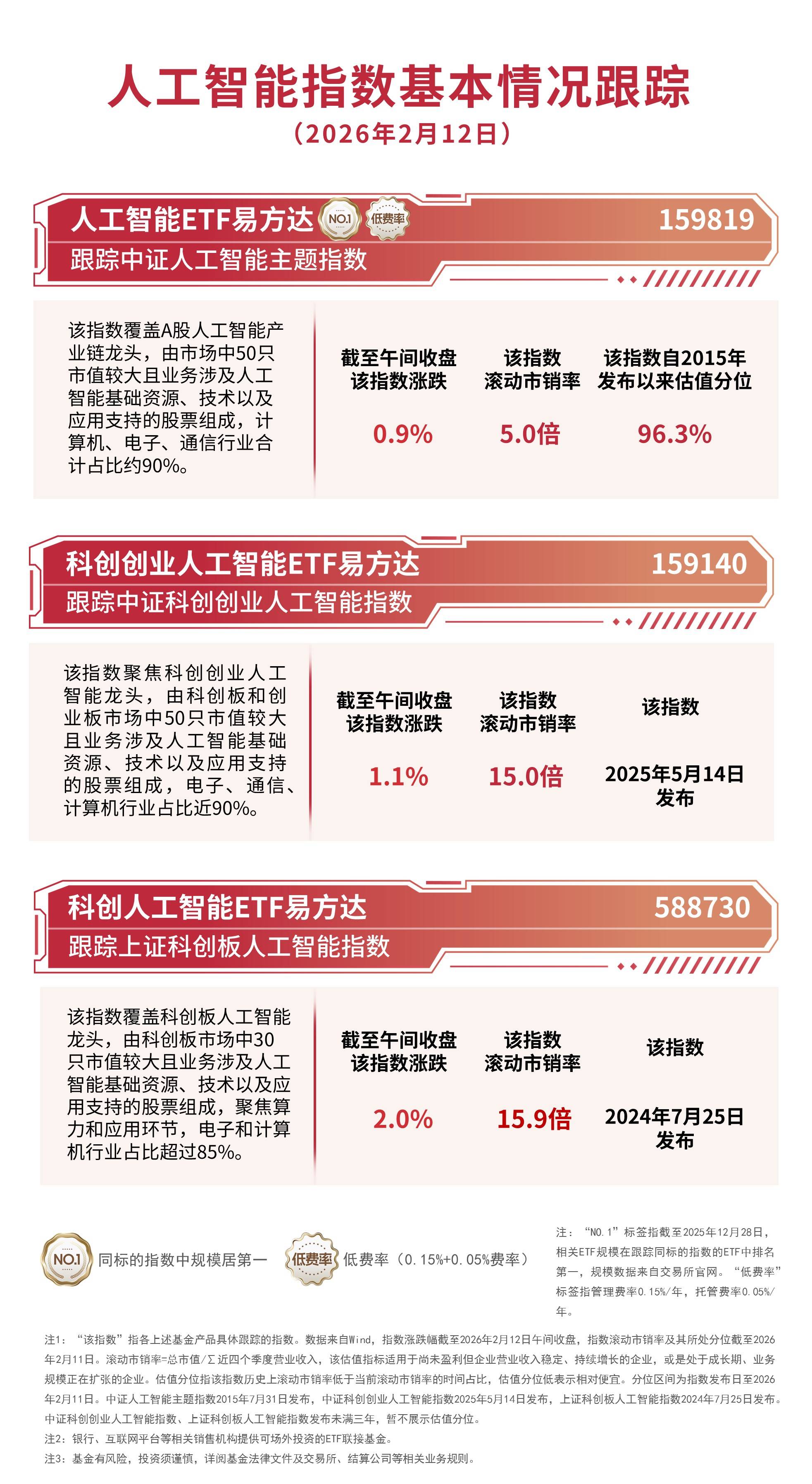
Group 1 - The AI industry chain is experiencing a collective surge, with significant activity in AI hardware sectors such as CPO and chips, leading to an increase in relevant indices [1] - The Shanghai Stock Exchange's Sci-Tech Innovation Board Artificial Intelligence Index rose by 2.0%, while the CSI Innovation and Entrepreneurship Artificial Intelligence Index increased by 1.1%, and the CSI Artificial Intelligence Theme Index went up by 0.9% [1] - The E Fund Artificial Intelligence ETF (159819) saw a net subscription of 16 million units during the morning session [1] Group 2 - The indices focus on leading companies in the AI sector, comprising 50 stocks with large market capitalizations involved in AI foundational resources, technology, and application support, with nearly 90% representation from the electronics, communications, and computer industries [3] - The E Fund Artificial Intelligence ETF tracks the Shanghai Stock Exchange Sci-Tech Innovation Board Artificial Intelligence Index, which includes 30 large-cap stocks in the AI sector, focusing on computing power and application segments, with over 85% representation from electronics and computer industries [3]

多款国产大模型将重磅落地,光模块、CPO等算力硬件股回调,通信ETF华夏(515050)跌超1.5%
Xin Lang Cai Jing· 2026-02-11 05:40
Group 1 - The AI industry chain is experiencing a divergence, with hardware like optical modules seeing a pullback, while sectors like computing rental and cloud computing are performing well [1] - Notable stocks such as Huace Film & TV have dropped over 10%, while others like Zhongji Xuchuang and New Yisheng are also adjusting [1] - The AI sector's short-term adjustment presents a cost-effective investment opportunity, with several significant domestic AI products expected to launch during the Spring Festival [1] Group 2 - Nomura Securities emphasizes the importance of software companies that can leverage next-generation large model capabilities to create disruptive AI-native applications, potentially raising their growth ceilings [2] - Major global cloud service providers are aggressively pursuing general artificial intelligence, but developers of large models and applications are facing increasing capital expenditure burdens [2] - If DeepSeek V4 can significantly reduce training and inference costs while maintaining high performance, it may help these players convert technology into revenue more quickly, alleviating profit pressures [2] Group 3 - The Huaxia Communication ETF (515050) focuses on electronic and communication hardware, with top holdings including Zhongji Xuchuang and New Yisheng [2] - The Huaxia Growth AI ETF (159381) tracks an index with nearly 50% weight in CPO, covering domestic software and AI application companies, providing high elasticity [2] - The Huaxia Cloud Computing ETF (516630) emphasizes domestic AI software and hardware, with a combined weight of 83.7% in computer software, cloud services, and computer equipment [3]


未知机构:东财策略每日复盘20260209一市场概况2月9日A股震荡-20260210
未知机构· 2026-02-10 02:05
Summary of Conference Call Notes Industry Overview - The A-share market experienced a strong upward trend on February 9, with all three major indices rising collectively. The Shanghai Composite Index increased by 1.41% to close at 4123 points, the Shenzhen Component Index rose by 2.17%, and the ChiNext Index climbed by 2.98%. The total trading volume reached 2.25 trillion yuan, an increase of over 100 billion yuan compared to the previous trading day. A total of 4612 stocks rose while 759 stocks fell [1][2]. Key Industry Performance - All primary industries under the Shenwan classification saw gains, with the top five performing sectors being: - Communication: +5.17% - Comprehensive: +4.70% - Media: +3.50% - Electronics: +2.97% - Computer: +2.88% - Sectors with relatively lower gains included: - Oil and Petrochemicals: +0.21% - Banking: +0.36% - Food and Beverage: +0.37% - Agriculture, Forestry, Animal Husbandry, and Fishery: +0.42% - Home Appliances: +0.47% [2]. Notable Market News 1. ByteDance launched the Seedance 2.0 video generation model on its Dream platform, featuring a series of technological innovations such as multi-modal reference, generation, and editing integration, which is described as a "revolution in AI video creation efficiency" [2]. 2. The first mass-produced version of the Platinum Smart 4X Robotaxi has officially rolled off the production line, marking a new phase in the strategic cooperation between Pony.ai and Toyota China, as well as GAC Toyota, moving into large-scale production and operation [2]. 3. Elon Musk stated that SpaceX has shifted its focus to building a "self-expanding city" on the Moon, which he expects to achieve within 10 years, while Mars colonization may take over 20 years [2]. Market Outlook - Following a broad-based increase in trading volume, the market is likely to enter a phase of high-level turnover and rotation of hot sectors. There is anticipation for a "spring red envelope" market, with applications of AI video models potentially boosting risk appetite. However, the sustainability of this trend will depend on whether commercialization leads can keep pace [2][3].