
Brokerage

Search documents
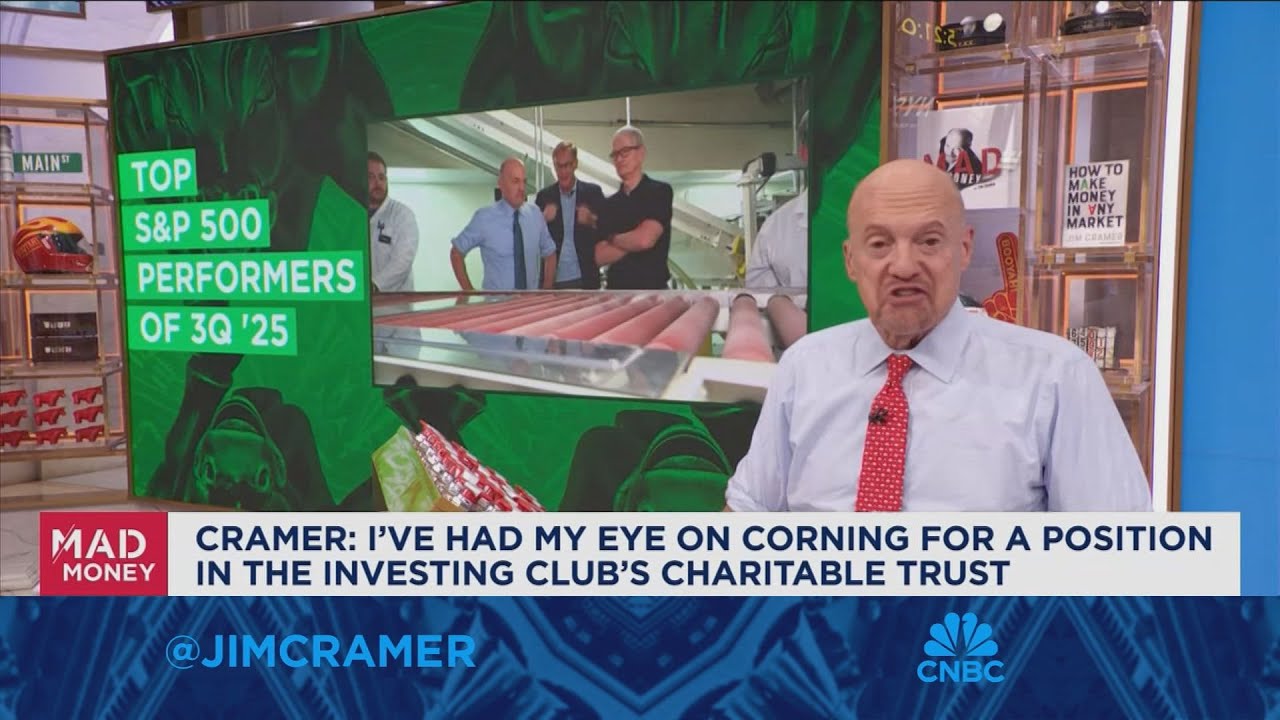
Embrace the tape Q3 winners can still rally, says Jim Cramer
Youtube· 2025-10-01 23:57
Core Viewpoint - The third quarter's stock performance reveals significant winners and losers, with a focus on the implications of the government shutdown being less impactful on stock performance than initially thought [2][4]. Group 1: Third Quarter Winners - Apploven emerged as the best-performing S&P 500 stock, rallying 105% in the third quarter, driven by its mobile technology services for app developers [5][6]. - Western Digital and Seagate Technologies also performed well, with Western Digital up nearly 88% and Seagate up almost 64%, benefiting from the market's demand for data storage solutions [7][8]. - Warner Brothers Discovery saw a resurgence with a 70% increase, attributed to an improved balance sheet and potential takeover discussions [9][10]. - Corning, known for its glass products, rallied 56% due to its fiber optic glass technology, which is crucial for data centers [12][13]. - Teradyne, a semiconductor test equipment manufacturer, increased by 53% for the quarter, showcasing its strong market position [14]. - Robinhood, appealing to younger investors, rose 53% as it integrated cryptocurrency into its offerings [17][18]. - Intel's stock appreciated nearly 50% under new leadership, focusing on balance sheet improvements and strategic partnerships [19]. - Invesco, a money management firm, saw a 45% increase, reflecting the overall positive market conditions [20][21]. Group 2: Third Quarter Losers - Chipotle was identified as a potential comeback candidate despite a 30% decline, as the company has a history of recovery after management adjustments [22]. - Other notable losers included managed care, cable, used cars, and Invisalign braces, which are viewed as less likely to rebound in the near term [23]. Group 3: Market Outlook - The overall sentiment suggests that the winners from the third quarter are likely to continue performing well through the end of the year, although the most significant gains may have already been realized [24].


Trends & Trades
Fidelity Investments· 2025-10-01 15:50
Fidelity Brokerage Services LLC, Member NYSE, SIPC, 900 Salem Street, Smithfield, RI 02917 ...

New Fixed Income Dashboard & Bond Ladder
Fidelity Investments· 2025-10-01 14:45
Company Information - Fidelity Brokerage Services LLC is a member of NYSE and SIPC [1] - The company's address is 900 Salem Street, Smithfield, RI 02917 [1]

Trends & Trades
Fidelity Investments· 2025-10-01 13:39
Fidelity Brokerage Services LLC, Member NYSE, SIPC, 900 Salem Street, Smithfield, RI 02917 ...

SEC plan for blockchain-based stocks pits Coinbase and Robinhood against Wall Street giants
Yahoo Finance· 2025-09-30 20:26
Core Viewpoint - The SEC is reportedly advancing a plan to allow companies to offer stock trading on blockchain, which could benefit firms like Coinbase and Robinhood while raising concerns among major financial companies like Citadel Securities [1][2]. Group 1: SEC's Plan and Implications - The SEC's initiative aims to provide exemptive relief for blockchain-based stock trading, meaning some existing stock trading rules may not apply, although the specifics of the exemption remain unclear [2]. - This plan would enable investors to use platforms like Coinbase and Robinhood to purchase tokenized versions of popular stocks, integrating them with traditional cryptocurrencies [2]. Group 2: Current Market Landscape - Tokenized stocks are not entirely new, as Robinhood and Kraken have already been offering them in international markets, particularly in regions like South Africa where they provide access to U.S. equities with lower brokerage fees [3]. - The mechanics of tokenized stock ownership differ from traditional stocks, as they involve a brokerage creating a token on a blockchain that represents a claim on the underlying share [4]. Group 3: Advantages of Tokenization - Proponents argue that tokenizing stocks can lead to faster trade settlements, addressing issues that have caused market disruptions during high trading volumes, as highlighted by Robinhood's CEO during the COVID-era trading surge [5].
Rosenblatt Initiates Coverage of Webull (BULL) Stock With a Buy Rating
Yahoo Finance· 2025-09-30 19:29
Core Viewpoint - Webull Corporation (NASDAQ:BULL) is recognized as a promising investment opportunity, particularly following the initiation of coverage by Rosenblatt with a "Buy" rating and a price target of $19, highlighting its growth in the retail trading sector [1][2] Group 1: Company Performance - Webull's total revenues for Q2 2025 increased by 46% year-over-year, reaching $131.5 million, with trading-related revenue rising by 63% year-over-year [2] - The company has transitioned from a niche market data platform to the second-largest mobile-first brokerage in the U.S., capitalizing on the growth of retail trading [1] Group 2: Product and Market Strategy - Webull is focused on delivering new products tailored for sophisticated retail traders, including the recent re-launch of its crypto offerings and ongoing global expansion [2] - The firm positions itself as a primary beneficiary of the rising demand for an all-in-one trading platform among self-directed traders [2] Group 3: Market Position - Webull's app and integrated desktop platform have gained traction as preferred solutions in both the U.S. and international markets [1]
Robinhood Markets Inc (NASDAQ: HOOD) Sees Price Target Increase and Record Highs
Financial Modeling Prep· 2025-09-30 18:05
John Todaro from Needham sets a new price target for Robinhood at $145, indicating a bullish outlook.Robinhood's shares surge by more than 10% following its expansion into prediction markets and private-banking style services.The stock is on track to reach a record closing high, trading at $138.49 with a market capitalization of approximately $123.07 billion.Robinhood Markets Inc (NASDAQ: HOOD) is a financial services company known for its commission-free trading platform. It has gained popularity among ret ...


Robinhood Explores Launching Prediction Markets Outside US
Yahoo Finance· 2025-09-30 16:00
Core Insights - Robinhood Markets Inc. is planning to expand its prediction markets product internationally, aiming to tap into the growing demand for such services outside the US [1][4] - The company is in discussions with overseas regulators, including the UK's Financial Conduct Authority, to understand the regulatory landscape for offering prediction markets in those regions [2][3] - The rise in popularity of prediction markets, particularly during the 2024 US presidential election, has blurred the lines between financial markets and gambling, presenting both opportunities and regulatory challenges for Robinhood [5][6] Regulatory Considerations - The structure and regulation of prediction markets differ significantly between the US and other countries, with these products classified as futures in the US but often viewed as gambling elsewhere [2][7] - Robinhood is focused on ensuring that its prediction market offerings are compliant with local regulations as it seeks to expand globally [7] Market Demand - There is increasing customer interest in prediction markets in the UK and Europe, indicating a potential growth area for Robinhood's services [4] - The company's primary business remains centered on equities and cryptocurrency trading, but the expansion into prediction markets represents a strategic diversification [4][5]
US Stock Market Navigates Premarket Dips Amid Shutdown Fears and Key Economic Data
Stock Market News· 2025-09-30 10:07
Market Overview - The U.S. stock market is expected to open cautiously, with major index futures indicating a slight pullback due to concerns over a potential government shutdown and upcoming economic data releases [1][2] - September has been a positive month for major indexes, with the Nasdaq Composite gaining approximately 5.3%, the S&P 500 advancing around 3.1%, and the Dow Jones Industrial Average rising about 1.7% [3] Premarket Trading and Futures Movements - S&P 500 futures were down approximately 0.18% to 0.2%, Dow Jones Industrial Average futures declined around 0.18% to 0.23%, and Nasdaq 100 futures edged lower by about 0.16% to 0.21% [2] Corporate Earnings and Stock Movements - Nvidia (NVDA) shares rallied over 2% on Monday, settling above the $180 level, and rose 1% in premarket trading [6] - Electronic Arts (EA) surged after reports of a $55 billion going-private leveraged buyout deal, with the stock jumping 15% on Friday and climbing a further 4.5% on Monday [6] - Intel (INTC) shares were down almost 3% on Monday after a significant 20% surge last week [10] - Robinhood Markets (HOOD) saw its shares surge over 12% on Monday, closing at an all-time high [10] - Western Digital (WDC) rose 9.2% and Seagate Technology (STX) added 5.3% after analysts raised price targets due to growing demand for hard drives to support AI [10] - Coinbase Global (COIN) gained 6.8% as major cryptocurrencies moved higher [10] - Lam Research (LRCX) shares rose 3.3% after Deutsche Bank upgraded the company to a "Buy" rating [10] - Novo Nordisk (NVO) dropped 3% after receiving a downgrade to "Underweight" [10] - The energy sector was the worst-performing sector in the S&P 500 on Monday, declining 1.9% [10] Upcoming Economic Data - Key reports to be released include the Job Openings and Labor Turnover Survey (JOLTS) for August, Consumer Confidence Report for September, and Chicago Region's Business Activity Data for September [6] - The JOLTS report is expected to provide insights into labor market health, while the Consumer Confidence Report will reflect household sentiment amidst inflation concerns [6]



瑞银王宗豪:国际投资者总体对中国股票兴趣浓厚
Zheng Quan Shi Bao Wang· 2025-09-30 03:32
Core Insights - International investors show strong interest in Chinese stocks, with an increasing number adopting a more optimistic outlook on the market [1] - Some investors express concerns over recent economic performance, but strong market trends and potential retail inflows suggest they are unlikely to reduce their Chinese positions in the short term [1] - Many investors still view China as a tactical trading opportunity due to weak economic fundamentals, continued underweighting by foreign investors, relatively cheaper valuations compared to global markets, and expectations of further interest rate cuts in the U.S. [1] Investment Themes - "Anti-involution" has emerged as a key discussion topic among investors, with a focus on China's AI/technology development and capital return prospects [1] - UBS's overweight stance on A-shares in the TMT (Technology, Media, and Telecommunications) sector and brokerage firms has garnered significant interest from investors [1]
