玻璃纤维

Search documents
国际复材9月29日获融资买入3137.12万元,融资余额3.52亿元
Xin Lang Cai Jing· 2025-09-30 01:37
Group 1 - The core viewpoint of the news highlights the financial performance and trading activity of Chongqing International Composite Materials Co., Ltd. (International Composite Materials) as of late September 2023, indicating a strong growth trajectory in revenue and profit [1][2]. - As of September 29, 2023, International Composite Materials' stock price increased by 1.45%, with a trading volume of 327 million yuan, and a net financing purchase of 3.06 million yuan [1]. - The company reported a significant year-on-year revenue growth of 19.40% for the first half of 2025, reaching 4.153 billion yuan, and an impressive net profit growth of 341.55%, amounting to 231 million yuan [2]. Group 2 - The financing balance of International Composite Materials reached 352 million yuan, accounting for 3.98% of its market capitalization, indicating a high level of financing activity compared to the past year [1]. - The company has distributed a total of 113 million yuan in dividends since its A-share listing [3]. - As of June 30, 2025, the top ten circulating shareholders include significant institutional investors, with the Southern CSI 1000 ETF increasing its holdings by 4.776 million shares [3].
中国巨石:截至2025年9月24日前十大流通股东持股占比60.1%
Mei Ri Jing Ji Xin Wen· 2025-09-29 09:34
Group 1 - The company announced a share repurchase plan approved by its board on September 24, 2025 [1] - The top ten unrestricted shareholders hold approximately 2.407 billion shares, accounting for 60.1% of the total shares [1] - Major shareholders include China National Building Material Group with about 1.17 billion shares (29.22%) and Zhenhua Holdings Group with approximately 676 million shares (16.88%) [1] Group 2 - For the first half of 2025, the company's revenue composition was as follows: fiberglass yarn and products accounted for 97.41%, other businesses 1.63%, and wind power 0.96% [2] - The current market capitalization of the company is 68.2 billion yuan [2]

2025年7月中国玻璃纤维及其制品进口数量和进口金额分别为0.89万吨和0.9亿美元
Chan Ye Xin Xi Wang· 2025-09-28 03:12
Core Insights - The report by Zhiyan Consulting highlights the current market status and investment prospects of the fiberglass industry in China from 2025 to 2031 [1] Import Data Summary - In July 2025, China's import volume of fiberglass and its products was 0.89 million tons, representing a year-on-year decrease of 11.5% [1] - The import value for the same period was 0.9 million USD, showing a year-on-year increase of 5.9% [1] Company Profile - Zhiyan Consulting is recognized as a leading industry consulting firm in China, specializing in in-depth industry research reports, business plans, feasibility studies, and customized services [1] - The company has over a decade of experience in the industry research field, providing comprehensive industry solutions to empower investment decisions [1]


宏和科技拟募资9.95亿元投向玻纤纱产线等项目,回应上交所审核问询
Xin Lang Cai Jing· 2025-09-26 13:00
Core Viewpoint - Honghe Technology is responding to the Shanghai Stock Exchange's inquiry regarding its application for a specific stock issuance, providing detailed explanations on fundraising projects, operational conditions, and financial investments [1] Fundraising and Investment Projects - Honghe Technology plans to raise a total of no more than 999.46 million yuan, which will be allocated to three major projects: "High-Performance Glass Fiber Yarn Production Line Construction Project," "High-Performance Special Glass Fiber R&D Center Construction Project," and "Supplementing Working Capital and Repaying Loans" [2] - The investment breakdown includes 720 million yuan for the glass fiber yarn production line, with 632.63 million yuan from the raised funds; 92 million yuan for the R&D center, with 81.98 million yuan from the raised funds; and 280 million yuan for working capital and loan repayment [2] - The projected average gross profit margin for the glass fiber yarn production line is 53.25%, with a post-tax internal rate of return of 14.40% and a static investment payback period of 8.26 years [2] Operational Analysis - The company's revenue for the reporting periods was 612.10 million yuan, 661.15 million yuan, 834.63 million yuan, and 245.99 million yuan, with gross profit margins of 28.82%, 8.84%, 17.38%, and 28.06% respectively [3] - The net profit attributable to the parent company showed significant fluctuations, primarily influenced by gross profit changes, with a notable decline in 2023 due to reduced product prices [3] - Accounts receivable increased with revenue growth, with a low bad debt provision ratio compared to industry peers, indicating a good customer credit status [3] Other Matters - The company has not engaged in any financial investments in the past six months and does not hold significant long-term financial investments [4] - The sales model for a specific client has been adjusted to a consignment basis, aligning with industry practices, and the revenue recognition policy has been updated accordingly [4]

中国巨石抛8.8亿回购用于股权激励 业绩强劲复苏上市后共派现105.74亿
Chang Jiang Shang Bao· 2025-09-26 01:33
Core Viewpoint - China Jushi, a global leader in the fiberglass industry, announced a share buyback plan to boost investor confidence, with a buyback range of 30 million to 40 million shares at a maximum price of 22 yuan per share, totaling up to 880 million yuan [1][2][3] Financial Performance - In the first half of 2025, China Jushi achieved revenue of 9.109 billion yuan, net profit of 1.687 billion yuan, and net profit excluding non-recurring items of 1.701 billion yuan, representing year-on-year growth of 17.70%, 75.51%, and 170.74% respectively [1][5] - The company’s gross profit margin increased by 10.71 percentage points to 32.21% during the same period, driven by increased demand in key downstream applications, particularly in the wind power sector [5] Share Buyback Details - The buyback will utilize self-owned and self-raised funds, with the total amount not exceeding 880 million yuan, which represents a small percentage of the company's total assets, net assets, and current assets, ensuring no significant pressure on daily operations and cash flow [2][3] - The maximum buyback price of 22 yuan per share is 35.97% higher than the closing price of 16.18 yuan on September 24, reflecting management's confidence in the company's intrinsic value [3] Historical Performance and Dividends - Since its listing in 1999, China Jushi has distributed cash dividends 21 times, totaling 10.574 billion yuan, with cumulative cash dividends (including buybacks) reaching 4.147 billion yuan in the past three years [3][4] R&D Investment - China Jushi has invested significantly in research and development, with total R&D expenses amounting to 2.769 billion yuan over the past five and a half years, maintaining annual R&D expenditures exceeding 500 million yuan since 2021 [5][6] Asset Growth - From 1999 to 2024, China Jushi's total assets grew from 1.094 billion yuan to 53.38 billion yuan, a 47.79-fold increase, with total assets reaching 53.7 billion yuan as of the first half of 2025, reflecting strong operational resilience [6]
中国银河证券:建材行业季节性需求持续恢复 反内卷推动供给优化
智通财经网· 2025-09-25 00:43
Group 1: Cement Industry - The demand for cement is improving slightly, with companies actively pushing for price increases due to the traditional peak season [1] - National cement prices have seen a slight increase this week, driven by higher demand and proactive pricing strategies from cement companies [1] - Despite some recovery in market demand, it remains weaker compared to the same period last year, and the overall increase in demand is expected to be limited [1] Group 2: Consumer Building Materials - The home decoration market is expected to recover in September, supported by urban renewal initiatives, which will improve demand for consumer building materials [2] - Retail sales of building and decoration materials from January to August 2025 grew by 1.8% year-on-year, with a slight decline in August due to adverse weather conditions [2] - The ongoing "old-for-new" policy is anticipated to further stimulate demand in the home decoration market [2] Group 3: Glass Fiber - Prices for roving and electronic yarns remain stable, with strong demand for high-end electronic yarns [3] - The market for roving is stable, but traditional thermosetting product demand is recovering slowly, leading to sustained supply pressure [3] - High-end electronic yarns are experiencing a supply gap, while traditional electronic yarns see stable production and demand [3] Group 4: Float Glass - Float glass prices have seen a slight increase, with seasonal demand recovering slowly [4] - The market is characterized by high inventory levels at float glass manufacturers, leading to significant pressure to reduce stock [4] - Overall market demand is expected to increase gradually, but the improvement will be limited, with companies primarily purchasing based on immediate needs [4]

中国巨石:拟回购3000万股至4000万股公司股份
Mei Ri Jing Ji Xin Wen· 2025-09-24 11:21
Group 1 - China Jushi announced a share repurchase plan to buy back 30 million to 40 million shares, accounting for 0.75%-1% of total share capital, with a maximum expenditure of 880 million RMB [1] - The repurchase price will not exceed 22 RMB per share, which is 150% of the average trading price over the previous 30 trading days [1] - The repurchase period is set for 12 months from the date of shareholder approval [1] Group 2 - For the first half of 2025, China Jushi's revenue composition shows that fiberglass yarn and products account for 97.41%, while other businesses and wind power contribute 1.63% and 0.96% respectively [1] - As of the report date, China Jushi's market capitalization stands at 64.8 billion RMB [1]
中国巨石:9月24日召开董事会会议
Mei Ri Jing Ji Xin Wen· 2025-09-24 11:13
Group 1 - The company China Jushi (SH 600176) held its 25th meeting of the 7th board of directors on September 24, 2025, via communication, discussing the proposal for the 4th extraordinary shareholders' meeting of 2025 [1] - For the first half of 2025, the company's revenue composition was as follows: fiberglass yarn and products accounted for 97.41%, other businesses 1.63%, and wind power 0.96% [1] - As of the report date, China Jushi's market capitalization was 64.8 billion yuan [1] Group 2 - On the anniversary of September 24, the total market capitalization of A-shares exceeded 116 trillion yuan, indicating significant changes in the Chinese capital market [1]
行业周报:政策驱动力度持续,积极布局建材机会-20250921
KAIYUAN SECURITIES· 2025-09-21 12:41
Investment Rating - The investment rating for the building materials industry is "Positive" (maintained) [1] Core Viewpoints - The building materials sector is driven by dual forces of policy and demand, with a focus on high-performance new materials supporting green construction and renovation [3] - The new materials industry in China is expected to grow from a value of 6.8 trillion yuan in 2022 to 10 trillion yuan by 2025, with 30 sub-industries transitioning to high value-added products [3] - The report highlights specific companies to invest in, including Sankeshu (channel expansion), Dongfang Yuhong (waterproofing leader), Weixing New Materials (high-quality operations), and Jianlang Hardware [3] - The cement sector is expected to benefit from energy-saving and carbon reduction initiatives, with a target to control cement clinker capacity at around 1.8 billion tons by the end of 2025 [3] Market Performance - The building materials index increased by 0.43% in the week from September 15 to September 19, outperforming the CSI 300 index by 0.88 percentage points [4][13] - Over the past three months, the building materials index has risen by 19.82%, while the CSI 300 index has increased by 14.18%, indicating a 5.64 percentage point outperformance [4][13] - In the past year, the building materials index has grown by 43.00%, compared to a 34.31% increase in the CSI 300 index, resulting in an 8.69 percentage point outperformance [4][13] Cement Sector Insights - As of September 19, the average price of P.O42.5 bulk cement in China was 279.00 yuan/ton, reflecting a 1.44% increase from the previous period [6][24] - The clinker inventory ratio reached 65.11%, up by 2.52 percentage points [6][24] - Regional price variations were noted, with increases in East China (+2.04%) and South China (+1.72%), while North China saw a decrease of 1.01% [24] Glass Sector Insights - The average price of float glass as of September 19 was 1208.98 yuan/ton, with a slight increase of 0.55% [6][76] - The inventory of float glass decreased by 29,000 weight boxes, a decline of 0.53% [6][78] - The price of photovoltaic glass remained stable at 125.00 yuan/weight box [6][80] Fiberglass Sector Insights - The price of non-alkali 2400tex direct yarn ranged from 3400 to 4000 yuan/ton, with variations based on specific product types [6][5] - The market for fiberglass is showing stability, with flexible pricing strategies being employed by some manufacturers [6][5] Consumer Building Materials Insights - As of September 19, the price of asphalt was stable at 4570 yuan/ton, while the price of titanium dioxide decreased by 0.38% to 13000 yuan/ton [6][5] - The report indicates that raw material prices for consumer building materials are experiencing slight fluctuations [6][5]


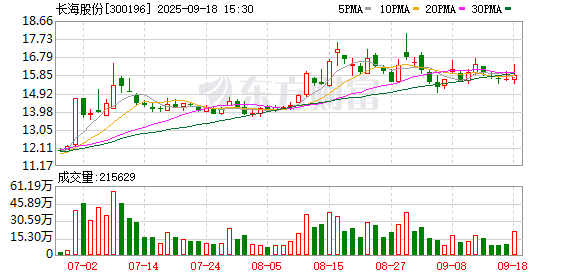
长海股份:2025年半年度权益分派实施公告
Zheng Quan Ri Bao· 2025-09-18 14:07
Group 1 - The company announced a cash dividend distribution plan for the first half of 2025, proposing to distribute 1 RMB per 10 shares to all shareholders, including tax [2] - The record date for the dividend distribution is set for September 25, 2025, while the ex-dividend date is September 26, 2025 [2]