
医药零售

Search documents
漱玉平民:公司及子公司无逾期担保
Zheng Quan Ri Bao Wang· 2025-09-03 10:48
Summary of Key Points Core Viewpoint - The company announced a total guarantee amount of 167,011.00 million yuan, which represents 81.85% of the latest audited net assets [1] Company Guarantees - The cumulative external guarantee balance after this provision is 60,981.17 million yuan, accounting for 29.89% of the latest audited net assets [1] - There are no guarantees provided to entities outside the consolidated financial statements [1] - The company and its subsidiaries have no overdue guarantees, no guarantees involved in litigation, and no losses due to judgments related to guarantees [1]

药店也调改 一心堂未来专业药房、泛健康药店"三七开"
Zheng Quan Shi Bao· 2025-09-03 04:46
Core Viewpoint - The overall supply surplus in the industry is leading to a decline in the average number of services per store, necessitating improvements in store output and efficiency [1] Group 1: Company Performance - In the first half of the year, the company reported a revenue of 8.914 billion yuan, a year-on-year decline of 4.20%, and a net profit of 250 million yuan, down 11.44% year-on-year [1] - The decline in revenue is attributed to a drop of over 2 percentage points in retail income, with significant decreases in distribution, traditional Chinese medicine raw material supply, and Chinese medicine pieces business [1] - The company opened 203 new stores and closed 241 stores in the first half of the year, resulting in a net decrease in store count to 11,372, marking the first net reduction in recent years [1] Group 2: Industry Trends - The retail pharmacy sector is entering a transformation phase, with a consensus that the growth inflection point occurred in Q4 2024, leading to a negative growth phase in 2025 [2] - By the first quarter of 2025, the total number of pharmacies in the country is expected to fall below 700,000, with a net decrease of approximately 3,000 pharmacies [2] Group 3: Store Transformation Initiatives - The company has initiated a store classification and upgrading process, planning for 70% of stores to transition to multi-category pharmacies and 30% to professional pharmacies [3] - The transformation includes enhancing the medical attributes of nearly one-third of the stores and introducing various product categories such as beauty, personal care, and health products [3] - The company aims to complete the transformation of 1,000 multi-category stores by 2025 and to establish a systematic upgrade of chronic disease medication and routine service systems by 2027 [4] Group 4: Financial Outlook and Cost Management - The company anticipates that the financial indicators will not see significant changes due to store transformations alone in 2025, as net profit will be influenced by multiple factors [4] - The company is focused on cost control and efficiency improvements, believing there is still room for optimization in sales and management expenses [4]

九州通:新零售战略进展良好 打造“线上线下一体化”新零售服务体系
Quan Jing Wang· 2025-09-03 04:37
Core Insights - The company has made significant progress in its new retail strategy, focusing on a "ten-thousand store franchise" model to create a comprehensive online and offline retail service system [1] Group 1: Business Expansion - As of June 30, 2025, the total number of direct-operated and franchise stores of the company reached 31,535, covering all 31 provinces, municipalities, and autonomous regions in China [1] - The company is in the grid expansion phase of its "ten-thousand store franchise" initiative, with expectations to exceed 33,500 stores by the end of 2025 [1] Group 2: Financial Performance - The sales revenue from franchise stores in the first half of 2025 reached 3.418 billion yuan, representing a year-on-year growth of 41.30% [1] - The new retail business aimed at end consumers achieved sales revenue of 1.493 billion yuan in the first half of 2025 [1] Group 3: Supplier Collaboration - The company has established partnerships with over 800 brand suppliers to provide strong product variety assurance for franchise stores, with 76 customized products introduced [1] - The cumulative number of products under the centralized procurement strategic cooperation KA policy has reached 625 [1] Group 4: E-commerce Performance - The B2C e-commerce general sales business generated sales revenue of 565 million yuan in the first half of 2025, marking a year-on-year increase of 13.96% [2] - Sales during the "618" shopping festival surpassed 200 million yuan, with rapid growth in interest e-commerce channels like Douyin and Kuaishou, achieving a year-on-year growth of 95% [2]

医药零售半年报:转型深水区承压前行 从“规模”向“质量”转身
2 1 Shi Ji Jing Ji Bao Dao· 2025-09-02 23:08
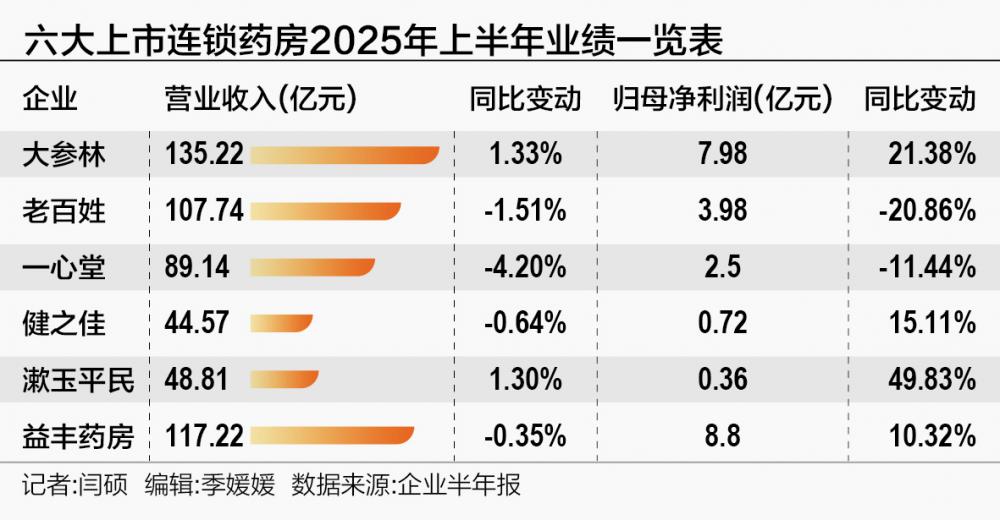
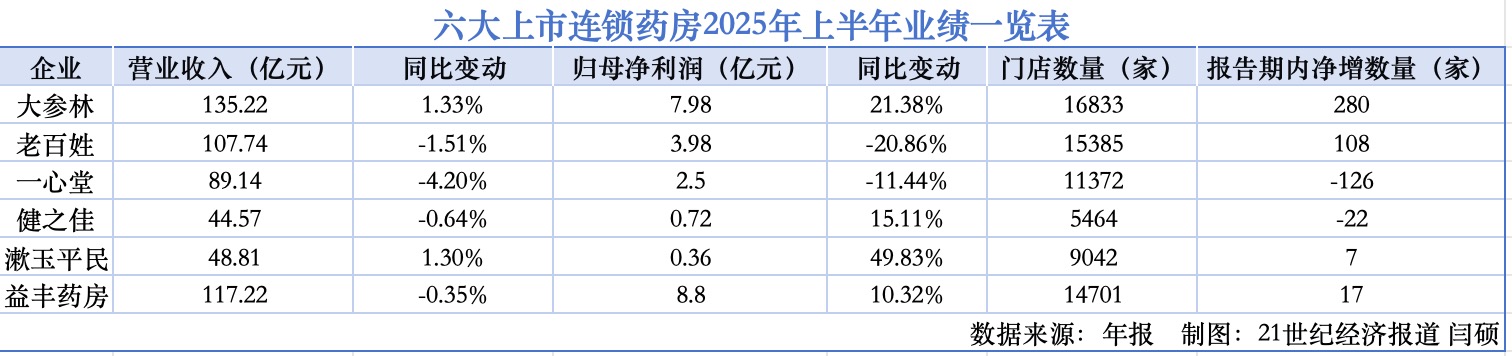
Core Viewpoint - The pharmaceutical retail industry is undergoing a structural transformation, moving from extensive growth driven by scale expansion to a focus on quality optimization and efficiency improvement in 2025 [1][5]. Group 1: Performance Overview - In the first half of 2025, six major listed pharmacy chains showed a polarized performance, with Dazhenglin and Shuyupingmin achieving both revenue and net profit growth, while Laobaixing and Yixintang experienced declines [1][3]. - Dazhenglin reported the highest revenue among the chains at 13.522 billion yuan, a year-on-year increase of 1.33%, and a net profit of 798 million yuan, up 21.38% [2][3]. - Shuyupingmin's revenue and net profit were 4.881 billion yuan and 36.25 million yuan, respectively, reflecting increases of 1.30% and 49.83% [3]. - Laobaixing and Yixintang saw revenue declines of 1.51% and 4.20%, with net profits dropping by 20.86% and 11.44% respectively [4][3]. Group 2: Store Expansion Trends - Dazhenglin continued to expand its store count, adding 280 stores, although this growth rate has significantly slowed compared to previous years [1][7]. - Yixintang and Jianzhijia experienced net decreases in store numbers, with Yixintang losing 126 stores and Jianzhijia losing 22 [7]. - The overall trend indicates a shift from rapid expansion to focusing on the efficiency of existing stores, with many chains emphasizing the importance of franchise models for growth [7][8]. Group 3: Strategic Shifts and Innovations - The industry is moving towards diversification and specialization, with companies like Yixintang planning to develop 30% specialized pharmacies and 70% multi-category stores [8][9]. - Shuyupingmin is focusing on high-potential product categories and optimizing its product range while exploring various store formats [9]. - The implementation of O2O (Online to Offline) strategies is gaining traction, with significant sales contributions from O2O channels across multiple chains [10][11]. Group 4: Digital Transformation and AI Integration - Companies are increasingly adopting digital transformation strategies, with AI becoming a focal point for enhancing operational efficiency and customer service [11][12]. - Laobaixing has initiated AI development as a key strategic project, deploying various AI assistants to improve business operations [11][12]. - Dazhenglin has integrated AI tools to provide intelligent customer service and data analysis, enhancing its operational capabilities [12][13].


一心堂(002727) - 2025年9月1日投资者关系活动记录表
2025-09-02 11:30
Group 1: Investor Relations Activity Overview - The investor relations activity was a performance exchange meeting for the 2025 mid-year report [2] - The event took place on September 1, 2025, from 15:00 to 16:30 at the company's headquarters [2] - A total of 60 investors participated, including representatives from Northeast Securities, China International Capital Corporation, and others [2][3] Group 2: Attendee Details - Key attendees included Li Zhenghong (Vice President and Board Secretary) and Xiao Donglei (Financial Officer) [2] - Notable participating companies included Northeast Securities, China International Capital Corporation, and several asset management firms [3] - The list of attendees featured 60 individuals from various financial institutions [3] Group 3: Event Format and Purpose - The event was categorized as an analyst meeting, with a focus on discussing the company's mid-year performance [2] - The meeting aimed to enhance communication between the company and its investors [2] - The format included presentations and discussions led by company executives [2]
济南已有四千余家零售药店入驻“码上放心”平台
Qi Lu Wan Bao Wang· 2025-09-02 05:19
Core Viewpoint - Jinan City is actively advancing the drug market supervision and information traceability pilot work, achieving high participation rates among retail pharmacies and medical institutions in the "Code on Ease" platform [1] Group 1: Drug Market Supervision Progress - As of now, 4,211 retail pharmacies have joined the "Code on Ease" platform, with an effective participation rate of 99.88% [1] - A total of 6,066 medical institutions have also joined the platform, achieving an effective participation rate of 99.41% [1] - Both participation rates rank among the highest in the province [1] Group 2: Future Tasks for Drug Market Regulation - The next phase of drug market supervision will focus on four key tasks: completing drug sampling and testing by the end of October [1] - Enhancing the management of "scan upload" in the traceability pilot to improve efficiency and accuracy of verification [1] - Providing guidance and support to relevant pharmaceutical companies to address challenges in the information traceability pilot [1] - Strengthening supervision and inspection through various methods, including online and offline approaches, to ensure effective implementation of the traceability system [1]
一心堂药业集团股份有限公司 关于全资子公司山西鸿翔一心堂药业有限公司 向银行申请授信额度提供担保的进展公告
Zhong Guo Zheng Quan Bao - Zhong Zheng Wang· 2025-09-02 01:16
Overview of Guarantee Situation - The company approved a guarantee for its wholly-owned subsidiary, Shanxi Hongxiang Yixintang Pharmaceutical Co., Ltd., to apply for a comprehensive credit limit of RMB 1.368 billion from relevant banks [3] - The guarantee is within the approved limit, and no further approval procedures are required [5] Guarantee Progress - A maximum guarantee contract was signed with Shanghai Pudong Development Bank Taiyuan Branch, providing a joint liability guarantee for the subsidiary with a principal balance of up to RMB 30 million [4] Basic Information of the Guaranteed Party - Shanxi Hongxiang Yixintang Pharmaceutical Co., Ltd. has a registered capital of RMB 31.3 million and was established on November 27, 2009 [6] - The company operates in various sectors, including drug retail, medical device sales, and food sales [6][7] - The subsidiary is fully owned by the company, holding 100% of its shares [7] Financial Indicators - Shanxi Hongxiang Yixintang Pharmaceutical Co., Ltd. has a good credit status and is not listed as a dishonest executor [8] Main Content of the Guarantee Agreement - The creditor is Shanghai Pudong Development Bank Taiyuan Branch, the guarantor is the company, and the debtor is Shanxi Hongxiang Yixintang Pharmaceutical Co., Ltd. [9] - The guarantee covers the principal debt and related interests, penalties, and other costs incurred [9][10] Necessity and Reasonableness of the Guarantee - The guarantee is necessary for the subsidiary's daily operational needs and is expected to positively impact the company's development and efficiency [12] - The subsidiary has the ability to repay its debts, and the risks associated with the guarantee are controllable [12] Cumulative External Guarantee Amount - After this guarantee, the total guarantee amount for the company and its subsidiaries is RMB 1.34227 billion, with a total balance of RMB 843.7792 million, accounting for 11.03% of the company's audited net assets for 2024 [13]
上半年关店241家、营利双降,一心堂的“跑马圈地”不灵了?
Bei Ke Cai Jing· 2025-09-01 14:12
Core Viewpoint - YXTT Pharmaceutical Group Co., Ltd. (referred to as "YXTT") has reported a decline in performance for the first half of 2025, with revenue of 8.914 billion yuan, down 4.20% year-on-year, and a net profit of 250 million yuan, down 11.44% year-on-year, indicating challenges in its aggressive expansion strategy [1][2][3] Group 1: Financial Performance - In 2023, YXTT experienced its first revenue decline since its listing, with revenue of 17.38 billion yuan, down 0.29% year-on-year, and a net profit of 549 million yuan, down 45.60% year-on-year [1] - For 2024, YXTT's revenue increased to 18.0 billion yuan, up 3.6% year-on-year, but net profit fell to 114 million yuan, down 79.2% year-on-year [2] - In Q1 2025, YXTT reported revenue of 4.767 billion yuan, down 6.53% year-on-year, and a net profit of 160 million yuan, down 33.83% year-on-year [2] Group 2: Expansion Strategy - YXTT's aggressive "land grab" expansion model has led to increased operational costs, with new store openings contributing to rising expenses such as rent, decoration, and labor [2][3] - The company opened 2,867 new stores from 2020 to 2024, with 203 new stores opened and 241 closed in the first half of 2025, maintaining a total of 11,372 stores [3] Group 3: Regulatory Challenges - YXTT faced scrutiny from the National Medical Insurance Administration due to issues such as drug substitution and improper billing practices, resulting in the return of over 10 million yuan to the medical insurance fund [4][5] - Starting April 1, 2025, new regulations will require electronic prescriptions for dual-channel pharmacies, complicating operational processes and potentially impacting sales of prescription drugs [6] Group 4: Online Business Development - YXTT is actively developing its online business, achieving 727 million yuan in new retail sales in the first half of 2025, with O2O sales accounting for 81.02% [7] - The company aims to leverage big data and AI to enhance consumer health demand forecasting and explore cross-border e-commerce opportunities [7] Group 5: Industry Context - The retail pharmacy market is experiencing intense competition, with 35% of stores showing positive growth and 31% experiencing slight declines in early 2025 [8] - The industry is shifting from a focus on selling drugs to providing health services, necessitating a reevaluation of growth strategies in light of regulatory changes and market dynamics [8]
医药零售半年报:转型深水区承压前行,从“规模”向“质量”转身
2 1 Shi Ji Jing Ji Bao Dao· 2025-09-01 13:33
Core Viewpoint - The pharmaceutical retail industry is undergoing a structural transformation, moving from extensive growth driven by scale expansion to a focus on quality optimization and efficiency enhancement. Major chain pharmacies are adjusting their strategies to improve existing store performance rather than aggressively expanding their number of stores [1][4]. Financial Performance - In the first half of 2025, six major listed chain pharmacies showed a polarized performance, with Dazhenlin and Shuyupingmin achieving growth in both revenue and net profit, while Laobaixing and Yixintang experienced declines [1][5]. - Dazhenlin reported revenue of 135.22 billion yuan, a year-on-year increase of 1.33%, and a net profit of 7.98 billion yuan, up 21.38% [2][5]. - Shuyupingmin's revenue and net profit were 48.81 billion yuan and 3625.09 million yuan, respectively, reflecting increases of 1.30% and 49.83% [5][6]. - Conversely, Laobaixing's revenue decreased by 1.51% to 107.74 billion yuan, with a net profit drop of 20.86% to 3.98 billion yuan [2][6]. Store Expansion Trends - Dazhenlin continued to expand its store count, adding 280 stores, although this growth rate has significantly slowed compared to previous years. Yixintang and Jianzhijia saw a net decrease in store numbers [1][9]. - The overall trend indicates a shift towards optimizing existing stores rather than aggressive new openings, with many companies reporting a reduction in the pace of store expansion [9][10]. Market Dynamics - The pharmaceutical retail market is currently experiencing a profound transformation, with a slight decline in overall market size. From January to May 2025, the market size was approximately 215.2 billion yuan, down 1.3% year-on-year [7]. - The market is characterized by significant disparities in store growth, with only 35% of stores achieving positive growth and about one-third experiencing declines of over 15% [7]. Strategic Adjustments - Companies are focusing on enhancing supply chain efficiency, strengthening professional pharmaceutical services, and optimizing digital operations to improve competitiveness [4][11]. - The shift towards diversified services and professional capabilities is becoming a key growth driver in the industry [4][11]. Digital Transformation - The integration of digital technologies is reshaping the pharmaceutical retail landscape, with O2O (Online to Offline) sales becoming a significant growth engine. In the first half of 2025, major chain pharmacies reported substantial increases in O2O sales [13][15]. - Companies like Laobaixing and Dazhenlin are leveraging AI technologies to enhance customer service and operational efficiency, with Laobaixing emphasizing AI as a strategic priority [15][16].
华人健康:公司在安徽省、江苏省、浙江省、福建省等地区共拥有直营门店2266家
Zheng Quan Ri Bao Wang· 2025-09-01 11:12
Core Insights - The company, Huaren Health, announced its strategic focus on deepening its presence in Anhui and expanding in East China while radiating to surrounding areas [1] Store Expansion - As of the end of the reporting period, the company operated a total of 2,266 directly-operated stores across Anhui, Jiangsu, Zhejiang, and Fujian provinces [1] - During the reporting period, the company added 529 new directly-operated stores, which included 51 self-built stores and 478 acquired stores [1] Future Strategy - The company plans to continue optimizing resource allocation through a targeted acquisition strategy to fill market gaps, particularly in economically strong areas of East China [1] - This strategy aims to enhance market coverage and penetration, laying a solid foundation for the sustainable and steady development of its retail business [1]