第三方支付

Search documents
罕见利好!“跨境支付”第一龙头沉睡3年!拟10转40派10获批,有望10元到38元!
Sou Hu Cai Jing· 2025-06-24 13:23
Industry Overview - Cross-border payments are reshaping international trade and personal consumption at an unprecedented speed, driven by globalization [1] - Innovations in payment methods, from traditional bank wire transfers to emerging blockchain technology, are optimizing efficiency and costs, injecting new vitality into global economic integration [1] Technological Advancements - Emerging payment methods like blockchain technology and digital currencies show significant potential in the cross-border payment sector [3] - Blockchain technology enables direct settlement through distributed ledgers and smart contracts, bypassing traditional multi-tiered banking systems, significantly reducing payment time and costs [3] Recent Developments - The launch of the "Cross-border Payment Pass" on June 22 marks the interconnectivity of the mainland and Hong Kong rapid payment systems [3] - This system allows residents to conveniently conduct real-time cross-border remittances in RMB and HKD using mobile numbers or bank accounts, with most transactions exempt from fees [3] Potential Companies - Lakala is one of the first third-party payment companies in China to obtain cross-border payment licenses, holding full licenses for cross-border RMB payments and Hong Kong MSO, supporting cross-border payments in over 100 countries [6] - New Guodu holds a European payment license and its smart POS terminals support real-time settlement in 36 currencies, with overseas market revenue accounting for 38% [6] - Sifang Jingchuang participates in the mBridge project for multi-central bank digital currency, enabling real-time exchange between digital RMB and Euro, HKD [6] - Changliang Technology provides cross-border payment system development, testing, and operation services for banks, assisting clients in connecting to SWIFT and CIPS systems [7] Unique Investment Opportunity - A specific company possesses both "cross-border foreign currency payment license" and "cross-border RMB payment license," enabling two-way cross-border settlement for imports and exports [8] - This company serves 14 banks across different countries, with cross-border business revenue accounting for 31% [9] - Recent shareholder numbers have sharply decreased, indicating a concentrated shareholding structure, with significant trading volume and bullish technical indicators suggesting a favorable entry point for investment [9]


“支付老兵”孙陶然谋局跨境业务 拉卡拉扣非3季连降拟赴港IPO突围
Chang Jiang Shang Bao· 2025-06-23 00:52
Core Viewpoint - Lakala is facing significant operational challenges and is exploring a secondary listing in Hong Kong while accelerating the application of digital currency in cross-border scenarios to enhance its international competitiveness [1][8]. Group 1: Company Background - Founded in 2005 by Sun Taoran, Lakala was a pioneer in the domestic third-party payment sector, starting with card terminals in convenience stores and expanding to a global cross-border payment network covering over 100 countries [1]. - At its peak, Lakala achieved an annual net profit exceeding 1 billion yuan [1]. Group 2: Business Challenges - Lakala is currently experiencing a decline in both revenue and net profit, with a further drop in Q1 2024 [1][6]. - The company has faced increased competition and regulatory scrutiny, particularly from major players like Alipay and WeChat Pay, which have adopted a "card-binding" model for cashless payments [5]. Group 3: Strategic Initiatives - In response to operational pressures, Lakala is pursuing a strategy that integrates "payment + SaaS + AI" and is expanding its cross-border payment services [7]. - The company reported a year-on-year increase of 76% in the number of cross-border merchants and an 85% rise in cross-border payment transaction volume [7]. Group 4: Financial Performance - In Q1 2025, Lakala's revenue decreased by 13.02% to 1.3 billion yuan, while net profit fell by 51.71% to 101 million yuan, with a non-recurring net profit decline of 62.97% [6].

拉卡拉:孙浩然解除质押912万股
news flash· 2025-06-19 13:18
Core Viewpoint - Lakala (300773) announced that shareholder Sun Haoran has released a total of 9.12 million shares from pledge, which accounts for 61.83% of his holdings and 1.16% of the company's total share capital [1] Summary by Relevant Sections - **Shareholder Pledge Release** - Sun Haoran's release of 9.12 million shares from pledge occurred in multiple transactions: - 4.9 million shares released on August 9, 2023 - 210,000 shares released on January 31, 2024 - 140,000 shares released on February 2, 2024 - 630,000 shares released on February 5, 2024 - 3.24 million shares released on March 11, 2024 - The release does not involve any restrictions on share sales or freezing of shares [1]
新大陆20250618
2025-06-19 09:46
Summary of Newland's Conference Call Company Overview - Newland reported a net profit attributable to shareholders of 1.01 billion yuan in 2024, representing a year-on-year growth of 10% [2][3] - In Q1 2025, the company achieved revenue of 1.896 billion yuan, up 9% year-on-year, with a net profit of 311.1 million yuan, reflecting a significant increase of 25.16% [2][3] Industry Insights - The third-party payment industry in China is experiencing a supply-demand structure improvement, leading to enhanced profitability for companies like Newland [3][4] - The company is focusing on small and micro merchants in second and third-tier cities, particularly in the retail and catering sectors, with transaction volumes expected to remain stable throughout 2025 [2][4] Key Developments - Newland's overseas business has expanded to over 120 countries and regions, leveraging smart terminal exports to enhance market share [2][3][6] - The company is actively exploring opportunities in cross-border e-commerce and fintech, aiming to accelerate growth in the cross-border payment sector [2][6] Strategic Initiatives - Newland is applying for overseas payment licenses (MSO, MSB) and expects progress in Q2 2025, which will support its global collection and payment capabilities [2][7] - The company is a key player in the digital RMB ecosystem, being the only central bank-level service provider, and is exploring the internationalization of the digital RMB [2][8][9] AI Integration - Newland is integrating AI across its operations, collaborating with institutions like the Chinese Academy of Sciences and DeepMind to enhance merchant services and compliance [3][10][11] - The company has developed AI-driven products aimed at improving operational efficiency and customer experience, with expectations of significant contributions to growth in 2025 [10][15] Collaborations and Partnerships - Newland has partnered with Alipay to deploy over 200,000 "Tap and Go" terminals, enhancing its service capabilities [3][17] - The company signed a digital business ecosystem partnership with Alibaba Cloud to optimize payment scenarios and risk management [3][18] Market Trends - The domestic consumption sector is rebounding, with retail sales growth reaching 6.1% in May 2025, the highest since the beginning of the year [4] - The company anticipates stable transaction volumes in the second and third quarters of 2025, driven by improved payment services and value-added services [4][23] Future Outlook - Newland's strategic focus includes enhancing its overseas market presence, particularly in Europe and North America, where it has seen significant growth in smart terminal shipments [20][21] - The company aims to leverage its strengths in digital identity and QR code technology to capture more opportunities in the offline market following the implementation of the digital identity policy [22][23]

【支付观察】继A股上市七年后,拉卡拉筹划赴港上市
Sou Hu Cai Jing· 2025-06-18 07:34
Company Dynamics - Lakala announced plans to issue shares overseas (H-shares) and list on the Hong Kong Stock Exchange to advance its international development strategy and enhance its global competitiveness [2] - The details of this plan are yet to be determined and will require approval from the board, shareholders, and relevant regulatory bodies [2] Company Background - Lakala was established in 2005 and obtained a payment business license from the People's Bank of China in 2011, becoming the first third-party payment company listed on the A-share market in 2019 [3][4] - The company has evolved through various phases, expanding its services from credit card repayments to a comprehensive range of financial services, and has focused on empowering small and micro businesses through SaaS platforms [3][4] Financial Performance - After its listing in 2019, Lakala's revenue grew from 48.99 billion yuan to 65.96 billion yuan from 2019 to 2021, with net profit increasing from 8.06 billion yuan to 10.83 billion yuan [4] - In 2022, Lakala faced significant challenges, reporting a revenue decline of 18.65% to 53.66 billion yuan and a net loss of 14.37 billion yuan, primarily due to the "jump code" incident [5] - In 2023, the company achieved double-digit revenue growth and returned to profitability, but overall performance has not yet recovered to 2021 levels [5] - For 2024, Lakala reported a revenue of 57.59 billion yuan, a decrease of 2.96%, and a net profit of 3.51 billion yuan, down 23.26% [5] - In Q1 2025, revenue was 12.99 billion yuan, a decrease of 13.01%, with net profit down 51.71% to 1.01 billion yuan, although cross-border merchant scale and transaction amounts saw significant growth [5] Strategic Outlook - Lakala's move to target the Hong Kong market aims to provide short-term funding and brand effects, but the company still faces challenges in overcoming business bottlenecks and enhancing core competitiveness [5]
借势稳定币谋跨境,支付头部拉卡拉赴港上市
Bei Jing Shang Bao· 2025-06-17 12:51
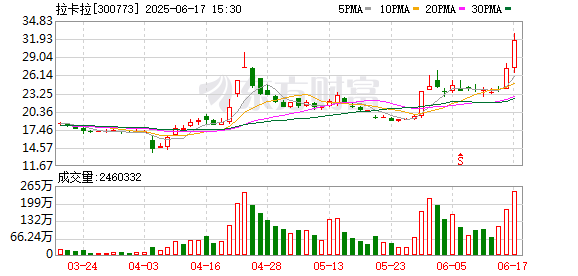
Core Viewpoint - Lakala is planning to issue H-shares and list on the Hong Kong Stock Exchange, aiming to advance its internationalization strategy and enhance its competitiveness in the digital currency space [1][4][5]. Group 1: Reasons for Hong Kong Listing - The company aims to promote international development and establish a dual circulation pattern, leveraging Hong Kong's advantages as an international financial center [4][5]. - Listing in Hong Kong is expected to provide broader financing channels and higher valuations for fintech companies, which can facilitate cross-border payment services [5][6]. - Recent supportive policies from Chinese regulatory bodies for companies seeking to list in Hong Kong have created a favorable environment for Lakala's internationalization efforts [6][12]. Group 2: Market Context and Challenges - The recent surge in interest around stablecoins has led to speculation that Lakala's move to Hong Kong may be linked to this trend, although the company has not disclosed specific plans in this area [3][9][10]. - Despite the stock price increase, Lakala's financial performance has been declining, with revenue and net profit expected to drop in 2024 and Q1 2025 [12][13]. - The company faces challenges such as high customer concentration, regulatory scrutiny, and the need to improve its operational capabilities to succeed in the competitive Hong Kong market [12][13].

拉卡拉谋划港股上市背后:稳定币带动股价上涨 难掩业绩下滑窘境
Xin Jing Bao· 2025-06-17 08:14
拉卡拉再传上市消息。6月16日,拉卡拉发布公告称,该公司正在筹划境外发行股份(H股)并在香港 联合交易所有限公司上市。 拉卡拉指出,公司正在与相关中介机构就本次H股上市的具体推进工作进行商讨,相关细节尚未确定。 待具体方案确定后,本次H股上市工作尚需提交公司董事会和股东大会审议,并经相关监管机构批准、 备案和审核。 另有业内分析指出,拉卡拉此次赴港上市的核心目标之一是推进国际化发展战略。近年来,随着国内支 付市场竞争加剧,拓展海外市场成为支付机构的重要方向。香港作为国际金融中心,拥有成熟的资本市 场和开放的跨境支付环境,为拉卡拉提供了理想的国际化跳板。 不过,在谋求港股上市的同时,拉卡拉却在悄然减少企业的注资本金。 近日,拉卡拉发布公告称,公司于2025年05月16日作出减少注册资本的决议,由78808.25万元减至 77666.4942万元。公告期限为2025年5月28日至2025年7月12日。这是拉卡拉近半年以来第二次进行减 资。今年1月,拉卡拉的注册资本从80002万元减少至78808.25万元。 但对比之下,支付行业其他机构在新规之下普遍增资。如财付通自去年以来已两次增资,目前其注册资 本已增至233 ...
高汇通回应退出预付卡业务!支付机构缘何主动“瘦身”
Bei Jing Shang Bao· 2025-06-15 12:34
Core Viewpoint - The payment industry is witnessing a significant business adjustment as Beijing GaoHuiTong Commercial Management Co., Ltd. has voluntarily reduced its business types, exiting the II category of stored value account operations, marking its departure from the prepaid card issuance and acceptance market [1][3]. Group 1: Company Actions - GaoHuiTong has actively communicated with the People's Bank of China to cancel its prepaid card business qualifications in provinces where it has not been actively operating, aiming to concentrate resources on developing more competitive internet payment services [3][4]. - The company has retained its I category stored value account operations while exiting the II category, indicating a strategic shift in its business focus [3][4]. - GaoHuiTong's ownership traces back to Hong Kong's Jinsheng Enterprise Co., Ltd., and it operates under the umbrella of the Hong Kong-listed company Youzan, with its headquarters in Beijing and branches in several major cities [3][4]. Group 2: Industry Context - The exit from the prepaid card market by GaoHuiTong reflects a broader trend in the industry, where many payment institutions are struggling to sustain prepaid card transactions due to external pressures such as the rise of internet payments and regulatory changes [6][7]. - The prepaid card sector is facing significant challenges, with many institutions opting to relinquish their qualifications to avoid the costs associated with maintaining dual payment systems and regulatory compliance [6][7]. - Since 2025, the People's Bank of China has revoked licenses from six payment institutions, indicating a trend of consolidation within the industry, particularly affecting the prepaid card business [6][7]. Group 3: Regulatory Environment - The regulatory landscape has tightened, with the implementation of the Non-Bank Payment Institution Supervision and Management Regulations, which require a minimum registered capital of 100 million yuan, leading to expectations of further reductions in the number of prepaid card licenses [7][10]. - The industry is undergoing a cleansing process, with increased scrutiny on compliance and operational practices, as evidenced by GaoHuiTong's previous penalties for regulatory violations totaling approximately 27.87 million yuan [5][10]. - Analysts predict that only a few institutions that successfully transition to digital models or maintain stable large enterprise clients will survive in the evolving market [7][10].

70亿!微信支付再次大幅增加注册资本
Guo Ji Jin Rong Bao· 2025-06-11 12:15
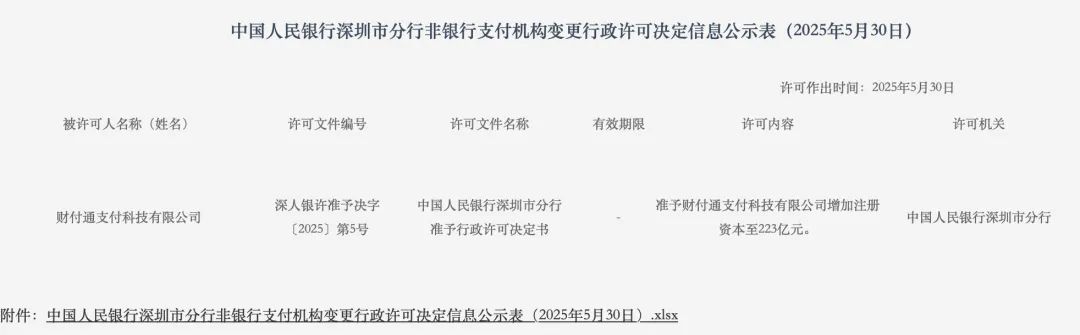
Core Viewpoint - The People's Bank of China (PBOC) has approved a capital increase for Tenpay Technology Co., Ltd. (Tenpay), the operator of WeChat Pay, raising its registered capital from 15.3 billion to 22.3 billion yuan, a significant increase of 45.75% [1][2]. Group 1: Company Overview - Tenpay was established in 2006 with an initial registered capital of 1 billion yuan and is currently controlled by Shenzhen Tencent Computer Systems Co., Ltd. [2][3]. - The company received its first payment business license from the PBOC in 2011 and currently holds qualifications for operating stored value accounts and payment transaction processing [3]. Group 2: Regulatory Context - The increase in registered capital aligns with the regulatory requirements set forth in the Non-Bank Payment Institutions Supervision Management Regulations, which stipulate a minimum registered capital of 1 billion yuan for non-bank payment institutions [3]. - The PBOC has the authority to raise the minimum capital requirement based on the business type, operational region, and scale of operations of non-bank payment institutions [3]. Group 3: Industry Implications - The capital increase is seen as a move to meet compliance and regulatory standards while supporting Tenpay's ongoing development and innovation in payment services [4]. - This action is expected to enhance Tenpay's financial foundation, support technological advancements, and improve service quality, thereby strengthening its market competitiveness [4].
央行年内注销第六张支付牌照 第三方支付机构总数降至169家
Sou Hu Cai Jing· 2025-06-11 01:12
Core Viewpoint - The recent cancellation of the payment license for Shanghai Runtong Industrial Investment Co., Ltd. marks the sixth payment institution to exit the market this year, reflecting a significant trend of consolidation in the industry as the total number of licensed payment institutions has decreased to 169, with a cumulative total of 102 licenses revoked by the People's Bank of China [1][4]. Group 1: Company Overview - Shanghai Runtong was established in September 2006 and obtained its payment license in 2012, initially authorized to issue and accept prepaid cards in Shanghai [3]. - The company’s main product, "Yingdian Life Card," provided services for expense payments and welfare distribution to enterprises and institutions in Shanghai [3]. Group 2: Industry Trends - The frequency of payment institution license cancellations has increased significantly this year, with five institutions, including Deshi Co., Ltd. and Zhonghui Electronic Payment Co., Ltd., also having their licenses revoked [4]. - Many of these institutions face challenges such as difficulties in business transformation and rising compliance costs [4]. - The majority of revoked licenses (over 80%) belong to prepaid card businesses, indicating structural challenges within the prepaid card sector [5]. Group 3: Market Dynamics - The rise of mobile payments has significantly impacted traditional prepaid card businesses, as new business models like online group buying and credit payments offer consumers more choices [5]. - Prepaid card institutions are struggling with digital transformation, facing challenges in technology upgrades and market expansion [5]. - The implementation of the "Non-Bank Payment Institutions Supervision and Management Regulations" has raised entry barriers, with a minimum registered capital requirement of 100 million yuan, putting pressure on smaller institutions [5]. - Remaining prepaid card institutions are mostly nationally qualified, while revoked licenses predominantly belong to regional small enterprises, suggesting a trend towards increased concentration in the prepaid card industry [5].